



ARTICLE CONTENTSOn this page 6 sections
Classification of Living Organisms
Performance Objectives
By the end of the lesson, students should be able to:
- classify organisms based on cell types and characteristics;
- classify organisms based on mode of feeding.
Introduction to Classification
Living organisms on Earth are incredibly diverse, ranging from microscopic bacteria to giant whales and towering trees. To study and understand this vast diversity, biologists group organisms based on their similarities and differences. This process of arranging organisms into groups or categories is called biological classification.
Classification helps scientists to:
- Organise the immense number of known species.
- Identify newly discovered organisms.
- Understand the evolutionary relationships between different groups of organisms.
- Communicate clearly about specific organisms using a universal system.
The system used for classification is known as taxonomy, and it involves placing organisms into a hierarchical structure, from broad categories to more specific ones.
Taxonomic Hierarchy
Taxonomic hierarchy is a system of classifying organisms in a series of ranks or levels, from the broadest (most inclusive) to the most specific (least inclusive). Each level in the hierarchy is called a taxon (plural: taxa). The main taxonomic ranks, from broadest to most specific, are Domain, Kingdom, Phylum, Class, Order, Family, Genus, and Species.
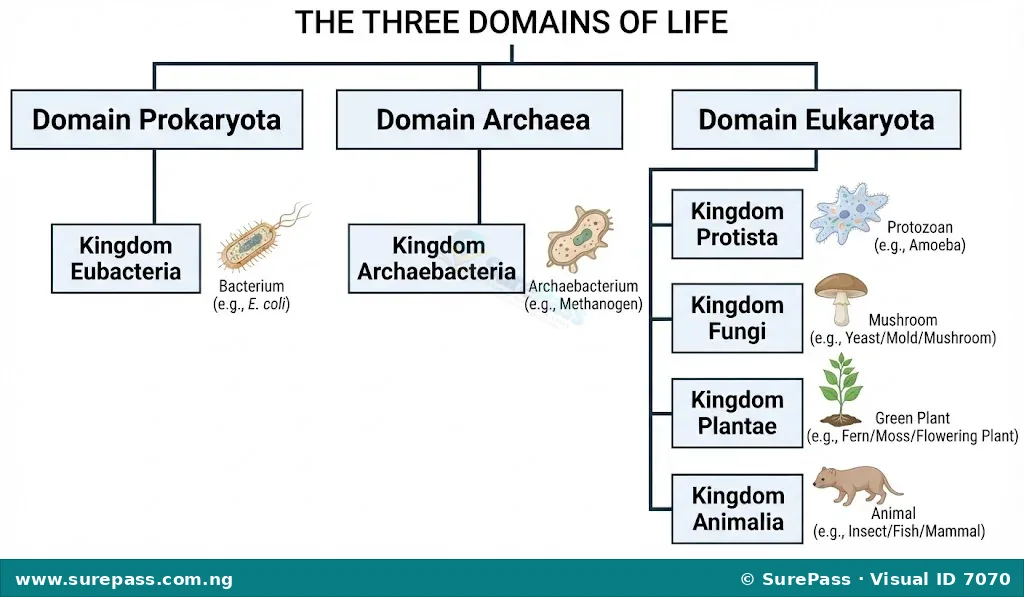
At the highest level, living organisms are divided into three main domains based on their cell structure and genetic makeup. These domains are Prokaryota, Archaea, and Eukaryota.
Domain: Prokaryota
The Domain Prokaryota includes organisms that are prokaryotic. Prokaryotic cells are simple cells that lack a true nucleus and other membrane-bound organelles. Their genetic material (DNA) is found in the cytoplasm, not enclosed within a nucleus. These organisms are typically single-celled.
Within the Domain Prokaryota, the main kingdom is:
-
Kingdom: Eubacteria
Eubacteria, also known as “true bacteria,” are common prokaryotic organisms found almost everywhere, including soil, water, and inside other organisms. They play vital roles in ecosystems, such as decomposition and nutrient cycling. Examples include Escherichia coli (E. coli), Lactobacillus (found in yoghurt), and cyanobacteria (blue-green algae).
Domain: Archaea
The Domain Archaea also consists of prokaryotic organisms, meaning their cells lack a true nucleus and membrane-bound organelles, similar to bacteria. However, archaea have distinct genetic and biochemical characteristics that set them apart from eubacteria. They are often found in extreme environments.
Within the Domain Archaea, the main kingdom is:
-
Kingdom: Archaebacteria
Archaebacteria are known for living in harsh conditions that are typically hostile to most other life forms. These environments include hot springs, highly salty lakes, and oxygen-deprived swamps. Examples include methanogens (which produce methane gas), halophiles (salt-loving organisms), and thermophiles (heat-loving organisms).
Domain: Eukaryota
The Domain Eukaryota comprises all organisms whose cells are eukaryotic. Eukaryotic cells are more complex than prokaryotic cells, possessing a true nucleus that encloses their genetic material, as well as various membrane-bound organelles like mitochondria, chloroplasts (in plants), and the endoplasmic reticulum. Eukaryotic organisms can be single-celled or multicellular.
Within the Domain Eukaryota, there are several kingdoms, including:
-
Kingdom: Protista
Protists are a diverse group of eukaryotic organisms that do not fit into the other eukaryotic kingdoms (Fungi, Plantae, Animalia). Most protists are single-celled, but some are multicellular. They exhibit a wide range of characteristics and modes of life.
Examples of protists include:
- Protozoa: These are animal-like protists that are typically motile and heterotrophic, meaning they obtain food by ingesting other organisms or organic matter. Examples include Amoeba, Paramecium, and Plasmodium (which causes malaria).
- Protophyta: These are plant-like protists that are typically autotrophic, meaning they produce their own food through photosynthesis. They are often referred to as algae. Examples include Euglena and Chlamydomonas.
-
Kingdom: Fungi
Fungi are eukaryotic organisms that are typically heterotrophic, obtaining nutrients by absorbing dissolved organic molecules from their environment. They are important decomposers. Fungi can be single-celled (like yeasts) or multicellular (like molds and mushrooms).
Examples of fungi include:
- Yeasts: Single-celled fungi used in baking and brewing.
- Molds: Multicellular fungi that grow as filaments and are often seen on stale food.
- Mushrooms: Complex multicellular fungi with a cap and stalk structure.
-
Kingdom: Plantae
Plants are multicellular eukaryotic organisms that are primarily autotrophic, producing their own food through photosynthesis. They are characterised by rigid cell walls made of cellulose and the presence of chloroplasts. The Kingdom Plantae is further divided into several groups, including:
- Thallophyta (Algae): These are simple plant-like organisms, mostly aquatic, that lack true roots, stems, and leaves. Their body is a simple thallus. Examples include Spirogyra and Chlorella.
- Bryophyta (Mosses, Liverworts): These are non-vascular plants, meaning they lack specialised tissues for transporting water and nutrients. They are typically small and grow in moist environments. Examples include mosses and liverworts.
- Tracheophyta: These are vascular plants, possessing specialised vascular tissues (xylem and phloem) for efficient transport of water, minerals, and food throughout the plant body. This group includes ferns, conifers, and flowering plants, which are the most dominant plant forms on land.
-
Kingdom: Animalia
Animals are multicellular eukaryotic organisms that are heterotrophic, meaning they obtain nutrients by consuming other organisms. They typically have specialised tissues, organs, and organ systems, and most are capable of movement. The Kingdom Animalia is broadly divided into two major groups:
- Vertebrates: These are animals that possess a backbone or vertebral column. Examples include fish, amphibians, reptiles, birds, and mammals (e.g., humans, dogs, cows).
- Invertebrates: These are animals that do not possess a backbone. This group is very diverse and includes a vast majority of animal species. Examples include insects (e.g., butterflies, ants), worms, snails, spiders, and jellyfish.
Classification Based on Mode of Nutrition
Another fundamental way to classify living organisms is by how they obtain their food and energy. This divides organisms into two main categories: autotrophs and heterotrophs.
Autotrophic Organisms
Autotrophic organisms, also known as autotrophs, are organisms that can produce their own food from simple inorganic substances. They do not need to consume other organisms for energy.
The primary method of food production for most autotrophs is photosynthesis, where they use sunlight, water, and carbon dioxide to create glucose (sugar) and oxygen. Some autotrophs use chemosynthesis, deriving energy from chemical reactions.
Examples of autotrophic organisms include:
- Green plants (e.g., maize, mango tree, hibiscus)
- Algae (e.g., Spirogyra, Chlorella)
- Cyanobacteria (blue-green algae)
- Some other types of bacteria
Heterotrophic Organisms
Heterotrophic organisms, also known as heterotrophs, are organisms that cannot produce their own food. They obtain nutrients and energy by consuming other organisms or organic matter.
Heterotrophs depend directly or indirectly on autotrophs for their food supply. They can consume plants, animals, or decaying organic material.
Examples of heterotrophic organisms include:
- Animals (e.g., humans, lions, goats, insects)
- Fungi (e.g., mushrooms, yeasts, molds)
- Most bacteria (e.g., Escherichia coli)
- Protozoa (e.g., Amoeba, Paramecium)
Classifying Living Things
Classifying living things involves observing their characteristics and placing them into appropriate groups based on established criteria. The two main criteria discussed are cell type/characteristics and mode of nutrition.
Classifying by Cell Types and Characteristics
To classify organisms based on cell types and characteristics, consider the following:
-
Presence of a true nucleus: Does the cell have a membrane-bound nucleus?
- If no true nucleus, it is prokaryotic (Domain Prokaryota or Archaea).
- If a true nucleus is present, it is eukaryotic (Domain Eukaryota).
-
Number of cells: Is the organism single-celled or multicellular?
- Single-celled prokaryotes are Eubacteria or Archaebacteria.
- Single-celled eukaryotes are often Protists or Yeasts (Fungi).
- Multicellular eukaryotes are typically Fungi, Plants, or Animals.
-
Presence of cell wall and chloroplasts:
- If a cell wall and chloroplasts are present, it is likely a plant.
- If a cell wall is present but no chloroplasts, it could be a fungus or some bacteria.
- If no cell wall or chloroplasts, it is likely an animal or protozoan.
-
Motility: Is the organism capable of movement?
- Most animals and protozoa are motile.
- Plants and fungi are generally non-motile.
Classifying by Mode of Feeding
To classify organisms based on their mode of feeding, consider how they obtain their nutrients:
-
Self-feeding (Autotrophic): Does the organism produce its own food, usually through photosynthesis?
- If yes, it is an autotroph. This includes most plants, algae, and some bacteria.
-
Other-feeding (Heterotrophic): Does the organism obtain food by consuming other organisms or organic matter?
- If yes, it is a heterotroph. This includes all animals, fungi, protozoa, and most bacteria.
By carefully observing these characteristics, organisms can be systematically grouped, making the study of biology more organised and understandable.





0 comments
Open the discussion when you need it. Comments stay collapsed until requested so the initial article remains light.