



ARTICLE CONTENTSOn this page 7 sections
Food Chains, Food Webs, Trophic Levels and Energy Flow
Performance Objectives
By the end of the lesson, students should be able to:
- identify the components of a simple food chain;
- construct a simple food web using organisms in an environment;
- identify organisms at different trophic levels;
- explain how energy flows in an ecosystem.
Introduction to Feeding Relationships
In any environment, living organisms depend on each other for survival. One of the most important ways they interact is through feeding. Organisms need food to get the energy they require for growth, movement, reproduction and all other life processes. The way energy is transferred from one organism to another through food forms feeding relationships.
Food Chains
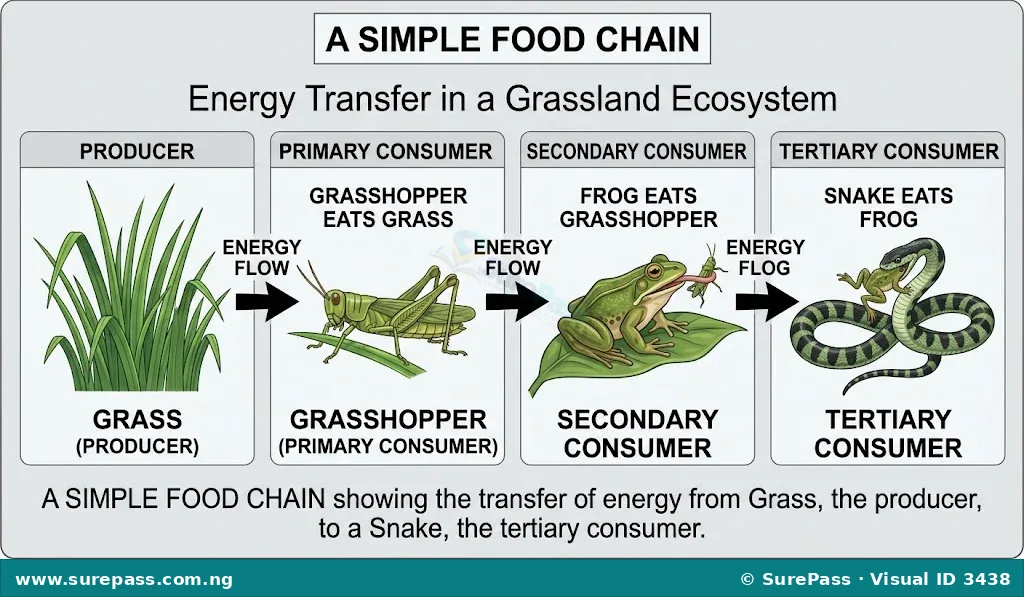
A food chain describes a single pathway through which energy and nutrients are transferred from one living organism to another in an ecosystem. It shows who eats whom, starting with the producers and moving up to the consumers.
Components of a Food Chain
Every food chain has specific components that represent the different roles organisms play in the transfer of energy. These components include producers, consumers and decomposers.
-
Producers: These are organisms that can produce their own food, usually through photosynthesis. They convert light energy from the sun into chemical energy stored in organic matter. Plants, algae and some bacteria are examples of producers. They form the base of every food chain.
-
Consumers: These are organisms that cannot produce their own food and must obtain energy by feeding on other organisms. Consumers are categorised based on what they eat:
-
Primary Consumers (Herbivores): These organisms feed directly on producers. Examples include grasshoppers eating grass, goats eating leaves, and caterpillars eating plant leaves.
-
Secondary Consumers (Carnivores or Omnivores): These organisms feed on primary consumers. Examples include a frog eating a grasshopper, a snake eating a rat, or a human eating a goat.
-
Tertiary Consumers (Top Carnivores or Omnivores): These organisms feed on secondary consumers. Examples include an eagle eating a snake, or a lion eating a hyena that ate a smaller animal.
-
-
Decomposers: These are organisms that break down dead organic matter from all other trophic levels, returning nutrients to the soil or water. Bacteria and fungi are common examples of decomposers. They play a crucial role in recycling nutrients in an ecosystem.
Examples of Simple Food Chains
Food chains are typically represented by arrows pointing from the organism being eaten to the organism that eats it, showing the direction of energy flow.
Examples of simple food chains include:
-
Grass → Grasshopper → Frog → Snake → Eagle
-
Algae → Tadpole → Fish → Kingfisher
-
Maize plant → Rat → Snake → Hawk
-
Leaf → Caterpillar → Bird → Cat
Food Webs
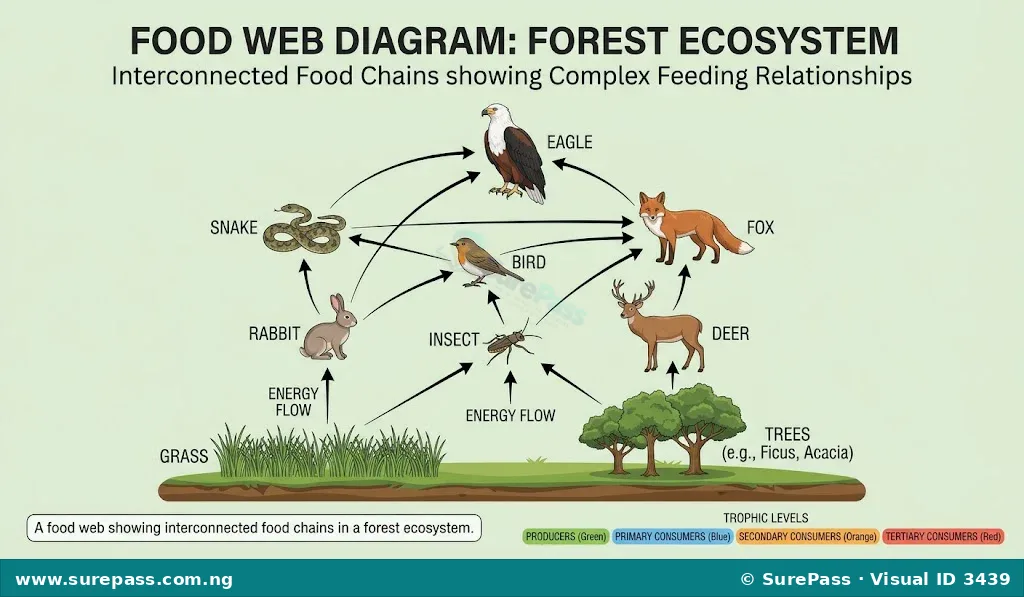
In reality, feeding relationships in an ecosystem are much more complex than a single food chain. Most organisms eat more than one type of food, and they can also be eaten by more than one type of predator. A food web consists of many interconnected food chains in an ecosystem.
A food web provides a more complete and realistic picture of how energy and nutrients flow through an ecosystem. It shows the various feeding options available to different organisms.
Constructing a Simple Food Web
To construct a simple food web, identify all the organisms present in a particular environment and determine their feeding relationships. Start by listing the producers, then identify which primary consumers feed on them. Next, identify the secondary consumers that feed on the primary consumers, and so on. Connect the organisms with arrows showing the direction of energy flow.
For example, in a forest environment, a food web might include:
-
Producers: Trees, shrubs, grass.
-
Primary Consumers: Deer (eats trees, shrubs), rabbits (eat grass, shrubs), insects (eat leaves).
-
Secondary Consumers: Fox (eats rabbits, insects), birds (eat insects), snake (eats rabbits).
-
Tertiary Consumers: Eagle (eats snakes, birds, rabbits), lion (eats deer).
By drawing arrows from the food source to the consumer, a complex network of feeding relationships emerges.
Trophic Levels
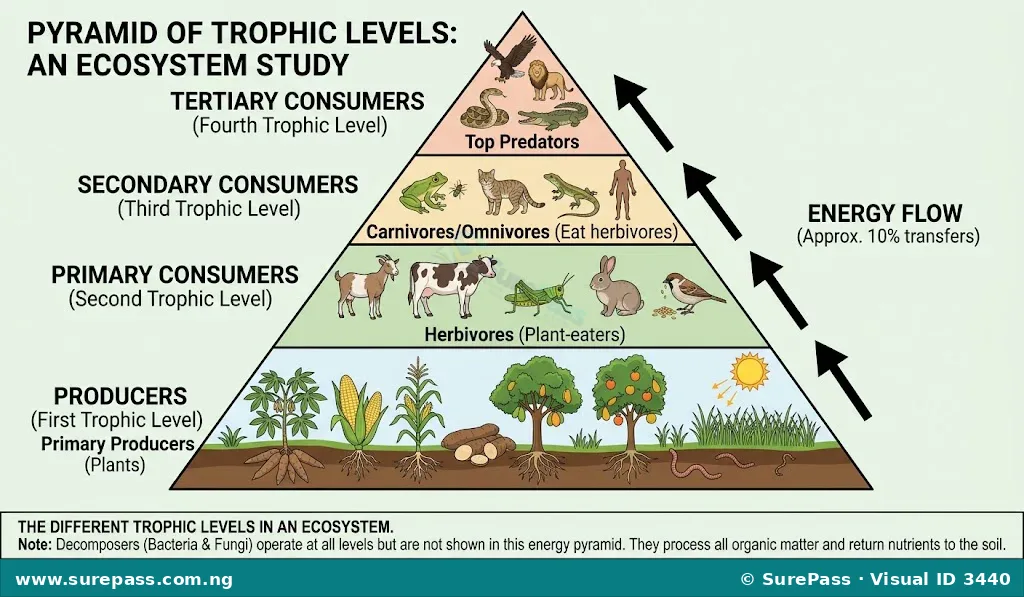
A trophic level is the position an organism occupies in a food chain. It describes how far an organism is from the initial source of energy, which is usually the sun.
There are several trophic levels in an ecosystem:
-
First Trophic Level (Producers): This level consists of organisms that produce their own food, mainly plants and algae. They are the foundation of all food chains.
-
Second Trophic Level (Primary Consumers): This level includes herbivores that feed directly on producers. Examples are grasshoppers, rabbits, cows and goats.
-
Third Trophic Level (Secondary Consumers): This level consists of carnivores or omnivores that feed on primary consumers. Examples are frogs, snakes, small birds and humans who eat meat.
-
Fourth Trophic Level (Tertiary Consumers): This level includes carnivores or omnivores that feed on secondary consumers. Examples are eagles, lions and humans who eat other carnivores.
-
Decomposers: While not typically assigned a specific trophic level in the main chain, decomposers (bacteria and fungi) break down dead organic matter from all trophic levels, recycling nutrients back into the ecosystem.
Energy Flow in an Ecosystem
Energy flows through an ecosystem, typically starting from the sun. Producers capture solar energy and convert it into chemical energy through photosynthesis. This energy is then transferred to consumers when they eat other organisms.
The flow of energy in an ecosystem is unidirectional, meaning it moves in one direction, from producers to consumers. It is also characterised by significant energy loss at each transfer.
Energy Loss Across Trophic Levels
When energy is transferred from one trophic level to the next, a large portion of it is lost. Only about 10% of the energy from one trophic level is transferred to the next. The remaining 90% is lost as heat during metabolic processes (like respiration, movement, and maintaining body temperature) or remains in uneaten or undigested parts of organisms.
This means that the amount of available energy decreases significantly as you move up the food chain. For example, if producers have 10,000 units of energy, primary consumers might only get 1,000 units, secondary consumers 100 units, and tertiary consumers only 10 units.
This decrease in available energy limits the number of trophic levels an ecosystem can support. Most ecosystems rarely have more than four or five trophic levels.
Ecological Pyramids
Ecological pyramids are graphical representations that show the relationship between different trophic levels in terms of energy, numbers or biomass.
-
Pyramid of Energy:
A pyramid of energy shows the total amount of energy present at each trophic level in an ecosystem. The base of the pyramid, representing the producers, always has the largest amount of energy. The amount of energy decreases progressively at each successive trophic level.
The pyramid of energy is always upright because energy is lost at each transfer, meaning there is always less energy available at higher trophic levels than at lower ones. This illustrates the fundamental principle of energy flow and loss in ecosystems.
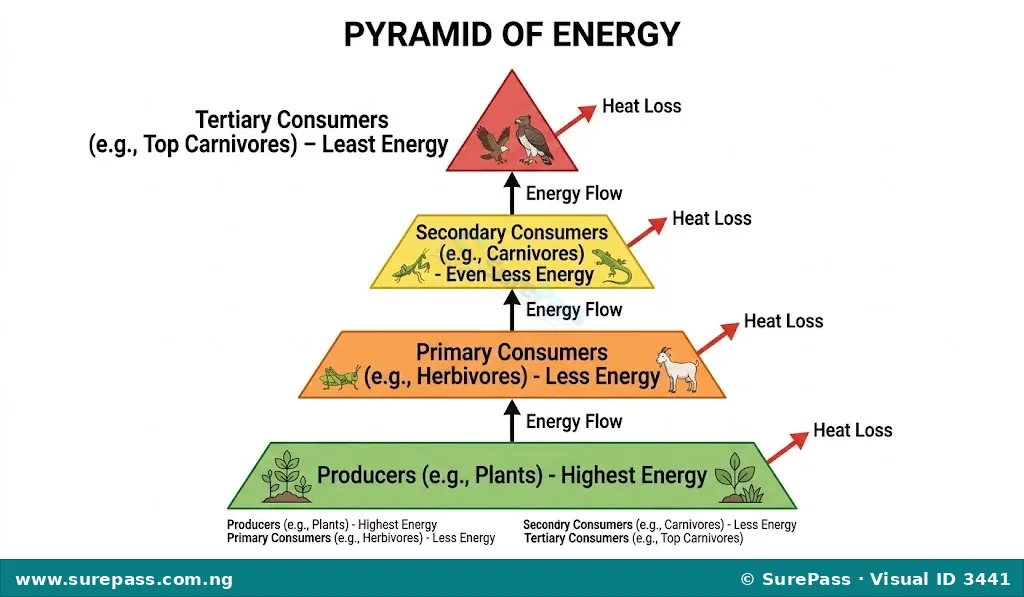
A pyramid of energy, which is always upright due to energy loss at each trophic level. -
Pyramid of Numbers:
A pyramid of numbers shows the number of individual organisms at each trophic level. The shape of a pyramid of numbers can vary depending on the ecosystem.
-
Upright Pyramid: In most ecosystems, the number of producers is greater than the number of primary consumers, which in turn is greater than the number of secondary consumers. For example, many grass plants support fewer grasshoppers, which support even fewer frogs.
-
Inverted Pyramid: In some cases, the pyramid of numbers can be inverted. This occurs when a single large producer supports many smaller consumers. For example, one large tree can support thousands of insects.
-
Spindle-shaped Pyramid: This shape occurs when a small number of producers support a larger number of primary consumers, which then support a smaller number of secondary consumers. For example, a few trees (producers) might support many insects (primary consumers), which are then eaten by a smaller number of birds (secondary consumers).
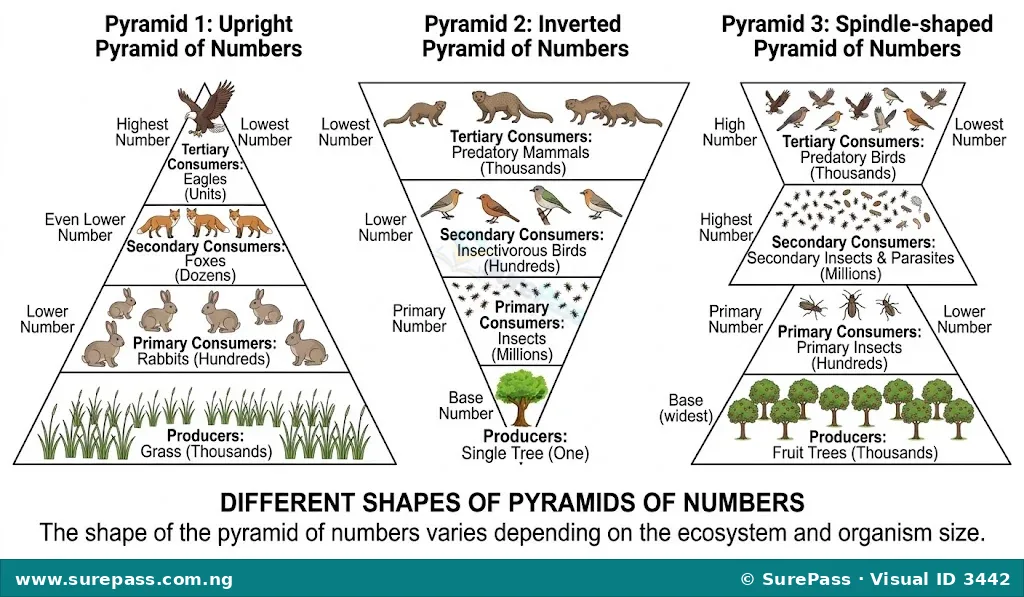
Different shapes of pyramids of numbers, depending on the ecosystem. -
-
Pyramid of Mass (Biomass):
A pyramid of biomass shows the total dry mass (biomass) of organisms at each trophic level. Biomass is the total mass of living organisms in a given area or trophic level.
-
Upright Pyramid: In most terrestrial ecosystems, the biomass of producers is greater than that of primary consumers, and so on. For example, the total mass of grass is much greater than the total mass of the cows that eat it.
-
Inverted Pyramid: In some aquatic ecosystems, the pyramid of biomass can be inverted. This happens because producers (like phytoplankton) reproduce very quickly but have a short lifespan, so their total biomass at any given time might be less than the biomass of the longer-lived primary consumers (like zooplankton) that feed on them. However, the phytoplankton still produce enough energy to support the zooplankton due to their high turnover rate.
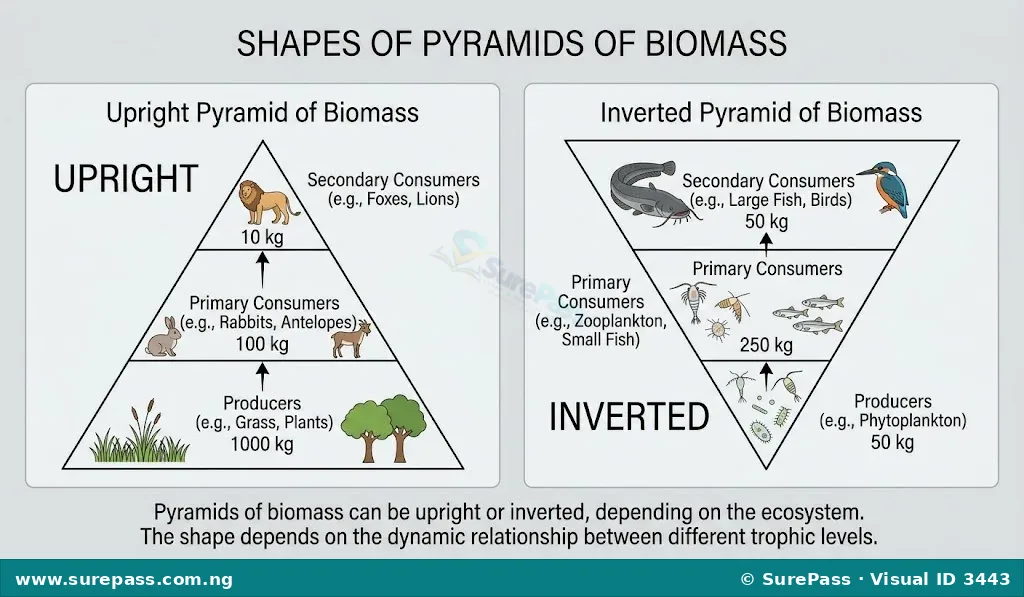
Pyramids of biomass can be upright or inverted, depending on the ecosystem. -





0 comments
Open the discussion when you need it. Comments stay collapsed until requested so the initial article remains light.