



ARTICLE CONTENTSOn this page 10 sections
Production
Performance Objectives
By the end of the lesson, students should be able to:
- explain the types and importance of production;
- describe the factors of production;
- apply automation, robotics and ICT in production processes;
- demonstrate a classroom simulation of efficient production;
- create a quality control checklist for a simple class- made product;
- design a simple supply chain diagram for a chosen product.
Meaning of Production
Production is the process of creating goods and services to satisfy human wants.
It involves transforming raw materials and other resources into finished products or useful services. The goal of production is to add value to resources, making them more useful and desirable to consumers.
For example, a farmer grows maize (a raw material), which is then processed into maize flour (a finished good). A tailor uses fabric and thread to produce clothes. A teacher provides an educational service.
Types of Production
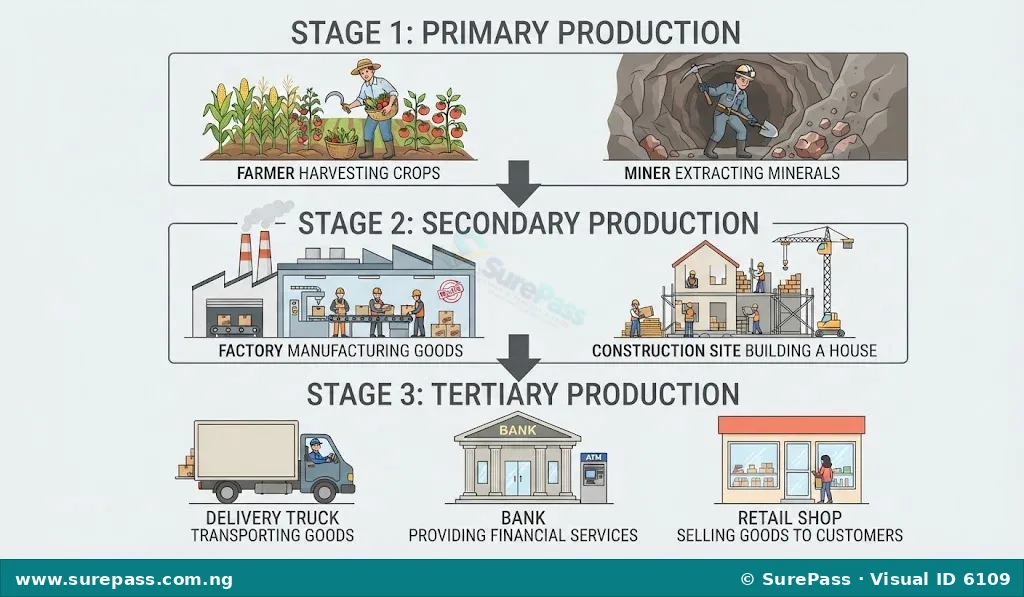
Production can be broadly categorised into three main types, based on the stage of economic activity involved:
- Primary Production: This involves the extraction and collection of natural resources. It is the first stage of production, providing raw materials for other industries.
- Secondary Production: This involves transforming raw materials into finished or semi-finished goods. It includes manufacturing and construction activities.
- Tertiary Production: This involves providing services to individuals and businesses. These services support primary and secondary production and directly satisfy consumer needs.
Primary Production
Primary production focuses on obtaining natural resources directly from the earth. These resources are often used as raw materials in secondary production.
Examples of primary production activities include:
- Agriculture: Farming, crop cultivation, livestock rearing.
- Fishing: Catching fish and other aquatic animals from rivers, lakes, and oceans.
- Mining: Extracting minerals like crude oil, coal, tin, and iron ore from the ground.
- Forestry: Harvesting timber and other forest products.
Secondary Production
Secondary production takes the raw materials from primary production and converts them into products that are ready for use or further processing. This stage adds significant value to the raw materials.
Examples of secondary production activities include:
- Manufacturing: Turning crude oil into petrol, flour into bread, cotton into textiles, or wood into furniture.
- Construction: Building houses, roads, bridges, and other infrastructure.
Tertiary Production
Tertiary production, also known as the service sector, provides intangible services rather than physical goods. These services are crucial for the smooth functioning of primary and secondary sectors and for meeting consumer demands.
Examples of tertiary production activities include:
- Transportation: Moving goods and people by road, rail, air, and sea.
- Banking: Providing financial services like loans, savings, and investments.
- Insurance: Offering protection against financial risks.
- Wholesaling and Retailing: Distributing goods from producers to consumers.
- Education: Teaching and training services.
- Healthcare: Medical services provided by doctors, nurses, and hospitals.
Importance of Production
Production is vital for the survival and growth of any economy. It plays a crucial role in satisfying human needs and improving living standards.
The importance of production includes:
- Satisfaction of Human Wants: Production creates the goods (like food, clothing, shelter, electronics) and services (like education, healthcare, transportation) that people need and desire to live comfortably.
- Creation of Employment Opportunities: Production activities require labour at various stages, from extracting raw materials to manufacturing and distributing finished goods. This creates jobs for many people, reducing unemployment.
- Generation of Income: Through employment, individuals earn wages and salaries, while businesses earn profits. This income allows people to purchase goods and services, further stimulating the economy.
- Economic Growth and Development: Increased production leads to a greater supply of goods and services, which contributes to a country’s Gross Domestic Product (GDP). This indicates economic growth and can lead to improved infrastructure and public services.
- Improved Standard of Living: A wide availability of diverse and affordable goods and services, resulting from efficient production, enhances the quality of life for citizens.
- Foreign Exchange Earnings: When a country produces more than it consumes, the surplus can be exported to other countries. This generates foreign exchange, which can be used to import essential goods and services or to pay off international debts.
- Resource Utilisation: Production ensures that natural resources, human skills, and capital are effectively used to create value, preventing waste and promoting efficiency.
Factors of Production
For any production process to take place, certain resources are required. These resources are known as the factors of production. They are the inputs used to produce goods and services.
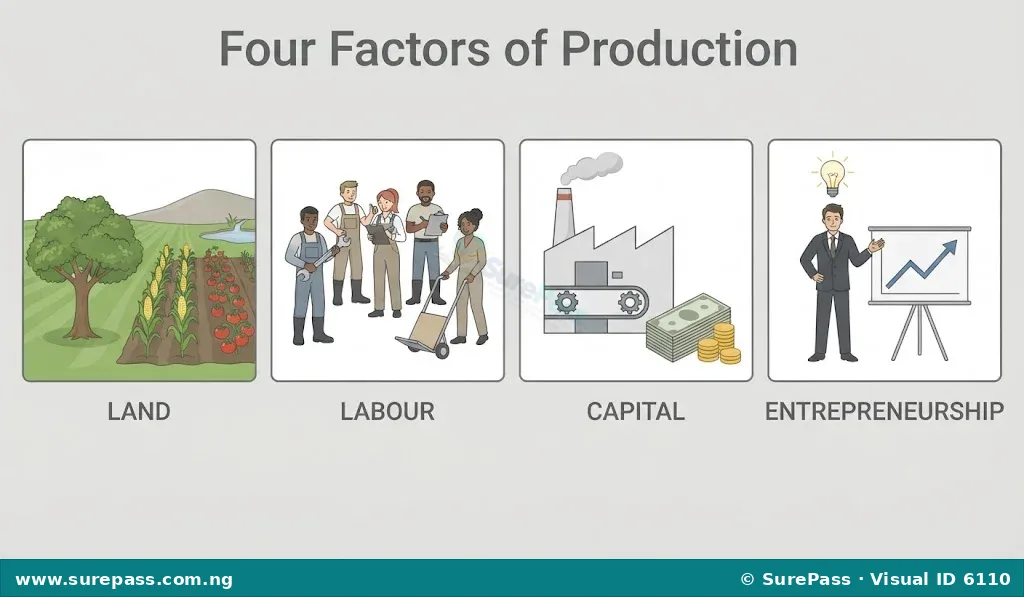
The four main factors of production are:
- Land: This refers to all natural resources provided by nature that are used in production.
- Labour: This is the human effort, both physical and mental, used in the production process.
- Capital: This refers to man-made resources used to produce other goods and services.
- Entrepreneurship (or Enterprise): This is the special human skill of organising and combining the other factors of production, taking risks, and innovating.
Land
Land, as a factor of production, includes not just the physical ground but also all natural resources found on or under it. These resources are gifts of nature and are not created by human effort.
Examples of land resources include:
- Agricultural land for farming.
- Forests for timber.
- Rivers, lakes, and oceans for fishing and water supply.
- Mineral deposits like crude oil, natural gas, tin, and limestone.
- Air and sunshine.
The reward for land is called rent.
Labour
Labour refers to the human effort, both physical and mental, that is applied in the production of goods and services. It includes the skills, knowledge, and energy of workers.
Examples of labour include:
- Farmers working on a farm.
- Factory workers operating machines.
- Teachers educating students.
- Doctors providing medical care.
- Engineers designing structures.
The reward for labour is called wages or salaries.
Capital
Capital refers to all man-made resources used in the production process. These are goods that are used to produce other goods, rather than being consumed directly.
Examples of capital include:
- Machinery and equipment in factories.
- Buildings, such as factories, offices, and warehouses.
- Tools used by artisans and farmers.
- Vehicles used for transportation.
- Money used to purchase raw materials, pay wages, or invest in equipment (often called financial capital, which facilitates the acquisition of physical capital).
The reward for capital is called interest.
Entrepreneurship (or Enterprise)
Entrepreneurship is the special human talent that involves organising and combining the other three factors of production (land, labour, and capital) to create goods and services. Entrepreneurs are innovators who take risks and make decisions to start and run businesses.
Examples of entrepreneurial activities include:
- A person starting a new business venture, like a restaurant or a tech company.
- An individual identifying a market need and developing a product to meet it.
- Someone taking financial risks to invest in a new production method.
The reward for entrepreneurship is called profit.
Modern Trends in Production: Automation, Robotics, and ICT
Modern production processes are increasingly adopting advanced technologies to improve efficiency, speed, and quality. Automation, robotics, and Information and Communication Technology (ICT) are key drivers of these changes.
Automation in Production Processes
Automation involves using machines and control systems to perform tasks automatically, with minimal human intervention. This trend aims to reduce manual labour, increase output, and ensure consistency.
Examples of automation in production include:
- Automated assembly lines in car manufacturing plants, where vehicles move along a conveyor belt and machines perform specific tasks.
- Automated bottling and packaging systems in beverage and food industries, which fill, cap, and label products at high speeds.
- Automated sorting systems in warehouses that use sensors and conveyor belts to sort packages for delivery.
Robotics in Production Processes
Robotics is a specific form of automation that uses robots to perform tasks. Robots are programmable machines capable of carrying out complex actions with precision and speed. They are particularly useful for repetitive, dangerous, or highly precise tasks.
Examples of robotics in production include:
- Robots used for welding and painting in automotive factories, ensuring uniform quality and safety.
- Robotic arms used for picking and placing components in electronics manufacturing.
- Robots used in pharmaceutical production for precise mixing and packaging of medicines.
ICT in Production Processes
Information and Communication Technology (ICT) plays a crucial role in managing, monitoring, and optimising production. It involves the use of computers, software, networks, and the internet to handle information and facilitate communication.
Examples of ICT applications in production include:
- Computer-Aided Design (CAD) and Computer-Aided Manufacturing (CAM): Software used to design products and control manufacturing machinery.
- Enterprise Resource Planning (ERP) Systems: Software that integrates all aspects of a business, including production planning, inventory management, and supply chain operations.
- Quality Control Systems: Using sensors and software to monitor product quality in real-time and identify defects.
- Communication and Collaboration Tools: Using email, video conferencing, and project management software to coordinate production teams and suppliers globally.
- Data Analytics: Collecting and analysing production data to identify areas for improvement and predict maintenance needs for machinery.
Demonstrating a Classroom Simulation of Efficient Production
A classroom simulation can help understand how efficient production works, often by applying principles like division of labour and quality control.
The procedure involves the following steps:
- Choose a Simple Product: Select a simple item that can be made from readily available materials, such as a paper aeroplane, a small paper box, or a paper hat. For this simulation, let’s choose a simple paper box.
- Gather Materials: The required materials are:
- Cardboard papers (or thick paper)
- Markers
- Rulers
- Scissors
- Glue or tape
- Define Production Stages: Break down the production of the paper box into several distinct stages. For example:
- Cutting the base shape.
- Scoring and folding the sides.
- Applying glue/tape.
- Assembling the box.
- Decorating/labelling.
- Assign Roles (Division of Labour): Divide the class into small groups, and within each group, assign specific tasks to individual students for each stage. For example, one student cuts, another folds, another glues, and another decorates.
- Establish Quality Standards: Before starting, define what makes a “good” paper box (e.g., neat folds, strong joints, correct size, clear decoration).
- Conduct the First Production Run (Without Efficiency Focus): Have each group produce a few boxes without strict time limits or emphasis on speed, just to understand the process. Observe challenges.
- Introduce Efficiency Measures: After the first run, discuss how to improve. Emphasise:
- Specialisation: Each person focuses on their assigned task to become faster and more accurate.
- Clear Instructions: Ensure everyone understands their role.
- Smooth Flow: Pass the semi-finished product quickly from one stage to the next.
- Minimising Waste: Use materials carefully.
- Conduct the Second Production Run (With Efficiency Focus): Repeat the production process, applying the discussed efficiency measures. Compare the output quantity and quality with the first run.
- Review and Discuss: Discuss the results. How did division of labour affect speed and quality? What challenges were faced? How did the team work together?
Creating a Quality Control Checklist for a Simple Class-Made Product
Quality control is the process of ensuring that products meet certain standards and specifications. A quality control checklist helps to systematically check for these standards.
To create a quality control checklist for the simple paper box from the simulation, consider the key features and potential defects.
The steps to create a checklist are:
- Identify Key Product Features: List the essential characteristics of the product. For the paper box, these might include its shape, size, strength, and appearance.
- Determine Quality Standards: For each feature, define what constitutes “good” quality. For example, “square shape,” “all sides equal length,” “no visible glue marks.”
- List Potential Defects: Think about what could go wrong during production. For example, uneven cuts, weak joints, smudged decoration.
- Design the Checklist Format: Create a table or a list with columns for the item to check, the standard, and a space to mark if it passes or fails.
An example quality control checklist for a simple paper box:
| Feature to Check | Quality Standard | Pass (✓) / Fail (X) | Comments (if Fail) |
|---|---|---|---|
| Overall Shape | Box is square/rectangular and not distorted. | ||
| Dimensions | All sides are of the intended length and height. | ||
| Joints/Seams | All glued/taped joints are strong and secure. No gaps. | ||
| Folding | All folds are neat, sharp, and straight. | ||
| Surface Condition | No tears, creases, or smudges on the exterior. | ||
| Decoration/Label | Decoration is neat, centred, and legible (if applicable). |
Designing a Simple Supply Chain Diagram for a Chosen Product
A supply chain is the entire network of organisations, people, activities, information, and resources involved in moving a product or service from supplier to customer. A supply chain diagram visually represents these stages.
Let’s design a simple supply chain diagram for a common Nigerian product: Garri.
The stages in the supply chain for garri typically include:
- Cassava Farm (Raw Material Sourcing): Farmers cultivate and harvest cassava tubers.
- Processing Plant (Production): Cassava tubers are peeled, washed, grated, fermented, pressed to remove water, sieved, and then roasted into garri granules. This can happen in small-scale local processing centres or larger factories.
- Packaging: The finished garri is packaged into bags or sacks.
- Transportation (to Wholesaler): Packaged garri is transported from the processing plant to wholesale markets or distributors.
- Wholesaler: Wholesalers buy large quantities of garri from producers and sell them in smaller bulk to retailers.
- Transportation (to Retailer): Garri is transported from wholesale markets to various retail outlets.
- Retailer: Retailers (e.g., market stalls, supermarkets, small shops) sell garri directly to individual consumers.
- Consumer: The end-user who purchases and consumes the garri.




0 comments
Open the discussion when you need it. Comments stay collapsed until requested so the initial article remains light.