


ARTICLE CONTENTSOn this page 7 sections
Capital
Performance Objectives
By the end of the lesson, students should be able to:
- state the meaning of capital;
- identify types of capital;
- explain the sources of capital;
- discuss the importance of working capital;
- calculate working capital for a given business.
Meaning of Capital
Capital refers to the money, assets, or resources used to start and run a business or commercial activity.
It is one of the essential factors of production, alongside land, labour, and entrepreneurship. Capital helps a business acquire the necessary tools, equipment, buildings, and raw materials needed for its operations. Without sufficient capital, a business cannot function effectively or grow.
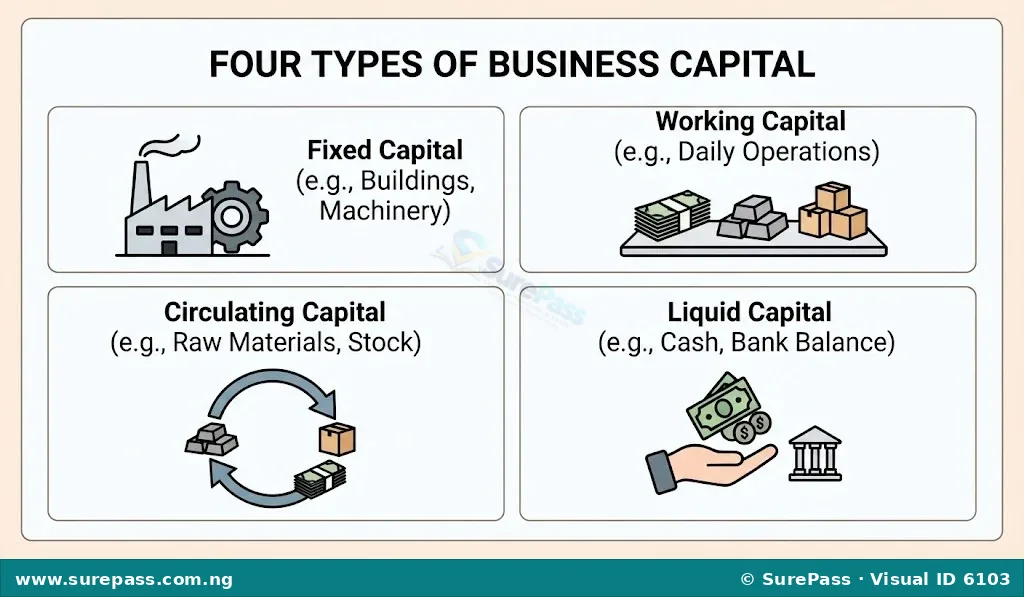
Types of Capital
Capital can be classified into different types based on its nature and how it is used in a business. Understanding these types helps businesses manage their resources effectively.
Fixed Capital
Fixed capital refers to assets that are used repeatedly over a long period in a business and are not meant for resale.
These assets provide a long-term base for operations and are not consumed or converted into cash quickly. Examples of fixed capital include land, buildings, machinery, vehicles, and furniture. A bakery, for instance, uses its oven, mixing machines, and delivery van as fixed capital.
Working Capital
Working capital is the capital required for the day-to-day operations of a business.
It represents the difference between a business’s current assets and its current liabilities. Working capital is crucial for meeting short-term expenses and obligations, such as paying for raw materials, wages, utility bills, and other operational costs. It ensures the smooth running of the business cycle.
Circulating Capital
Circulating capital refers to the capital that is continuously used up or converted from one form to another during the production and sales process.
This type of capital changes its form repeatedly within a short period. Examples include raw materials that are transformed into finished goods, and finished goods that are sold and converted into cash. The cash is then used to buy more raw materials, continuing the cycle. For a fashion designer, the fabrics, threads, and buttons purchased are circulating capital.
Liquid Capital
Liquid capital refers to assets that can be easily and quickly converted into cash without significant loss of value.
This is the most readily available form of capital. Examples of liquid capital include cash in hand, money in the bank, and short-term investments that can be quickly sold. Businesses need liquid capital to meet immediate expenses and unexpected financial needs.
Sources of Capital for Commercial Activities
Businesses need capital to operate, and this capital can come from various sources. The choice of source often depends on the amount of capital needed, the stage of the business, and the owner’s preferences.
Personal Savings
Personal savings refer to the money that a business owner has saved from their income over time.
This is often the first source of capital for many small businesses and startups. Using personal savings means the owner does not have to pay interest or repay a loan to an external party. For example, a tailor might use money saved from previous jobs to buy a new sewing machine and rent a shop space.
Family and Friends
Capital can also be sourced from family members and friends who are willing to lend money or invest in the business.
This source is often more flexible than formal loans, with potentially lower interest rates or more lenient repayment terms. A young entrepreneur starting a catering business might receive a loan from an aunt or uncle to purchase cooking equipment and ingredients.
Trade Credit
Trade credit is a financing arrangement where a supplier allows a business to purchase goods or services on credit, with payment due at a later date.
This means the business can acquire necessary inventory or supplies without immediate cash payment, effectively using the supplier’s capital for a short period. For instance, a retailer might receive a consignment of clothes from a wholesaler with an agreement to pay within 30 or 60 days after selling the items.
Importance of Working Capital
Working capital is vital for the smooth and efficient operation of any business. Its importance cannot be overemphasised, especially for commercial activities that rely on continuous buying and selling.
The importance of working capital includes the following:
- Ensures Smooth Operations: Adequate working capital allows a business to pay for daily expenses like raw materials, wages, and utility bills without interruption. This ensures that production or service delivery continues smoothly.
- Meets Short-Term Obligations: Businesses constantly have short-term debts, such as payments to suppliers (creditors) or short-term loans. Sufficient working capital ensures these obligations are met on time, maintaining the business’s creditworthiness and reputation.
- Handles Unexpected Expenses: Unexpected costs can arise in any business, such as emergency repairs or sudden increases in material prices. Good working capital provides a buffer to cover these unforeseen expenses without disrupting core operations.
- Seizes Business Opportunities: With enough working capital, a business can take advantage of opportunities like bulk purchase discounts from suppliers or sudden increases in customer demand. This can lead to higher profits and growth.
- Maintains Solvency: Solvency means a business’s ability to pay its debts. Healthy working capital indicates that a business has enough liquid assets to cover its short-term liabilities, preventing financial distress or bankruptcy.
- Supports Growth and Expansion: As a business grows, it needs more stock, more staff, and more operational funds. Sufficient working capital provides the financial flexibility to support such expansion without relying heavily on long-term borrowing.
Calculating Working Capital for a Given Business
Calculating working capital involves comparing a business’s current assets with its current liabilities. This calculation helps determine the net amount of capital available for day-to-day operations.
The formula for calculating working capital is:
Working Capital = Current Assets – Current Liabilities
To understand this, it is important to know what current assets and current liabilities are:
- Current Assets: These are assets that can be converted into cash within one year. Examples include cash in hand, cash at bank, stock (inventory of goods for sale or raw materials), and debtors (money owed to the business by customers).
- Current Liabilities: These are debts or obligations that must be paid within one year. Examples include creditors (money owed by the business to suppliers), short-term loans, and accrued expenses (expenses incurred but not yet paid).
Worked Example: Calculating Working Capital
A business, “Mama Ngozi’s Provisions Store,” has the following financial information at the end of the month:
- Cash in hand: N50,000
- Cash at bank: N150,000
- Stock of goods: N300,000
- Money owed by customers (Debtors): N100,000
- Money owed to suppliers (Creditors): N120,000
- Short-term loan: N80,000
Let us calculate the working capital for Mama Ngozi’s Provisions Store.
Step 1: Identify and sum up all Current Assets.
Current Assets = Cash in hand + Cash at bank + Stock of goods + Debtors
Current Assets = N50,000 + N150,000 + N300,000 + N100,000
Current Assets = N600,000
Step 2: Identify and sum up all Current Liabilities.
Current Liabilities = Creditors + Short-term loan
Current Liabilities = N120,000 + N80,000
Current Liabilities = N200,000
Step 3: Apply the Working Capital formula.
Working Capital = Current Assets – Current Liabilities
Working Capital = N600,000 – N200,000
Working Capital = N400,000
Therefore, Mama Ngozi’s Provisions Store has a working capital of N400,000.




0 comments
Open the discussion when you need it. Comments stay collapsed until requested so the initial article remains light.