



ARTICLE CONTENTSOn this page 6 sections
Financial Crime
Performance Objectives
By the end of the lesson, students should be able to:
- state the meaning of financial crime;
- identify types of financial crime;
- discuss the consequences of engaging in financial crime;
- develop a code of financial ethics.
Meaning of Financial Crime
Financial crime refers to illegal acts committed against individuals, companies, or governments, with the aim of gaining financial advantage or causing financial loss.
These crimes often involve deception, fraud, or theft of money or assets. They can range from simple scams to complex schemes involving large sums of money and multiple parties. Financial crimes undermine trust in financial systems and can have severe impacts on victims and the economy.
Types of Financial Crime
Financial crimes take various forms, each with distinct methods and targets. Understanding these types helps in recognising and preventing them.
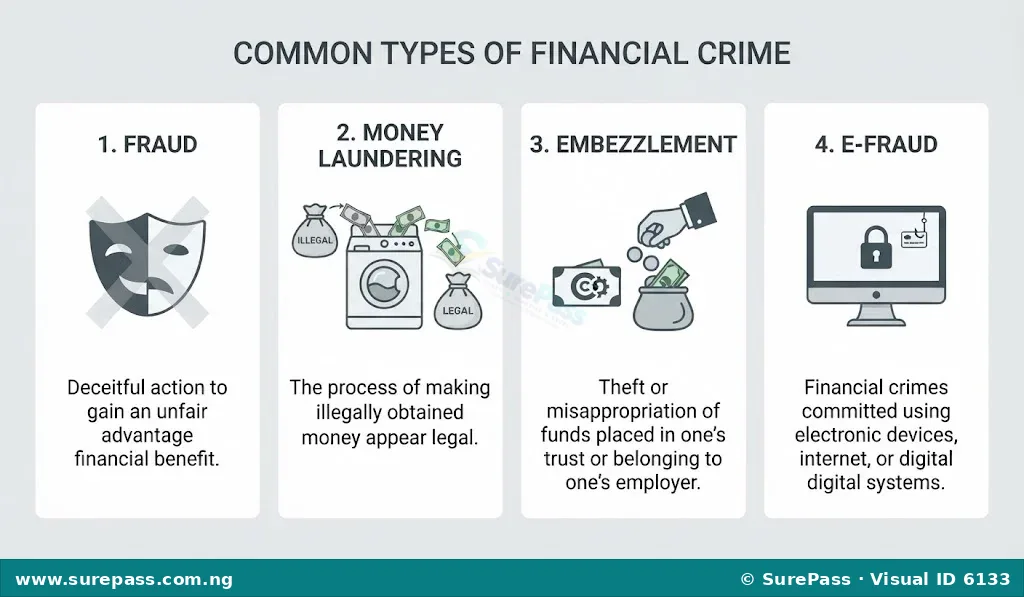
Fraud
Fraud is a deliberate deception carried out to secure unfair or unlawful gain, or to deprive a victim of a legal right. It involves misrepresentation of facts, often through false statements or promises, to trick someone into giving up money or property.
Examples of fraud include:
- Identity theft: Stealing someone’s personal information (like bank details or national identification number) to open accounts or make purchases.
- Advance fee fraud: Asking victims to pay an upfront fee in exchange for a service or large sum of money that never materialises.
- Insurance fraud: Making false claims to an insurance company to receive payouts.
- Investment fraud: Deceiving investors into putting money into fake or worthless schemes.
Money Laundering
Money laundering is the process of concealing the origins of illegally obtained money, typically by passing it through a complex sequence of banking transfers or commercial transactions, so that it appears to have come from a legitimate source.
Criminals use money laundering to make their illicit gains seem legitimate. This process typically involves three stages:
- Placement: Introducing the illegal money into the financial system, often in small amounts to avoid suspicion.
- Layering: Moving the money through complex transactions to obscure its origin, such as multiple transfers between different accounts or countries.
- Integration: Returning the money to the criminals from what appear to be legitimate sources, such as business investments or property purchases.
Embezzlement
Embezzlement is the fraudulent appropriation of property by a person to whom that property has been entrusted.
This crime typically occurs when an individual in a position of trust, such as an employee, manager, or accountant, takes money or assets that belong to their employer or client for personal use. Unlike simple theft, the embezzler initially has legal access to the funds or assets but then misuses them.
Examples of embezzlement include:
- An accountant transferring company funds into their personal bank account.
- A cashier taking money from the till and not recording the sale.
- A trustee misusing funds entrusted to them for a beneficiary.
E-fraud (Electronic Fraud)
E-fraud, also known as cyber fraud, refers to any type of fraud scheme that uses electronic communication and digital technology, such as the internet, email, or mobile phones, to deceive victims and obtain money or personal information.
E-fraud is a growing concern due to the widespread use of digital platforms for financial transactions. It exploits vulnerabilities in technology and human behaviour.
Common forms of e-fraud include:
- Phishing: Sending fake emails or messages that appear to be from legitimate organisations (like banks or government agencies) to trick recipients into revealing personal information.
- Online shopping scams: Creating fake online stores or advertisements to collect payment for goods that are never delivered.
- Hacking: Gaining unauthorised access to computer systems or accounts to steal data or money.
- Ransomware: Malicious software that blocks access to a computer system until a sum of money is paid.
Consequences of Engaging in Financial Crime
Engaging in financial crime carries severe consequences, affecting not only the individuals involved but also the wider economy and society.
Conviction
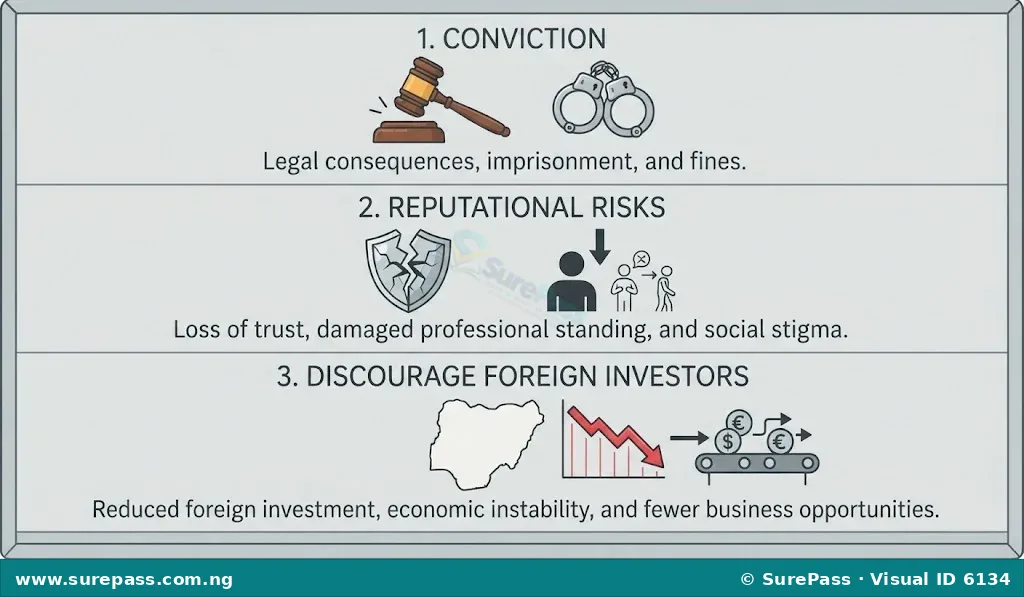
Conviction refers to a formal declaration by a court that someone is guilty of a criminal offence. For financial crimes, conviction often leads to severe penalties.
Consequences of conviction include:
- Imprisonment: Individuals found guilty of financial crimes can face long jail sentences, depending on the severity and nature of the offence.
- Fines: Courts can impose heavy financial penalties, requiring offenders to pay large sums of money.
- Asset forfeiture: Any assets or money obtained through criminal activities can be seized by the government.
- Criminal record: A criminal record can limit future employment opportunities, travel, and access to financial services.
Reputational Risks
Reputational risk refers to the potential for damage to an individual’s or organisation’s good name and public image, which can lead to a loss of trust and business.
For individuals, being associated with financial crime can destroy personal and professional reputations, making it difficult to find employment or maintain social standing. For businesses, involvement in financial crime can lead to a loss of customer trust, reduced sales, and difficulty in attracting new clients or partners. This damage to reputation can be long-lasting and very difficult to repair.
Discourage Foreign Investors
A high incidence of financial crime in a country can deter foreign investors from bringing their capital and businesses into that economy.
Foreign investors seek stable and predictable environments where their investments are safe and protected by law. When financial crimes are rampant, it signals a lack of transparency, weak legal enforcement, and high operational risks. This uncertainty makes foreign investors hesitant to commit funds, leading to reduced foreign direct investment (FDI). A decrease in FDI can slow down economic growth, limit job creation, and hinder national development.
Developing a Code of Financial Ethics
A code of financial ethics is a set of principles and guidelines that dictate how individuals and organisations should conduct themselves in financial matters, promoting honesty, integrity, and transparency.
Developing a code of financial ethics helps to prevent financial crimes by establishing clear moral boundaries and expectations for behaviour. It encourages individuals and organisations to act responsibly and ethically, fostering trust and accountability.
Steps to Develop a Code of Financial Ethics
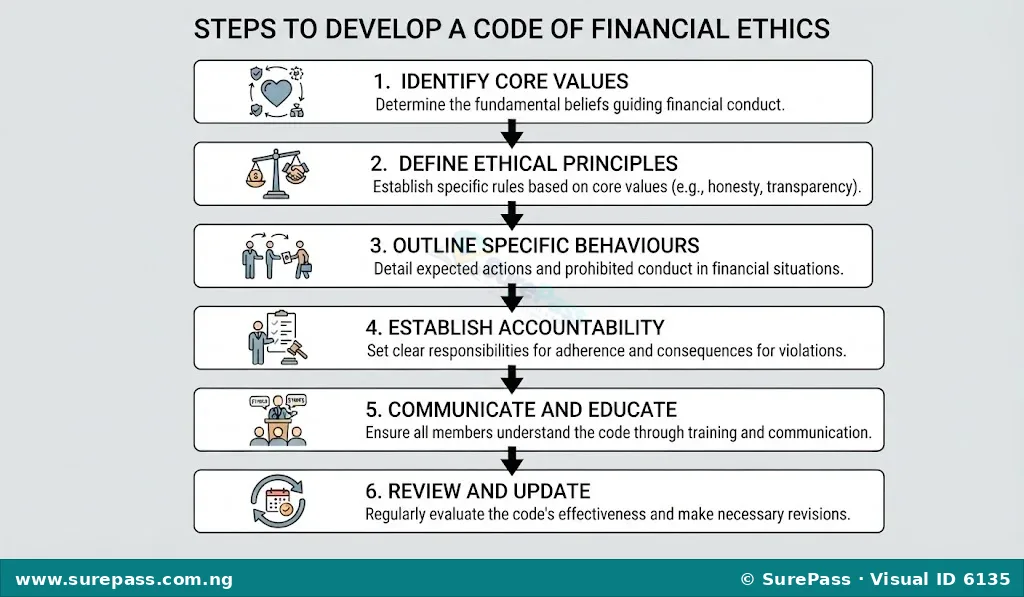
The procedure for developing a code of financial ethics involves the following steps:
- Identify Core Values: Begin by identifying the fundamental values that should guide financial behaviour. These might include honesty, integrity, fairness, transparency, and responsibility.
- Define Ethical Principles: Translate the core values into specific ethical principles. For example, “honesty” can become “always provide accurate and truthful financial information.”
- Outline Specific Behaviours: Detail the expected behaviours that align with the ethical principles. This involves stating what actions are acceptable and what actions are not. For instance, “do not engage in any form of fraud or deception.”
- Establish Accountability: Include provisions for how the code will be enforced and what consequences will follow if the code is violated. This ensures that the code is taken seriously.
- Communicate and Educate: Share the code with all relevant individuals (e.g., employees, team members) and provide training or discussions to ensure everyone understands its importance and content.
- Review and Update: Periodically review the code to ensure it remains relevant and effective, making updates as necessary to address new challenges or circumstances.
For example, a class code of financial ethics might include principles such as:
- Always be honest when handling class funds or materials.
- Do not take items that do not belong to you.
- Report any suspicious financial activities to the appropriate authority.
- Be transparent about how class money is spent.
- Respect the financial privacy of others.




0 comments
Open the discussion when you need it. Comments stay collapsed until requested so the initial article remains light.