



ARTICLE CONTENTSOn this page 11 sections
Partnership
Performance Objectives
By the end of the lesson, students should be able to:
- explain the meaning of partnership;
- discuss types of partnership;
- draft a simple partnership deed;
- discuss the characteristics of partnership;
- identify the sources of capital for partnership business;
- discuss the advantages and disadvantages of partnership.
Introduction to Partnership
In the world of business, people often come together to achieve common goals. While a sole proprietorship involves one person owning and running a business, a partnership is a business structure where two or more individuals agree to combine their resources, skills, and efforts to operate a business. This arrangement allows them to share both the profits and the risks involved.
Meaning of Partnership
A partnership is a type of business organisation where two or more persons agree to carry on a business in common with a view to making a profit.
In Nigeria, partnerships are generally governed by the Partnership Act of 1890 (a British statute still applicable in some states) or specific state partnership laws. The agreement between the partners is crucial as it defines their roles, responsibilities, and how the business will be managed.
Types of Partnership
Partnerships can be classified based on the liability of the partners and their roles within the business. Understanding these types helps in knowing how different partnerships affect business operations.
General Partnership
A general partnership is the most common type, where all partners share equally in the management and liability of the business.
In a general partnership, each partner has unlimited liability, meaning they are personally responsible for all the debts and obligations of the business. If the business fails, creditors can claim the personal assets of any partner to settle the business debts. This type of partnership is common among professionals like lawyers, accountants, and doctors.
Limited Partnership
A limited partnership consists of at least one general partner and one or more limited partners.
In this structure, general partners have unlimited liability and manage the business, similar to a general partnership. Limited partners, however, have limited liability, meaning their financial responsibility is restricted to the amount of capital they have invested in the business. They typically do not participate in the day-to-day management of the business. This type of partnership is often used when investors want to contribute capital without taking on full management responsibilities or unlimited risk.
Partners Based on Role
Within a partnership, partners can also be distinguished by their level of involvement and recognition:
- Active Partner: An active partner takes a full and active part in the management and operations of the business. They are known to the public and share in profits and losses.
- Sleeping or Dormant Partner: A sleeping partner contributes capital to the business but does not take an active part in its management. They are generally not known to the public but share in profits and losses and have unlimited liability in a general partnership.
- Nominal Partner: A nominal partner lends their name to the partnership but does not contribute capital or participate in management. They share in neither profits nor losses but are liable to third parties for the firm’s debts because their name is used.
- Partner by Estoppel or Holding Out: A person who, by their words or conduct, represents themselves as a partner, or knowingly allows themselves to be represented as one, becomes liable as a partner to anyone who has given credit to the firm on the faith of such representation.
Partnership Agreement (Partnership Deed)
A partnership agreement, often called a partnership deed, is a legal document that outlines the rights, duties, and responsibilities of each partner in a partnership business.
While a partnership can be formed through an oral agreement, a written partnership deed is highly recommended. It helps to prevent misunderstandings and disputes among partners by clearly defining the terms and conditions of their business relationship. It acts as a blueprint for how the business will operate and how conflicts will be resolved.
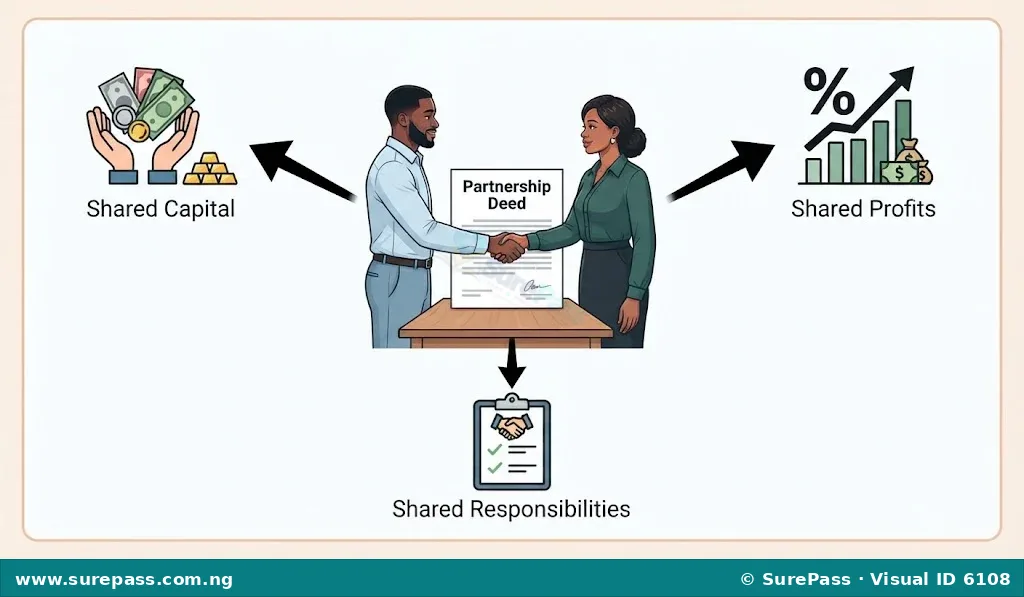
The main contents of a partnership deed typically include:
- Name and Nature of Business: The official name of the partnership firm and the type of business it will conduct.
- Names and Addresses of Partners: Full details of all individuals involved in the partnership.
- Commencement Date: The date from which the partnership officially begins its operations.
- Duration of Partnership: Whether the partnership is for a fixed period or for a specific venture, or if it is at will (can be dissolved by any partner at any time).
- Capital Contribution: The amount of capital (money or assets) each partner will contribute to the business.
- Profit and Loss Sharing Ratio: How profits and losses will be divided among the partners. This can be equal or based on capital contribution or other agreed terms.
- Salaries, Commissions, and Drawings: Whether any partner will receive a salary or commission, and the rules regarding partners withdrawing money (drawings) for personal use.
- Interest on Capital and Drawings: Whether interest will be paid on partners’ capital contributions or charged on their drawings.
- Duties and Responsibilities of Partners: The specific roles, duties, and powers assigned to each partner.
- Management of the Business: How decisions will be made, who will manage daily operations, and the voting rights of partners.
- Admission of New Partners: The conditions and procedures for admitting new partners into the firm.
- Retirement and Death of a Partner: Procedures for a partner leaving the firm, including how their share will be valued and paid out.
- Dissolution of Partnership: The conditions under which the partnership can be dissolved and the process for winding up the business.
- Arbitration Clause: A clause specifying how disputes among partners will be resolved, often through arbitration.
Characteristics of Partnership Business
Partnership businesses possess several distinct features that differentiate them from other forms of business organisation:
- Two or More Persons: A partnership must have at least two persons. The maximum number of partners is usually limited by law, often 20 for general businesses, but can be less for professional firms (e.g., 10 for banking).
- Agreement: A partnership is formed based on an agreement, which can be oral or written, among the partners. This agreement defines their relationship and terms of business.
- Business Activity: The partners must agree to carry on a lawful business. An agreement to share profits from a non-business activity does not constitute a partnership.
- Profit Sharing: The primary objective of a partnership is to make a profit, and these profits must be shared among the partners according to their agreement. Losses are also shared.
- Unlimited Liability (for General Partners): In a general partnership, each partner is personally liable for all the debts of the business. This means their personal assets can be used to pay off business debts if the business cannot.
- Mutual Agency: Each partner is an agent of the firm and of the other partners. The actions of one partner in the ordinary course of business can bind all other partners and the firm.
- Lack of Separate Legal Entity: A partnership is not a separate legal entity from its owners. The partners and the business are considered one and the same in the eyes of the law.
- Lack of Perpetual Succession: The partnership can be dissolved by the death, retirement, insolvency, or insanity of any partner, unless the partnership deed specifies otherwise. This means it lacks continuity.
- Restriction on Transfer of Interest: A partner cannot transfer their share or interest in the partnership to an outsider without the consent of all other partners.
Sources of Capital for Partnership Business
Raising sufficient capital is essential for starting and running any business, including a partnership. Partners can obtain the necessary funds from various sources:
- Partners’ Personal Contributions: This is the primary source. Each partner contributes money, assets (like land, buildings, machinery, or vehicles), or even expertise and goodwill as their share of capital.
- Loans from Partners: Partners can provide additional funds to the business in the form of loans, beyond their initial capital contributions. These loans usually attract interest as agreed upon.
- Loans from Banks and Financial Institutions: Partnerships can apply for loans from commercial banks, microfinance banks, or other financial institutions. The ability to secure such loans often depends on the partners’ creditworthiness and the business’s viability.
- Retained Earnings: If the business generates profits, a portion of these profits can be reinvested back into the business instead of being fully distributed to partners. This is known as retained earnings and serves as an internal source of capital for expansion or operational needs.
- Trade Credit: Partnerships can obtain goods or services from suppliers on credit, effectively delaying payment and freeing up cash for other uses. This is a short-term source of financing.
Advantages of Partnership
Partnerships offer several benefits that make them an attractive business structure for many entrepreneurs:
- Ease of Formation: Forming a partnership is relatively simple and less costly compared to forming a limited liability company. It requires an agreement among partners and registration with the Corporate Affairs Commission (CAC) in Nigeria.
- More Capital: A partnership can raise more capital than a sole proprietorship because multiple partners contribute funds and assets. This allows for larger-scale operations or faster expansion.
- Combined Skills and Expertise: Partners often bring diverse skills, knowledge, and experience to the business. For example, one partner might be good at marketing, while another excels in finance or operations.
- Shared Workload and Responsibilities: The workload and responsibilities of running the business can be distributed among partners, reducing the burden on any single individual.
- Shared Risks: Business risks and losses are shared among the partners, which can be less daunting than bearing all risks alone in a sole proprietorship.
- Flexibility in Decision-Making: Partnerships generally have fewer legal formalities and can make decisions more quickly than companies, which often require board meetings and extensive documentation.
- Better Management: With multiple minds involved, decision-making can be more robust and well-rounded, leading to better management of the business.
Disadvantages of Partnership
Despite its advantages, the partnership structure also comes with certain drawbacks:
- Unlimited Liability: For general partners, unlimited liability is a significant disadvantage. Their personal assets are at risk if the business incurs heavy debts or faces financial difficulties.
- Potential for Disagreements: With multiple individuals involved, there is a higher chance of conflicts and disagreements over business decisions, profit sharing, or management styles. These disputes can harm the business.
- Lack of Continuity: A partnership can be easily dissolved by the death, retirement, insolvency, or insanity of a partner, unless the partnership deed makes specific provisions for continuation. This can lead to instability.
- Limited Capital: While partnerships can raise more capital than sole proprietorships, their ability to raise very large amounts of capital is often limited compared to public limited companies that can issue shares to the public.
- Mutual Agency: The actions of one partner can bind all other partners, even if those actions were taken without their knowledge or approval. This means partners must have high trust in each other.
- Difficulty in Transferring Ownership: A partner cannot easily sell their share of the business to an outsider without the consent of all other partners, making it less liquid than shares in a company.
- Lack of Public Confidence: Partnerships do not have to publish their financial accounts, which can sometimes lead to less public confidence compared to limited liability companies.
Drafting a Simple Partnership Deed
Drafting a partnership deed is a crucial skill for understanding how partnerships are legally structured. A simple deed should clearly outline the basic terms of the partnership.
The procedure for drafting a simple partnership deed involves the following steps:
- Identify the Parties: Clearly state the full names and addresses of all individuals who will be partners in the business.
- State the Business Name and Nature: Decide on an official name for the partnership firm and describe the type of business activities it will undertake.
- Specify the Commencement Date: Indicate the date from which the partnership will officially begin.
- Outline Capital Contributions: Detail the amount of capital (money or assets) each partner will contribute to the business.
- Define Profit and Loss Sharing: Clearly state the ratio or percentage in which profits and losses will be shared among the partners. For example, “equally” or “in the ratio of their capital contributions.”
- Address Management and Duties: Briefly describe how the business will be managed and if specific duties are assigned to particular partners. For a simple deed, it might state that all partners will participate in management.
- Include Provisions for Drawings: State any rules regarding partners withdrawing money from the business for personal use.
- Add a Dissolution Clause: Include a basic clause on how the partnership can be dissolved, for example, by mutual agreement or if a partner dies.
- Sign and Witness: Ensure all partners sign the deed, and their signatures are witnessed by independent individuals.
Here is an example of a simple partnership deed structure:
PARTNERSHIP DEED
THIS DEED OF PARTNERSHIP is made and entered into on this [Day] day of [Month], [Year]
BETWEEN:
- [Partner 1 Full Name] of [Partner 1 Address] (hereinafter referred to as “Partner A”)
- [Partner 2 Full Name] of [Partner 2 Address] (hereinafter referred to as “Partner B”)
- [Partner 3 Full Name] of [Partner 3 Address] (hereinafter referred to as “Partner C”)
(Partner A, Partner B, and Partner C collectively referred to as “the Partners” and individually as “Partner”)
WHEREAS:
- The Partners are desirous of carrying on the business of [Nature of Business, e.g., general trading, consulting services, manufacturing] in partnership.
- The Partners have agreed to enter into a partnership upon the terms and conditions hereinafter appearing.
NOW, THIS DEED WITNESSETH AS FOLLOWS:
- Name of the Firm: The name of the partnership firm shall be “[Firm Name]”.
- Nature of Business: The business of the partnership shall be [Detailed description of business activities].
- Commencement of Business: The business shall commence from the [Day] day of [Month], [Year].
- Duration of Partnership: The partnership shall be for an indefinite period unless dissolved earlier in accordance with the provisions of this Deed.
- Capital Contribution: Each Partner shall contribute the following capital to the firm:
- Partner A: N[Amount]
- Partner B: N[Amount]
- Partner C: N[Amount]
- Profit and Loss Sharing: The net profits and losses of the business shall be shared among the Partners in the following ratio:
- Partner A: [Percentage]%
- Partner B: [Percentage]%
- Partner C: [Percentage]%
- Management and Duties: All Partners shall have equal rights in the management of the firm and shall devote their full time and attention to the business of the firm.
- Drawings: No Partner shall be entitled to draw any salary or remuneration from the firm. However, each Partner may draw an amount not exceeding N[Amount] per month as drawings, subject to the financial position of the firm.
- Dissolution of Partnership: The partnership may be dissolved by mutual agreement of all Partners, or upon the death or permanent incapacity of any Partner, unless otherwise agreed by the remaining Partners.
IN WITNESS WHEREOF, the parties have executed this Deed on the date first above written.
SIGNATURES:
_______________
[Partner 1 Full Name]
(Partner A)
_______________
[Partner 2 Full Name]
(Partner B)
_______________
[Partner 3 Full Name]
(Partner C)
WITNESSES:
_______________
[Witness 1 Full Name]
Address: [Witness 1 Address]
_______________
[Witness 2 Full Name]
Address: [Witness 2 Address]




0 comments
Open the discussion when you need it. Comments stay collapsed until requested so the initial article remains light.