


ARTICLE CONTENTSOn this page 8 sections
Personal Finance Management
Performance Objectives
By the end of the lesson, students should be able to:
- explain the meaning and importance of personal finance management;
- state the components of personal finance;
- identify the various sources of personal income;
- prepare a simple monthly budget based on a given income scenario;
- set a personal savings goal for one month and record progress weekly.
Managing money effectively is a crucial life skill. Personal finance management involves making smart decisions about how money is earned, spent, saved, and invested. These decisions affect a person’s financial well-being and ability to achieve future goals.
Meaning of Personal Finance Management
Personal finance management is the process of planning and controlling one’s financial resources and activities, such as income, expenses, savings, and investments, to achieve personal financial goals.
It involves understanding where money comes from, where it goes, and how to make it work harder to meet both short-term needs and long-term aspirations. Effective personal finance management helps individuals take charge of their money rather than letting money control them.
Importance of Personal Finance Management
Managing personal finance is important for several reasons:
- Achieving Financial Goals: It helps individuals set and achieve goals like buying a house, funding education, starting a business, or saving for retirement.
- Avoiding Debt: Proper management helps prevent unnecessary borrowing and accumulating large debts, which can be a heavy burden.
- Financial Security: It creates a sense of security by building an emergency fund for unexpected events like illness or job loss.
- Better Spending Habits: It encourages conscious spending, ensuring money is used on what is truly important rather than wasted on impulse purchases.
- Future Planning: It allows for planning for the future, ensuring there are enough resources for important life events and old age.
- Reduced Stress: Knowing that one’s finances are in order can significantly reduce stress and anxiety related to money matters.
Components of Personal Finance
Personal finance is made up of several key components that individuals manage. Understanding these components is the first step towards effective financial management.
Income
Income is the money an individual receives, usually in exchange for work or through investments.
It is the total amount of money that comes into a person’s possession over a specific period, such as weekly, monthly, or annually. Income is the foundation of personal finance, as it determines how much money is available for spending, saving, and investing.
Spending (Expenses)
Spending, also known as expenses, refers to the money an individual pays out for goods and services.
Expenses can be categorised into needs and wants. Needs are essential items like food, shelter, and transportation. Wants are non-essential items that improve quality of life but are not necessary for survival, such as entertainment or luxury items. Managing expenses involves tracking where money goes and making choices about what to spend on.
Saving
Saving is the act of setting aside money for future use instead of spending it immediately.
It is a crucial component of personal finance, providing a safety net for emergencies and a means to achieve future goals. Money can be saved in various ways, such as in a bank account, a savings box, or through specific savings schemes.

Investing
Investing is the act of committing money or capital to an endeavour with the expectation of obtaining an additional income or profit.
Unlike saving, which focuses on preserving capital, investing aims to grow wealth over time. This can involve putting money into assets like stocks, bonds, or real estate, or even in a bank account that offers higher interest rates than a regular savings account. Investing carries some level of risk, but it also offers the potential for greater returns.

Sources of Personal Income
Personal income can come from various sources. Understanding these sources helps individuals identify their financial inflows.
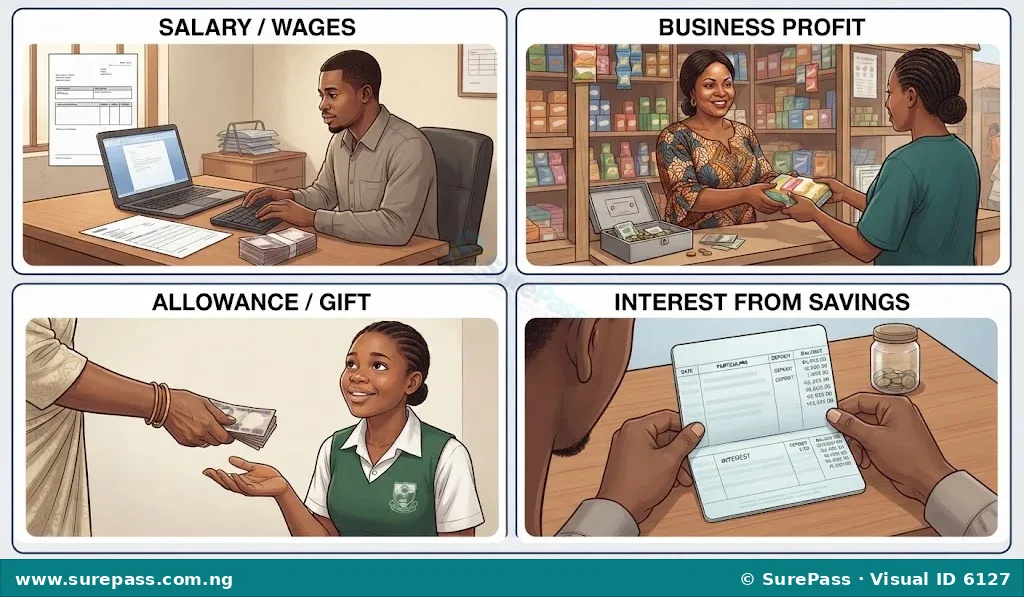
- Salaries and Wages: This is money earned from employment, typically paid weekly, bi-weekly, or monthly. Salaries are usually fixed amounts, while wages are often based on hours worked or tasks completed.
- Profits from Business: Individuals who own businesses earn income from the profits generated by their business activities after all expenses are paid.
- Allowances: This refers to money received regularly from parents, guardians, or other family members, often given to students or dependents for their personal needs.
- Gifts: Money received as a gift from family, friends, or other individuals, especially during special occasions.
- Interest from Savings: Money earned from keeping funds in a savings account or fixed deposit account in a bank. The bank pays a small percentage of the saved amount as interest.
- Rent from Property: Income earned from leasing out property, such as a house, apartment, or land, to tenants.
- Dividends from Shares: Money received as a share of a company’s profits by individuals who own shares (part-ownership) in that company.
- Royalties: Payments received by authors, musicians, or inventors for the use of their work or inventions.
Personal Budgeting
Personal budgeting is the process of creating a plan to spend and save money.
It involves estimating income and expenses over a specific period, usually a month, to ensure that spending does not exceed income and that enough money is set aside for savings and financial goals. A budget acts as a roadmap for financial decisions, helping individuals stay on track with their money.
Preparing a Simple Personal Budget
Preparing a budget helps individuals understand their financial situation and make informed decisions. A simple monthly budget can be prepared by following these steps:
- Calculate Total Monthly Income: Add up all sources of income expected for the month. This includes salaries, allowances, profits, and any other regular inflows.
- List All Monthly Expenses: Write down all anticipated expenses for the month. Categorise them into fixed expenses (those that stay the same, like rent or school fees) and variable expenses (those that change, like food or transportation).
- Subtract Expenses from Income: Deduct the total expenses from the total income.
- Allocate Funds for Savings: Before spending, set aside a portion of income for savings. This is often referred to as “paying yourself first.”
- Review and Adjust: At the end of the month, compare actual income and expenses with the budgeted amounts. Adjust the budget for the next month based on what was learned.
The following table shows an example of a simple monthly budget for a student receiving an allowance:
| Item | Amount (₦) | Category |
|---|---|---|
| Income | ||
| Monthly Allowance | 10,000 | Income |
| Expenses | ||
| Transportation | 2,000 | Variable |
| Food/Snacks | 3,500 | Variable |
| School Supplies | 1,000 | Variable |
| Airtime/Data | 1,500 | Variable |
| Entertainment | 500 | Variable |
| Savings | ||
| Savings Goal | 1,500 | Savings |
| Summary | ||
| Total Income | 10,000 | |
| Total Expenses + Savings | 10,000 | |
| Balance (Income – Expenses – Savings) | 0 | |
Setting a Personal Savings Goal
A personal savings goal is a specific amount of money an individual aims to save within a certain timeframe for a particular purpose.
Setting clear savings goals makes saving more purposeful and achievable. It provides motivation and a target to work towards.
How to Set and Track a Personal Savings Goal
To effectively set and track a personal savings goal, follow these steps:
- Define Your Goal: Clearly state what you are saving for. Examples include saving for a new textbook, a school trip, a gift for a family member, or an emergency fund.
- Determine the Amount Needed: Find out the exact cost of your goal. For example, if a textbook costs ₦5,000, that is your target amount.
- Set a Timeframe: Decide by when you want to achieve your goal. For instance, “I want to save ₦5,000 in one month.”
- Calculate Weekly/Monthly Savings: Divide the total amount needed by the number of weeks or months in your timeframe. For a ₦5,000 textbook in one month (4 weeks), you would need to save ₦1,250 per week.
- Integrate into Your Budget: Include your calculated savings amount as a line item in your personal budget. This ensures you allocate money for it regularly.
- Record Progress Weekly: Keep a simple record of how much you save each week. This can be in a notebook, a spreadsheet, or a dedicated savings tracker. Seeing your progress can be very motivating.
- Review and Adjust: Regularly check if you are on track. If you save less than planned one week, try to save more the next, or adjust your spending to meet your goal.
For example, if your goal is to save ₦6,000 in one month (4 weeks) for a new school bag, you would aim to save ₦1,500 each week. You would then record your actual savings weekly to see if you are meeting your target.



0 comments
Open the discussion when you need it. Comments stay collapsed until requested so the initial article remains light.