



ARTICLE CONTENTSOn this page 8 sections
Transportation
Performance Objectives
By the end of the lesson, students should be able to:
- explain the meaning and role of transportation in commerce;
- explain the modes of transportation and their advantages and disadvantages;
- identify the documents used in transportation in commerce;
- choose the best transportation mode and route for products;
- use technology in transportation management.
Meaning of Transportation
Transportation refers to the movement of goods, people, and animals from one place to another.
In commerce, transportation is essential for moving raw materials to factories, finished goods from factories to markets, and consumers to shopping areas. It bridges the geographical gap between producers and consumers, making goods available where they are needed.
Role of Transportation in Commerce
Transportation plays a vital role in facilitating commercial activities and economic development. Its importance can be seen in several ways:
- Facilitates Trade: Transportation enables the movement of goods from areas of production to areas of consumption, both within a country (local trade) and between countries (international trade). This makes a wider variety of goods available to consumers.
- Creates Place Utility: By moving goods to places where they are in demand, transportation adds value to products. For example, moving fresh fish from coastal areas to inland markets makes the fish more valuable to people who live far from the sea.
- Supports Production: Industries rely on transportation to bring in raw materials, components, and machinery from various sources. Without efficient transport, production processes would be severely hampered.
- Expands Markets: With effective transportation networks, businesses can reach customers in distant locations, expanding their market size and increasing sales opportunities.
- Reduces Costs: Efficient transportation can help reduce the overall cost of goods by allowing businesses to source materials from cheaper locations or distribute products more widely, benefiting from economies of scale.
- Promotes Specialisation: Regions can specialise in producing goods for which they have a comparative advantage, knowing that transportation will allow them to sell their surplus products elsewhere and import what they do not produce.
- Enhances Economic Growth: By facilitating trade, production, and market expansion, transportation contributes significantly to job creation, income generation, and overall economic growth.
Modes of Transportation in Commerce
The mode of transportation refers to the method or type of transport used to move goods or people. Each mode has unique characteristics, advantages, and disadvantages, making it suitable for different types of goods and distances.
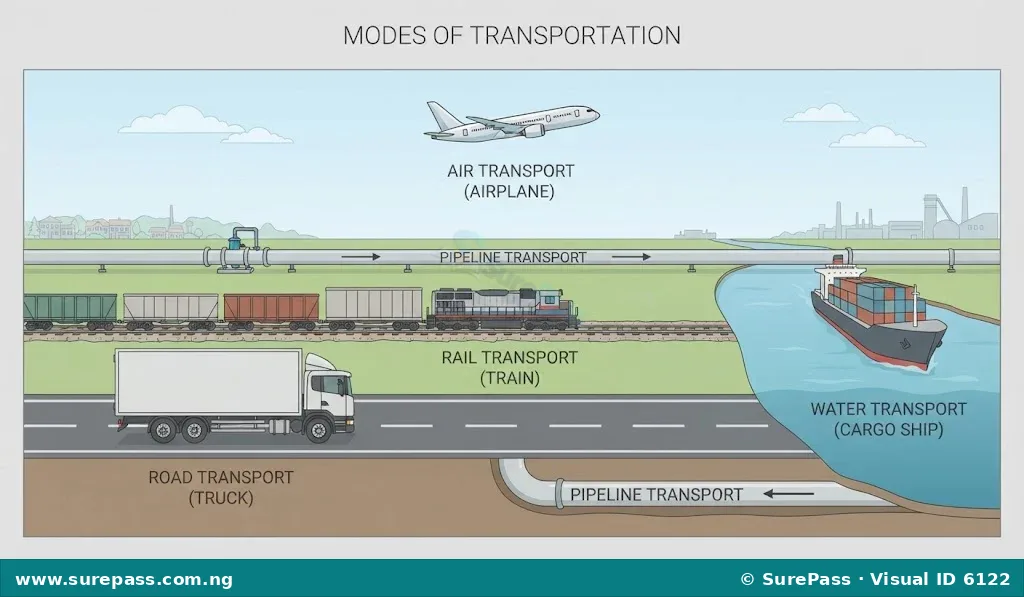
The main modes of transportation used in commerce are:
- Road Transportation
- Rail Transportation
- Water Transportation
- Air Transportation
- Pipeline Transportation
Road Transportation
Road transportation involves the use of vehicles like lorries, vans, and trucks to move goods over roads.
- Advantages:
- Flexibility: It offers door-to-door service, meaning goods can be picked up directly from the sender and delivered directly to the receiver without intermediate handling.
- Speed over Short Distances: For short to medium distances, road transport is often faster than other modes.
- Accessibility: Roads can reach almost any location, including remote areas not served by rail, air, or water.
- Less Handling: Direct delivery reduces the need for multiple loading and unloading, which can minimise damage to goods.
- Suitable for Perishable Goods: Refrigerated trucks can transport perishable items like fresh produce and dairy products quickly.
- Disadvantages:
- Limited Capacity: Trucks have a smaller carrying capacity compared to trains or ships, making it less economical for very large volumes.
- Higher Cost for Long Distances: Fuel costs and maintenance can make road transport expensive for very long hauls.
- Traffic Congestion: Roads can suffer from traffic jams, leading to delays.
- Accidents: Road transport is more prone to accidents compared to rail or air.
- Environmental Impact: Vehicles contribute to air pollution and noise.
Rail Transportation
Rail transportation uses trains to move goods and passengers along railway tracks.
- Advantages:
- High Carrying Capacity: Trains can transport very large volumes of goods, especially bulk commodities like coal, cement, and grains, over long distances.
- Cost-Effective for Bulk Goods: It is generally cheaper than road or air transport for moving heavy, bulky goods over long distances.
- Reliability: Train schedules are often more predictable and less affected by weather conditions or traffic congestion than road transport.
- Energy Efficient: Per tonne-kilometre, rail transport is often more fuel-efficient than road transport.
- Disadvantages:
- Lack of Flexibility: Rail transport does not offer door-to-door service. Goods need to be transported by road to and from railway stations.
- Limited Network: Railway lines do not cover all areas, restricting accessibility.
- Slower Speed: While efficient for bulk, trains are generally slower than air transport and sometimes slower than road transport for certain goods.
- High Initial Investment: Building and maintaining railway infrastructure is very expensive.
Water Transportation
Water transportation involves moving goods and people by ships, boats, and barges across oceans, seas, rivers, and canals.
- Advantages:
- Lowest Cost for Bulk Goods: It is the cheapest mode for transporting very heavy and bulky goods over long international distances.
- High Carrying Capacity: Ships can carry enormous quantities of cargo, making it ideal for international trade.
- Suitable for Heavy and Bulky Goods: Raw materials like crude oil, iron ore, and agricultural products are commonly transported by water.
- Less Congestion: Waterways are generally less congested than roads or railways.
- Disadvantages:
- Very Slow Speed: Water transport is the slowest mode, making it unsuitable for perishable goods or urgent deliveries.
- Lack of Flexibility: It is restricted to waterways and ports, requiring other modes for inland distribution.
- Weather Dependent: Shipping can be affected by adverse weather conditions like storms and fog.
- High Risk of Damage/Loss: Goods are exposed to risks like piracy, sinking, or damage during long voyages.
- High Capital Investment: Building and maintaining ports and ships requires significant investment.
Air Transportation
Air transportation uses aircraft like cargo planes to move goods and people through the air.
- Advantages:
- Fastest Mode: Air transport is the quickest way to move goods over long distances, especially internationally.
- Suitable for Perishable and High-Value Goods: Ideal for items that need to reach their destination quickly, such as fresh flowers, pharmaceuticals, electronics, and urgent documents.
- High Security: Goods are generally handled with greater care and security, reducing the risk of theft or damage.
- Global Reach: Air cargo can reach almost any part of the world with an airport.
- Disadvantages:
- Highest Cost: Air freight is the most expensive mode of transportation.
- Limited Carrying Capacity: Aircraft have limited space and weight capacity compared to ships or trains.
- Weather Dependent: Flights can be delayed or cancelled due to bad weather conditions.
- Lack of Flexibility: Requires additional transport (usually road) to move goods to and from airports.
- Environmental Impact: High fuel consumption and emissions.
Pipeline Transportation
Pipeline transportation involves moving liquids (like crude oil, refined petroleum products, water) and gases (like natural gas) through a system of pipes.
- Advantages:
- Continuous Flow: Provides a constant and uninterrupted flow of products.
- Low Operating Cost: Once installed, pipelines have very low operating and maintenance costs.
- Safe and Secure: Less prone to theft, leakage, or environmental damage compared to other modes for liquids and gases.
- Unaffected by Weather: Pipelines are largely unaffected by adverse weather conditions.
- Environmentally Friendly: Reduces the need for road or rail transport of hazardous liquids and gases.
- Disadvantages:
- High Initial Investment: Construction of pipelines is extremely expensive.
- Limited Product Range: Can only transport liquids and gases.
- Lack of Flexibility: The route is fixed, and it cannot be easily changed or adapted.
- Difficult to Repair: Repairs can be complex and costly, especially for underground or underwater pipelines.
Documents Used in Transportation
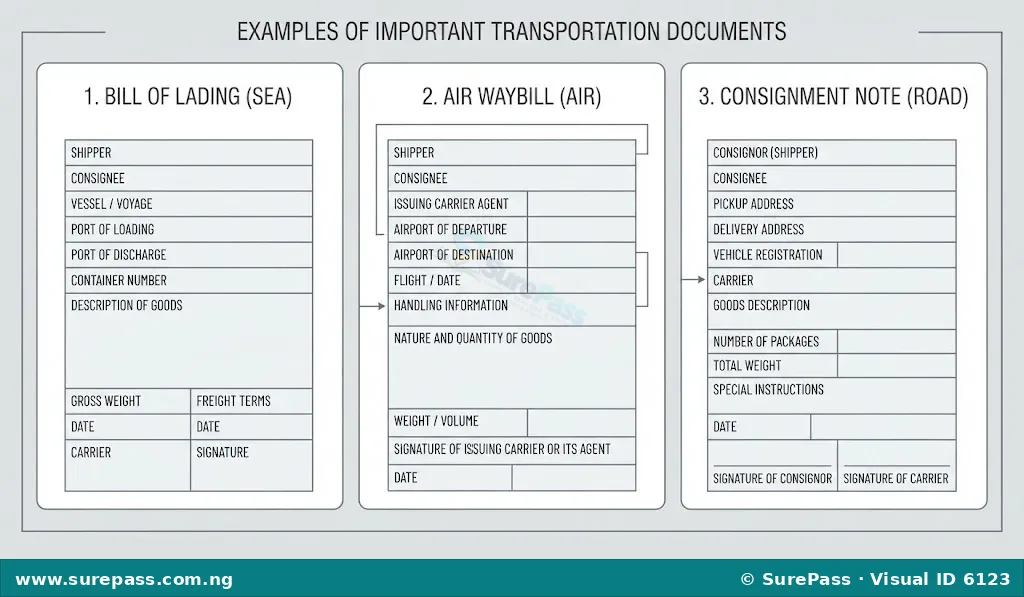
Various documents are used in transportation to ensure the smooth, legal, and accountable movement of goods. These documents serve different purposes, such as proof of ownership, contract of carriage, customs declaration, and delivery instructions.
Common documents used in transportation include:
- Bill of Lading: This is a legal document issued by a carrier (e.g., shipping company) to a shipper. It serves as:
- A contract between the shipper and the carrier for the transportation of goods.
- A receipt for the goods, acknowledging that the goods have been received in good condition.
- A document of title, meaning the holder of the bill of lading has ownership of the goods.
- Air Waybill: Similar to a bill of lading but used for air cargo. It is a non-negotiable document that serves as a contract of carriage and a receipt for goods. It does not act as a document of title.
- Consignment Note: Used primarily for road and rail transportation. It is a document prepared by the consignor (sender) and signed by the carrier, acknowledging receipt of goods for transport. It contains details about the goods, sender, receiver, and destination.
- Manifest: A document containing a detailed list of all cargo on a ship, aircraft, or train. It includes information about each consignment, such as description, quantity, weight, and consignee. It is used for customs clearance and internal tracking.
- Customs Declaration Form: A document required by customs authorities when goods are imported or exported. It provides details about the goods, their value, origin, and destination, allowing customs to assess duties and ensure compliance with regulations.
- Delivery Note: A document that accompanies a shipment of goods and lists the items included in the delivery. The recipient signs it to confirm receipt of the goods. It does not usually show prices.
- Packing List: A document that provides details about the contents of each package or container within a shipment. It includes information such as the quantity, description, and weight of items, helping with customs inspection and inventory management.
- Insurance Certificate: A document issued by an insurance company confirming that a shipment of goods is insured against loss or damage during transit. This is crucial for protecting the financial interests of the shipper or consignee.
Choosing the Best Transportation Mode and Route for Products
Selecting the most appropriate mode of transportation and route is a critical decision for businesses, as it impacts costs, delivery time, product safety, and customer satisfaction. The choice depends on several factors:
Factors Influencing Mode Selection:
- Nature of the Product:
- Perishable Goods: Items like fresh food, flowers, and pharmaceuticals require fast transport (air or refrigerated road transport).
- High-Value Goods: Electronics, jewellery, or sensitive equipment often need secure and fast transport (air or secure road transport).
- Bulky/Heavy Goods: Raw materials like coal, cement, or timber are best transported by rail or water due to their high carrying capacity and lower cost.
- Hazardous Materials: Specialised carriers and routes are required, often with pipeline for liquids/gases, or dedicated road/rail for others.
- Cost: Businesses aim to minimise transport costs while meeting delivery requirements. Air transport is the most expensive, followed by road, rail, and then water/pipeline (cheapest for bulk).
- Speed/Urgency: If goods need to reach their destination quickly (e.g., urgent spare parts, fashion items), air transport is preferred. For less urgent items, slower but cheaper modes can be used.
- Distance:
- Short Distances: Road transport is often the most efficient and flexible.
- Medium to Long Distances (within a country): Rail or road can be suitable, depending on the goods.
- Very Long/International Distances: Water (for bulk) or air (for speed/value) are typically used.
- Accessibility: The ability of a mode to reach the origin and destination directly. Road transport offers the highest accessibility (door-to-door), while other modes require intermodal transfers.
- Reliability and Safety: The consistency of delivery times and the risk of damage or loss. Air and rail are generally more reliable in terms of schedule, while water transport can be affected by weather. Security measures vary by mode.
- Volume and Quantity: For large volumes of bulk goods, rail and water transport are most economical. For smaller, frequent shipments, road transport is often preferred.
Choosing the Best Route:
Once a mode is chosen, the route must be determined. Route selection considers:
- Distance: Shorter routes generally mean lower costs and faster delivery.
- Road Conditions: For road transport, the quality of roads, potential for traffic congestion, and safety of the route are important.
- Availability of Infrastructure: Access to ports, railway stations, or airports along the route.
- Security: Avoiding routes known for high crime rates or political instability.
- Cost of Tolls/Fees: Some routes may involve tolls, bridge fees, or other charges that add to the overall cost.
- Regulatory Restrictions: Certain routes might have restrictions on vehicle size, weight, or types of goods.
Using Technology in Transportation Management
Technology has revolutionised transportation management, making it more efficient, cost-effective, and transparent. Businesses now use various tools to optimise their logistics operations.
Global Positioning System (GPS)
GPS is a satellite-based navigation system that provides location and time information anywhere on Earth where there is an unobstructed line of sight to four or more GPS satellites.
- How it is used in transportation:
- Vehicle Tracking: GPS devices installed in vehicles allow businesses to monitor the real-time location of their fleet. This helps in knowing where goods are at any given moment.
- Route Navigation: Drivers use GPS devices or smartphone apps to get turn-by-turn directions, find the fastest routes, and avoid traffic congestion.
- Estimated Time of Arrival (ETA): GPS data helps in calculating accurate ETAs for deliveries, which can be communicated to customers.
- Security: In case of vehicle theft, GPS tracking can help locate and recover the vehicle and its cargo.
- Optimising Fuel Consumption: By guiding drivers to efficient routes and monitoring driving behaviour, GPS can help reduce fuel usage.
Route Optimisation Software
Route optimisation software uses algorithms to calculate the most efficient routes for multiple stops, considering factors like traffic, delivery windows, vehicle capacity, and driver availability.
- How it is used in transportation management:
- Efficient Route Planning: The software plans the best sequence of stops for multiple deliveries or pickups, minimising distance travelled and time spent on the road.
- Cost Reduction: By optimising routes, businesses can reduce fuel consumption, vehicle wear and tear, and driver labour costs.
- Improved Delivery Times: Efficient routes lead to faster deliveries and better adherence to delivery schedules.
- Increased Customer Satisfaction: Reliable and timely deliveries enhance customer experience.
- Resource Allocation: Helps in assigning the right vehicle and driver to specific routes based on capacity and skill.
- Real-time Adjustments: Some advanced software can make real-time adjustments to routes in response to unexpected events like traffic accidents or new orders.



0 comments
Open the discussion when you need it. Comments stay collapsed until requested so the initial article remains light.