


ARTICLE CONTENTSOn this page 5 sections
Business Documents
Performance Objectives
By the end of the lesson, students should be able to:
- explain the meaning of business document;
- identify the documents used in commerce;
- describe the features and uses of business documents;
- prepare business documents for different commercial transactions.
Meaning of Business Documents
A business document is any written or electronic record that provides information about a business transaction or activity.
These documents are essential for the smooth operation of any business, whether small or large. They serve as proof of transactions, aid communication, help in record-keeping, and ensure that all parties involved understand the terms of an agreement.
Types of Business Documents in Commerce
Many different types of documents are used in commerce to facilitate various transactions and communications. These documents help businesses keep track of their activities, manage finances, and maintain clear relationships with customers and suppliers. Some common types include:
Letters and Emails
Letters and emails are fundamental tools for communication in business. They are used to convey information, make inquiries, place orders, send confirmations, resolve issues, and build relationships with customers, suppliers, and other stakeholders.
Features:
- Sender and Recipient Information: Clearly state who is sending and receiving the communication.
- Date: Indicates when the communication was sent.
- Subject Line (for emails): A brief summary of the email’s content.
- Salutation and Closing: Formal greetings and farewells.
- Body: The main message or content of the communication.
- Signature: The sender’s name and designation.
Uses:
- Making inquiries about products or services.
- Placing or confirming orders.
- Sending quotations or proposals.
- Notifying customers about changes or updates.
- Resolving complaints or issues.
- Formal communication for legal or contractual matters.
Invoice (and E-Invoice)
An invoice is a commercial document issued by a seller to a buyer, indicating the products, quantities, and agreed prices for products or services the seller has provided to the buyer.
It serves as a request for payment and a record of the sale. An e-invoice is simply an electronic version of a traditional invoice, sent and received digitally.
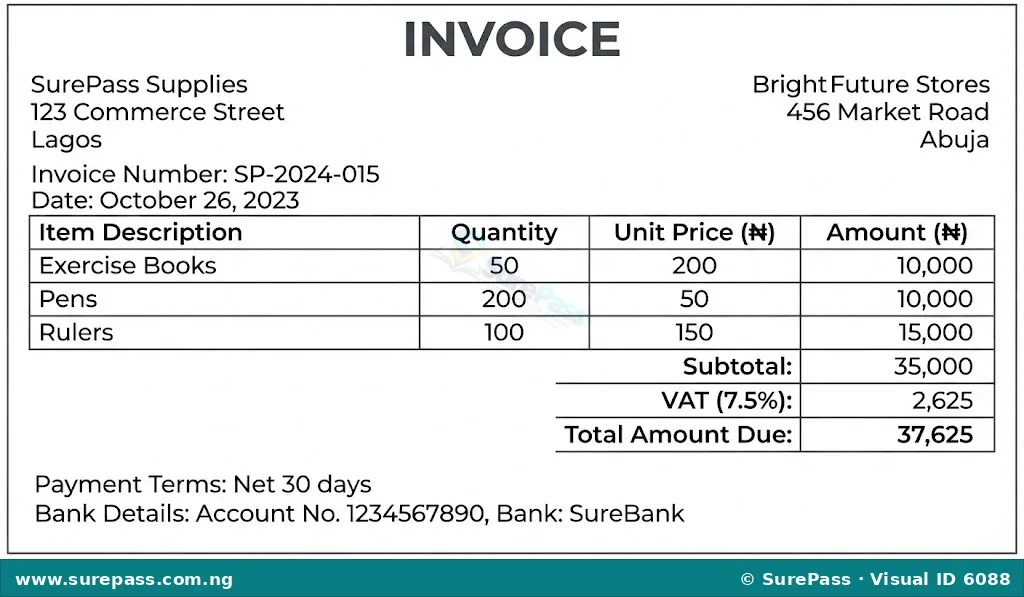
Features:
- Invoice Number: A unique identification number for the invoice.
- Date of Issue: The date the invoice was created.
- Seller’s Details: Name, address, and contact information of the business issuing the invoice.
- Buyer’s Details: Name, address, and contact information of the customer.
- Description of Goods/Services: A clear list of items sold or services rendered.
- Quantity: The number of each item.
- Unit Price: The price of a single unit of each item.
- Total Amount for Each Item: Quantity multiplied by unit price.
- Subtotal: The sum of all item totals before taxes.
- Taxes (e.g., VAT): Any applicable taxes.
- Total Amount Due: The final amount the buyer needs to pay.
- Payment Terms: Conditions for payment, such as due date, accepted payment methods, and credit period.
Uses:
- Requesting payment from a customer.
- Providing a detailed record of a sale for both seller and buyer.
- Tracking sales and revenue for accounting purposes.
- Serving as legal proof of a transaction.
- Facilitating inventory management.
Electronic Purchase Order (EPO)
A purchase order (PO) is a commercial document issued by a buyer to a seller, indicating types, quantities, and agreed prices for products or services the buyer wishes to purchase.
It serves as an official confirmation of an order. An Electronic Purchase Order (EPO) is a purchase order created and transmitted digitally, often through an online system.
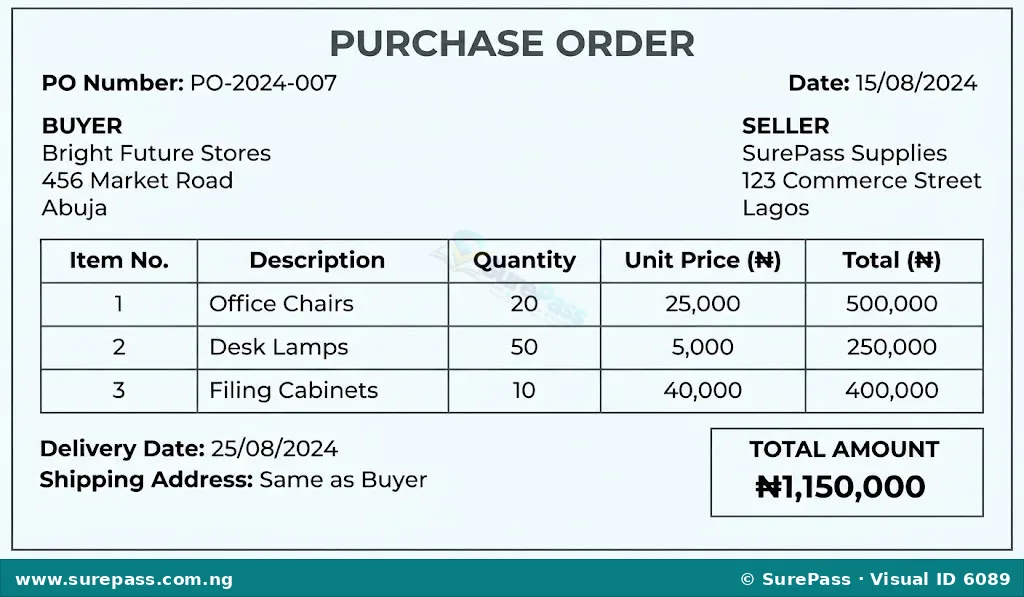
Features:
- Purchase Order Number: A unique identification number for the order.
- Date of Issue: The date the purchase order was created.
- Buyer’s Details: Name, address, and contact information of the business placing the order.
- Seller’s Details: Name, address, and contact information of the supplier.
- Description of Goods/Services: A clear list of items or services being ordered.
- Quantity: The number of each item requested.
- Unit Price: The agreed price of a single unit of each item.
- Total Amount: The sum of all item totals.
- Delivery Date: The requested date for delivery.
- Shipping Address: Where the goods should be delivered.
- Payment Terms: Agreed conditions for payment.
Uses:
- Authorising a purchase from a supplier.
- Providing a clear record of what was ordered, by whom, and at what price.
- Helping to manage inventory and budget.
- Serving as a legal document that binds the buyer to purchase and the seller to supply.
- Preventing duplicate orders.
Receipt
A receipt is a written or electronic acknowledgment that a specified article or sum of money has been received.
It serves as proof of payment for goods or services. Receipts are crucial for both buyers and sellers for record-keeping and financial reconciliation.
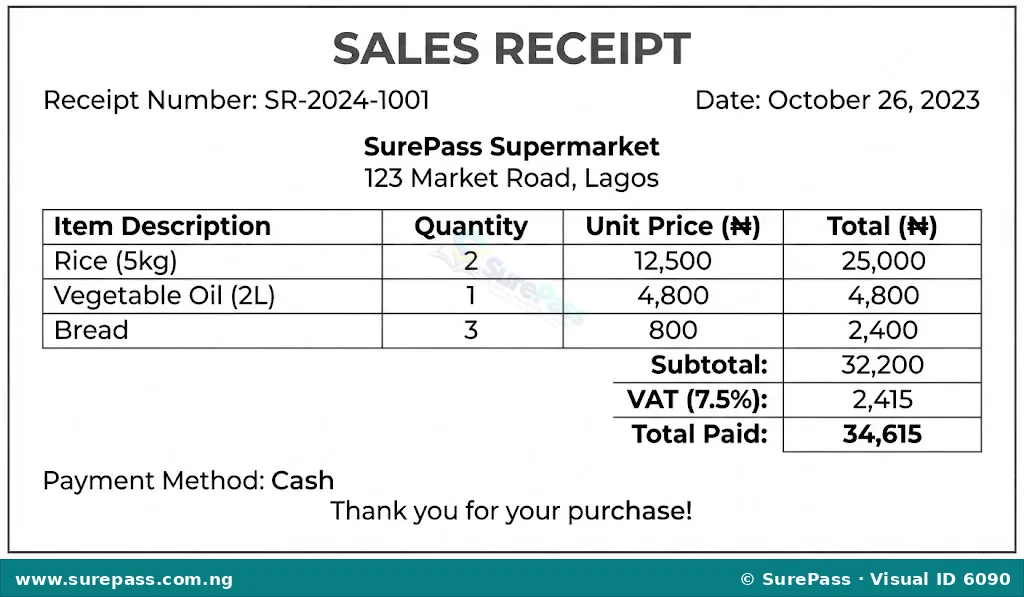
Features:
- Receipt Number: A unique identification number.
- Date of Transaction: The date the payment was received.
- Seller’s Details: Name and address of the business issuing the receipt.
- Buyer’s Details (optional for retail): Name of the customer, especially for larger transactions.
- Description of Goods/Services: What was purchased or for what service payment was made.
- Amount Paid: The total sum of money received.
- Payment Method: How the payment was made (e.g., cash, card, bank transfer).
- Signature/Stamp: An authorisation from the seller.
Uses:
- Providing proof to the buyer that payment has been made.
- Serving as a record of income for the seller.
- Facilitating returns or exchanges for the buyer.
- Used for expense tracking and tax purposes by both parties.
- Resolving disputes over payments.
Trade Terms and Abbreviations
Trade terms are the specific conditions and agreements between a buyer and a seller regarding a commercial transaction.
These terms clarify responsibilities, costs, and risks associated with the sale and delivery of goods. Abbreviations are often used to shorten these terms on documents.
Features:
- Clarity: They clearly define aspects of the transaction.
- Standardisation: Many are internationally recognised.
- Conciseness: Abbreviations save space on documents.
Uses:
- Specifying when payment is due (e.g., “Net 30” means payment due in 30 days).
- Indicating who pays for shipping and insurance.
- Defining the point at which ownership and risk of goods transfer from seller to buyer.
- Common abbreviations include:
- C.O.D. (Cash on Delivery): Payment is made when the goods are delivered.
- E. & O.E. (Errors and Omissions Excepted): A clause stating that the document may contain errors or omissions that can be corrected later.
- F.O.B. (Free On Board): Indicates that the seller pays for transportation of the goods to the port of shipment, plus loading costs. The buyer pays the cost of marine freight, insurance, unloading, and transportation from the arrival port to the final destination.
- C.I.F. (Cost, Insurance, and Freight): The seller pays for the cost of goods, insurance, and freight to the buyer’s port of destination.
Terms of Trade
In the context of a specific business transaction, “terms of trade” refers to the detailed conditions under which a sale is made, including payment terms, delivery terms, and any credit arrangements.
These terms are crucial for defining the obligations of both the buyer and the seller.
Features:
- Payment Terms: Specifies when and how payment should be made (e.g., “30 days credit,” “payment in advance”).
- Delivery Terms: Details how and when goods will be delivered (e.g., “delivery within 7 days,” “customer collects”).
- Credit Period: The length of time allowed for payment after delivery.
- Discounts: Any trade or cash discounts offered.
Uses:
- Establishing clear expectations for both parties in a transaction.
- Preventing misunderstandings and disputes.
- Influencing pricing and profitability.
- Forming part of the legal agreement between buyer and seller.
Means of Payment
Means of payment are the methods or instruments used by a buyer to settle a financial obligation to a seller.
These methods facilitate the transfer of money and are often recorded on business documents like receipts or invoices.
Features:
- Security: Some methods offer more security than others.
- Convenience: Ease of use for both payer and payee.
- Traceability: Ability to track the payment.
Uses:
- Cash: Physical currency used for immediate payment, common for small transactions.
- Cheque: A written order to a bank to pay a stated sum of money from the drawer’s account to the payee.
- Bank Transfer (Electronic Funds Transfer – EFT): Direct transfer of money from one bank account to another.
- Debit/Credit Card: Plastic cards used to make payments electronically, either directly from a bank account (debit) or using borrowed funds (credit).
- Mobile Money: Payments made using a mobile phone, often through a mobile money agent or app.
Digital Contracts
A digital contract is an agreement between two or more parties that is created, executed, and stored in an electronic format.
These contracts are legally binding and are increasingly used in modern business due to their efficiency and convenience.
Features:
- Electronic Signatures: Digital representations of a person’s signature, legally binding in many jurisdictions.
- Digital Format: Stored as electronic files (e.g., PDF, Word document).
- Security: Often secured with encryption and blockchain technology to prevent tampering.
- Accessibility: Can be accessed and managed from anywhere with an internet connection.
Uses:
- Formalising agreements between businesses and customers (e.g., service agreements, terms of service).
- Contracting with suppliers and partners.
- Employment contracts.
- Ensuring legal compliance and record-keeping in a digital environment.
- Speeding up the contracting process.
Preparing Business Documents for Commercial Transactions
The ability to prepare accurate business documents is a vital skill in commerce. This involves understanding the purpose of each document and ensuring all necessary information is included. Below are guidelines for preparing common business documents.
Preparing an Invoice
An invoice is prepared by the seller to request payment from the buyer after goods or services have been provided. The procedure involves the following steps:
- Header: Start with “INVOICE” clearly at the top.
- Seller’s Information: Include your business name, address, phone number, and email.
- Invoice Number and Date: Assign a unique invoice number and state the current date.
- Buyer’s Information: Include the customer’s business name, address, and contact person.
- Itemised List: Create a table with columns for:
- Item Description (e.g., “50kg Bag of Rice,” “Consultancy Service”).
- Quantity.
- Unit Price (per item or hour).
- Amount (Quantity x Unit Price).
- Subtotal: Sum up the “Amount” column.
- Taxes: Calculate and add any applicable taxes (e.g., VAT).
- Total Amount Due: Add the subtotal and taxes to get the final amount.
- Payment Terms: Clearly state when payment is due (e.g., “Payment due in 30 days,” “Due on receipt”).
- Bank Details: Provide your bank name, account number, and account name for electronic transfers.
- Optional: Add a “Thank You” message or notes.
Preparing a Purchase Order (PO)
A purchase order is prepared by the buyer to formally request goods or services from a supplier. The procedure involves the following steps:
- Header: Start with “PURCHASE ORDER” clearly at the top.
- Buyer’s Information: Include your business name, address, phone number, and email.
- Purchase Order Number and Date: Assign a unique PO number and state the current date.
- Supplier’s Information: Include the supplier’s business name, address, and contact person.
- Itemised List: Create a table with columns for:
- Item Number (if applicable).
- Description of Goods/Services.
- Quantity.
- Unit Price (agreed price per item).
- Total (Quantity x Unit Price).
- Delivery Details: Specify the requested delivery date and the shipping address.
- Payment Terms: State the agreed payment terms with the supplier.
- Total Amount: Sum up the “Total” column to show the overall cost.
- Authorisation: Include a space for an authorised signature from your company.
Preparing a Receipt
A receipt is prepared by the seller to acknowledge that payment has been received from the buyer. The procedure involves the following steps:
- Header: Start with “RECEIPT” clearly at the top.
- Seller’s Information: Include your business name, address, and contact details.
- Receipt Number and Date: Assign a unique receipt number and state the current date.
- Payer’s Name: State the name of the person or business from whom payment was received.
- Amount Received: Clearly state the total amount of money received, both in figures and words (e.g., “₦5,000.00 (Five Thousand Naira Only)”).
- For What: Briefly describe the goods or services for which payment was made.
- Payment Method: Indicate how the payment was made (e.g., “Cash,” “Bank Transfer,” “Debit Card”).
- Signature: Include a signature of the person who received the payment on behalf of the business.
- Optional: Add a “Thank You” message.


0 comments
Open the discussion when you need it. Comments stay collapsed until requested so the initial article remains light.