


ARTICLE CONTENTSOn this page 8 sections
Introduction to Commerce
Performance Objectives
By the end of the lesson, students should be able to:
- state the meaning of commerce;
- identify key terminologies in commerce;
- describe the scope of commerce;
- discuss the role of commerce in promoting economic development in Nigeria;
- Trace the origin and development of commerce in Nigeria;
- discuss the major factors influencing the growth of commerce in Nigeria.
Meaning of Commerce
Commerce refers to all the activities involved in the buying and selling of goods and services, and all the activities that facilitate these exchanges.
It is the branch of business that deals with the exchange of goods and services from the producers to the final consumers. Commerce ensures that goods produced in one location can reach consumers in another location, overcoming barriers of place, time, finance, knowledge, and risk.
Key Terminologies in Commerce
Understanding commerce requires familiarity with several key terms. These terms describe the various elements and processes involved in commercial activities:
- Trade: Trade is the buying and selling of goods and services. It is the core activity of commerce. Trade can be local, national, or international.
- Aids to Trade: These are all the activities and services that support and facilitate trade. They help to remove the various barriers that can hinder the smooth flow of goods and services from producers to consumers.
- Production: Production is the process of creating goods and services that satisfy human wants. It is the starting point before any commercial activity can take place.
- Exchange: Exchange is the act of giving one thing and receiving another in return. In commerce, it typically involves the exchange of goods or services for money or other goods/services.
- Producer: A producer is an individual or organisation that creates goods or provides services.
- Consumer: A consumer is an individual or organisation that uses goods and services to satisfy their needs and wants.
- Market: A market is any place or system where buyers and sellers meet to exchange goods and services. It can be a physical location or an online platform.
Scope of Commerce
The scope of commerce is broad, covering all activities that facilitate the movement of goods and services from the point of production to the point of consumption. It is generally divided into two main parts:
- Trade: This is the direct buying and selling of goods and services. Trade can be further categorised into:
- Home Trade (Internal Trade): This involves the exchange of goods and services within the borders of a single country. It includes:
- Wholesale Trade: Buying goods in large quantities from producers and selling them in smaller quantities to retailers.
- Retail Trade: Buying goods from wholesalers and selling them directly to the final consumers.
- Foreign Trade (External Trade): This involves the exchange of goods and services between different countries. It includes:
- Import Trade: Buying goods and services from another country.
- Export Trade: Selling goods and services to another country.
- Entrepot Trade: Importing goods from one country and re-exporting them to another country without significant processing.
- Home Trade (Internal Trade): This involves the exchange of goods and services within the borders of a single country. It includes:
- Aids to Trade (Commercial Services): These are the essential services that support and make trade possible. They help to overcome various obstacles in the process of exchange. The main aids to trade include:
- Transportation: This involves moving goods from the place of production to the place of consumption, overcoming the barrier of distance. Examples include road, rail, air, and water transport.
- Communication: This facilitates the exchange of information between buyers, sellers, and other commercial parties, overcoming the barrier of information. Examples include postal services, telephone, internet, and courier services.
- Banking: This provides financial services such as payments, loans, and safekeeping of money, overcoming the barrier of finance.
- Insurance: This protects businesses and individuals against various risks such as loss, damage, or theft of goods, overcoming the barrier of risk.
- Warehousing: This involves storing goods until they are needed by consumers, overcoming the barrier of time.
- Advertising: This informs potential buyers about available goods and services, overcoming the barrier of knowledge and promoting sales.
Role of Commerce in Promoting Economic Development in Nigeria
Commerce plays a vital role in the economic development of Nigeria by facilitating the flow of goods, services, and capital. Its contributions are numerous and impact various sectors of the economy:
- Facilitates Exchange of Goods and Services: Commerce ensures that goods produced in one part of Nigeria can reach consumers in other parts, and even in other countries. This efficient distribution system prevents waste and ensures that consumer needs are met.
- Creates Employment Opportunities: The various activities within commerce, such as trading, transportation, banking, and advertising, create a wide range of jobs for many Nigerians. This includes traders, drivers, bankers, marketers, and many others.
- Generates Revenue for Government: Through taxes on commercial activities, such as Value Added Tax (VAT), customs duties on imports and exports, and company income tax, commerce contributes significantly to government revenue. This revenue is then used to fund public services and infrastructure projects.
- Encourages Specialisation and Mass Production: By providing a wider market for goods, commerce encourages producers to specialise in specific products and produce them in larger quantities (mass production). This leads to economies of scale and lower production costs.
- Improves Standard of Living: By making a variety of goods and services available at competitive prices, commerce improves the choices and purchasing power of consumers, thereby enhancing their standard of living.
- Promotes Industrial Growth: Commerce creates demand for industrial products and also supplies raw materials to industries. This symbiotic relationship fosters the growth of the manufacturing sector.
- Facilitates International Trade: Through import and export activities, commerce enables Nigeria to earn foreign exchange from its exports and acquire essential goods and technology from other countries, which are crucial for national development.
- Develops Infrastructure: The need to support commercial activities often drives the development of infrastructure such as roads, railways, seaports, airports, communication networks, and banking facilities.
History of Commerce in Nigeria
The history of commerce in Nigeria can be traced through different periods, each marked by distinct trading practices and influences.
Pre-Colonial Era
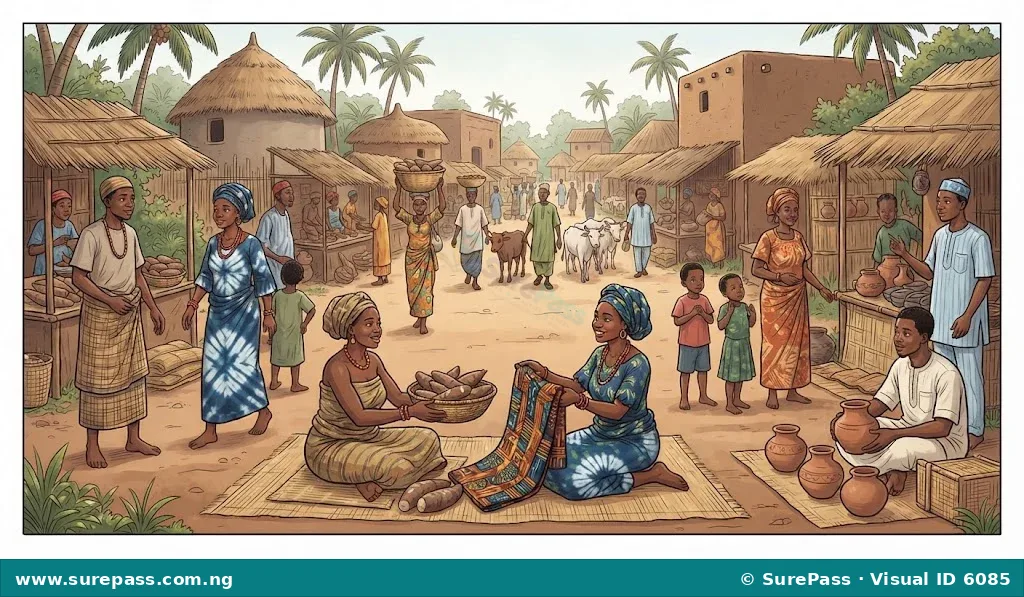
Before the arrival of European colonialists, commerce in Nigeria was well-established and diverse. The primary form of exchange was barter, where goods were directly exchanged for other goods without the use of money. Local markets were central to economic life, serving as hubs for the exchange of agricultural produce, crafts, and livestock. Long-distance trade routes also existed, such as the Trans-Saharan trade, which connected various Nigerian communities with North Africa and the Middle East, exchanging goods like kola nuts, gold, salt, and textiles. Coastal trade also flourished, with communities exchanging goods along the Atlantic coast.
Colonial Era
The advent of colonialism brought significant changes to Nigerian commerce. The British introduced a monetary system, replacing barter with currency-based transactions. European trading companies, such as the Royal Niger Company, gained prominence, establishing trading posts and controlling much of the external trade. The focus shifted towards exporting raw materials (like palm oil, groundnuts, cocoa, and rubber) to Britain and importing manufactured goods. This period saw the development of modern infrastructure like railways and seaports, primarily to facilitate the movement of raw materials for export.
Post-Colonial Era
After Nigeria gained independence, commerce continued to evolve. The government took a more active role in regulating trade and promoting local industries. The discovery of crude oil led to a significant shift in the economy, with oil becoming the dominant export commodity. This era has seen the growth of modern commercial practices, including the expansion of banking, insurance, and communication services. Globalisation and technological advancements, especially the internet, have further transformed commerce, leading to the rise of e-commerce and increased international trade. Despite these advancements, challenges such as inadequate infrastructure and security issues continue to influence commercial activities.
Factors Affecting the Growth of Commerce in Nigeria
Several factors influence the growth and development of commerce in Nigeria. These factors can either promote or hinder commercial progress:
- Government Policies: Favourable government policies, such as stable trade policies, tax incentives, and support for small and medium-sized enterprises (SMEs), can encourage commercial growth. Conversely, inconsistent or unfavourable policies can stifle it.
- Infrastructure Development: Adequate infrastructure, including good road networks, reliable electricity supply, efficient seaports and airports, and robust communication systems, is crucial for the smooth flow of goods and services. Poor infrastructure increases costs and delays.
- Security: A secure environment is essential for commercial activities. Insecurity, such as banditry, kidnapping, and civil unrest, disrupts supply chains, discourages investment, and makes it difficult for businesses to operate effectively.
- Access to Finance: The availability of affordable credit and financial services from banks and other financial institutions enables businesses to start, expand, and manage their operations. Limited access to finance, especially for SMEs, can hinder growth.
- Technology Adoption: The use of modern technology, such as e-commerce platforms, digital payment systems, and advanced logistics software, can significantly improve efficiency, reach wider markets, and reduce operational costs.
- Education and Skilled Labour: A well-educated and skilled workforce is necessary for managing complex commercial operations, adopting new technologies, and providing quality services. Lack of skilled labour can limit commercial expansion.
- Market Size and Population Growth: Nigeria’s large and growing population provides a substantial domestic market for goods and services, which is a strong driver for commercial growth.
- Economic Stability: A stable economic environment, characterised by low inflation, stable exchange rates, and predictable economic policies, creates confidence for investors and encourages commercial activities.



0 comments
Open the discussion when you need it. Comments stay collapsed until requested so the initial article remains light.