



ARTICLE CONTENTSOn this page 8 sections
Trafficking in Persons (TIP)
Performance Objectives
By the end of the lesson, students should be able to:
- explain the meaning of human trafficking;
- discuss the elements of TIP;
- explain the causes of human trafficking;
- discuss the purpose of trafficking in persons.
Meaning of Human Trafficking
Human trafficking, also known as Trafficking in Persons (TIP), is the recruitment, transportation, transfer, harbouring, or receipt of people through force, fraud, deception, or coercion for the purpose of exploitation.
This modern form of slavery deprives victims of their basic human rights, freedom, and dignity. Traffickers often target vulnerable individuals, promising them lucrative jobs, quality education, or better living conditions, only to subject them to forced labour, sexual abuse, or other forms of servitude. In Nigeria, the National Agency for the Prohibition of Trafficking in Persons (NAPTIP) is the primary government body established to combat this crime, rescue victims, and prosecute offenders.
Elements of Trafficking in Persons (TIP)
According to the United Nations Palermo Protocol, human trafficking consists of three essential elements. For an action to be legally classified as trafficking in persons, these three elements must be present. The three elements are:
- The Act (What is done): This refers to the physical actions taken by the trafficker. It includes the recruitment, transportation, transferring, harbouring, or receipt of a person.
- The Means (How it is done): This refers to the methods used by the trafficker to control the victim. It includes the threat or use of force, coercion, abduction, fraud, deception, abuse of power, or taking advantage of a person’s vulnerability.
- The Purpose (Why it is done): This refers to the ultimate goal of the trafficker, which is always exploitation. Examples include forced labour, sexual exploitation, slavery, domestic servitude, or the removal of organs.
The table below illustrates how these three elements interact to constitute the crime of human trafficking:
| The Act (What is done) | The Means (How it is done) | The Purpose (Why it is done) |
|---|---|---|
| Recruiting | Force or threat of force | Prostitution or sexual exploitation |
| Transporting | Coercion or abduction | Forced labour or services |
| Harbouring | Deception or fraud | Slavery or practices similar to slavery |
| Receiving | Abuse of power or vulnerability | Removal of organs |
Observe the diagram below to understand the relationship between these three elements.
Causes of Human Trafficking
The causes of human trafficking are generally classified into push factors and pull factors. Push factors are the negative conditions in the home environment that compel or drive individuals to leave. Pull factors are the attractive conditions in destination areas that draw or entice individuals toward them.
Push Factors of Human Trafficking
Push factors represent the domestic pressures that make individuals vulnerable to traffickers. The main push factors include:
- Poverty: Severe financial hardship makes individuals desperate for survival. Families living in extreme poverty may easily fall victim to traffickers who promise financial relief or employment opportunities for their children.
- Unemployment: The lack of viable job opportunities, especially for young school leavers and graduates, creates a large pool of vulnerable citizens. Traffickers exploit this desperation by offering fake employment opportunities in urban centres or foreign countries.
- Ignorance: A lack of awareness about the dangers of human trafficking and the deceptive methods used by traffickers makes individuals easy targets. Many victims and their parents genuinely believe the false promises of traffickers due to a lack of information.
Pull Factors of Human Trafficking
Pull factors represent the external attractions that make destination areas highly appealing to vulnerable individuals. The main pull factors include:
- Search for Greener Pastures: The desire to escape difficult local conditions in search of wealth, high-paying jobs, and a luxurious lifestyle abroad acts as a powerful pull factor. Traffickers exploit this desire by painting false pictures of easy success in destination cities or countries.
- Economic and Political Stability: Destination countries or cities with stable economies, strong currencies, peace, and security naturally attract individuals from unstable regions. Victims are drawn to these areas in search of safety, better infrastructure, and reliable income.
Purpose of Trafficking in Persons
Traffickers engage in the trade of human beings solely for exploitation and financial gain. The primary purposes of human trafficking include:
- Forced Labour: Victims are forced to work long hours under harsh conditions in agricultural plantations, construction sites, mines, or factories with little or no pay.
- Sexual Exploitation: Many victims, particularly women and young girls, are trafficked into prostitution, pornography, and other forms of sexual abuse.
- Domestic Servitude: Victims are employed as house helps, maids, or nannies, where they are subjected to physical abuse, isolation, and unpaid labour.
- Organ Harvesting: In extreme cases, victims are trafficked so that their vital organs, such as kidneys, can be illegally harvested and sold on the black market.
- Forced Marriage: Young girls are sometimes trafficked and sold into marriages against their will, where they are treated as property.
- Begging and Criminal Activities: Children are sometimes trafficked to beg on city streets or to participate in criminal syndicates, such as drug trafficking or theft, for the benefit of the traffickers.
Designing Awareness and Prevention Actions on TIP
Preventing human trafficking requires active participation from individuals, schools, and communities. Designing effective awareness campaigns helps educate vulnerable populations and expose the tactics of traffickers.
The procedure for designing a school-based or community awareness campaign involves the following steps:
- Identify the Target Audience: Determine who needs the message most. In a school setting, the target audience could be junior students, peers, or parents during school events.
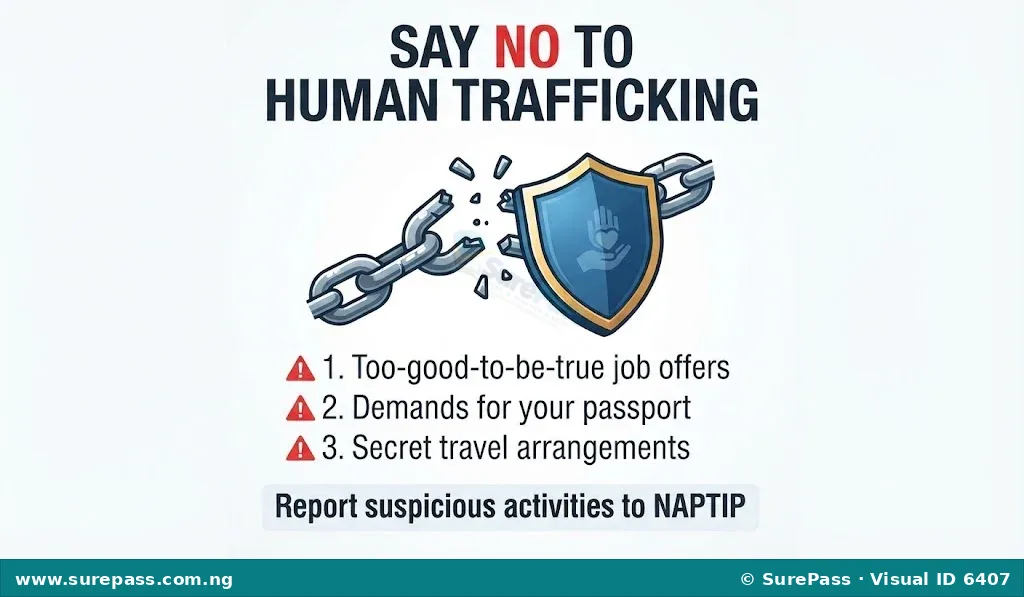
- Formulate Clear Messages: Create simple, memorable slogans that highlight the dangers of trafficking and the importance of vigilance. An example of a message is: “Not for Sale: Report Suspicious Job Offers to NAPTIP.”
- Select the Communication Medium: Choose the best tools to deliver the message. This can include posters, handbills, short drama presentations during school assemblies, or debates.
- Include Reporting Channels: Ensure that all awareness materials display official contact details for help, such as the NAPTIP hotline or local security numbers.
- Execute and Evaluate: Present the campaign, distribute the materials, and gather feedback from peers to measure the impact of the awareness action.
The diagram below shows a sample layout for an educational awareness poster designed to prevent human trafficking.
Review Questions
The following questions are designed to test the understanding of this unit:
- Define Trafficking in Persons (TIP).
- Identify and explain the three elements of human trafficking.
- Distinguish between the push and pull factors of human trafficking, giving three examples of each.
- State four purposes for which people are trafficked.
- Propose three practical awareness actions that a school civic club can take to prevent human trafficking in their community.



0 comments
Open the discussion when you need it. Comments stay collapsed until requested so the initial article remains light.