


ARTICLE CONTENTSOn this page 9 sections
Traditional Institutions and Leadership Systems
Performance Objectives
By the end of the lesson, students should be able to:
- discuss the major traditional institutions and leadership systems in Nigeria;
- explain the roles and functions of traditional rulers and leaders in community governance;
- discuss the relationship between traditional institutions and modern government systems;
- explain the leadership structures across different ethnic groups in Nigeria.
Meaning of Traditional Institutions
A traditional institution is a long-established system of governance, leadership, and social organisation rooted in the history, culture, and customs of a particular group of people.
These institutions existed long before the advent of British colonial rule and the establishment of modern democratic government in Nigeria. They are headed by traditional rulers who hold sacred offices, custodians of culture, and symbols of unity for their respective communities. The selection, installation, and authority of these rulers are guided by unwritten customary laws and traditions passed down through generations.
Major Traditional Institutions and Leadership Systems in Nigeria
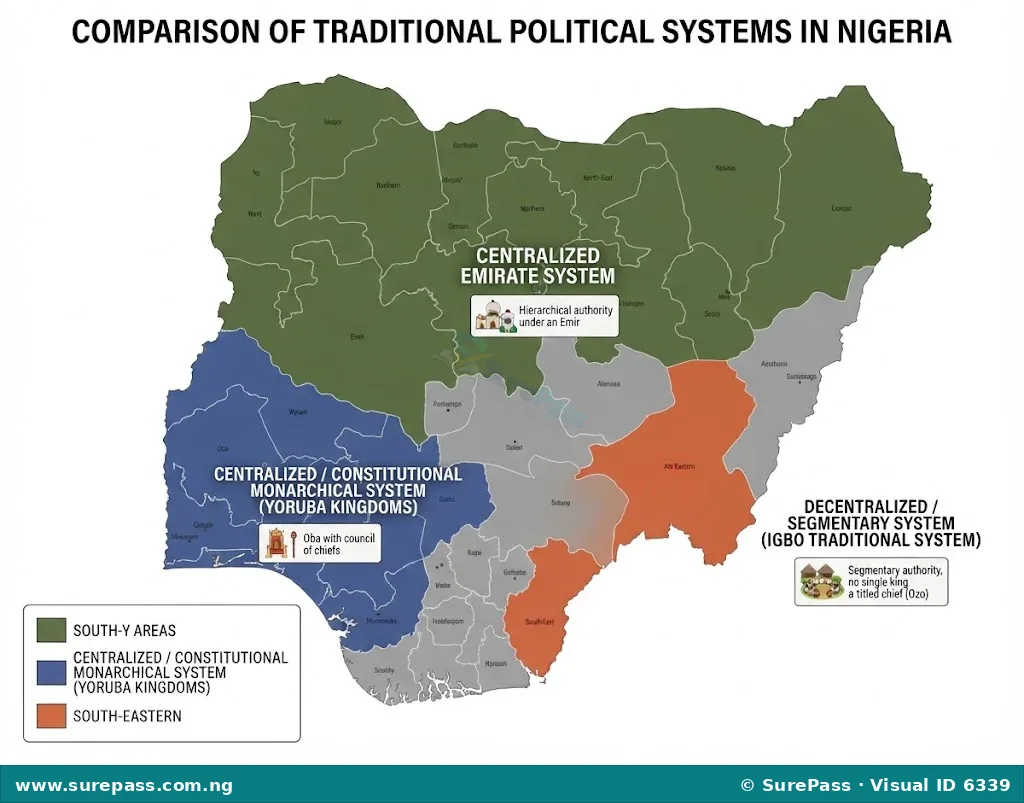
Nigeria is a multi-ethnic nation with over two hundred and fifty ethnic groups. Consequently, diverse traditional leadership systems developed over centuries to suit the geographical, social, and religious needs of different regions. These systems are broadly classified into two major categories based on the concentration of political power.
The major traditional leadership systems in Nigeria are:
- Centralised (Monarchical) Systems: These are highly structured, hierarchical systems where political, administrative, judicial, and religious authority is concentrated in a single supreme ruler. Power flows from the monarch down to subordinate chiefs, district heads, and village heads. Examples include the Hausa-Fulani Emirate system, the Yoruba Kingdom system, and the Kingdom of Benin.
- Decentralised (Acephalous or Segmentary) Systems: These are egalitarian systems where political authority is dispersed among various institutions rather than concentrated in a single individual. Decisions are made through consensus, consultation, and collective leadership involving councils of elders, age grades, title societies, and family heads. The traditional Igbo political system is the primary example of a decentralised system.
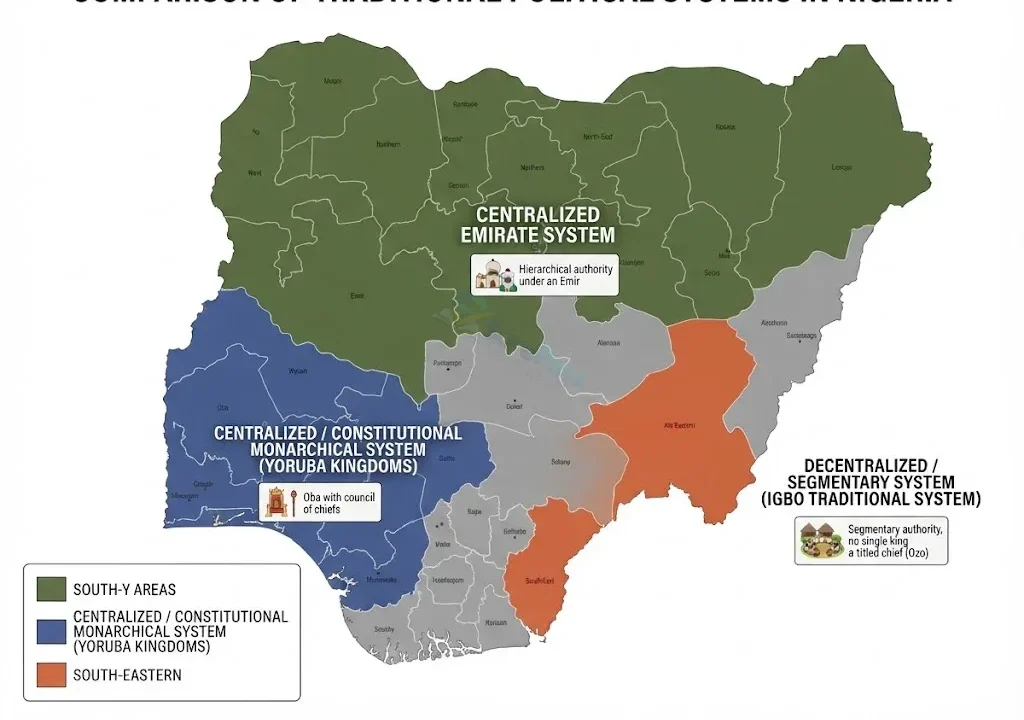
Observe the map below showing the geographical distribution of these traditional leadership systems across Nigeria.
Leadership Structures Across Different Ethnic Groups
To understand the diversity of Nigerian heritage, it is necessary to examine the specific political structures of the major ethnic groups: the Hausa-Fulani, the Yoruba, and the Igbo.
The Hausa-Fulani Emirate System
Following the early 19th-century Islamic Jihad led by Usman dan Fodio, the Hausa states were unified under the Sokoto Caliphate. This established a highly centralised Islamic administrative system known as the Emirate system. The Caliphate was divided into emirates, each headed by an Emir.
The Emir (Sarkin) was the supreme political, administrative, and religious leader of the emirate. He ruled according to Islamic law (Sharia). To manage the vast territory, the Emir appointed various officials to assist in administration.
The key administrative officials in the Emirate system include:
- The Waziri: The Prime Minister and chief adviser to the Emir, who coordinated the activities of all other officials.
- The Madawaki: The commander-in-chief of the army, responsible for defense and military campaigns.
- The Galadima: The administrator of the capital city, in charge of municipal affairs and palace security.
- The Sarkin Fada: The head of the palace workers and administration.
- The Dogari: The chief of police, responsible for maintaining law, order, and executing the judicial decisions of the Emir.
- The Hakimi: District heads appointed by the Emir to oversee specific administrative subdivisions called districts, collect taxes, and maintain order.
- The Dagaci: Village heads who assisted the Hakimi at the grassroots level, dealing directly with the local farmers and traders.
Look at the diagram below showing the hierarchical structure of the Hausa-Fulani Emirate system.
The Yoruba Kingdom System
The traditional political system of the Yoruba kingdoms, such as the Oyo Empire, was centralised but featured a sophisticated system of checks and balances. This prevented the monarch from becoming an absolute dictator.
The primary components of the Yoruba political system include:
- The Oba: The Oba (such as the Alaafin of Oyo) was the political and spiritual head of the kingdom. He was regarded as a divine ruler (Alase Ekeji Orisa) and held supreme executive powers, but he could not rule without consulting his council.
- The Oyomesi: This was the Council of State, consisting of seven noble kingmakers led by the Bashorun (Prime Minister). The Oyomesi assisted the Oba in administration, but they also acted as a major check on his power. If an Oba became tyrannical or violated customs, the Oyomesi could reject him, forcing him to commit suicide by presenting him with an empty calabash or a parrot’s egg.
- The Ogboni Society: A powerful secret society composed of prominent elders, religious leaders, and titleholders. The Ogboni acted as a mediator between the Oba and the Oyomesi. They possessed judicial powers, settled serious disputes, and approved or vetoed decisions made by the Oyomesi, including the deposition of an Oba.
- The Eso: The military wing of the kingdom, led by the Are-Ona-Kakanfo (Field Marshal). The Are-Ona-Kakanfo was expected to win all battles or commit suicide if defeated, which kept the military highly disciplined and loyal to the state.
- The Baale: Lineage or village heads who administered outlying towns and villages loyal to the central kingdom, collecting tributes and settling minor disputes.
Observe the diagram below illustrating the checks and balances in the Yoruba political system.
The Igbo Traditional System
The traditional Igbo political system was decentralised, republican, and highly democratic. There was no single monarch or king ruling over the entire territory. Instead, political power was shared among several democratic institutions within each autonomous community.
The key institutions in the traditional Igbo political system include:
- The Umunna: This is the patrilineal family lineage group. It is the basic unit of political and social organisation. Every adult male in the Umunna had a voice in decision-making, ensuring direct democracy at the family level.
- The Ama-ala (Council of Elders): This council consisted of the heads of various family lineages (Opara). They met to discuss community affairs, make laws, and settle disputes. Decisions were reached through consensus rather than majority vote.
- The Ozo Title Society: This was an association of wealthy and influential men who had taken the prestigious Ozo title. Members were highly respected for their integrity, wisdom, and wealth. They served as advisers to the Council of Elders and helped maintain high moral standards in the community.
- The Age Grades (Uke): Groups of individuals born within the same three-to-five-year period. The age grades performed executive functions, including executing laws passed by the elders, maintaining public infrastructure (such as clearing paths and markets), defending the community, and collecting fines from offenders.
- The Ala (Earth Goddess) and Chief Priests: The traditional religion played a vital role in governance. The Chief Priest of the Earth Goddess (Ala) interpreted the laws of the land. Crimes such as murder, theft of yams, and incest were viewed as abominations against the earth (Alu) and were punished severely to prevent spiritual calamity.
Look at the diagram below showing the decentralised structure of the traditional Igbo political system.
Roles and Functions of Traditional Rulers in Community Governance
Traditional rulers, such as the Sultan of Sokoto, the Oni of Ife, the Oba of Benin, the Obi of Onitsha, and the Tor Tiv, continue to play significant roles in the governance of their local communities.
The roles and functions of traditional rulers in community governance include:
- Maintenance of Law and Order: Traditional rulers work closely with local vigilantes, age grades, and modern security agencies to prevent crime, monitor suspicious activities, and maintain peace within their domains.
- Conflict Resolution and Mediation: They act as arbitrators in civil disputes, including land disputes, family conflicts, marital issues, and chieftaincy tussles. This customary arbitration reduces the burden of cases on modern courts.
- Cultural Preservation and Promotion: As the custodians of culture, they preserve the history, language, festivals, arts, and moral values of their people. They organise cultural festivals (such as the Argungu Fishing Festival, the New Yam Festival, and the Durbar) which promote tourism and cultural pride.
- Community Development and Mobilisation: Traditional rulers mobilise their subjects for self-help projects, such as building schools, health centres, markets, and roads. They also encourage wealthy citizens to invest in their home communities.
- Acting as a Link between the Government and the Grassroots: They communicate government policies, programmes, and health campaigns (such as immunisation drives) to the local population in languages they understand. Conversely, they present the needs and grievances of their people to the government.
- Spiritual and Religious Leadership: Many traditional rulers perform sacred rites, offer prayers for the peace and prosperity of their domains, and serve as the spiritual heads of their communities.
Relationship Between Traditional Institutions and Modern Government Systems
The relationship between traditional institutions and the modern government of Nigeria has evolved through different historical phases, from cooperation to subordination.
The relationship between traditional institutions and modern government is characterised by:
- The Colonial Era (Indirect Rule): The British colonial administration used traditional rulers to govern the local population. Under the system of Indirect Rule, rulers like the Emirs and Obas collected taxes, maintained order, and ran native courts on behalf of the colonial government. In Eastern Nigeria, where there were no centralised rulers, the British created “Warrant Chiefs,” which led to significant social unrest, such as the Aba Women’s Riot of 1929.
- Post-Independence and the 1999 Constitution: In modern Nigeria, traditional rulers do not possess formal executive, legislative, or judicial powers under the 1999 Constitution of the Federal Republic of Nigeria. Their roles are largely advisory. However, they exercise significant informal influence over voters and politicians.
- Advisory Councils: At the state level, State Councils of Chiefs exist to advise governors on traditional matters, security, and customary laws. Nationally, traditional rulers are often consulted by the President during national crises to appeal for peace.
- Collaboration on Security and Health: Modern governments rely heavily on traditional rulers to tackle security challenges, such as banditry, kidnapping, and communal clashes. Rulers also play a critical role in public health campaigns by convincing their communities to accept vaccines and modern medical treatments.
- Political Neutrality vs. Political Influence: While traditional rulers are constitutionally expected to remain politically neutral, politicians frequently visit their palaces during election campaigns to seek their blessings and endorsement, recognizing their immense influence over local voters.
The table below compares the key features of traditional institutions and the modern government system in Nigeria.
| Feature | Traditional Institutions | Modern Government System |
|---|---|---|
| Source of Authority | Customs, traditions, ancestral heritage, and religious beliefs. | The Constitution of the Federal Republic of Nigeria. |
| Method of Selection | Inheritance, selection by kingmakers, or customary rites. | Democratic elections or civil service appointments. |
| Tenure of Office | Life tenure (unless deposed, abdicated, or deceased). | Fixed terms of office (e.g., 4 years for elected officials). |
| Scope of Power | Limited to a specific ethnic group, kingdom, or local domain. | National, state, or local government area boundaries. |
| Primary Law Applied | Customary law, unwritten traditions, and religious laws (e.g., Sharia). | Statutory laws enacted by the legislature and the Constitution. |
Summary
Traditional institutions represent the bedrock of Nigeria’s cultural heritage. Whether through the highly centralised Emirate system of the North, the balanced monarchical system of the Yoruba West, or the decentralised, democratic system of the Igbo East, these structures successfully governed Nigerian societies before colonial intervention. Today, despite lacking formal constitutional powers, traditional rulers remain vital partners to the modern government, serving as custodians of peace, culture, and grassroots development.
Questions for Evaluation
Answer the following questions to test your understanding of the lesson:
- Define traditional institutions and explain the difference between centralised and decentralised leadership systems.
- Describe the administrative structure of the Hausa-Fulani Emirate system, highlighting the roles of the Waziri and the Hakimi.
- Explain how the system of checks and balances functioned in the traditional Yoruba political system.
- Discuss the roles played by the Umunna, the Ama-ala, and the Age Grades in the traditional Igbo political system.
- Identify and explain four major roles that traditional rulers play in modern community governance.
- Analyse the relationship between traditional institutions and the modern government of Nigeria, highlighting their constitutional status.



0 comments
Open the discussion when you need it. Comments stay collapsed until requested so the initial article remains light.