



ARTICLE CONTENTSOn this page 8 sections
Causes and Effects of Disasters
Performance Objectives
By the end of the lesson, students should be able to:
- discuss the causes of disasters;
- discuss the effects of disasters on communities and the nation;
- explain the relationship between disaster and development.
Meaning of Disaster
A disaster is a sudden, calamitous event that brings great damage, loss, destruction and devastation to life, property and the environment, severely disrupting the normal functioning of a community or society.
Disasters often exceed the capacity of the affected community or society to cope using its own resources. This vulnerability necessitates external assistance from state, national, or international bodies to restore normalcy. Disasters can occur suddenly with little to no warning, or they can develop gradually over a prolonged period.
Causes of Disasters
Disasters are generally classified into two main categories based on their origin: natural disasters and human-induced (man-made) disasters. Understanding these causes is essential for planning mitigation and response strategies.
Natural Causes of Disasters
Natural disasters are caused by environmental, geological, or meteorological forces that are beyond direct human control. The primary natural causes include:
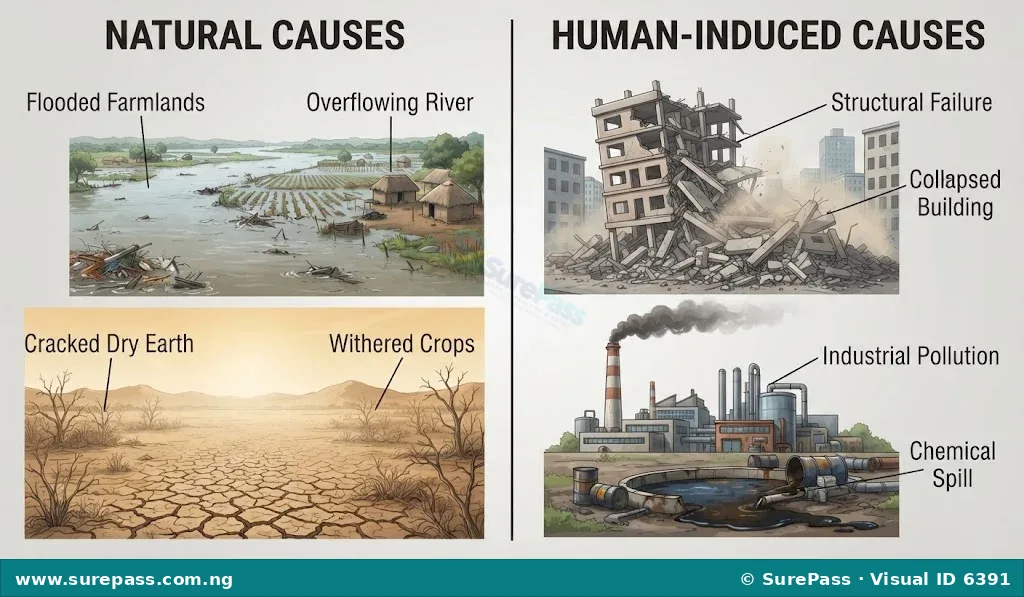
- Flooding: Excessive rainfall, ocean surges, or the overflowing of riverbanks that submerge dry land. In Nigeria, seasonal flooding along the Niger and Benue rivers frequently displaces communities and destroys agricultural lands.
- Droughts: Prolonged periods of abnormally low rainfall, leading to severe water shortages, crop failures, and famine. This is particularly common in the semi-arid regions of Northern Nigeria.
- Earthquakes and Tremors: Sudden movements of the Earth’s tectonic plates that cause the ground to shake, leading to the collapse of buildings and infrastructure. While major earthquakes are rare in West Africa, minor earth tremors have been recorded in parts of Nigeria.
- Windstorms and Hurricanes: Violent atmospheric disturbances characterized by high-velocity winds that can rip off roofs, uproot trees, and destroy electrical installations.
- Landslides: The rapid downward movement of rock, earth, or debris down a slope, often triggered by heavy rainfall or geological instability.
- Epidemics: The rapid spread of infectious diseases across a large population within a short period, such as outbreaks of cholera, Lassa fever, or meningitis.
Human-Induced Causes of Disasters
Human-induced disasters, also known as man-made disasters, result from human negligence, technological failures, poor planning, or deliberate acts of malice. The primary human-induced causes include:
- Industrial and Technological Accidents: Chemical spills, gas explosions, and nuclear radiation leaks resulting from industrial failures or poor safety standards.
- Transportation Accidents: Major plane crashes, train derailments, shipwrecks, and fatal road traffic collisions caused by mechanical failure, poor infrastructure, or human error.
- Environmental Degradation: Human activities such as deforestation, overgrazing, and improper waste disposal that weaken natural ecosystems. For instance, blocking drainage channels with refuse directly causes urban flooding in major Nigerian cities.
- Socio-Political Conflicts: Wars, civil unrest, communal clashes, and acts of terrorism that lead to mass casualties, destruction of property, and displacement of populations.
- Structural Failures: The collapse of buildings, bridges, and dams due to substandard construction materials, poor engineering designs, or lack of maintenance.
- Oil Spills and Pipeline Explosions: Environmental contamination and fire disasters caused by oil pipeline vandalism or equipment failure, particularly in the Niger Delta region.
Observe the image below to understand the distinction between natural and human-induced disaster causes.
Effects of Disasters on Communities and the Nation
Disasters have far-reaching consequences that affect every sector of society. These impacts are categorized into social, economic, and political activities.
Effects on Social Activities
Social activities revolve around human relationships, community life, health, and education. Disasters disrupt these activities in the following ways:
- Loss of Lives and Injuries: The most devastating social effect is the loss of human lives and permanent physical disabilities suffered by survivors.
- Displacement of Populations: Disasters force thousands of people to flee their homes, turning them into Internally Displaced Persons (IDPs) or refugees. This strains host communities and leads to overcrowding in temporary camps.
- Disruption of Education: School buildings are often destroyed, damaged, or converted into temporary shelters for displaced persons, halting academic calendars and affecting students’ learning.
- Breakdown of Healthcare Systems: Hospitals may be damaged, and the sudden influx of injured victims can overwhelm existing medical facilities. Additionally, poor sanitation in post-disaster areas often triggers outbreaks of waterborne diseases.
- Loss of Cultural Heritage and Social Cohesion: Disasters can destroy historical monuments, places of worship, and community spaces, disrupting traditional festivals, communal gatherings, and social support networks.
Effects on Economic Activities
Economic activities involve the production, distribution, and consumption of goods and services. Disasters damage the economic foundation of communities and the nation through:
- Destruction of Infrastructure: Roads, bridges, railways, power grids, and telecommunication networks are often ruined, halting trade, transport, and communication.
- Loss of Livelihoods: Floods and droughts destroy farmlands, wash away crops, and kill livestock, depriving farmers of their income. Similarly, urban disasters destroy markets, shops, and factories, leading to job losses.
- Financial Strain on Governments: Governments must divert scarce financial resources from planned developmental projects to fund emergency relief, medical care, and the reconstruction of destroyed public infrastructure.
- Inflation and Scarcity: The destruction of agricultural lands and transport routes leads to severe food shortages, driving up the prices of essential commodities and increasing the cost of living.
Effects on Political Activities
Political activities involve governance, policy-making, security, and administration. Disasters impact the political landscape in the following ways:
- Political Instability: Ineffective government response to a disaster can lead to public anger, protests, and a loss of confidence in political leadership, which can destabilize the government.
- Resource Conflicts: Disasters that cause scarcity of land, water, or food can trigger violent conflicts between different communities or ethnic groups competing for survival resources.
- Disruption of Electoral Processes: Mass displacement of citizens and destruction of administrative infrastructure can make it impossible to conduct free, fair, and timely elections in affected regions.
- Policy Shifts and Legislative Changes: Governments are forced to alter their legislative priorities, passing emergency laws, establishing new regulatory bodies, and shifting national security focuses to disaster management.
Look at the flowchart below to see how these social, economic, and political effects are interconnected.
Relationship Between Disaster and Development
There is a close, reciprocal relationship between disaster and development. Development decisions can either increase or decrease a society’s vulnerability to disasters, while disasters can severely hinder or redirect a nation’s development path.
The relationship between disaster and development is explained through three main dynamics:
- Disasters Set Back Development: Decades of hard-won developmental gains in education, health, and infrastructure can be wiped out in a single disaster event. Funds that were originally budgeted for building new schools, hospitals, and roads must be redirected to emergency relief, debris clearance, and rebuilding destroyed structures. This stalls national growth and increases public debt.
- Unplanned Development Increases Disaster Risk: Rapid, poorly planned developmental activities can create new disaster risks or worsen existing ones. For example, constructing buildings on floodplains, deforesting hillsides for urban expansion, and failing to enforce building codes increase the likelihood and severity of floods, landslides, and building collapses.
- Sustainable Development Reduces Disaster Vulnerability: Positive, well-planned development strengthens a nation’s resilience. Investing in strong infrastructure, establishing early warning systems, implementing strict building regulations, conserving the environment, and educating citizens on safety measures ensure that communities can withstand and recover quickly from hazards. This is known as disaster risk reduction (DRR).
Observe the diagram below to understand the cyclical relationship between disaster and development.
Summary of Key Concepts
The key concepts discussed in this unit are summarized below:
- Definition: A disaster is a sudden, catastrophic event that causes widespread destruction of lives, property, and the environment, exceeding a community’s capacity to cope.
- Causes: Disasters are caused by natural forces (such as floods, droughts, and windstorms) or human actions (such as industrial accidents, socio-political conflicts, and poor structural engineering).
- Effects: The consequences of disasters span social activities (displacement, loss of life, disrupted education), economic activities (destroyed infrastructure, lost livelihoods, inflation), and political activities (instability, resource conflicts).
- Disaster-Development Link: Disasters destroy developmental progress, while poor development choices increase disaster risks. Conversely, sustainable development practices build community resilience and reduce disaster impacts.
Review Questions
Answer the following questions to assess understanding of the topic:
- Define the term “disaster” and explain why external assistance is often required when one occurs.
- Distinguish between natural and human-induced causes of disasters, providing three examples of each.
- Discuss three social effects of disasters on a local community.
- Explain how disasters can negatively impact the economic activities of a nation.
- Describe two ways in which disasters can affect political activities and governance.
- Explain the relationship between disaster and development, showing how development can both increase and decrease disaster risk.




0 comments
Open the discussion when you need it. Comments stay collapsed until requested so the initial article remains light.