



ARTICLE CONTENTSOn this page 6 sections
Social Vices: Bullying, Gangsterism and Examination Malpractices
Performance Objectives
By the end of the lesson, students should be able to:
- explain the meaning of social vices;
- discuss the forms of social vices;
- discuss the consequences of bullying, gangsterism, and examination malpractices.
Meaning of Social Vices
Social vices are unacceptable, immoral, or illegal behaviours and habits that negatively affect individuals and the wider society.
In every society, there are established laws, moral codes, and cultural values designed to maintain peace, order, and mutual respect. When individuals or groups deliberately violate these standards, their actions are classified as social vices. These behaviours disrupt social harmony, hinder personal development, and create an atmosphere of fear and insecurity.
In the context of citizenship education, understanding social vices is essential for developing civic responsibility. Social vices manifest in various environments, including homes, schools, workplaces, and local communities. While some vices are minor infractions of social norms, others constitute serious criminal offences punishable under the laws of the Federal Republic of Nigeria.
Forms of Social Vices
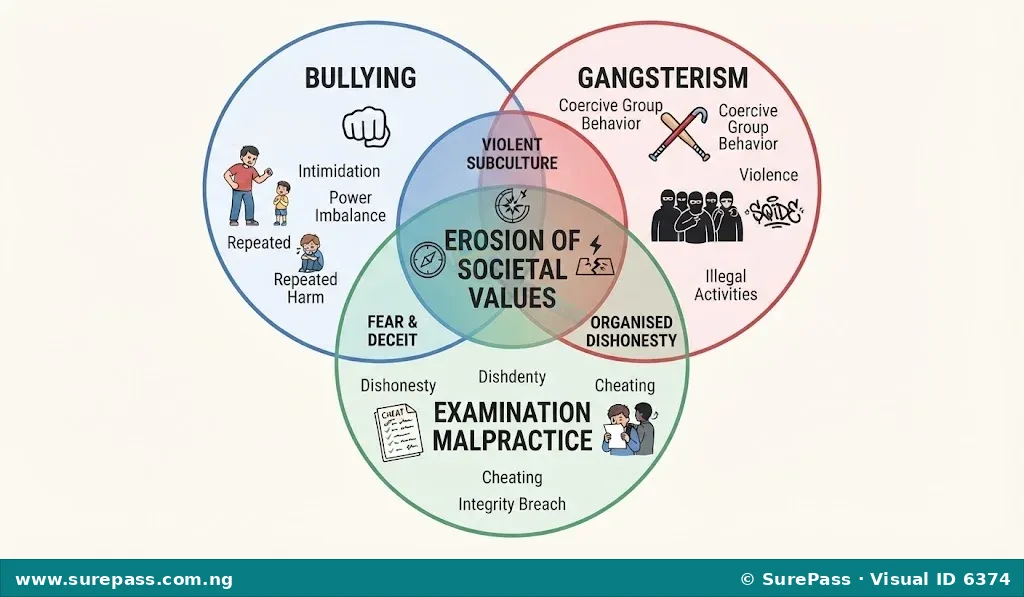
Social vices exist in many forms, but three of the most prevalent and damaging vices affecting youth and educational institutions are bullying, gangsterism, and examination malpractices.
Bullying
Bullying is the repetitive, intentional hurt or intimidation of a weaker or more vulnerable person by a stronger or more powerful individual or group.
Bullying is not a one-off disagreement or conflict; it is a systematic abuse of power. It occurs in schools, neighbourhoods, and online spaces. The primary forms of bullying include:
- Physical Bullying: This involves bodily contact or damage to property, such as hitting, kicking, pushing, tripping, or damaging a victim’s personal belongings.
- Verbal Bullying: This includes the use of spoken words to cause harm, such as name-calling, insults, teasing, intimidation, and making homophobic or racist remarks.
- Social or Relational Bullying: This is designed to harm a victim’s social reputation or relationships. It includes spreading malicious rumours, deliberate exclusion from social groups, and encouraging others to avoid the victim.
- Cyberbullying: This occurs through digital devices such as mobile phones, computers, and tablets. It involves sending threatening messages, sharing embarrassing photos or videos on social media, or creating fake profiles to humiliate the victim.
Gangsterism
Gangsterism is the act of belonging to or operating within an organized group of individuals, often called a gang, that engages in criminal, violent, or anti-social activities.
In secondary schools and higher institutions, gangsterism often manifests as cultism. Members of these groups use violence, intimidation, and weapons to assert dominance over others, settle disputes, or carry out illegal activities. The characteristics of gangsterism include:
- Secret Initiation Rites: New members are often subjected to physical abuse, oaths of secrecy, and dangerous rituals to prove their loyalty.
- Territorial Control: Gangs claim specific areas within schools or communities and violently defend them against rival groups.
- Criminal Activities: These include armed robbery, extortion, drug trafficking, physical assaults, and sometimes murder.
- Use of Symbols and Colours: Members identify themselves through specific dress codes, hand signs, slang, or tattoos.
Examination Malpractice
Examination malpractice is any illegal, dishonest, or irregular activity carried out by a candidate, educator, or external agent before, during, or after an examination to secure an unfair advantage.
This vice undermines the educational system by rewarding dishonesty and penalizing hard work. The common forms of examination malpractice in Nigeria include:
- Leakage: This occurs when examination questions are illegally acquired and distributed to candidates before the official examination time.
- Smuggling of Materials: Candidates bring unauthorized materials, such as textbooks, prepared notes, or electronic devices containing answers, into the examination hall.
- Impersonation: This involves hiring another person to write the examination on behalf of the registered candidate.
- Collusion: This is unauthorized cooperation between candidates, or between candidates and invigilators, which may involve copying from one another or dictating answers.
- Electronic Cheating: The use of smart devices, micro-chips, and internet-connected gadgets to search for answers or receive external assistance during an examination.
Observe the diagram below, which illustrates the three major forms of social vices prevalent in educational and social environments.
Consequences of Social Vices
The persistence of social vices has devastating effects on individuals, families, educational institutions, and the nation as a whole. Each vice carries specific consequences that undermine social order and development.
Consequences of Bullying
Bullying affects both the immediate victims and the broader community in several ways. The consequences of bullying include:
- Psychological and Emotional Trauma: Victims of bullying often suffer from severe anxiety, depression, low self-esteem, and feelings of loneliness. In extreme cases, it can lead to self-harm or suicidal thoughts.
- Academic Decline: Fear of being bullied leads to frequent school absenteeism, poor concentration in class, and a significant drop in academic performance.
- Physical Injuries: Physical bullying can result in severe bodily harm, scars, and long-term health complications.
- Erosion of Community Safety: In schools and neighbourhoods where bullying is tolerated, a culture of fear and hostility develops, making the environment unsafe for learning and social interaction.
Consequences of Gangsterism
Gangsterism poses a direct threat to public safety and social cohesion. The consequences of gangsterism include:
- Loss of Lives and Property: Violent clashes between rival gangs or cult groups often result in the death of members and innocent bystanders, as well as the destruction of public and private property.
- Breakdown of Social Cohesion: Gangsterism destroys trust within communities. It creates divisions, suspicion, and fear, preventing community members from working together for mutual development.
- Increase in Crime Rates: Gangs serve as breeding grounds for professional criminals, leading to an increase in armed robbery, kidnapping, drug abuse, and sexual violence.
- Disruption of Academic Calendars: In educational institutions, cult clashes often force school authorities to shut down campuses, thereby delaying students’ academic progress.
Consequences of Examination Malpractices
Examination malpractice devalues the entire educational system and destroys national credibility. The consequences of examination malpractice include:
- Devaluation of Academic Certificates: When cheating becomes widespread, the certificates issued by educational bodies lose their value and credibility both locally and internationally.
- Production of Incompetent Professionals: Students who cheat their way through school lack the actual knowledge and skills required for professional practice. This leads to incompetent doctors, engineers, teachers, and administrators, which can have fatal consequences for society.
- Loss of Academic Integrity: Examination malpractice discourages honest students from studying hard, as they see dishonest students obtaining higher grades without effort.
- Punitive Actions and Blacklisting: Candidates caught engaging in malpractice face severe penalties, including the cancellation of results, suspension, expulsion, or imprisonment. Educational institutions involved may also be blacklisted by examination bodies like WAEC and NECO.
Look at the flowchart below, which traces the systemic impact of examination malpractice on national development.
Step 2: Devalued Certificates -> Step 3: Incompetent Graduates in the Workforce -> Step 4: National Underdevelopment and Loss of International Credibility. The boxes are clearly labelled with arrows pointing from one step to the next. alt: A flowchart showing how examination malpractice leads to incompetent professionals and national underdevelopment. caption: The systemic consequences of examination malpractice on national development. aspect_ratio: 4:3 –>Summary and Review
Social vices represent a major challenge to law, order, and citizenship in Nigeria. Addressing these vices requires collective effort from students, parents, teachers, religious bodies, and law enforcement agencies. By rejecting bullying, gangsterism, and examination malpractices, students contribute to building a safer, more credible, and prosperous society.
The following questions are designed to test understanding of the concepts covered in this unit:
- Define the term “social vices” in a single sentence.
- Identify and describe three distinct forms of bullying.
- Explain how gangsterism disrupts social cohesion and safety in Nigerian communities.
- Analyse the long-term effects of examination malpractice on the international credibility of Nigerian academic certificates.
- Suggest three practical measures that school authorities can implement to curb social vices among students.





0 comments
Open the discussion when you need it. Comments stay collapsed until requested so the initial article remains light.