


ARTICLE CONTENTSOn this page 6 sections
National Identity
Performance Objectives
By the end of the lesson, students should be able to:
- explain the meaning and importance of national identity, unity, consciousness, and symbols;
- discuss the ways of promoting national identity, national unity and national consciousness;
- discuss the historical background and reasons for adopting each symbol.
Meaning and Importance of National Concepts
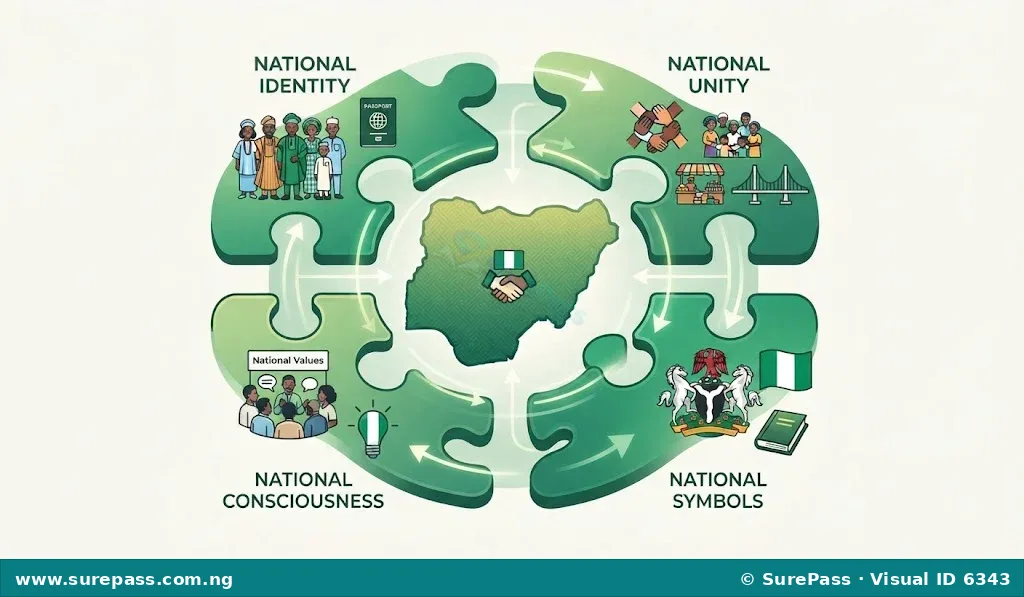
To understand the foundation of a sovereign nation like Nigeria, it is essential to examine the core concepts that bind its citizens together. These concepts include national identity, national unity, national consciousness, and national symbols.
National Identity
National identity is the sense of belonging to a specific nation, characterized by shared culture, history, language, values, and allegiance to the state.
It is the collective feeling of being part of a country, which distinguishes citizens of one nation from those of another. In Nigeria, national identity transcends ethnic, religious, and regional boundaries, uniting individuals under the common umbrella of being Nigerian citizens.
The importance of national identity includes:
- Fostering Patriotism: It inspires citizens to love, defend, and work for the progress of their country.
- Providing a Sense of Belonging: It gives individuals a distinct political and cultural home, establishing their legal status globally.
- Encouraging Civic Responsibility: Citizens with a strong national identity are more likely to obey laws, pay taxes, and participate in democratic processes.
- Enhancing International Recognition: A clear national identity projects a positive and unified image of the country to the rest of the world.
National Unity
National unity is the state of togetherness, solidarity, and peaceful coexistence among diverse ethnic, religious, and social groups within a country.
Nigeria is a multi-ethnic nation with over 250 ethnic groups. National unity ensures that these diverse groups work together harmoniously to build a stable and prosperous nation, rather than allowing differences to cause division.
The importance of national unity includes:
- Preventing Civil Conflict: Unity reduces ethnic and religious tensions, minimizing the risk of communal clashes and civil wars.
- Promoting Economic Growth: A peaceful and united country attracts foreign investment and allows internal trade to thrive across regional borders.
- Ensuring Political Stability: Unity fosters trust in national institutions and encourages peaceful transitions of power.
- Facilitating Balanced Development: It ensures that national resources are distributed equitably to develop all parts of the country.
National Consciousness
National consciousness is the collective awareness and shared feeling of love, pride, and devotion that citizens have toward their country, placing national interests above personal, religious, or ethnic interests.
It is the mental attitude that prioritizes the survival, progress, and honour of the nation over sectional sentiments. It requires citizens to think of themselves first as Nigerians before identifying with their specific ethnic groups.
The importance of national consciousness includes:
- Driving National Development: It motivates citizens to contribute selflessly to public projects, education, and community development.
- Combating Corruption: A high level of national consciousness makes citizens reject practices that harm the collective wealth and reputation of the country.
- Strengthening Democratic Institutions: It encourages citizens to vote based on merit and national interest rather than ethnic or religious bias.
- Building Resilience During Crises: It unites the population to face external threats, economic hardships, or natural disasters with a common purpose.
National Symbols
National symbols are visual, auditory, or physical representations, signs, or emblems that officially represent a sovereign nation and its values, history, and aspirations.
These symbols are legally recognized and respected. They serve as visible reminders of the sovereignty of the state and the shared heritage of its citizens.
The importance of national symbols includes:
- Serving as a Unifying Force: They bring diverse groups together under shared emblems that represent everyone equally.
- Inspiring Patriotism: Beholding or reciting these symbols evokes pride and emotional attachment to the nation.
- Representing Sovereignty: They signal to the international community that the nation is independent and self-governing.
- Preserving Historical Heritage: They carry historical meanings that remind citizens of the struggles and achievements of past leaders.
Ways of Promoting National Identity, Unity, and Consciousness
Building a strong nation requires deliberate efforts by both the government and the citizens. There are several practical ways to promote these values across Nigeria.
The primary ways of promoting national identity include:
- Civic Education: Teaching civic education, history, and social studies in schools helps young citizens understand their rights, duties, and national heritage.
- Respecting National Symbols: Citizens should show respect to the national flag, anthem, and pledge during public gatherings and school assemblies.
- Promoting Local Industries: Patronizing locally made goods and services (the “Buy Nigeria” initiative) strengthens the national economy and builds collective pride.
- Preserving Cultural Heritage: Encouraging the wearing of traditional attire, speaking indigenous languages, and celebrating national cultural festivals.
The primary ways of promoting national unity include:
- The National Youth Service Corps (NYSC): This scheme, established in 1973, deploys tertiary education graduates to states other than their states of origin to foster cultural integration and mutual understanding.
- Inter-Ethnic Marriages: Encouraging marriages across different ethnic groups helps break down cultural prejudices and builds familial ties across regions.
- The Federal Character Principle: Ensuring that appointments into public offices and distribution of resources reflect the diverse ethnic and regional composition of the country.
- National Sports and Festivals: Events like the National Sports Festival and the National Festival of Arts and Culture (NAFEST) bring Nigerians from different backgrounds together in friendly competition and celebration.
The primary ways of promoting national consciousness include:
- Public Enlightenment Campaigns: Agencies like the National Orientation Agency (NOA) carry out campaigns to educate citizens on national values, patriotism, and social responsibility.
- Honouring National Heroes: Recognizing and celebrating the contributions of past and present leaders, scientists, artists, and athletes who have brought honour to the nation.
- Responsible Media Reporting: The media should focus on stories that promote peace, progress, and national achievements rather than sensationalizing divisive issues.
- Encouraging Selfless Community Service: Promoting volunteerism and community development projects that encourage citizens to work together for the public good.
Historical Background and Reasons for Adopting Nigerian National Symbols
Nigeria’s national symbols carry deep historical significance. Each symbol was adopted for specific reasons to reflect the country’s journey to independence, its natural wealth, and its national values.
The National Flag
The Nigerian national flag consists of three equal vertical bands of green, white, and green.
The flag was designed in 1959 by Michael Taiwo Akinkunmi, who was then a twenty-three-year-old student studying engineering at Norwood Technical College in London. He entered a national competition advertised in the newspapers and won. His original design had a red radiating sun in the middle of the white band, but the judges removed the sun, leaving the simple green-white-green design. The flag was officially hoisted on Nigeria’s Independence Day, October 1, 1960, replacing the British Union Jack.
The reasons for adopting the national flag include:
- Representation of Agriculture: The green bands represent Nigeria’s rich agricultural wealth, fertile land, and vast natural resources.
- Representation of Peace: The white band represents peace, unity, and the undivided love of the citizens for their country.
- Symbol of Sovereignty: It serves as the primary visual representation of Nigeria’s independence from British colonial rule.

The Coat of Arms
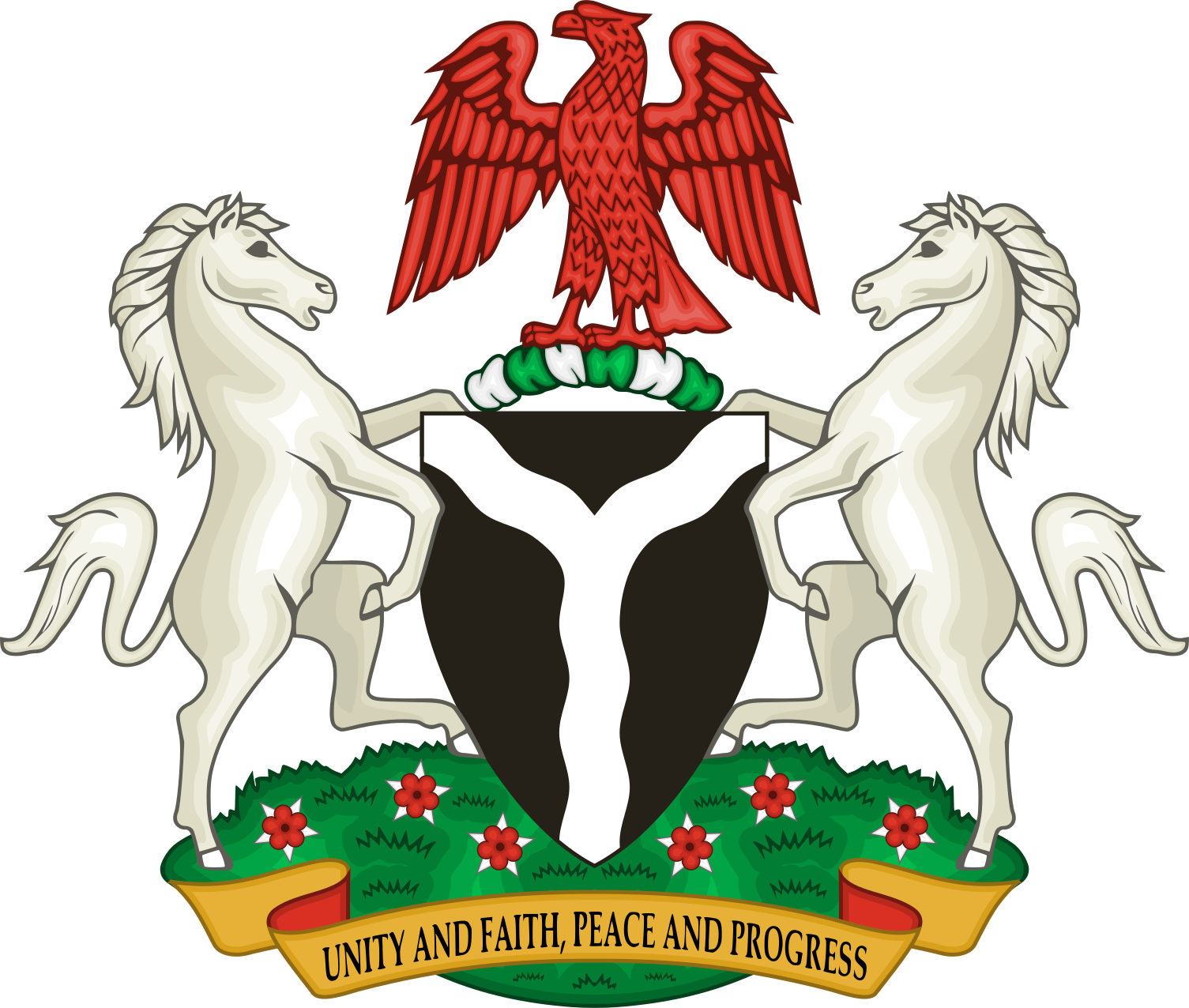
The Coat of Arms is an official emblem that represents the authority, strength, and unity of the Nigerian government.
It was officially adopted in 1960 to coincide with the country’s independence. The emblem features several distinct elements, each carrying a specific symbolic meaning.
The components of the Coat of Arms and the reasons for their adoption are:
- The Black Shield: Represents Nigeria’s fertile agricultural soil.
- The Silver Y-shaped Band: Represents the Rivers Niger and Benue, which are the two major rivers that flow through Nigeria, meeting at a confluence in Lokoja.
- The Two Supporting White Horses: Represent dignity, pride, and strength.
- The Red Eagle: Surmounts the shield and represents the strength and resilience of the nation.
- The Green and White Wreath: Holds the eagle in place and represents the agricultural potential of the country.
- The Yellow Wildflowers (Costus Spectabilis): Located at the base of the shield, these flowers grow wild across Nigeria and represent the natural beauty of the nation.
- The National Motto: Written on a golden scroll at the base, the motto reads “Unity and Faith, Peace and Progress,” which outlines the guiding principles for national development.
The National Anthem
The national anthem is a patriotic musical composition that defines the national character and calls citizens to service.
Nigeria has used two national anthems since independence. The first anthem, “Nigeria, We Hail Thee,” was used from 1960 to 1978. The lyrics were written by Lillian Jean Williams, and the music was composed by Frances Benda. In 1978, under the military administration of General Olusegun Obasanjo, a new anthem, “Arise, O Compatriots,” was adopted. The lyrics were compiled from the five best entries in a national competition (written by John A. Ilechukwu, Eme Etim Akpan, B. A. Ognafe, Sola Adeniyi, and S. O. Alilu), and the music was composed by the Nigerian Police Band under the direction of Benedict Odiase. In May 2024, the Nigerian government officially reinstated the original independence anthem, “Nigeria, We Hail Thee,” as the official national anthem.
The reasons for adopting the national anthem include:
- Inspiring Patriotism: The lyrics encourage citizens to serve the nation with dedication, love, and strength.
- Honouring National Heroes: It serves as a constant reminder of the struggles and sacrifices made by past leaders to secure the nation’s freedom.
- Promoting Unity: Singing the anthem collectively at public events reinforces a sense of shared destiny and national brotherhood.
The National Pledge
The National Pledge is a solemn oath of allegiance recited by citizens to express loyalty to the country.
The pledge was written in 1976 by Professor Felicia Adebola Adeyoyin, an educationist. She wrote it after her children, who had attended school in the United States, asked why they did not recite a pledge of allegiance to Nigeria as they did in America. The pledge was published in a daily newspaper and caught the attention of the then Head of State, General Olusegun Obasanjo, who officially introduced it to be recited by school children during morning assemblies.
The reasons for adopting the national pledge include:
- Instilling Loyalty: It binds citizens to a promise of faithfulness, honesty, and dedication to the nation.
- Encouraging Civic Duty: It reminds citizens of their responsibility to defend Nigeria’s unity and uphold its honour.
- Character Building: Reciting the pledge daily in schools helps instill moral values and patriotism in young citizens from an early age.
The National Currency (Naira and Kobo)
The Naira and Kobo serve as the official legal tender and monetary unit of Nigeria.
Before 1973, Nigeria used the British West African pound, shillings, and pence. On January 1, 1973, under the military administration of General Yakubu Gowon, Nigeria decimalized its currency and introduced the Naira (subdivided into 100 Kobo). The name “Naira” was coined by Chief Obafemi Awolowo, who was then the Federal Commissioner for Finance, by collapsing the word “Nigeria.”
The reasons for adopting the national currency include:
- Economic Sovereignty: It established Nigeria’s complete financial independence from the British colonial monetary system.
- Facilitating Trade: The decimal system made financial transactions, accounting, and trade much simpler than the previous pound system.
- National Pride: Featuring national landmarks, agricultural activities, and portraits of national heroes on the banknotes projects Nigeria’s history and cultural diversity.
The National Passport
The Nigerian passport is an official travel document issued by the Federal Government through the Nigeria Immigration Service.
It is issued to citizens to facilitate international travel and serve as proof of citizenship abroad. The passport has evolved over the years from paper-based documents to the modern electronic passport (e-passport) containing biometric data.
The reasons for adopting the national passport include:
- Proof of Citizenship: It serves as the ultimate legal identification for a Nigerian citizen traveling outside the country.
- National Security: The integration of biometric technology helps prevent identity theft, forgery, and unauthorized border crossings.
- Consular Protection: It guarantees that the holder is entitled to the protection and assistance of Nigerian embassies and consulates worldwide.
Evaluation Guide
To assess understanding of this unit, answer the following questions:
- Define and explain the significance of national identity, unity, consciousness, and symbols.
- Describe four ways to promote national identity, unity, and consciousness in Nigeria.
- Explain the history and reasons behind the adoption of Nigeria’s national flag and Coat of Arms.
- Who designed the Nigerian national flag, and what do its colours represent?
- Discuss the historical transition of the Nigerian national anthem from 1960 to the present day.
- Explain the origin of the Nigerian National Pledge and the reasons for its adoption in schools.




0 comments
Open the discussion when you need it. Comments stay collapsed until requested so the initial article remains light.