



ARTICLE CONTENTSOn this page 8 sections
National Security Threats: Sabotage
Performance Objectives
By the end of the lesson, students should be able to:
- discuss the meaning, types and factors of sabotage;
- discuss how to counter sabotage.
Meaning of Sabotage
Sabotage is the deliberate destruction, disruption, or damage of equipment, infrastructure, systems, or processes to weaken an organization, community, or nation.
As a national security threat, sabotage is typically carried out covertly. The perpetrators, known as saboteurs, may be disgruntled employees, political extremists, criminal syndicates, or foreign agents. Unlike open warfare, sabotage relies on stealth, surprise, and deception to undermine the economic, military, or social stability of a country without engaging in direct military confrontation.
Types of Sabotage
Sabotage manifests in various forms depending on the target, the method used, and the ultimate objective of the saboteur. The primary types of sabotage include:
1. Environmental Sabotage
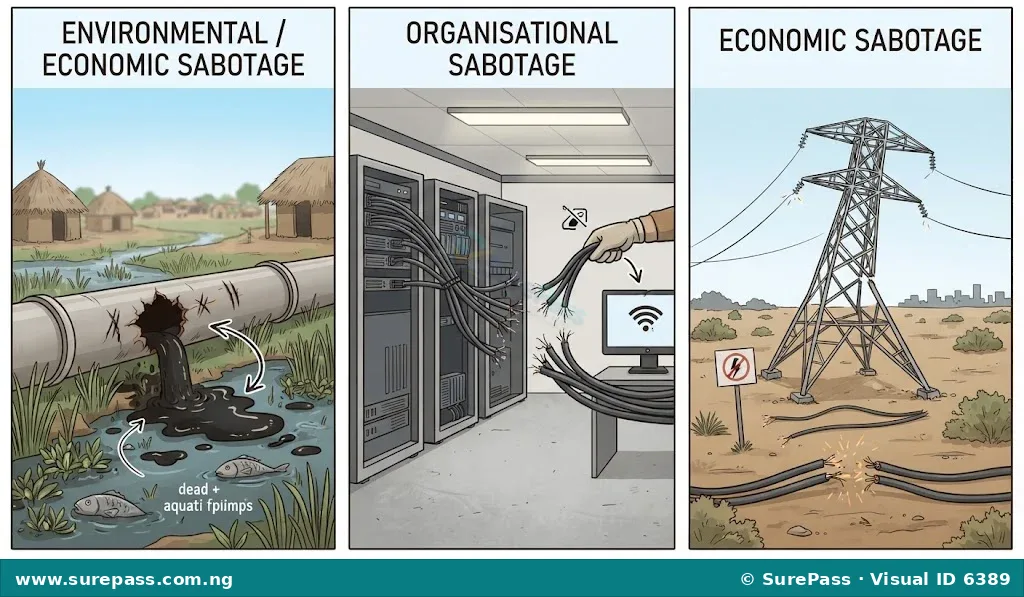
This involves deliberate actions that damage ecosystems, natural resources, or critical environmental infrastructure. In Nigeria, a common example is the illegal puncturing and vandalism of oil pipelines in the Niger Delta. This action causes massive oil spills that pollute farmlands, destroy aquatic life, and ruin the livelihoods of local communities. Other examples include the deliberate poisoning of public water sources or the starting of forest fires.
2. Organisational Sabotage
This occurs within an institution, government agency, or private corporation. It is often carried out by internal actors, such as disgruntled workers, to disrupt daily operations, destroy records, or damage the institution’s reputation. Examples include the intentional deletion of critical databases, damaging office equipment, or leaking confidential administrative documents to the public to cause embarrassment.
3. Economic Sabotage
This refers to deliberate acts aimed at weakening the financial stability, trade, or economic infrastructure of a nation. Economic sabotage directly threatens national survival by reducing state revenue and disrupting public services. Examples include the theft and vandalism of electricity transmission cables, destruction of railway tracks, smuggling of restricted goods, counterfeiting of national currency, and the hoarding of essential commodities to create artificial scarcity.
4. Psychological Sabotage
This involves the deliberate manipulation of information to weaken the morale, trust, and mental resilience of a population or security force. It is often executed through the spread of fake news, malicious propaganda, and conspiracy theories designed to cause public panic, incite ethnic or religious violence, or reduce public confidence in government institutions and security agencies.
5. Personal Sabotage
This is targeted at destroying the career, reputation, social standing, or physical well-being of a specific individual. It is often driven by professional rivalry, jealousy, or political competition. Examples include spreading malicious falsehoods about a colleague to prevent their promotion, or deliberately altering a co-worker’s presentation files to make them fail an important assessment.
Factors Influencing Sabotage
Understanding why individuals or groups engage in sabotage is essential for developing effective preventive measures. The main factors that drive sabotage include:
The primary factors influencing sabotage are:
- Political Grievances: Individuals or rebel groups may resort to sabotage to express anger against government policies, protest political marginalization, or attempt to destabilize the ruling administration.
- Economic Hardship and Greed: High rates of unemployment and poverty can drive individuals to vandalize public infrastructure for immediate financial gain, such as selling stolen copper cables or siphoned petroleum products on the black market.
- Disgruntled Employees: Perceived unfair treatment, poor working conditions, low wages, or lack of promotion within an organization can motivate workers to secretly damage company property or disrupt operations.
- Ideological and Religious Extremism: Radical groups often use sabotage as a tool to attack state symbols, communication networks, and transport systems to enforce their beliefs or weaken state authority.
- Foreign Interference: Hostile foreign nations may sponsor local saboteurs or deploy secret agents to damage a country’s military installations, research facilities, or economic hubs to weaken its geopolitical standing.
- Lack of Patriotism: A weak sense of national identity and civic responsibility makes individuals indifferent to the preservation of public property, leading them to prioritize personal gain over national security.
Counter-Sabotage
Counter-sabotage refers to the collective measures, strategies, and systems put in place to detect, prevent, and neutralize acts of sabotage before they cause harm to national security or organizational stability.
Effective counter-sabotage requires cooperation between government security agencies, private organizations, and ordinary citizens.
The key strategies for countering sabotage include:
- Physical Security Measures: Installing robust physical barriers, such as perimeter fencing, access control gates, and surveillance systems like Closed-Circuit Television (CCTV) cameras around critical national infrastructure. Regular security patrols around pipelines, power stations, and military bases are also vital.
- Personnel Vetting and Background Checks: Conducting thorough security clearances and background investigations on individuals before employing them in sensitive positions within government agencies, financial institutions, and utility companies.
- Cybersecurity and Information Security: Implementing strong firewalls, encryption, multi-factor authentication, and regular data backups to protect digital infrastructure from internal and external digital saboteurs.
- Intelligence Gathering and Surveillance: Strengthening national intelligence agencies to monitor threat groups, gather actionable information, and intercept sabotage plots before they are executed.
- Public Awareness and Civic Education: Educating citizens on the importance of protecting public property, recognizing suspicious behavior, and using dedicated hotlines to report suspected saboteurs to law enforcement agencies.
- Strict Legal Sanctions: Enforcing harsh legal penalties, including long-term imprisonment, for individuals convicted of vandalizing public infrastructure or committing other acts of sabotage to serve as a strong deterrent.
Summary of Key Concepts
The core concepts of national security threats regarding sabotage are summarized below:
- Sabotage is a covert and deliberate act of destruction aimed at weakening an entity or a nation.
- The types of sabotage include environmental, organisational, economic, psychological, and personal sabotage.
- Factors such as political grievances, economic greed, workplace dissatisfaction, extremism, and foreign influence drive individuals to commit sabotage.
- Counter-sabotage involves physical security, personnel vetting, cybersecurity, intelligence gathering, public vigilance, and strict legal prosecution.
Review Questions
Answer the following questions to test understanding of the lesson:
- Define the term sabotage.
- Identify and explain three types of sabotage with relevant examples.
- State four factors that can influence an individual to commit acts of sabotage.
- Discuss three ways the government and citizens can cooperate to counter sabotage in Nigeria.




0 comments
Open the discussion when you need it. Comments stay collapsed until requested so the initial article remains light.