



ARTICLE CONTENTSOn this page 8 sections
Introduction to Trade
Performance Objectives
By the end of the lesson, students should be able to:
- state the meaning and importance of trade;
- explain the purpose of trade in economic development;
- distinguish among home trade, foreign trade and digital trade;
- discuss the advantages and disadvantages of each form of trade;
- buy and sell goods at home and abroad.
Meaning of Trade
Trade refers to the exchange of goods and services between two or more parties.
This exchange usually involves money, where one party gives money in return for goods or services received from another party. However, trade can also occur through barter, which is the direct exchange of goods or services without the use of money. Trade is a fundamental activity in commerce, allowing individuals, businesses, and countries to obtain what they need or want.
Importance of Trade
Trade is crucial for several reasons, impacting individuals, businesses, and entire economies.
-
Satisfaction of Wants: Trade allows people to acquire goods and services they do not produce themselves, thereby satisfying a wide range of human wants and needs. For example, a farmer who grows yam can trade it for clothes made by a tailor.
-
Specialisation: Trade encourages specialisation, where individuals, regions, or countries focus on producing what they are best at. This leads to increased efficiency and higher quality products. A country rich in crude oil can specialise in oil production, trading it for manufactured goods from another country.
-
Increased Production: When there is a market for goods through trade, producers are motivated to increase their output. This leads to greater availability of goods and services in the economy.
-
Variety of Goods: Trade makes a wider variety of goods and services available to consumers. Without trade, people would be limited to only what is produced locally.
-
Economic Growth: By facilitating the movement of goods and services, trade stimulates economic activity, creates jobs, and generates income, all of which contribute to overall economic growth and development.
-
Improved Standard of Living: Access to a wider range of goods and services, often at competitive prices, helps to improve the standard of living for people within a country.
Purpose of Trade in Economic Development
Trade plays a vital role in the economic development of any nation by driving growth, fostering innovation, and integrating economies into the global market.
-
Resource Allocation: Trade enables countries to make the best use of their natural resources. Countries can export resources they have in abundance and import those they lack, leading to efficient resource allocation globally.
-
Market Expansion: Trade allows businesses to sell their products beyond their local markets, reaching a larger customer base. This expansion can lead to economies of scale, where increased production lowers the cost per unit.
-
Technology Transfer: Through trade, countries can import advanced machinery, equipment, and technological know-how. This transfer of technology can boost productivity and industrial development.
-
Foreign Exchange Earnings: Exporting goods and services generates foreign currency, which is essential for importing necessary goods, servicing foreign debts, and stabilising the national currency.
-
Competition and Efficiency: Exposure to international competition through trade encourages domestic industries to become more efficient, innovative, and competitive in terms of quality and pricing.
-
Infrastructure Development: To support trade activities, countries often invest in better infrastructure such as roads, ports, airports, and communication networks. This infrastructure benefits other sectors of the economy as well.
Forms of Trade
Trade can be categorised into different forms based on the geographical area where the exchange takes place and the methods used.
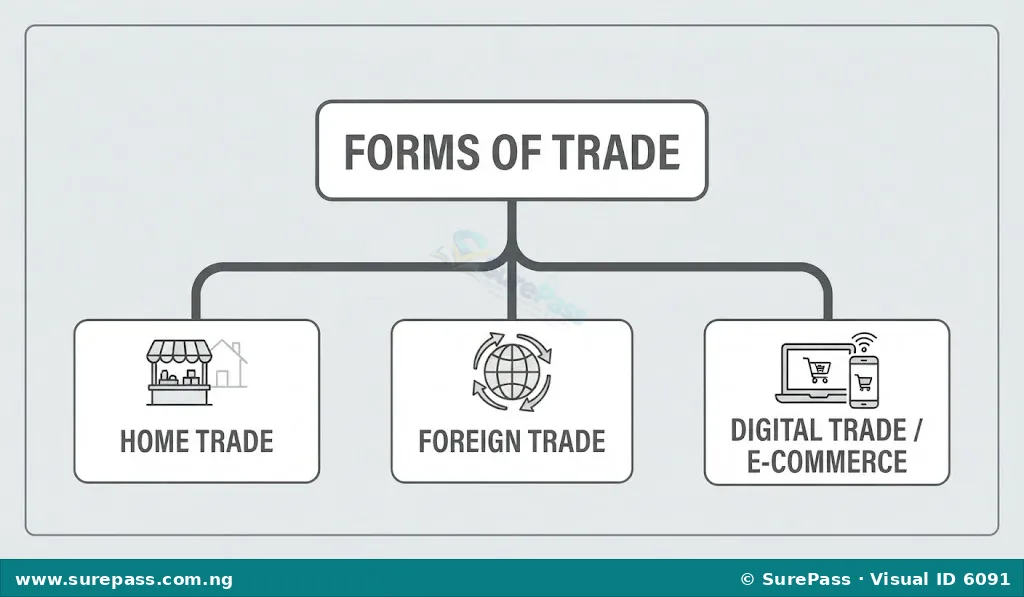
Home Trade
Home trade, also known as domestic trade or internal trade, involves the exchange of goods and services within the geographical boundaries of a single country.
This type of trade occurs between individuals, businesses, or regions located in the same nation. It is typically conducted using the national currency and is subject to the laws and regulations of that country.
Advantages of Home Trade
Home trade offers several benefits to a country’s economy:
-
No Currency Exchange Issues: Transactions are conducted in the local currency, eliminating the need for currency conversion and associated risks.
-
Familiarity with Laws and Culture: Traders are familiar with the local laws, customs, and consumer preferences, which simplifies business operations.
-
Lower Transportation Costs: Generally, goods do not have to travel long distances, leading to lower transportation expenses compared to international trade.
-
Faster Delivery: Goods can be delivered more quickly within the country, improving efficiency and customer satisfaction.
-
Supports Local Industries: Home trade encourages the growth of domestic industries, creating jobs and fostering national economic self-reliance.
Disadvantages of Home Trade
Despite its advantages, home trade also has some drawbacks:
-
Limited Market Size: The market is restricted to the population within the country, which may limit growth opportunities for businesses.
-
Lack of Variety: Consumers may have access to a limited range of goods and services if the country does not produce a wide variety of items.
-
Less Competition: Reduced competition from foreign businesses can sometimes lead to higher prices or lower quality products from domestic producers.
-
Inefficient Resource Utilisation: A country might not be able to fully utilise its abundant resources if there is no demand for them within its borders.
Foreign Trade
Foreign trade, also known as international trade or external trade, involves the exchange of goods and services between different countries.
This form of trade includes exports (selling goods and services to other countries) and imports (buying goods and services from other countries). It is more complex than home trade due to differences in currencies, laws, languages, and cultures.
Advantages of Foreign Trade
Foreign trade provides significant benefits to participating countries:
-
Access to Wider Markets: Businesses can sell their products to a global audience, leading to increased sales, production, and profits.
-
Greater Variety of Goods: Consumers gain access to a wider range of products and services that may not be available or produced efficiently domestically.
-
Specialisation and Efficiency: Countries can specialise in producing goods where they have a comparative advantage, leading to more efficient use of global resources and lower production costs.
-
Technological Advancement: Importing advanced technology and machinery can help domestic industries modernise and improve their production processes.
-
Foreign Exchange Earnings: Exports generate foreign currency, which is vital for a country’s balance of payments and for financing imports.
-
Increased Competition: Foreign competition can encourage domestic producers to improve quality, innovate, and offer competitive prices.
Disadvantages of Foreign Trade
Foreign trade also comes with its own set of challenges:
-
Currency Fluctuations: Changes in exchange rates can make imports more expensive or exports less profitable, creating financial risks for traders.
-
Trade Barriers: Countries often impose tariffs, quotas, and other restrictions on imports, which can hinder trade flow and increase costs.
-
Political and Economic Risks: Political instability, wars, or economic crises in trading partner countries can disrupt trade relationships and supply chains.
-
Cultural and Language Barriers: Differences in culture, language, and business practices can lead to misunderstandings and difficulties in negotiations.
-
High Transportation Costs: Shipping goods across international borders often involves higher transportation and logistics costs.
-
Competition for Domestic Industries: Local industries may struggle to compete with cheaper or higher-quality imported goods, potentially leading to job losses.
Digital Trade / E-commerce
Digital trade, commonly known as e-commerce, involves the buying and selling of goods and services using electronic networks, primarily the internet.
This form of trade allows transactions to occur online, often across geographical boundaries, without the need for physical presence. It includes online retail, digital services, and electronic payments.
Advantages of Digital Trade / E-commerce
E-commerce offers numerous benefits for businesses and consumers:
-
Global Reach: Businesses can reach customers anywhere in the world, expanding their market far beyond physical locations.
-
24/7 Availability: Online stores operate continuously, allowing customers to shop at any time, day or night.
-
Lower Operating Costs: E-commerce businesses often have lower overhead costs compared to traditional brick-and-mortar stores, as they may not require physical storefronts or large sales teams.
-
Convenience for Consumers: Customers can shop from the comfort of their homes, compare prices easily, and have products delivered to their doorstep.
-
Wider Product Selection: Online platforms can offer a much larger inventory and variety of products than physical stores.
-
Personalisation and Data Analytics: E-commerce platforms can collect data on customer preferences, allowing for personalised recommendations and targeted marketing.
Disadvantages of Digital Trade / E-commerce
Despite its advantages, digital trade also presents challenges:
-
Lack of Physical Interaction: Customers cannot physically inspect or try on products before purchasing, which can lead to dissatisfaction or returns.
-
Security Concerns: Online transactions carry risks of data breaches, fraud, and identity theft, requiring robust security measures.
-
Shipping and Delivery Issues: Delays in shipping, damaged goods, or high delivery costs can be a deterrent for customers.
-
Returns and Refunds: Managing returns and refunds can be complex and costly for e-commerce businesses.
-
Intense Competition: The global nature of e-commerce means businesses face competition from a vast number of online retailers.
-
Technical Glitches: Website crashes, payment gateway failures, or other technical issues can disrupt sales and customer experience.
Distinguishing Among Forms of Trade
The key differences between home trade, foreign trade, and digital trade lie in their geographical scope, regulatory environment, and operational characteristics.
-
Geographical Scope: Home trade is confined within national borders, foreign trade crosses international borders, and digital trade can occur both domestically and internationally through online platforms.
-
Currency: Home trade typically uses a single national currency. Foreign trade involves multiple currencies and exchange rate considerations. Digital trade can use various payment methods, including local currencies, international currencies, and sometimes cryptocurrencies.
-
Laws and Regulations: Home trade is governed by domestic laws. Foreign trade is subject to international trade laws, customs duties, and regulations of multiple countries. Digital trade is governed by a mix of national and international laws, particularly concerning data privacy, consumer protection, and taxation.
-
Physical Presence: Home and foreign trade traditionally involve physical movement of goods and often require physical storefronts or distribution centres. Digital trade primarily operates virtually, with physical goods shipped from warehouses.
-
Barriers: Home trade faces fewer barriers. Foreign trade encounters tariffs, quotas, and non-tariff barriers. Digital trade faces challenges like internet access, digital literacy, and cyber security threats.
Buying and Selling Goods
Buying and selling are the core activities of trade, whether conducted locally or internationally, physically or digitally. The process involves several fundamental steps and considerations.
How to Engage in Buying and Selling
The process of buying and selling involves a series of steps that ensure a smooth transaction between a buyer and a seller.
-
Identify a Need or Product: The process begins when a buyer identifies a need for a product or service, or a seller identifies a product to offer.
-
Search for Suppliers/Buyers: Buyers search for suitable suppliers, while sellers look for potential customers. This can involve market research, advertising, or using online platforms.
-
Negotiation: Buyers and sellers discuss terms such as price, quantity, quality, delivery schedule, and payment methods. This stage often involves negotiation to reach a mutually agreeable deal.
-
Agreement and Contract: Once terms are agreed upon, a formal or informal agreement is made. For larger transactions, a contract may be drawn up to legally bind both parties.
-
Payment: The buyer makes payment according to the agreed terms. This could be cash, bank transfer, mobile money, or other electronic payment methods.
-
Delivery of Goods/Services: The seller delivers the goods or provides the service to the buyer as per the agreement. This involves logistics such as packaging, transportation, and customs clearance for foreign trade.
-
After-Sales Service (Optional): For some products, especially durable goods, sellers may provide after-sales services like installation, warranty, or maintenance.
Considerations for Buying and Selling at Home and Abroad
While the basic steps remain similar, buying and selling across different trade forms require specific considerations.
-
For Home Trade:
-
Local Market Knowledge: Understanding local demand, competition, and distribution channels is key.
-
Domestic Regulations: Adhering to national business laws, taxation, and consumer protection policies.
-
Logistics: Efficient local transportation networks are important for timely delivery.
-
-
For Foreign Trade:
-
International Market Research: Thorough research into foreign markets, including cultural nuances, consumer preferences, and economic conditions.
-
Currency Exchange: Managing foreign exchange risks and understanding international payment systems.
-
Customs and Tariffs: Navigating import/export duties, customs procedures, and international trade agreements.
-
International Shipping: Arranging for international freight, insurance, and compliance with global shipping regulations.
-
Legal and Political Risks: Awareness of political stability and legal frameworks in trading partner countries.
-
-
For Digital Trade (E-commerce):
-
Online Platform Selection: Choosing the right e-commerce platform or building a suitable website.
-
Digital Marketing: Using online advertising, social media, and search engine optimisation to reach customers.
-
Secure Payment Gateways: Implementing reliable and secure online payment systems.
-
Data Privacy: Complying with data protection laws (e.g., GDPR, NDPR in Nigeria) when collecting customer information.
-
Customer Service: Providing effective online customer support for inquiries, complaints, and returns.
-




0 comments
Open the discussion when you need it. Comments stay collapsed until requested so the initial article remains light.