


ARTICLE CONTENTSOn this page 5 sections
Economic systems
Performance Objectives
By the end of the lesson, students should be able to:
- define economic system;
- identify different types economic systems and their features;
- evaluate the advantages and disadvantages of the different economic systems;
- analyze the features of each economic system and give an example of countries that have practiced/ practicing each economic system.
Meaning of Economic System
An economic system is a framework that a society uses to organise and distribute its available resources, goods, and services to meet the needs and wants of its members.
Every society faces the fundamental economic problem of scarcity, meaning that resources are limited while human wants are unlimited. To address this, societies must decide what to produce, how to produce it, and for whom to produce it. The way these decisions are made defines a society’s economic system.
Types and Features of Economic Systems
There are four main types of economic systems, each with distinct features, advantages, and disadvantages. These systems determine how economic decisions are made and how resources are allocated.
1. Traditional Economic System
A traditional economic system is one where economic decisions are based on customs, traditions, beliefs, and habits passed down from generation to generation.
In this system, people produce what their ancestors produced, using the same methods. Exchange often occurs through barter, and there is little innovation or technological advancement. Economic roles are usually inherited, and social structures are often rigid.
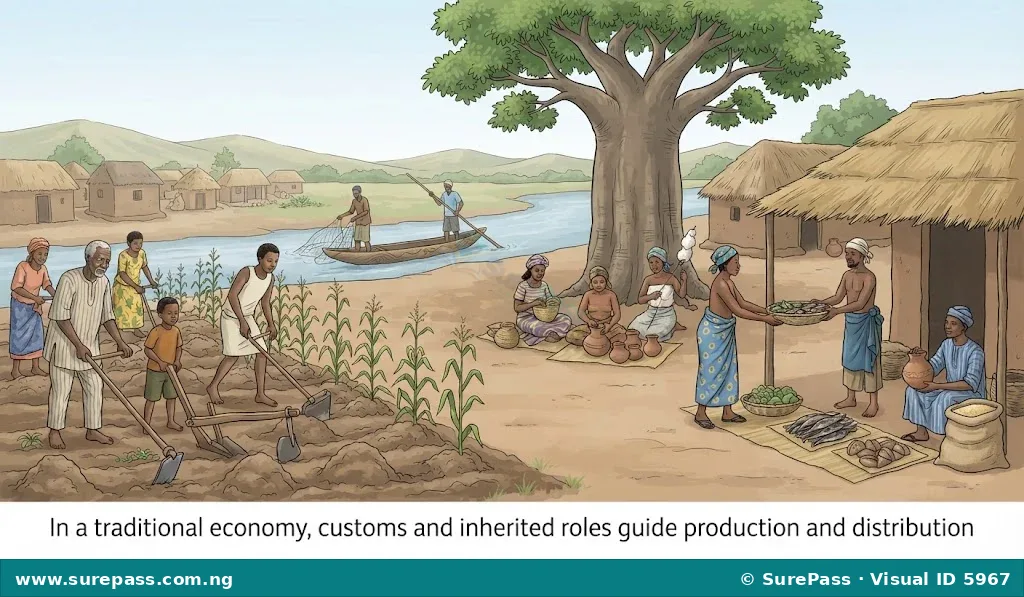
Features of a Traditional Economic System:
- Custom and Tradition: Economic decisions are primarily guided by long-standing customs, traditions, and beliefs.
- Subsistence Production: Production is mainly for self-consumption or the immediate community, with little surplus for trade.
- Barter System: Goods and services are often exchanged directly without the use of money.
- Limited Technology: Production methods are basic and rely on simple tools and traditional techniques.
- Inherited Roles: Occupations and economic roles are often passed down from parents to children.
- Slow to Change: There is little innovation or adoption of new technologies, leading to slow economic growth.
- Community Focus: Strong emphasis on community welfare and cooperation rather than individual profit.
Advantages of a Traditional Economic System:
- Stability and Predictability: Economic roles and decisions are clear, leading to a stable and predictable environment.
- Strong Social Ties: Close-knit communities and strong family bonds are fostered due to shared traditions and cooperation.
- Environmental Sustainability: Production methods are often in harmony with nature, leading to less environmental damage.
- Low Economic Inequality: Resources and wealth are often shared more equally within the community.
Disadvantages of a Traditional Economic System:
- Lack of Innovation: Resistance to change hinders technological advancement and economic progress.
- Low Standard of Living: Limited production and lack of specialisation often result in a low standard of living.
- Vulnerability to External Shocks: Dependence on natural resources makes these economies vulnerable to natural disasters or climate change.
- Limited Choices: Consumers have few choices of goods and services.
Examples of countries that have practiced or still practice elements of a traditional economic system include some indigenous communities in parts of Africa, South America, and Asia, where traditional farming and hunting practices persist.
2. Capitalism (Market Economy)
Capitalism, also known as a market economy or free enterprise system, is an economic system where the means of production are privately owned, and economic decisions are primarily driven by market forces (supply and demand).
In a capitalist system, individuals and private businesses make most of the decisions about what to produce, how to produce it, and for whom to produce it, with minimal government intervention. Competition among businesses is a key feature, aiming to maximise profit.
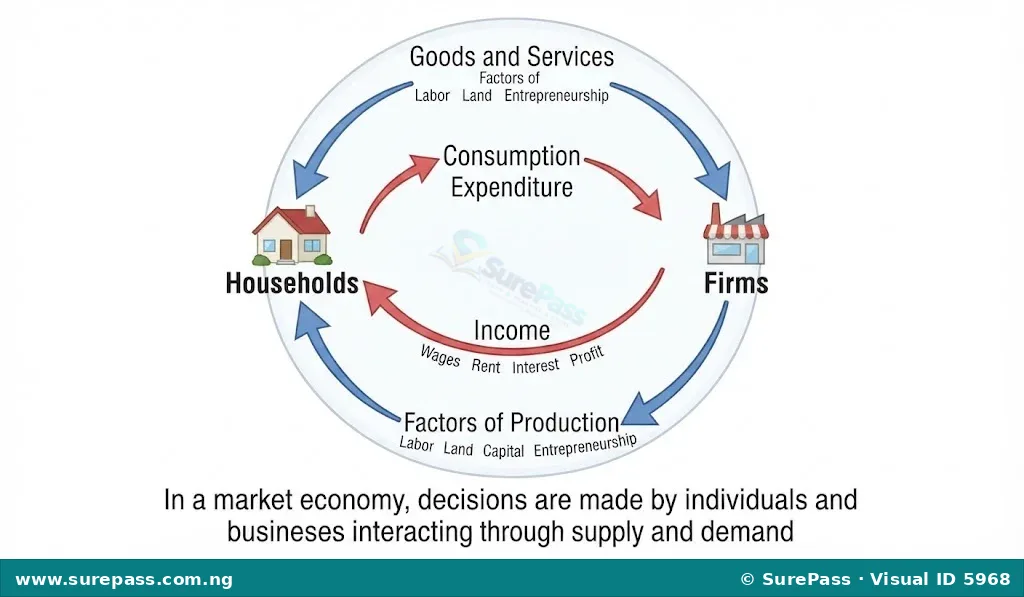
Features of Capitalism:
- Private Ownership of Resources: Most productive resources (land, factories, capital) are owned by individuals and private businesses.
- Profit Motive: Individuals and businesses are driven by the desire to maximise profit.
- Competition: Businesses compete with each other to attract customers, leading to innovation and efficiency.
- Consumer Sovereignty: Consumers largely determine what is produced through their purchasing decisions.
- Limited Government Intervention: The government’s role in the economy is minimal, primarily focusing on enforcing laws and contracts.
- Freedom of Enterprise and Choice: Individuals are free to start businesses, choose occupations, and make economic decisions.
- Price System: Prices are determined by the interaction of supply and demand in markets.
Advantages of Capitalism:
- Efficiency and Innovation: Competition and the profit motive encourage businesses to produce goods and services efficiently and innovate.
- Economic Growth: The pursuit of profit and innovation often leads to higher productivity and economic growth.
- Consumer Choice: Competition provides consumers with a wide variety of goods and services to choose from.
- Individual Freedom: Individuals have the freedom to pursue their economic interests and make choices.
Disadvantages of Capitalism:
- Income Inequality: The system can lead to significant disparities in wealth and income, as some individuals accumulate more resources than others.
- Market Failures: Markets may fail to provide certain public goods (like national defence) or address negative externalities (like pollution).
- Boom and Bust Cycles: Capitalist economies can experience periods of rapid growth followed by recessions or depressions.
- Monopolies: Successful businesses can sometimes grow so large that they eliminate competition, leading to monopolies.
Examples of countries that largely operate under capitalism include the United States, Canada, Australia, and many Western European nations, although most have some degree of government regulation.
3. Socialism (Command Economy)
Socialism, often associated with a command economy or centrally planned economy, is an economic system where the government or a central authority owns and controls most of the means of production and makes all major economic decisions.
In this system, the government decides what to produce, how to produce it, and for whom to produce it, aiming to allocate resources in a way that benefits society as a whole and reduces inequality. Private property rights are often limited.
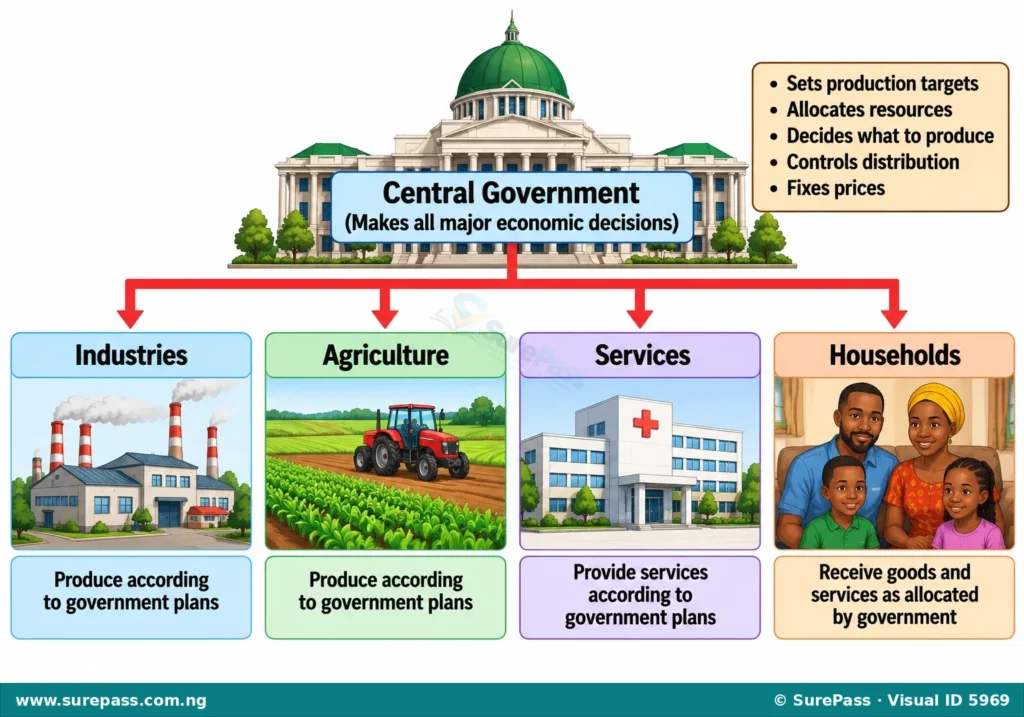
Features of Socialism:
- Central Planning: Economic decisions are made by a central planning authority or the government.
- State Ownership of Resources: Most productive resources (land, factories, banks) are owned and controlled by the state.
- Collective Goals: Production is aimed at meeting collective societal needs rather than individual profit.
- Limited Consumer Choice: The government determines the types and quantities of goods and services available.
- Income Equality: Efforts are made to distribute income and wealth more equally among citizens.
- Lack of Competition: State-owned enterprises often operate without competition.
- Bureaucracy: Economic activities are often managed through large government bureaucracies.
Advantages of Socialism:
- Reduced Inequality: The government aims to distribute wealth and resources more evenly, reducing income disparities.
- Provision of Public Goods: Essential services like healthcare, education, and housing are often provided universally by the state.
- Economic Stability: Central planning can potentially avoid the boom and bust cycles of market economies.
- Social Welfare: A strong social safety net is typically in place to protect vulnerable citizens.
Disadvantages of Socialism:
- Lack of Efficiency: Without competition and the profit motive, state-owned enterprises may be less efficient and innovative.
- Limited Consumer Choice: Central planning can lead to shortages or surpluses of goods and services, and limited variety.
- Lack of Innovation: Bureaucracy and lack of incentives can stifle innovation and technological progress.
- Loss of Individual Freedom: Economic freedoms, such as starting a business or choosing an occupation, may be restricted.
- Information Problems: Central planners may struggle to gather and process all the information needed to make effective economic decisions.
Examples of countries that have practiced or still practice elements of a command economy include Cuba, North Korea, and historically, the Soviet Union and China (before its economic reforms).
4. Mixed Economy
A mixed economy combines elements of both capitalism and socialism, incorporating both private enterprise and government intervention in economic decision-making.
Most modern economies are mixed economies, as they recognise the benefits of market efficiency while also acknowledging the need for government regulation and social welfare provisions. The degree of mix varies significantly from country to country.
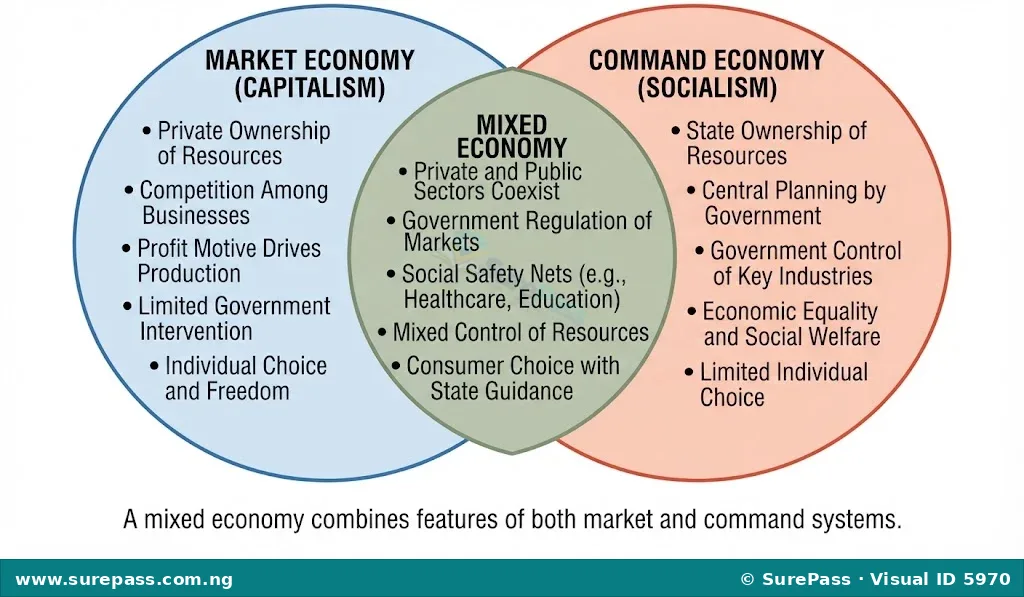
Features of a Mixed Economy:
- Coexistence of Private and Public Sectors: Both private individuals/businesses and the government own and control productive resources.
- Market Mechanisms and Government Regulation: Market forces guide many economic decisions, but the government intervenes to regulate markets, provide public goods, and address social issues.
- Social Safety Nets: Governments often provide social welfare programmes such as unemployment benefits, healthcare, and education.
- Consumer and Producer Freedom with Limits: Individuals and businesses have economic freedoms, but these are subject to government laws and regulations.
- Progressive Taxation: Tax systems are often designed to redistribute income and fund public services.
- Competition and Monopoly Control: Governments encourage competition while also regulating or breaking up monopolies.
Advantages of a Mixed Economy:
- Efficiency and Innovation: The private sector’s profit motive encourages efficiency and innovation.
- Social Welfare: Government intervention helps to provide essential services and a social safety net, reducing inequality.
- Economic Stability: Governments can use fiscal and monetary policies to stabilise the economy and mitigate recessions.
- Greater Choice: Consumers benefit from a wide range of goods and services from both private and public sectors.
- Flexibility: The system can adapt to changing economic conditions by adjusting the balance between market forces and government intervention.
Disadvantages of a Mixed Economy:
- Inefficiency: Government intervention can sometimes lead to bureaucracy, inefficiency, and slower decision-making.
- Higher Taxes: Funding social welfare programmes and public services often requires higher taxes.
- Potential for Corruption: Extensive government involvement can create opportunities for corruption.
- Difficulty in Balancing: Finding the right balance between private freedom and government control can be challenging.
- Less Economic Freedom: Compared to pure capitalism, there is less individual economic freedom due to regulations and taxes.
Most countries in the world today operate as mixed economies, including Nigeria, the United Kingdom, Germany, France, and India. The specific blend of market and command elements varies significantly among these nations.
Comparing Economic Systems
The differences between economic systems can be clearly seen when comparing their features, advantages, and disadvantages. Understanding these distinctions helps to explain why different countries organise their economies in particular ways.
A comparison of the main features of different economic systems is shown below:
| Feature | Traditional Economy | Capitalism (Market Economy) | Socialism (Command Economy) | Mixed Economy |
|---|---|---|---|---|
| Decision Making | Customs, traditions | Market forces (supply & demand) | Central government planning | Market forces & government intervention |
| Resource Ownership | Communal/Tribal | Private ownership | State ownership | Both private & state ownership |
| Motivation | Survival, community welfare | Profit motive | Collective welfare, equality | Profit motive & social welfare |
| Innovation | Very low | High | Low | Moderate to high |
| Government Role | Minimal (customs rule) | Minimal (regulator, enforcer) | Extensive (planner, owner) | Significant (regulator, provider, owner) |
| Consumer Choice | Very limited | Wide | Limited | Moderate to wide |
| Income Inequality | Low | High potential | Low potential | Moderate |

0 comments
Open the discussion when you need it. Comments stay collapsed until requested so the initial article remains light.