


ARTICLE CONTENTSOn this page 7 sections
Money
Performance Objectives
By the end of the lesson, students should be able to:
- explain the meaning and evolution of money;
- state the classification of money;
- discuss the characteristics and functions of money.
Meaning of Money
Money is anything that is generally accepted as a medium of exchange for goods and services, and for the settlement of debts.
In simple terms, money is what people use to buy things. Without money, trade would be much more difficult, as people would have to exchange goods and services directly.
Evolution of Money
The way people exchange goods and services has changed significantly over time. The evolution of money describes this journey from simple direct exchange to the complex financial systems of today.
Barter System
The earliest form of exchange was the barter system. This involved the direct exchange of goods and services for other goods and services without the use of money.
For example, a farmer might exchange a bag of yams for a fisherman’s catch, or a tailor might exchange clothes for a carpenter’s furniture. While simple, the barter system had many challenges.
The challenges of the barter system included:
- Double Coincidence of Wants: Both parties in a transaction must want what the other has to offer. For instance, the yam farmer must want fish, and the fisherman must want yams.
- Lack of Common Measure of Value: It was difficult to determine the exact value of one good in terms of another. How many yams are equal to one fish?
- Indivisibility of Certain Goods: Some goods could not be easily divided without losing their value. For example, it is hard to exchange half a cow.
- Difficulty in Storing Wealth: Perishable goods like food could not be stored for long periods without spoiling.
Commodity Money
To overcome the problems of barter, societies began to use certain commodities as money. These items were chosen because they were generally desired, durable, and easily divisible.
Commodity money refers to items that have intrinsic value (value in themselves) and are also used as a medium of exchange. Examples of commodity money used in different parts of the world and in Nigeria’s history include cowries, salt, tobacco, gold, silver, and even livestock.
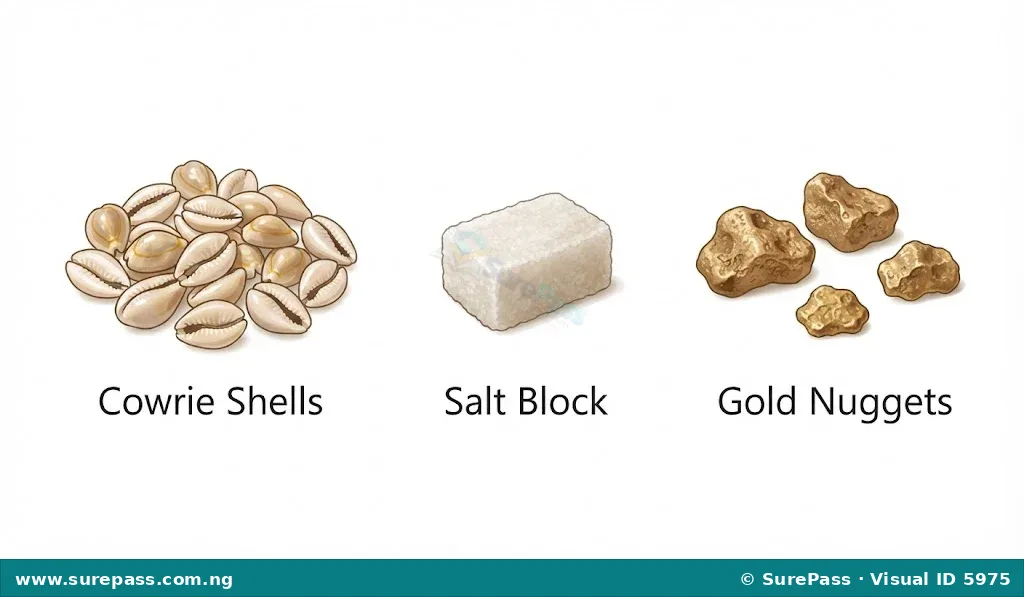
While commodity money was an improvement, it still had limitations. For example, the value of commodities could fluctuate, and they could be heavy or difficult to transport in large quantities.
Metallic Money
As societies developed, precious metals like gold and silver became widely accepted as money. These metals were durable, divisible, portable, and had high value in small quantities.
Metallic money was often weighed or minted into coins of specific weights and purity. This made transactions easier and more reliable than using raw commodities.
Paper Money (Banknotes)
The use of metallic money led to the development of paper money. Initially, goldsmiths or banks issued receipts for gold and silver deposited with them. These receipts, being easier to carry, began to be used as a medium of exchange.
Over time, governments and central banks took over the issuance of paper money, which was initially backed by reserves of gold or silver. Today, most paper money is fiat money, meaning its value is not derived from a physical commodity but from government decree and public trust.
Plastic Money (Debit and Credit Cards)
With advancements in technology, plastic cards like debit and credit cards emerged. These cards represent a promise to pay and allow individuals to make transactions without carrying physical cash.
Debit cards directly deduct money from a bank account, while credit cards allow purchases on credit, to be paid back later.
Electronic Money (E-money)
Electronic money, or e-money, refers to money that exists only in digital form and is exchanged electronically. This includes funds held in online bank accounts, mobile wallets, and digital payment systems.
E-money has become increasingly popular due to its convenience, speed, and security for transactions.
Cryptocurrency
Cryptocurrency is a modern form of digital money that uses cryptography for security and operates on a decentralised network called a blockchain. Unlike traditional currencies, cryptocurrencies are not typically issued by a central bank or government.
Examples include Bitcoin and Ethereum. While gaining popularity, their use as a general medium of exchange is still developing and can be volatile.
Classification of Money
Money can be classified into different forms based on its nature and how it is used.
Traditional Forms of Money
Traditional forms of money are those that have been used historically or are still in use today in their physical forms.
- Commodity Money: This is money that has intrinsic value, meaning it has value in itself apart from its use as money. Examples include cowries, gold, silver, and salt. These items were chosen because they were generally accepted and useful for other purposes.
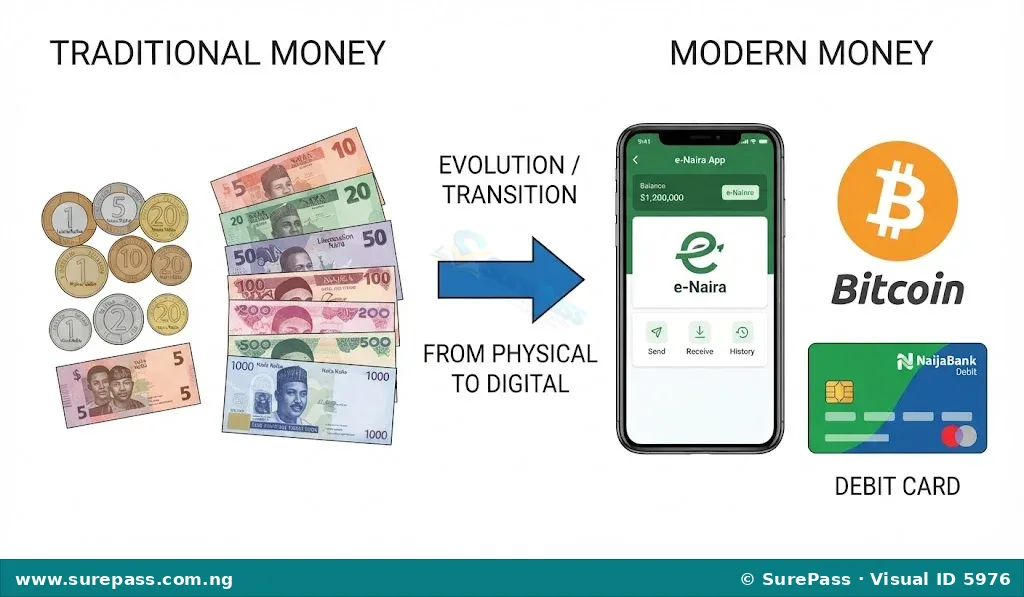
- Fiat Money: This is money that has no intrinsic value but is declared by a government to be legal tender. Its value comes from government decree and the public’s trust in it. Most modern paper currencies, like the Nigerian Naira, are fiat money.
- Representative Money: This is money that represents a claim to a commodity, such as a gold certificate that can be exchanged for a specific amount of gold. While not explicitly mentioned in the seed, it’s a common traditional classification that bridges commodity and fiat money.
Modern Forms of Money
Modern forms of money leverage technology for digital transactions and new types of digital assets.
- E-Naira: This is Nigeria’s Central Bank Digital Currency (CBDC). It is a digital form of the Nigerian Naira, issued and regulated by the Central Bank of Nigeria. It serves as a legal tender and is designed to complement physical cash.
- Cryptocurrency: As discussed earlier, this is a decentralised digital currency secured by cryptography. It operates independently of a central bank. Examples include Bitcoin and Ethereum.
- Mobile Money: This refers to money stored on a mobile phone and used for transactions via mobile networks. It allows users to send, receive, and store money using their phones, often without a traditional bank account.
- Digital Wallets: These are electronic devices or online services that allow an individual to make electronic transactions. This can include storing debit/credit card information, e-Naira, or other digital currencies for easy online or in-store payments.
Characteristics of Money
For anything to serve effectively as money, it must possess certain characteristics. These features ensure that money can perform its functions reliably.
- Acceptability: Money must be generally accepted by everyone in a society as a medium of exchange. If people do not trust or accept it, it cannot function as money.
- Portability: Money should be easy to carry from one place to another. Physical cash is portable, and modern digital money is even more so, existing on phones or cards.
- Durability: Money must be able to withstand wear and tear over time. It should not easily perish or disintegrate. Coins are very durable, and banknotes are made from special materials to last longer.
- Divisibility: Money should be easily divisible into smaller units without losing its value. This allows for transactions of different values. For example, the Naira can be divided into kobo, though kobo coins are less commonly used now.
- Homogeneity: All units of money of the same denomination should be identical in appearance and value. One N100 note should be exactly the same as any other N100 note.
- Scarcity (Limited Supply): Money must be relatively scarce to maintain its value. If money is too abundant, it loses its purchasing power, leading to inflation.
- Recognisability: Money should be easily identifiable and difficult to counterfeit. This helps to prevent fraud and maintain public trust.
- Stability of Value: While not perfectly stable, money should ideally maintain a relatively stable value over time. Rapid fluctuations in value make it less useful as a store of value and a medium of exchange.
Functions of Money
Money performs several crucial functions in an economy, making transactions and economic activities much smoother than the barter system.
1. Medium of Exchange
This is the primary function of money. Money acts as an intermediary in transactions, eliminating the need for a double coincidence of wants. Instead of exchanging goods directly, people sell their goods or services for money and then use that money to buy other goods or services.
For example, a teacher receives a salary in Naira and uses that Naira to buy food, pay for transport, and purchase clothes. The seller of food accepts the Naira because they know they can use it to buy other things they need.
2. Measure of Value (Unit of Account)
Money provides a common standard for measuring the value of different goods and services. It allows us to express the price of everything in monetary terms, making it easy to compare the worth of various items.
For instance, a bag of rice might cost N30,000, and a pair of shoes might cost N15,000. This allows us to easily see that the bag of rice is worth twice as much as the pair of shoes.
3. Store of Value
Money allows people to save their purchasing power for future use. Instead of spending all their income immediately, individuals can hold money and use it to buy goods and services later. This is particularly important for saving and investment.
For example, a trader who sells goods today can keep the money earned and use it next month to buy new stock or pay for their children’s school fees.
4. Standard of Deferred Payments
Money serves as a standard for future payments, especially in credit transactions. When people borrow or lend money, the repayment amount is usually specified in monetary terms.
This function is essential for loans, mortgages, and other forms of credit, as it provides a clear way to settle debts over time. For example, when a person takes a loan from a bank, the repayment schedule and amounts are all stated in Naira.



0 comments
Open the discussion when you need it. Comments stay collapsed until requested so the initial article remains light.