


ARTICLE CONTENTSOn this page 8 sections
Concepts of Economics
Performance Objectives
By the end of the lesson, students should be able to:
- define economics;
- differentiate between micro economics and macroeconomics;
- explain the basic concepts of Economics;
- state the importance of Economics;
- explain why Economics is a science.
Meaning of Economics
Economics is a social science that studies how individuals, households, firms, and governments make choices about how to allocate scarce resources to satisfy their unlimited wants.
It examines how societies manage their limited resources to produce goods and services, and how these goods and services are distributed among people. The core problem in economics is scarcity, which means that human wants for goods, services, and resources exceed what is available.
Branches of Economics
Economics is broadly divided into two main branches: Microeconomics and Macroeconomics. These branches focus on different levels of economic activity and decision-making.
Microeconomics
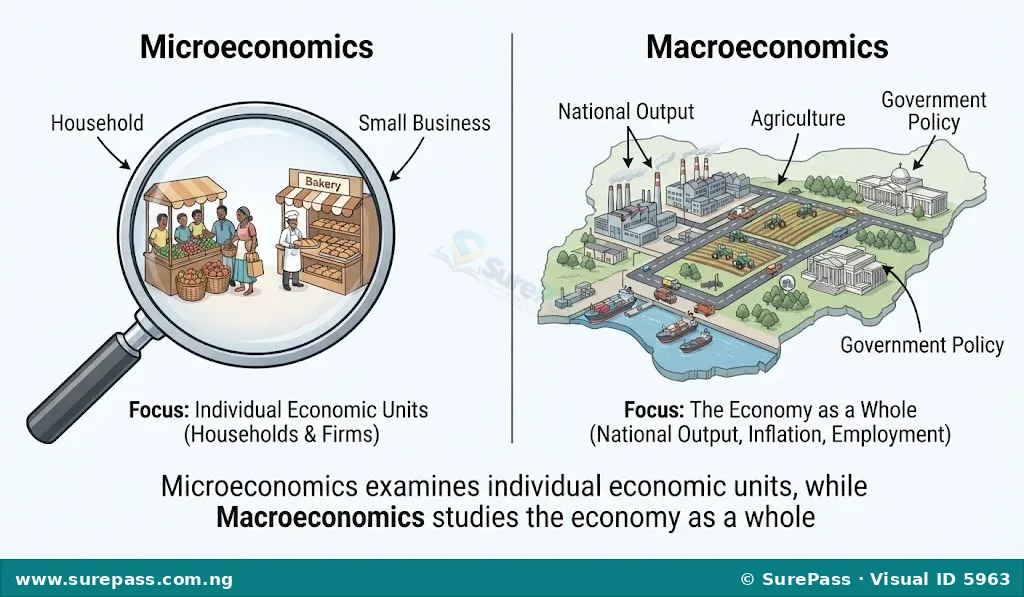
Microeconomics is the branch of economics that studies the behaviour of individual economic units. These units include individual consumers, households, firms, and industries.
Microeconomics focuses on how these individual units make decisions regarding the allocation of resources and prices of goods and services. It examines specific markets, individual prices, quantities, and the factors that influence them. For example, microeconomics would study why the price of yam increases, how a single company decides its production level, or how a consumer chooses what to buy.
Macroeconomics
Macroeconomics is the branch of economics that studies the economy as a whole. It focuses on aggregate economic phenomena, meaning the overall performance and behaviour of national or global economies.
Macroeconomics examines broad issues such as national income, total employment, inflation, economic growth, and government policies like taxation and spending. It looks at the big picture, for instance, why Nigeria’s unemployment rate is high, what causes general price increases across the country, or how government policies affect the entire economy.
Differentiating Microeconomics and Macroeconomics
The main difference between microeconomics and macroeconomics lies in their scope and focus. Microeconomics deals with individual parts of the economy, while macroeconomics deals with the economy as a whole.
Microeconomics looks at specific markets and individual decision-makers, such as a single farmer deciding how much maize to plant or a family deciding how much food to buy. Macroeconomics, on the other hand, considers the total output of all farmers in the country or the total spending by all families in the nation.
Basic Economic Concepts
Several fundamental concepts are central to understanding economics. These concepts help explain how individuals and societies make decisions in the face of limited resources.
Scarcity
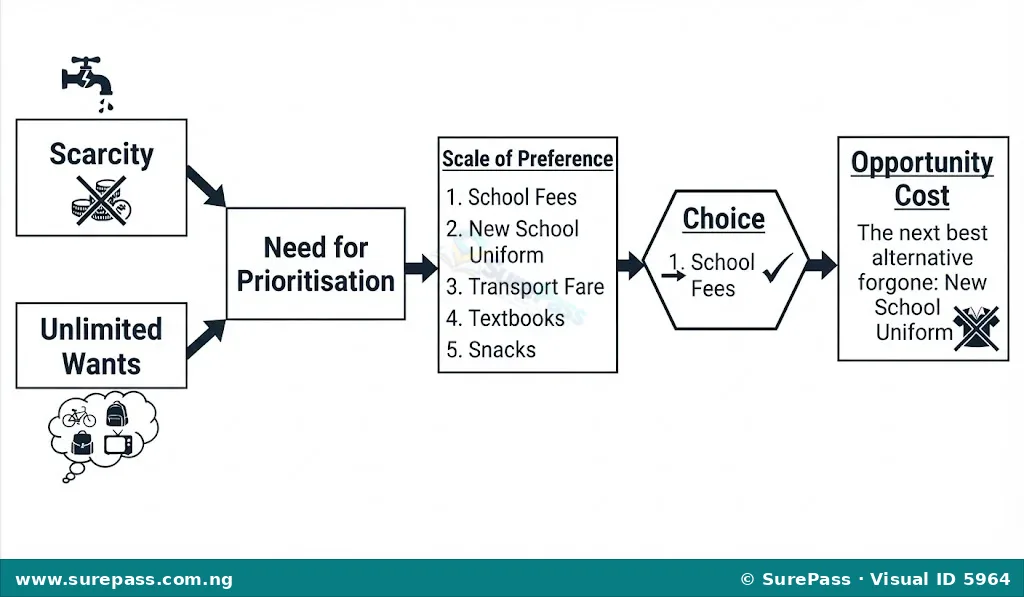
Scarcity is the fundamental economic problem that arises because human wants for goods, services, and resources exceed what is available.
Resources such as land, labour, capital, and entrepreneurship are limited, but human desires for food, shelter, clothing, entertainment, and other goods and services are virtually unlimited. Because resources are scarce, not all wants can be satisfied. This forces individuals and societies to make choices about what to produce and consume.
Wants
Wants are the desires of individuals for goods and services that provide satisfaction.
Human wants are numerous and insatiable, meaning they can never be fully satisfied. As one want is met, another often arises. Wants can range from basic necessities like food and water to luxuries like expensive cars or holidays. The unlimited nature of wants, combined with scarce resources, creates the need for economic decision-making.
Scale of Preference
A scale of preference is a list of an individual’s or a society’s wants arranged in order of their importance or priority, from the most urgent to the least urgent.
Because resources are scarce and wants are unlimited, individuals and societies must decide which wants to satisfy first. Creating a scale of preference helps in making rational choices by clearly identifying the most important wants that should be met before others. For example, a student might list paying school fees as their most important want, followed by buying textbooks, then a new phone, and finally going to a concert.
Choice
Choice is the act of selecting one particular want or option from a set of available alternatives, usually based on a scale of preference.
Since scarcity prevents the satisfaction of all wants, individuals and societies must make choices. These choices involve deciding which wants to satisfy and which to leave unsatisfied. A rational choice is typically made by selecting the most highly ranked want on a scale of preference that can be afforded with available resources.
Opportunity Cost
Opportunity cost is the value of the next best alternative that was forgone when a choice was made.
Every choice involves a trade-off. When a decision is made to satisfy one want, another want must be given up. The opportunity cost is not the sum of all other alternatives, but specifically the value of the single best alternative that was not chosen. For example, if a farmer decides to plant maize on a piece of land, the opportunity cost is the profit that could have been earned from planting beans, which was the next best alternative crop for that land.
Importance of Economics
The study of economics is important for individuals, businesses, and governments for several reasons:
- For Individuals: Economics helps individuals make better decisions about their personal finances, such as how to spend their income, save for the future, and invest wisely. It teaches them to prioritise their wants and understand the concept of opportunity cost in their daily lives.
- For Businesses: Businesses use economic principles to make decisions about production, pricing, and resource allocation. Understanding market demand, supply, and competition helps firms maximise profits and operate efficiently.
- For Governments: Governments rely on economic knowledge to formulate policies that promote economic growth, control inflation, reduce unemployment, and improve the welfare of citizens. Economic analysis guides decisions on taxation, public spending, and international trade.
- Resource Allocation: Economics provides tools for societies to allocate their scarce resources efficiently among competing uses. This ensures that resources are used in ways that provide the greatest benefit to the most people.
- Understanding Global Issues: Economics helps in understanding complex global issues such as poverty, inequality, international trade, and environmental challenges, and in developing strategies to address them.
Why Economics is a Science
Economics is considered a social science because it employs scientific methods to study human behaviour related to resource allocation. While it does not deal with physical phenomena like natural sciences, it shares key characteristics with scientific disciplines:
- Systematic Study: Economics involves the systematic observation, collection, and analysis of data related to economic activities. Economists gather information on prices, production, employment, and other variables.
- Formulation of Theories and Laws: Based on observations and data analysis, economists develop theories and models to explain economic phenomena. These theories, like the law of demand or the law of supply, aim to describe general patterns of behaviour.
- Use of Scientific Methods: Economists use logical reasoning, hypothesis testing, and empirical evidence to validate or refute their theories. They often use statistical tools and mathematical models to analyse data and make predictions.
- Prediction: Economic theories allow economists to make predictions about future economic events or the likely outcomes of certain policies. For example, an economist might predict the effect of a tax increase on consumer spending.
- Objectivity (to an extent): Although human behaviour can be complex and influenced by many factors, economists strive for objectivity in their analysis, separating personal opinions from factual observations and logical deductions.
However, unlike natural sciences, economics deals with human behaviour, which can be unpredictable and influenced by psychological and social factors. This makes it challenging to conduct controlled experiments and achieve the same level of precision as in physics or chemistry. Despite these challenges, its systematic approach and reliance on empirical evidence firmly establish economics as a science.
Classifying Economic Activities: Micro and Macro Components
Understanding the difference between microeconomics and macroeconomics is crucial for classifying economic activities. Microeconomic activities focus on individual units, while macroeconomic activities focus on the economy as a whole.
The following examples illustrate how various economic activities can be classified:
- A household deciding how much rice to buy: This is a microeconomic activity because it involves the decision-making of a single household, an individual economic unit.
- The Nigerian government increasing the national minimum wage: This is a macroeconomic activity because it affects the income of a large number of workers across the entire economy and has implications for national consumption and inflation.
- A shoe factory deciding to increase its production of sandals: This is a microeconomic activity as it pertains to the production decision of a single firm within an industry.
- The Central Bank of Nigeria (CBN) raising interest rates to control inflation: This is a macroeconomic activity because it is a monetary policy aimed at influencing the overall price level and economic stability of the entire nation.
- A student choosing between buying a textbook or a new pair of shoes: This is a microeconomic activity, representing an individual’s choice and resource allocation.
- The total value of all goods and services produced in Nigeria in a year (Gross Domestic Product – GDP): This is a macroeconomic concept, as it measures the aggregate output of the entire national economy.
- A local market trader setting the price for fresh tomatoes: This is a microeconomic activity, involving pricing decisions in a specific market for a particular good.
- The national unemployment rate rising due to a recession: This is a macroeconomic activity, as it describes a widespread economic condition affecting the entire labour force of the country.



0 comments
Open the discussion when you need it. Comments stay collapsed until requested so the initial article remains light.