


ARTICLE CONTENTSOn this page 10 sections
Population I
Performance Objectives
By the end of the lesson, students should be able to:
- define population, population growth and population;
- explain the classifications of population;
- state the merits and demerits of population growth;
- identify the factors affecting population growth and distribution.
Meaning of Population
Population refers to the total number of people living in a specific geographical area, such as a country, state, or city, at a particular time.
It is a count of all individuals residing within defined boundaries, whether they are citizens or non-citizens, permanent residents or temporary inhabitants.
Meaning of Population Growth
Population growth is the increase in the number of individuals in a population over a specific period.
This growth occurs when the number of births and people moving into an area (immigration) is greater than the number of deaths and people moving out of the area (emigration).
Meaning of Population Distribution
Population distribution describes the way people are spread out across a geographical area.
It shows where people live and where they do not, often highlighting areas of high population density (many people in a small area) and low population density (few people in a large area).
Classification of Population
Economists classify population into three main categories based on the relationship between the number of people and the available resources and technology in a country. These classifications help to understand the economic implications of a country’s population size.
Under-population
Under-population occurs when the available natural resources and capital in a country are more than sufficient to be fully utilised by the existing population, leading to under-utilisation of resources.
In an under-populated country, there are not enough people to effectively exploit all the resources, which can result in low productivity per person and a smaller overall output for the economy. Such a country could benefit from an increase in its population to achieve its full economic potential.
Over-population
Over-population exists when the number of people in a country is too large relative to the available natural resources, capital, and technology, making it difficult to maintain a high standard of living for everyone.
In an over-populated country, the population size puts excessive pressure on resources like food, housing, healthcare, and employment, often leading to a decline in the average standard of living, increased poverty, and environmental degradation.
Optimum Population
Optimum population is the ideal population size for a country, where the number of people is perfectly balanced with the available resources and technology to achieve the highest possible standard of living or per capita income for its citizens.
At the optimum level, resources are efficiently utilised, and the economy operates at its maximum potential, providing the best quality of life for its people without straining the environment or depleting resources unsustainably.
Merits of Population Growth
Population growth can bring several economic advantages to a country, especially when managed effectively. These merits include:
- Increased Labour Force: A growing population means a larger pool of workers, which can boost production and economic activity, especially in industries that require many hands.
- Larger Market Size: More people mean a larger domestic market for goods and services. This can encourage local businesses to produce more, leading to economies of scale and lower prices.
- Increased Production: With a larger labour force and market, there is potential for increased production of goods and services, contributing to higher Gross Domestic Product (GDP).
- Innovation and Creativity: A larger population can lead to more diverse ideas, skills, and talents, fostering innovation and technological advancements that drive economic progress.
- Military Strength: A larger population can provide a stronger base for national defence and security.
Demerits of Population Growth
While population growth has merits, uncontrolled or rapid growth can also lead to significant economic and social challenges. These demerits include:
- Unemployment: Rapid population growth can outpace the creation of jobs, leading to high rates of unemployment and underemployment, especially among young people.
- Pressure on Social Amenities: A growing population demands more schools, hospitals, housing, water, and electricity. If these amenities do not expand at the same rate, it leads to overcrowding and reduced quality of services.
- Low Standard of Living: When population grows faster than economic output, the per capita income may fall, leading to a lower standard of living for the average person.
- Increased Crime Rate: Poverty, unemployment, and competition for scarce resources, often associated with rapid population growth, can contribute to an increase in crime and social unrest.
- Environmental Degradation: More people consume more resources and generate more waste, leading to deforestation, pollution, soil erosion, and other environmental problems.
- Increased Dependency Ratio: High birth rates can lead to a large proportion of young dependents who rely on the working population, placing a burden on the economy.
Factors Affecting Population Growth
The size of a country’s population changes due to several key demographic factors. These factors determine whether a population increases, decreases, or remains stable over time.
- Birth Rate (Natality): This refers to the number of live births per 1,000 people in a year. A high birth rate contributes to population growth, while a low birth rate slows it down. Factors like cultural norms, access to family planning, education, and economic conditions influence birth rates.
- Death Rate (Mortality): This is the number of deaths per 1,000 people in a year. A low death rate, often due to improved healthcare, sanitation, and nutrition, contributes to population growth. High death rates, caused by diseases, famine, or conflict, reduce population growth.
- Migration: This involves the movement of people from one place to another.
- Immigration: The movement of people into a country from another country. High immigration rates increase the population.
- Emigration: The movement of people out of a country to another country. High emigration rates decrease the population.
Factors Affecting Population Distribution
The way people are spread across a country is influenced by a combination of geographical, economic, social, and political factors. These factors determine why some areas are densely populated while others are sparsely populated.
- Geographical Factors:
- Climate: Areas with favourable climates (moderate temperatures, sufficient rainfall) tend to attract more people than areas with extreme heat, cold, or aridity.
- Topography: Flat plains and river valleys are often more densely populated than mountainous or rugged terrains because they are easier to build on, farm, and develop infrastructure.
- Water Availability: Access to fresh water for drinking, agriculture, and industry is crucial, making areas near rivers, lakes, and reliable water sources more attractive for settlement.
- Natural Resources: Regions rich in natural resources like fertile soil, minerals (e.g., oil, tin, coal), and forests often attract populations due to economic opportunities.
- Economic Factors:
- Employment Opportunities: Areas with industries, businesses, and job prospects (e.g., cities, industrial zones) attract people seeking work.
- Infrastructure: Regions with well-developed infrastructure like roads, electricity, communication networks, and markets tend to be more populated.
- Agricultural Land: Fertile agricultural areas support large rural populations, especially in agrarian economies.
- Social Factors:
- Education and Healthcare: Areas with good schools, universities, hospitals, and other social services attract families and individuals.
- Cultural and Historical Factors: Some areas have historical significance or cultural importance that draws and retains populations.
- Political Factors:
- Government Policies: Government decisions on regional development, establishment of new towns, or provision of incentives can influence where people choose to live.
- Security: Areas that are politically stable and secure tend to attract more residents than conflict-prone regions.
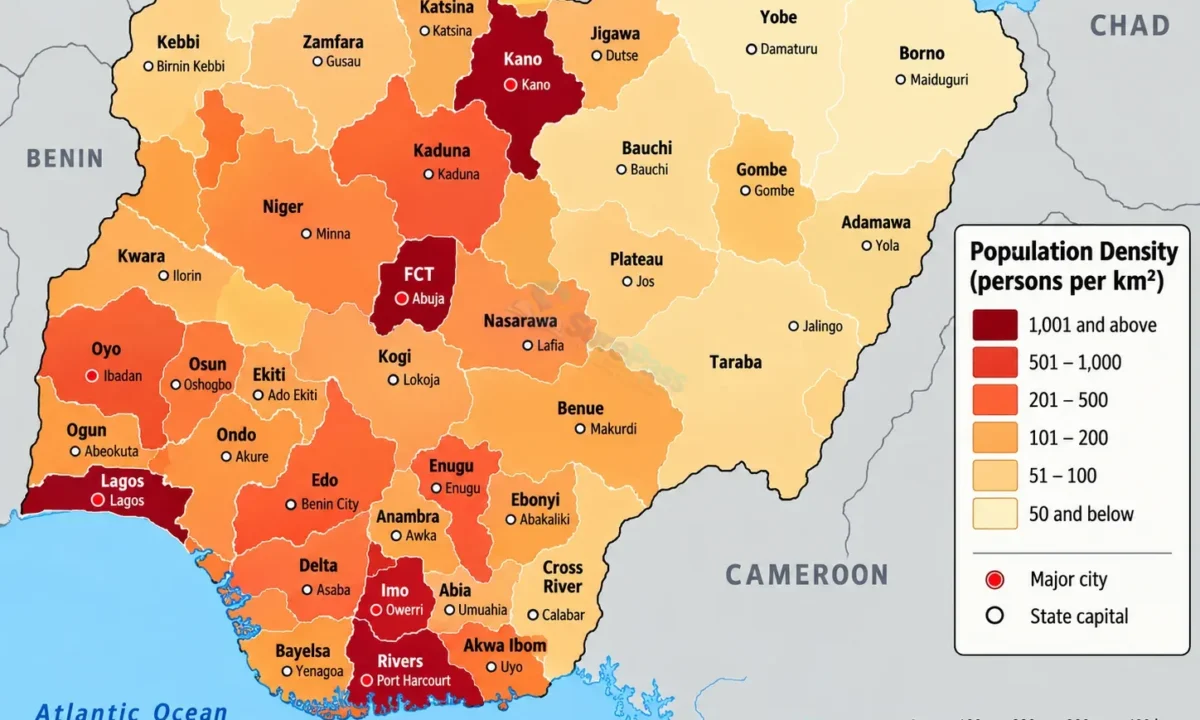
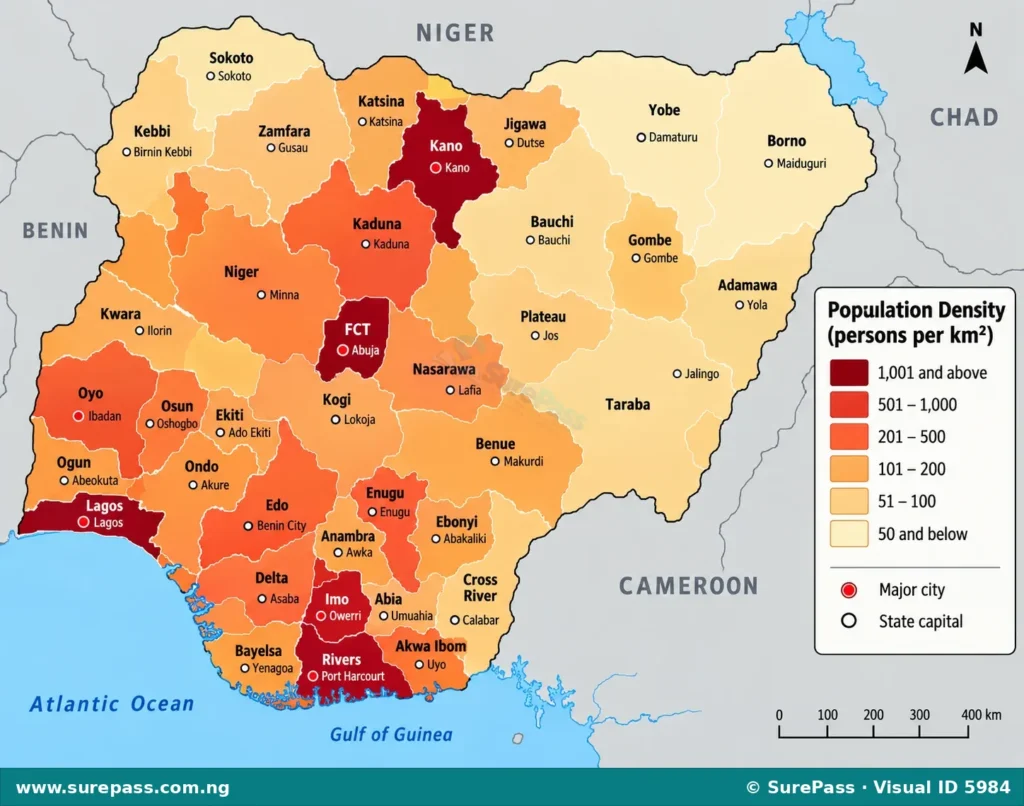
The map below illustrates how population is distributed across Nigeria, showing areas of higher and lower density.




0 comments
Open the discussion when you need it. Comments stay collapsed until requested so the initial article remains light.