


ARTICLE CONTENTSOn this page 6 sections
Theory of Production
Performance Objectives
By the end of the lesson, students should be able to:
- define production and explain the types of production;
- identify the factors of production and their characteristics;
- explain the difference between division of labour and specialization;
- identify the merits and demerits of division of labour;
- differentiate between small- and large-scale production.
Understanding Production
Production is the process of creating goods and services to satisfy human wants.
It involves transforming raw materials and other inputs into finished products or useful services. For example, a baker uses flour, sugar, eggs, and heat to produce bread. A tailor uses fabric, thread, and a sewing machine to produce clothes. A teacher provides the service of education.
Types of Production
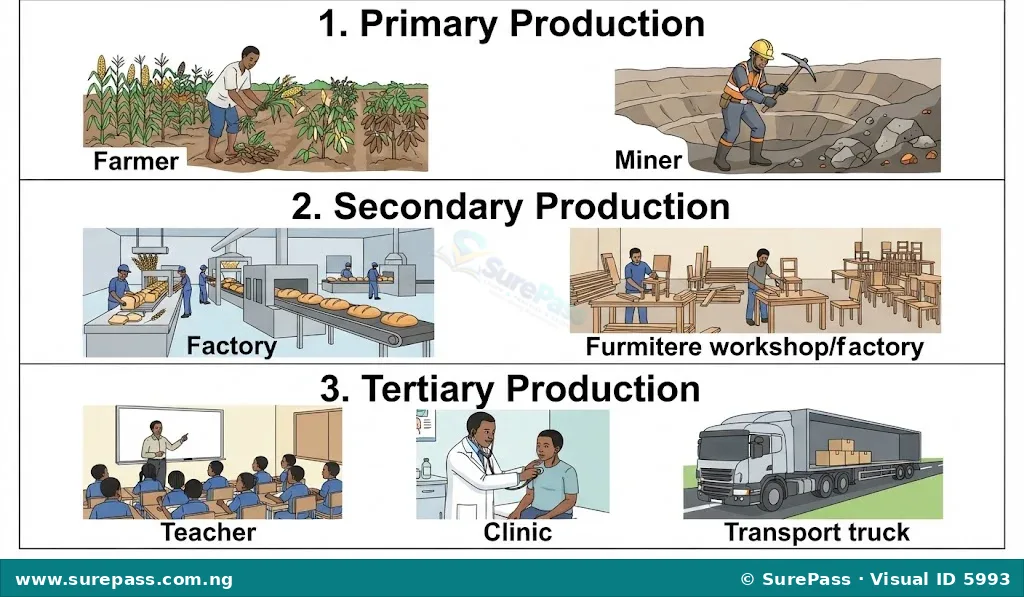
Production can be broadly categorised into three main types based on the stage of economic activity:
- Primary Production: This involves the extraction of raw materials directly from nature. It is the first stage of production.
- Secondary Production: This involves transforming raw materials into finished or semi-finished goods. It is the manufacturing stage.
- Tertiary Production: This involves providing services that support primary and secondary production, as well as direct consumer services.
Primary Production
Primary production involves activities that extract natural resources from the earth or sea. These resources serve as raw materials for further production or are consumed directly.
Examples of primary production activities include:
- Agriculture (farming, crop cultivation, livestock rearing)
- Fishing (catching fish and other aquatic animals)
- Forestry (logging, timber extraction)
- Mining (extraction of minerals like crude oil, coal, gold, iron ore)
- Quarrying (extraction of stones, sand, and gravel)
Secondary Production
Secondary production takes the raw materials obtained from primary production and converts them into finished goods or semi-finished products. This stage adds value to the raw materials through manufacturing and construction processes.
Examples of secondary production activities include:
- Manufacturing (producing cars, textiles, electronics, food processing)
- Construction (building houses, roads, bridges)
- Crafts (making pottery, weaving baskets, tailoring clothes)
Tertiary Production
Tertiary production, also known as the service sector, provides intangible services rather than physical goods. These services are essential for supporting primary and secondary production, and for meeting the direct needs of consumers.
Examples of tertiary production activities include:
- Transportation (moving goods and people)
- Banking and finance (providing loans, managing money)
- Education (teaching and learning)
- Healthcare (medical services)
- Retail and wholesale trade (selling goods to consumers)
- Communication (telecommunications, postal services)
- Tourism and hospitality (hotels, restaurants)
Factors of Production
Factors of production are the resources or inputs used to produce goods and services.
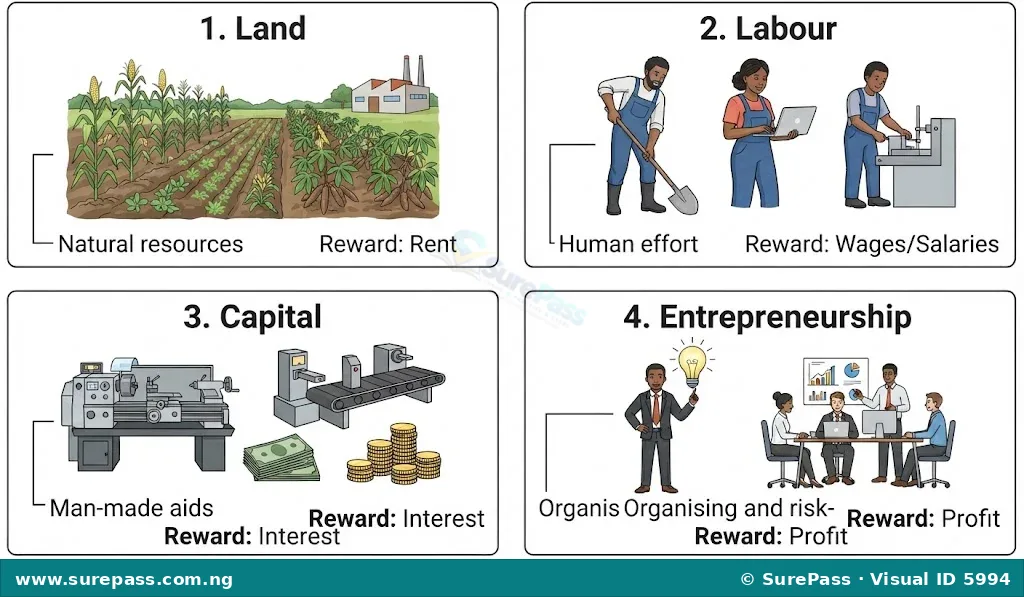
These resources are combined in various ways to create output. Economists traditionally identify four main factors of production:
- Land
- Labour
- Capital
- Entrepreneurship (or Organisation)
Land
Land, in economics, refers to all natural resources provided by nature that are used in production. It includes not just the surface of the earth, but also everything found above and below it.
Examples of land as a factor of production include:
- Agricultural land for farming
- Forests for timber
- Mineral deposits (crude oil, natural gas, coal, gold)
- Rivers, lakes, and oceans for fishing and transportation
- Climate and sunlight
The reward for land is rent.
Characteristics of Land
- Fixed in Supply: The total quantity of land on Earth is fixed and cannot be increased or decreased by human effort.
- Immobile: Land cannot be moved from one location to another.
- Heterogeneous: Land varies in quality, fertility, and location. No two pieces of land are exactly alike.
- Subject to the Law of Diminishing Returns: Beyond a certain point, increasing other factors of production on a fixed piece of land will lead to a less than proportionate increase in output.
- Gift of Nature: Land is not produced by human effort; it is a natural endowment.
Labour
Labour refers to all human effort, both physical and mental, directed towards the production of goods and services.
It includes the work done by farmers, factory workers, teachers, doctors, engineers, and artists. The quality and quantity of labour available in an economy are crucial for its productive capacity.
The reward for labour is wages or salaries.
Characteristics of Labour
- Human Factor: Labour is a human factor of production, involving human beings with feelings, emotions, and personal goals.
- Perishable: Labour cannot be stored. If a worker is absent for a day, the labour for that day is lost forever and cannot be recovered.
- Mobile: Labour can move from one place to another (geographical mobility) and from one occupation to another (occupational mobility).
- Heterogeneous: Workers differ in skills, education, experience, and productivity.
- Cannot be Separated from the Labourer: The labourer must be present to provide the labour.
Capital
Capital refers to all man-made resources used in the production of other goods and services. It is not consumed directly but aids in further production.
Examples of capital include:
- Machinery and equipment (tractors, factory machines, computers)
- Buildings (factories, offices, warehouses)
- Tools (hammers, wrenches, sewing machines)
- Infrastructure (roads, bridges, power plants)
- Raw materials and semi-finished goods held in stock
The reward for capital is interest.
Characteristics of Capital
- Man-made: Capital is produced by human effort, unlike land which is a gift of nature.
- Mobile: Capital, especially financial capital, can be moved easily. Physical capital like machinery can also be moved, though sometimes with difficulty.
- Depreciates: Capital goods wear out over time and lose value due to use, age, or obsolescence.
- Productive: Capital increases the productivity of labour and land.
- Accumulated through Savings: Capital is formed when a portion of current income is saved and invested rather than consumed.
Entrepreneurship (or Organisation)
Entrepreneurship is the factor of production that organises and coordinates the other factors of production (land, labour, and capital) to produce goods and services. It involves taking risks and making decisions.
An entrepreneur is the individual who performs these functions. They identify business opportunities, gather resources, innovate, and bear the risks associated with production.
The reward for entrepreneurship is profit.
Characteristics of Entrepreneurship
- Risk-bearing: Entrepreneurs take financial and business risks.
- Decision-making: Entrepreneurs make key decisions regarding what, how, and for whom to produce.
- Innovation: Entrepreneurs often introduce new ideas, products, processes, or methods of production.
- Organisation and Coordination: Entrepreneurs bring together and manage land, labour, and capital effectively.
- Dynamic: Entrepreneurs are adaptable and respond to changes in the market and economic environment.
Division of Labour and Specialisation
Meaning of Division of Labour
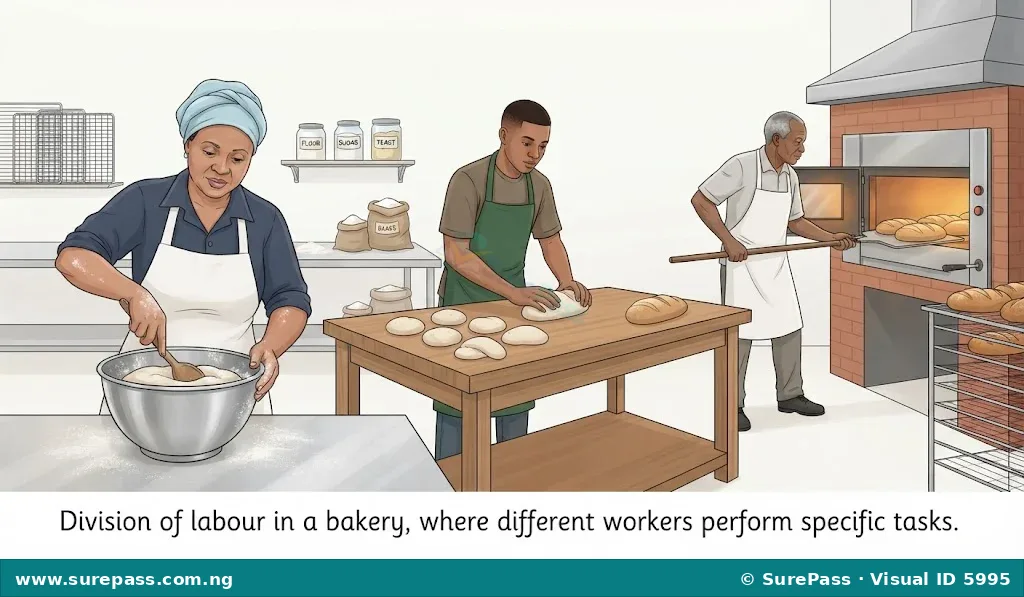
Division of labour is the breaking down of the production process into separate tasks, with each worker or group of workers performing a specific task.
Instead of one person completing an entire product, different people perform different parts of the work. For example, in a garment factory, one worker might cut the fabric, another might sew the sleeves, and another might attach the buttons.
Meaning of Specialisation
Specialisation is the concentration of an individual, firm, region, or country on the production of a particular good or service in which they have an advantage.
It arises naturally from the division of labour, as workers become highly skilled in their specific tasks. A tailor specialises in making clothes, a farmer specialises in growing crops, and Nigeria might specialise in crude oil production.
Difference between Division of Labour and Specialisation
While closely related, division of labour and specialisation are distinct concepts:
- Division of Labour: This refers to the process of splitting a production task into smaller, distinct operations. It is about how work is organised within a production unit.
- Specialisation: This refers to the outcome where individuals or entities focus on producing a particular good or service, or performing a specific task, due to their expertise or efficiency. It is about what is produced or what task is mastered.
Division of labour is a method of organising work, while specialisation is the result of that method, leading to expertise in a particular area.
Merits of Division of Labour
The division of labour offers several advantages in production:
- Increased Output: Workers become more efficient and faster at their specific tasks, leading to a higher quantity of goods produced in the same amount of time.
- Time Saving: Workers do not waste time moving from one task to another or changing tools.
- Skill Development: By repeatedly performing the same task, workers develop greater skill and expertise, becoming specialists.
- Use of Machinery: Division of labour makes it easier to introduce and use specialised machinery, as tasks are simplified and standardised.
- Reduced Training Time: Training workers for a single, simple task is quicker and less expensive than training them for all aspects of production.
- Discovery of New Methods: Specialised workers may discover new and more efficient ways to perform their tasks.
Demerits of Division of Labour
Despite its advantages, division of labour also has some drawbacks:
- Monotony and Boredom: Performing the same repetitive task for long periods can lead to boredom, lack of job satisfaction, and reduced morale.
- Loss of Craftsmanship: Workers may lose the sense of pride and accomplishment that comes from creating a complete product.
- Interdependence: Production becomes highly interdependent. If one worker or section fails, the entire production line can be disrupted.
- Loss of Mobility: Workers specialised in a very narrow task may find it difficult to switch to other jobs if their specific skill is no longer needed.
- Risk of Unemployment: If a specialised task becomes automated or obsolete, the workers performing that task may face unemployment.
- Standardisation of Products: Division of labour often leads to mass production of identical goods, reducing variety and customisation.
Scale of Production
Scale of production refers to the volume or quantity of goods and services produced by a firm or industry.
It indicates the size of the production unit and the level of output it achieves. The scale of production can be broadly categorised into small-scale and large-scale production.
Small-Scale Production
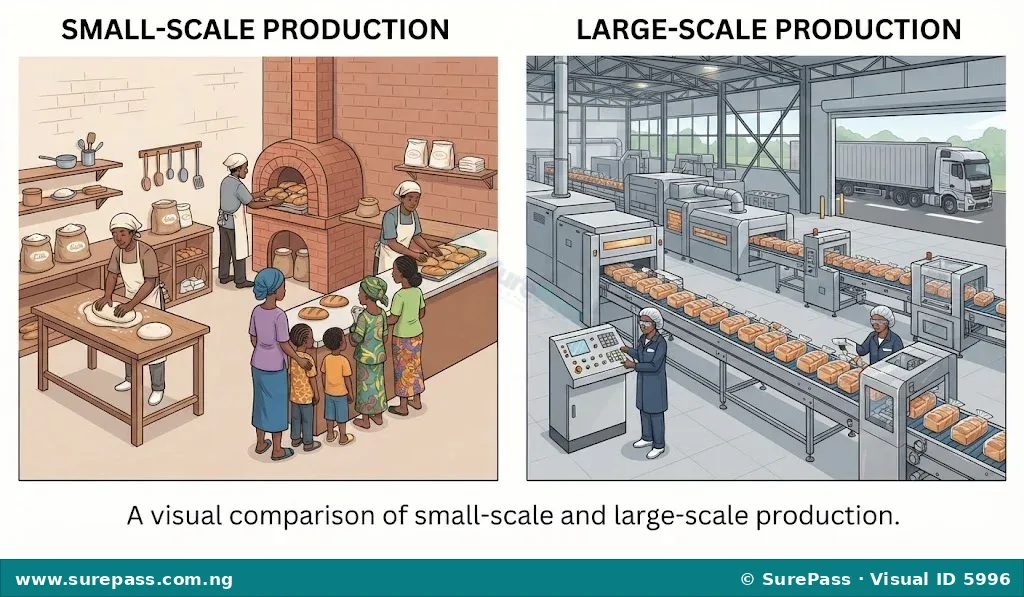
Small-scale production involves producing goods and services in relatively small quantities, typically with limited capital, labour, and machinery.
Small-scale businesses often serve local markets or cater to niche demands. Examples include local bakeries, tailoring shops, small craft workshops, and roadside mechanics.
Characteristics of Small-Scale Production
- Limited Capital: Requires a relatively small amount of investment in machinery, buildings, and raw materials.
- Simple Technology: Often uses basic tools and less complex machinery.
- Local Market: Primarily serves a local or regional market.
- Direct Supervision: Owners or managers can directly supervise workers and operations.
- Flexibility: Can easily adapt to changes in consumer tastes or market demand.
- Personalised Service: Often provides more personalised attention to customers.
Large-Scale Production
Large-scale production involves producing goods and services in very large quantities, typically using substantial capital, a large workforce, and advanced machinery.
Large-scale businesses often serve national or international markets. Examples include major manufacturing companies (e.g., car manufacturers, beverage companies), large commercial farms, and multinational corporations.
Characteristics of Large-Scale Production
- High Capital Investment: Requires significant investment in advanced machinery, large factories, and extensive infrastructure.
- Complex Technology: Employs sophisticated and often automated production processes.
- Wide Market Reach: Serves national and international markets.
- Specialised Management: Requires a complex organisational structure with specialised managers for different departments.
- Economies of Scale: Benefits from lower average costs of production as output increases.
- Standardised Products: Often produces uniform, standardised goods.
Differentiating Small-Scale and Large-Scale Production
The key differences between small-scale and large-scale production are:
- Output Volume: Small-scale produces low volume, while large-scale produces high volume.
- Capital Investment: Small-scale requires less capital, while large-scale requires significant capital.
- Technology Used: Small-scale uses simpler technology, while large-scale uses advanced and complex technology.
- Market Reach: Small-scale serves local markets, while large-scale serves national and international markets.
- Management Structure: Small-scale has direct supervision, while large-scale has a complex, hierarchical management structure.
- Flexibility: Small-scale is more flexible to changes, while large-scale can be less flexible due to high fixed costs.




0 comments
Open the discussion when you need it. Comments stay collapsed until requested so the initial article remains light.