



ARTICLE CONTENTSOn this page 6 sections
Basic Economic Problems
Performance Objectives
By the end of the lesson, students should be able to:
- identify the basic economic problems;
- analyze the basic economic problems.
Introduction to Economic Problems
Economics is the study of how people and societies make choices when faced with scarcity. Scarcity is the fundamental problem in economics. It means that human wants for goods, services, and resources exceed what is available. Resources, also known as factors of production, are limited, while human wants are unlimited.
Because resources are scarce, every society, whether rich or poor, must make choices about how to use its limited resources to satisfy its unlimited wants. These choices lead to what are known as the basic economic problems.
The Basic Economic Problems
Every society faces three fundamental economic problems that arise from scarcity. These problems are universal and must be addressed by individuals, businesses, and governments.
-
What to Produce?
This problem deals with the types and quantities of goods and services that an economy should produce. Since resources are limited, a society cannot produce everything its members want. It must choose which goods and services are most important and in what amounts. For example, a country might have to decide whether to produce more food crops or more cash crops for export. It might also need to decide between building more schools or more hospitals, or between producing consumer goods like mobile phones and capital goods like machinery.
The decision of what to produce reflects the priorities of a society. If a community needs better healthcare, it might prioritise building hospitals and training medical staff. If it needs to boost its economy, it might focus on producing goods that can be exported.
-
How to Produce?
Once a society decides what to produce, it must then determine the best method of production. This involves choosing the combination of resources (land, labour, capital, and entrepreneurship) and the techniques to be used. Production methods can be labour-intensive (using more human effort) or capital-intensive (using more machinery and technology).
For instance, a farmer might choose to cultivate land using traditional tools and manual labour (labour-intensive) or use tractors and modern irrigation systems (capital-intensive). A tailor might sew clothes by hand or use electric sewing machines. The choice of production method often depends on the availability and cost of resources. In a country with a large population and high unemployment, labour-intensive methods might be preferred to create jobs. In contrast, a country with high labour costs might opt for capital-intensive methods to increase efficiency and reduce production time.
-
For Whom to Produce?
This problem addresses how the goods and services produced are distributed among the members of society. It concerns who gets to consume the output of the economy. This distribution can be based on various factors, such as income, wealth, social status, or government policies.
For example, who gets access to quality education, affordable housing, or advanced healthcare? Is it only those who can pay the most, or are these services provided to everyone, perhaps through government subsidies? In Nigeria, for instance, the distribution of essential services like electricity, clean water, and good roads often raises questions about who benefits most and how equitable the distribution is across different regions and income groups. This problem highlights issues of fairness and equity within a society.
Efficiency of Resource Use
The concept of efficiency in economics refers to using resources in such a way that maximum output is achieved with minimum waste. Given the problem of scarcity, it is crucial for any society to use its limited resources as efficiently as possible.
Efficient resource use means:
- Producing the right goods: Ensuring that the goods and services produced are those most desired by society (addressing “what to produce” efficiently).
- Using the best methods: Employing production techniques that minimise costs and maximise output (addressing “how to produce” efficiently).
- Distributing fairly: Ensuring that goods and services reach those who need them most or those for whom they were intended, without significant waste or inequality (addressing “for whom to produce” efficiently).
When resources are used efficiently, a society can produce more goods and services, improve living standards, and better satisfy its unlimited wants despite scarcity. Inefficient use of resources leads to waste, lower output, and unmet needs.
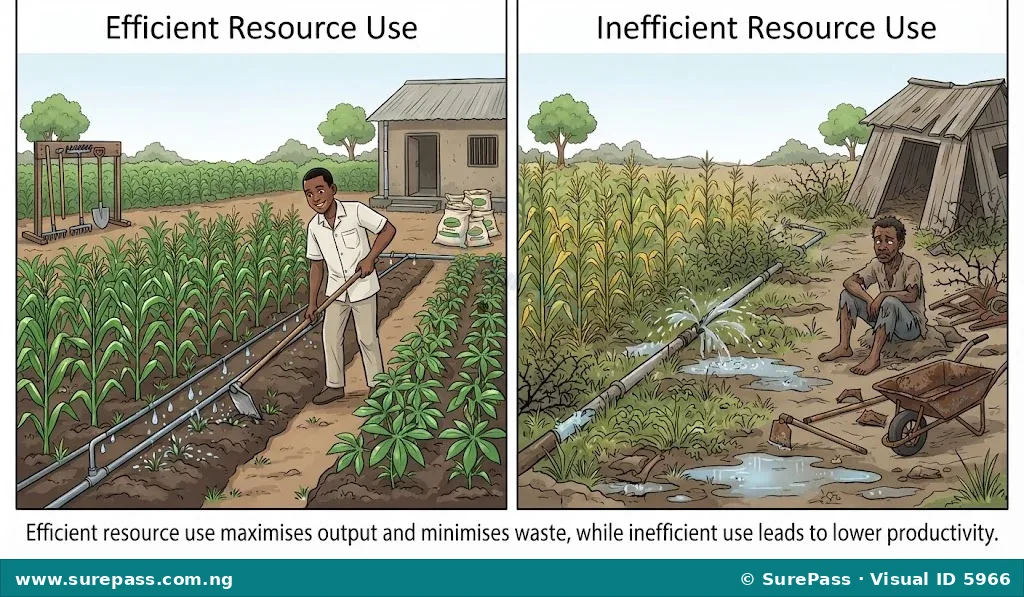
Examples of efficient resource use in Nigeria include:
- A farmer adopting modern farming techniques, using improved seeds, and applying the right amount of fertiliser to get a higher yield from the same piece of land.
- A factory investing in training its workers to operate machinery effectively, reducing errors and increasing production speed.
- A government agency implementing a transparent system for distributing relief materials to ensure they reach the intended beneficiaries without diversion.
- A community managing its waste effectively by recycling and composting, turning waste into useful resources like fertiliser.
Analyzing Economic Problems in the Immediate Environment
To understand basic economic problems better, it is helpful to analyze them within your immediate environment, such as your home, school, or community. This involves observing how choices are made due to limited resources.
The process of analyzing economic problems involves the following steps:
-
Identify the Scarce Resource: First, determine what resource is limited. This could be money, time, land, water, or even specific skills.
Example: In a household, the scarce resource might be the family’s monthly income.
-
Identify the Unlimited Wants: Next, list the various things that people want or need but cannot all be satisfied due to the scarce resource.
Example: The family wants food, clothes, school fees, electricity, entertainment, and savings.
-
Determine “What to Produce/Consume”: Observe the choices made regarding which goods and services are prioritised and consumed.
Example: The family decides to spend more on food and school fees, less on entertainment, and postpone buying new clothes.
-
Determine “How to Produce/Acquire”: Consider the methods used to obtain or produce the chosen goods and services.
Example: To save money, the family might cook meals at home instead of eating out, or mend old clothes instead of buying new ones.
-
Determine “For Whom to Produce/Distribute”: Observe how the available goods and services are shared among family members or community members.
Example: Food is shared among all family members, but perhaps older children get more responsibilities or specific allowances.
-
Assess Efficiency: Evaluate whether the resources are being used effectively to meet the most important wants with minimal waste.
Example: Is the family’s income being spent wisely to cover essential needs, or is there waste? Could they achieve more with the same income?
By applying these steps, you can better understand how scarcity forces choices and how these choices manifest as the basic economic problems in everyday life.




0 comments
Open the discussion when you need it. Comments stay collapsed until requested so the initial article remains light.