



ARTICLE CONTENTSOn this page 8 sections
Traffic Regulations
Performance Objectives
By the end of the lesson, students should be able to:
- explain the meaning of traffic regulations;
- discuss the traffic regulations;
- explain the roles of individuals, government agencies and NGO’s in maintaining traffic regulations;
- interpret traffic signs and signals.
Meaning of Traffic Regulations
Traffic regulations are the rules, laws and guidelines established by government authorities to govern the movement of vehicles, cyclists and pedestrians on public roads.
These rules are designed to ensure the orderly flow of traffic, protect road users from accidents and reduce congestion. In Nigeria, these regulations are codified in national laws, such as the National Road Traffic Regulations, and are enforced by various traffic management authorities to maintain safety on the highways.
Key Traffic Regulations
Road safety depends on the strict adherence to established rules. Safe road use requires every driver, passenger and pedestrian to understand and practice these guidelines daily.
The primary traffic regulations that govern road use include:
- Obeying Traffic Officials and Signs: Road users must comply with instructions given by authorized traffic officers and follow the directions indicated by road signs and markings.
- Avoiding Overspeeding: Drivers must adhere to designated speed limits. Speed limits vary depending on the type of road, such as residential areas, dual carriageways or expressways, and the type of vehicle being driven.
- Wearing Seatbelts and Safety Helmets: Drivers and passengers in motor vehicles must wear seatbelts at all times. Motorcyclists and their passengers are required to wear approved safety helmets to protect against head injuries.
- Avoiding Driving Under the Influence (DUI): Operating any vehicle while under the influence of alcohol, drugs or other intoxicating substances is illegal and highly dangerous.
- Avoiding the Use of Mobile Phones: Drivers must not make phone calls, send text messages or operate mobile devices while driving, as this causes severe distraction.
- Maintaining Lane Discipline: Drivers must stay within their designated lanes, avoid reckless overtaking and use indicators well in advance before turning or changing lanes.
- Respecting Pedestrian Rights: Drivers must yield to pedestrians at designated crossing points, such as zebra crossings, while pedestrians must use footbridges and pedestrian walks where available.
- Ensuring Vehicle Roadworthiness: Vehicles must be kept in good mechanical condition. Essential components such as brakes, tyres, headlights, indicators and windscreen wipers must function properly.
Interpreting Traffic Signs and Signals
Road signs and signals are visual tools used to communicate vital information to road users. They are categorized into traffic light signals, hand signals and road signs.
Traffic Light Signals
Traffic lights are automated signaling devices positioned at road intersections and pedestrian crossings to control the flow of vehicles and pedestrians.
The standard traffic light sequence consists of three colours:
- Red: This signal indicates an absolute command to stop. Vehicles must stop behind the stop line and must not proceed until the light turns green.
- Amber (Yellow): This signal indicates that the light is about to change to red. Drivers must slow down and stop, unless they are already so close to the intersection that stopping safely is impossible.
- Green: This signal indicates that vehicles may proceed in the direction indicated, provided the path is clear and it is safe to do so.
Categories of Road Signs
Road signs are divided into three main categories based on their shape, colour and purpose.
The three main categories of road signs are:
- Regulatory Signs: These signs give positive instructions or prohibitions that road users must obey. They are usually circular. Signs with red borders indicate prohibitions (e.g., “No Entry” or “Speed Limit”), while blue circles usually give positive mandatory instructions (e.g., “One Way” or “Keep Left”). The “Stop” sign (octagonal) and “Yield” sign (inverted triangle) are also regulatory signs.
- Warning Signs: These signs alert road users to potential hazards or dangerous conditions on the road ahead. They are typically triangular with a red border and a black symbol on a white or yellow background. Examples include “Sharp Bend Ahead,” “Narrow Bridge” and “Pedestrian Crossing.”
- Informative Signs: These signs provide directions, locations, distances and information about nearby services. They are usually rectangular or square with blue, green or white backgrounds. Examples include signs pointing to hospitals, filling stations, resting areas and specific towns.
Hand Signals
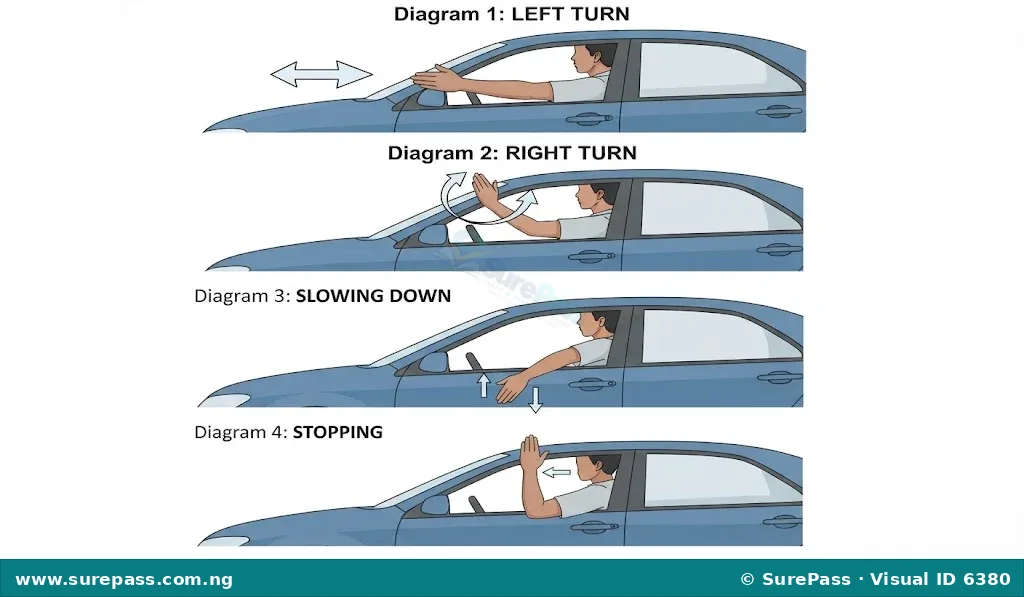
When traffic lights are non-functional or during heavy congestion, authorized traffic officials use hand signals to direct traffic. Drivers can also use hand signals to communicate their intentions to other road users if their vehicle’s electronic indicators fail.
Common hand signals used by drivers include:
- Turning Left: The driver extends the right arm straight out of the window horizontally.
- Turning Right: The driver extends the right arm out of the window and rotates it in a circular, forward motion.
- Slowing Down: The driver extends the right arm out of the window and moves it slowly up and down with the palm facing downwards.
- Stopping: The driver extends the right arm out of the window, bending the elbow upwards at a right angle with the palm facing forward.
Roles of Stakeholders in Maintaining Traffic Regulations
Maintaining order and safety on public roads is a collective responsibility. This effort involves individuals, government agencies and non-governmental organizations (NGOs).
Roles of Individuals
Every citizen has a personal responsibility to promote road safety.
The roles of individuals in maintaining traffic regulations include:
- Obeying Traffic Laws: Every driver, passenger and pedestrian must personally commit to following all traffic rules, signs and signals.
- Reporting Traffic Violations and Accidents: Individuals should report reckless driving, road hazards and accidents to the appropriate authorities immediately.
- Maintaining Vehicles: Vehicle owners must ensure that their cars, motorcycles or trucks are regularly serviced and kept in roadworthy conditions.
- Acquiring Proper Driving Education: Aspiring drivers must attend registered driving schools, pass the required driving tests and obtain a valid driver’s license before operating a vehicle.
Roles of Government Agencies
Government agencies are established by law to design, implement and enforce traffic regulations.
The key government agencies responsible for traffic management in Nigeria are:
- Federal Road Safety Corps (FRSC): This is the lead national agency responsible for road safety administration in Nigeria. Its roles include preventing and minimizing accidents on highways, clearing obstructions, educating the public on road safety, registering vehicles and issuing national driver’s licenses.
- State Traffic Management Agencies: These are state-owned agencies established to manage traffic within specific states, particularly in urban areas. Examples include the Lagos State Traffic Management Authority (LASTMA), the Kano State Road Traffic Agency (KAROTA) and the Kaduna State Traffic Laws Enforcement Authority (KASTLEA). They focus on controlling traffic congestion and enforcing state traffic laws.
- Vehicle Inspection Officers (VIO): Operating under the Ministry of Transportation, VIOs are responsible for inspecting vehicles to ensure they meet safety and emission standards, testing drivers for roadworthiness certification and issuing vehicle inspection certificates.
- Nigeria Police Force (NPF): The police assist in traffic control, enforce traffic laws and investigate road traffic accidents, particularly those involving criminal negligence, property damage or loss of life.
Roles of Non-Governmental Organisations (NGOs)
NGOs and voluntary groups support government efforts by raising awareness and providing community-based assistance.
The roles of NGOs in maintaining traffic regulations include:
- Public Enlightenment and Advocacy: NGOs organize road safety campaigns in schools, motor parks, religious centres and community halls to educate the public on safe road habits.
- Donation of Safety Materials: Voluntary organizations often donate safety equipment, such as first aid kits, breathalyzers, traffic cones and reflective jackets, to traffic enforcement agencies.
- Research and Policy Support: NGOs conduct research on road traffic accidents, identify high-risk areas and recommend policy changes to the government to improve road infrastructure and laws.
- Voluntary Traffic Control: Groups such as the FRSC Special Marshals (a voluntary arm of the FRSC made up of disciplined professionals) assist in directing traffic and educating motorists without receiving salaries.
Summary of Stakeholder Roles
The table below summarizes the primary responsibilities of each stakeholder group in ensuring road safety.
| Stakeholder Group | Primary Responsibility | Key Activities |
|---|---|---|
| Individuals | Personal compliance and civic responsibility | Obeying traffic signs, wearing seatbelts, maintaining personal vehicles, reporting accidents. |
| Government Agencies (FRSC, VIO, LASTMA) | Enforcement, licensing and policy implementation | Patrolling highways, issuing driver’s licenses, inspecting vehicle roadworthiness, managing urban traffic. |
| Non-Governmental Organisations (NGOs) | Advocacy, education and voluntary support | Conducting safety campaigns, donating equipment, assisting in traffic control through voluntary marshals. |
Evaluation Guide
Answer the following questions to assess understanding of the lesson:
- Define traffic regulations.
- State four major traffic rules that drivers must follow on Nigerian roads.
- Explain the difference between regulatory road signs and warning road signs, giving one example of each.
- Describe the meaning of the three colours of a standard traffic light.
- Identify two government agencies responsible for traffic management in Nigeria and state one role of each.
- Explain two ways in which non-governmental organizations (NGOs) contribute to road safety.
- Describe the hand signal a driver should use when intending to turn left.



0 comments
Open the discussion when you need it. Comments stay collapsed until requested so the initial article remains light.