


ARTICLE CONTENTSOn this page 7 sections
Basic Ecological Concepts
Performance Objectives
By the end of the lesson, students should be able to:
- explain the basic ecological concepts;
- identify the basic components of an ecosystem;
- measure ecological factors in an ecosystem.
Introduction to Ecology
Living organisms do not exist in isolation. They interact with each other and with their non-living surroundings. The study of these interactions is known as ecology.
Basic Ecological Concepts
Understanding how organisms interact with their environment requires knowledge of several key concepts. These concepts help to describe the different levels of organisation in nature and the relationships within them.
Ecology
Ecology is the scientific study of the relationships between living organisms and their environment.
This field of biology explores how organisms are affected by their surroundings and how they, in turn, affect their environment.
Environment
The environment refers to all the external conditions and factors, both living and non-living, that affect an organism or a community of organisms.
The environment includes everything from the air an organism breathes to the soil it lives in, and the other organisms it interacts with.
Biosphere
The biosphere is the part of the Earth and its atmosphere where living organisms exist.
It is the global sum of all ecosystems, extending from the deepest roots of trees to the tops of mountains, from the depths of the oceans to the highest parts of the atmosphere where living things can be found.
Lithosphere
The lithosphere is the solid outer part of the Earth, including the crust and the uppermost mantle.
It is the rocky layer of the Earth where terrestrial organisms live and find nutrients.
Atmosphere
The atmosphere is the layer of gases surrounding the Earth.
It provides the air that living organisms breathe, regulates temperature, and protects the Earth from harmful radiation.
Habitat
A habitat is the natural home or environment of an animal, plant, or other organism.
It is the specific place where an organism lives and finds all the resources it needs to survive, such as food, water, and shelter. Examples of habitats include a forest, a pond, a desert, or even the bark of a tree.
Niche
A niche is the specific role or position an organism occupies in its ecosystem, including its interactions with other organisms and its use of resources.
It describes how an organism lives, what it eats, where it lives, and how it interacts with its environment. For example, the niche of a lion includes its role as a predator, its hunting behaviour, and its preferred prey.
Population
A population is a group of individuals of the same species living in the same geographical area at the same time.
For instance, all the mango trees in a particular orchard form a population, or all the Tilapia fish in a specific pond form a population.
Biotic Community
A biotic community is a group of different populations of plants and animals living and interacting in the same area.
Unlike a population, which consists of only one species, a biotic community includes multiple species. For example, a forest community might include populations of trees, shrubs, insects, birds, and mammals all interacting with each other.
Ecosystem
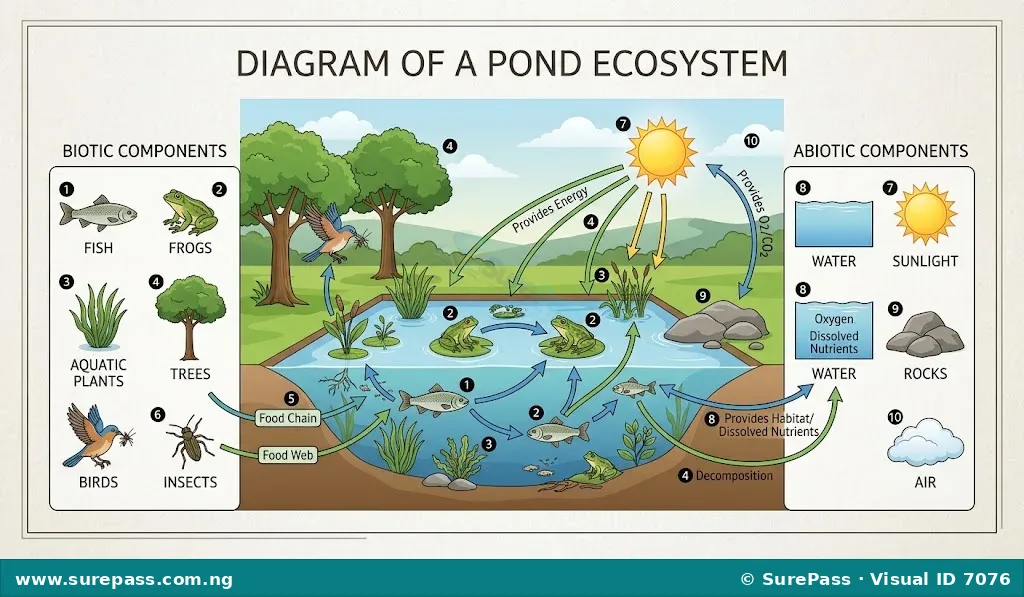
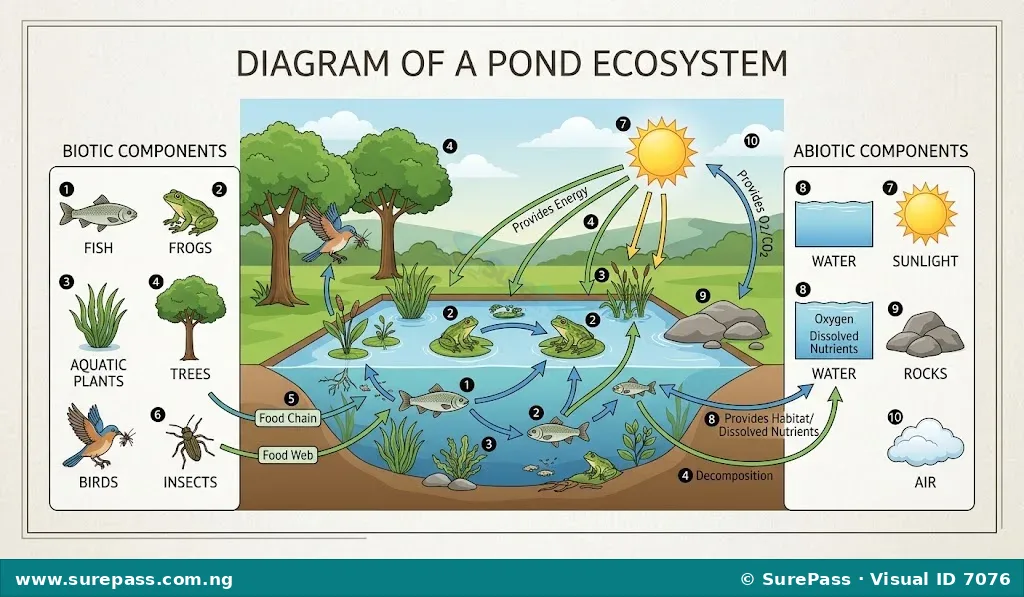
An ecosystem is a community of living organisms (biotic components) interacting with each other and with their non-living physical environment (abiotic components).
Ecosystems can vary greatly in size, from a small puddle to a vast forest or an ocean. All the components within an ecosystem are interconnected and depend on each other.
Components of an Ecosystem
Every ecosystem is made up of two main types of components: biotic and abiotic. These components constantly interact and influence each other.
Biotic Components
Biotic components are all the living organisms within an ecosystem.
These include plants, animals, fungi, bacteria, and other microorganisms. Biotic components can be further classified based on their roles in the ecosystem:
- Producers: Organisms that produce their own food, mainly through photosynthesis. Examples include plants, algae, and some bacteria. They form the base of the food chain.
- Consumers: Organisms that obtain energy by feeding on other organisms. Consumers can be herbivores (eat plants), carnivores (eat animals), or omnivores (eat both plants and animals). Examples include goats, lions, and humans.
- Decomposers: Organisms that break down dead organic matter, returning nutrients to the soil. Examples include bacteria and fungi. They play a crucial role in nutrient cycling.
Abiotic Components
Abiotic components are all the non-living physical and chemical factors in an ecosystem.
These factors include sunlight, water, temperature, soil, air, and minerals. Abiotic components determine which types of organisms can survive in a particular environment. For example, the amount of rainfall and temperature will influence the types of plants that can grow in an area.
Observing and Classifying Ecosystem Components
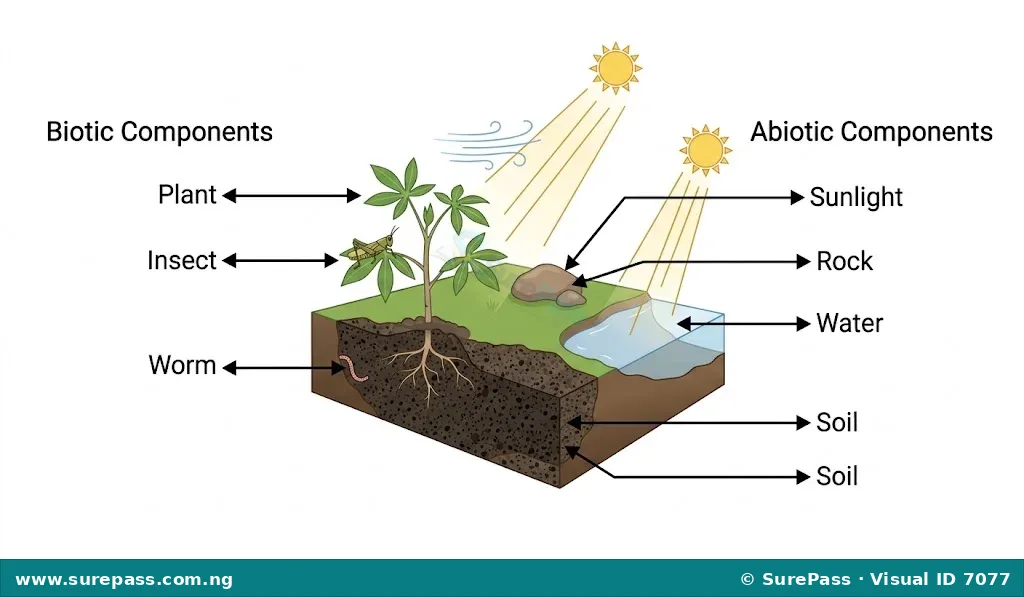
To understand an ecosystem, it is important to observe its components and classify them as biotic or abiotic. This skill helps in identifying the living and non-living parts that make up the environment.
The procedure for observing and classifying ecosystem components involves the following steps:
- Select an Area: Choose a small, manageable area to observe, such as a school garden, a section of a field, or a pond.
- Observe Living Things (Biotic): Carefully look for all living organisms in the chosen area. Note down different types of plants (trees, grasses, flowers), animals (insects, birds, lizards, snails), and any signs of microorganisms (like mould on decaying matter).
- Observe Non-Living Things (Abiotic): Identify and list all the non-living elements. These might include soil, rocks, water (if present), air, sunlight, temperature, and any human-made structures.
- Classify and Record: Create two columns, one for “Biotic Components” and another for “Abiotic Components.” Place each observed item into the correct category. For example, a mango tree goes under biotic, while a stone goes under abiotic.
- Note Interactions: Observe how the biotic and abiotic components interact. For example, how plants use sunlight, how animals drink water, or how soil provides support for plants.
Ecological Factors
Ecological factors are the environmental conditions that influence the distribution, abundance, and interactions of organisms within an ecosystem. These factors can be broadly categorised into physical and edaphic factors.
Physical Factors
Physical factors are non-living environmental conditions that directly affect organisms.
These factors include:
- Temperature: The degree of hotness or coldness of an environment. Temperature affects metabolic rates and the survival of organisms. Many organisms have specific temperature ranges within which they can thrive.
- Light Intensity: The amount of light available in an environment. Light is crucial for photosynthesis in plants and influences the behaviour of many animals, such as their activity patterns (day or night).
- Rainfall/Water: The amount of precipitation received in an area. Water is essential for all life processes. The availability of water determines the types of plants and animals that can live in a region.
- Humidity: The amount of water vapour in the air. High humidity can reduce water loss from organisms, while low humidity can lead to dehydration.
- Wind: The movement of air. Wind can affect temperature, humidity, and can also aid in seed dispersal and pollination. Strong winds can cause physical damage to plants and animals.
- Topography: The physical features of the land, such as altitude, slope, and aspect (direction a slope faces). Topography influences temperature, rainfall, and sunlight exposure, thereby affecting vegetation and animal distribution.
Edaphic Factors
Edaphic factors are physical, chemical, and biological properties of the soil that influence plant growth and animal life.
These factors include:
- Soil pH: The measure of acidity or alkalinity of the soil. Different plants prefer different pH levels. For example, some plants thrive in acidic soil, while others prefer alkaline soil.
- Soil Texture: The proportion of sand, silt, and clay particles in the soil. Soil texture affects water retention, drainage, and aeration, which are important for root growth.
- Soil Structure: The arrangement of soil particles into aggregates. Good soil structure allows for proper air and water movement.
- Soil Water Content: The amount of water present in the soil. This is crucial for plant uptake of nutrients and for many soil organisms.
- Soil Nutrients: The availability of essential minerals and organic matter in the soil. Nutrients like nitrogen, phosphorus, and potassium are vital for plant growth.
Adaptations of Organisms to Their Habitat
Organisms develop special features or behaviours that help them survive and reproduce in their specific habitats. These features are called adaptations.
Adaptations can be structural, physiological, or behavioural. For example, desert plants often have thick, waxy leaves to reduce water loss (structural adaptation), while desert animals may be nocturnal to avoid the heat of the day (behavioural adaptation). Fish have gills to breathe in water (structural adaptation), and camels can store water to survive in dry conditions (physiological adaptation).
Measuring Ecological Factors in an Environment
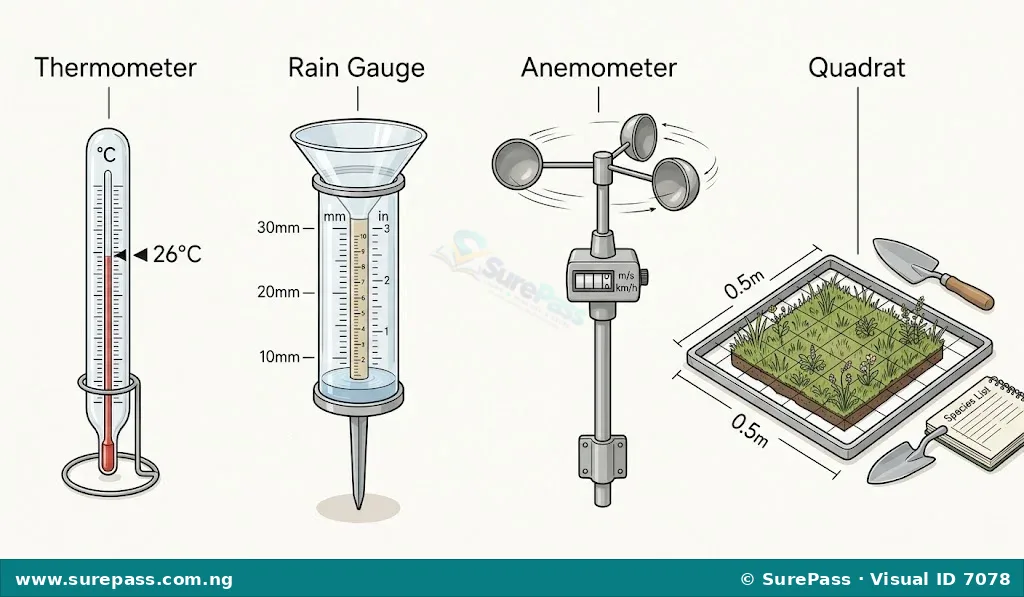
Measuring ecological factors helps scientists understand the conditions in a habitat and how they affect the organisms living there. Various tools are used to measure these factors accurately.
The procedure for measuring common ecological factors involves the following steps:
- Identify the Factors to Measure: Determine which ecological factors are relevant to the study, such as temperature, rainfall, or humidity.
- Gather Appropriate Tools: Collect the specific instruments needed for measurement.
- Thermometer: Used to measure temperature (in degrees Celsius or Fahrenheit).
- Rain Gauge: Used to measure the amount of rainfall (in millimetres or inches).
- Hydrometer: Used to measure the density of liquids, often used to infer salinity in water bodies.
- Anemometer: Used to measure wind speed (in metres per second or kilometres per hour).
- Measuring Tape/Range Pole: Used to measure distances or plot areas for sampling.
- Quadrat: A square frame used to define a specific area for ecological sampling, often used for counting plants or slow-moving animals.
- Select a Measurement Site: Choose a representative location within the ecosystem for taking measurements. For some factors, multiple readings across the area may be necessary.
- Take Measurements: Use each tool correctly to obtain readings.
- For Temperature: Place the thermometer in the desired location (air, soil, water) and wait for the reading to stabilise before recording.
- For Rainfall: Place the rain gauge in an open area away from obstructions. Read the accumulated water level at regular intervals (e.g., daily).
- For Humidity: A hygrometer (not hydrometer) is typically used for humidity. If a hydrometer is used for water density, immerse it in the water sample and read the scale at the water level.
- For Wind Speed: Hold the anemometer in an open area, allowing its cups or propeller to rotate freely. Read the speed indicated on the device.
- For Area/Distance: Use a measuring tape or range pole to mark out specific areas (e.g., for a quadrat) or measure distances between features.
- For Soil pH: Use a pH meter or pH test kit. For a pH meter, insert the probe into a soil-water mixture and read the value. For a test kit, follow the instructions to mix soil with a reagent and compare the colour change to a chart.
- Record Data: Write down all measurements accurately, noting the date, time, and specific location of each reading.
- Repeat Measurements (if necessary): For some factors like temperature or rainfall, taking multiple readings over time or in different spots provides a more complete picture of the environmental conditions.
The required tools are:




0 comments
Open the discussion when you need it. Comments stay collapsed until requested so the initial article remains light.