



ARTICLE CONTENTSOn this page 6 sections
Misconceptions in Biology
Performance Objectives
By the end of the lesson, students should be able to:
- explain misconceptions in Biology;
- identify misconceptions in Biology;
- describe the sources of misconceptions;
- correct misconceptions in biology.
Meaning of Misconceptions in Biology
A misconception in biology is an idea or belief about a biological concept that is incorrect or differs from the scientifically accepted understanding.
These incorrect ideas are often deeply rooted and can be difficult to change, even when presented with accurate information. They are not simply a lack of knowledge, but rather an active misunderstanding or an alternative framework for explaining biological phenomena.
Common Misconceptions in Biology and Their Corrections
Many people hold incorrect beliefs about how living things work, often based on everyday observations or incomplete information. Understanding these common misconceptions and their scientific corrections is crucial for a proper grasp of biology.
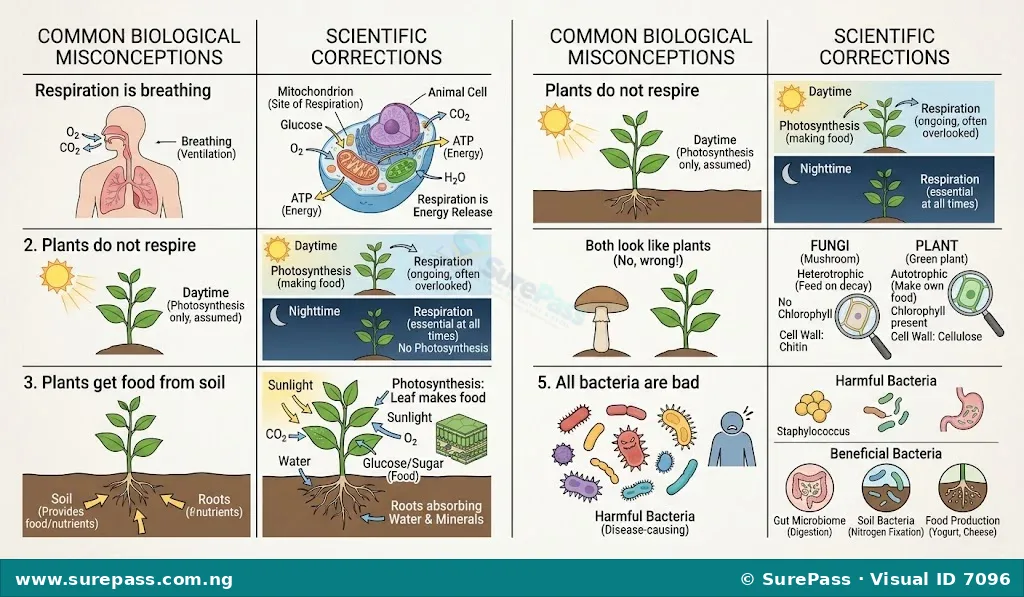
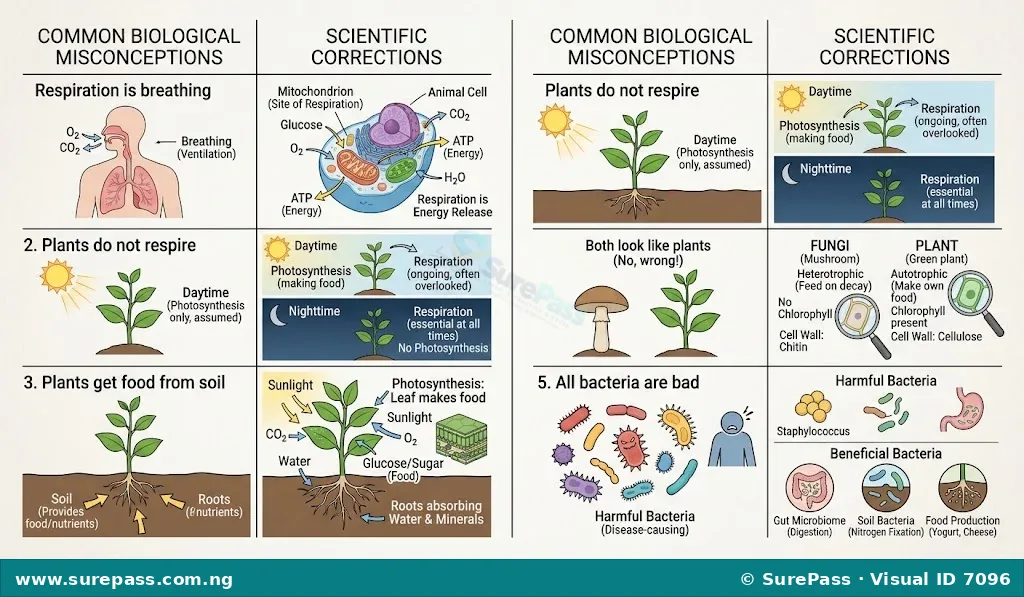
Misconception 1: Respiration is Breathing
Many people confuse respiration with breathing. They believe that respiration is simply the act of inhaling and exhaling air.
Correction: Breathing (also known as ventilation) is the physical process of moving air in and out of the lungs. It is a part of the larger process of gas exchange. Respiration, on the other hand, is a chemical process that occurs inside the cells of living organisms. During cellular respiration, glucose (food) is broken down in the presence of oxygen to release energy, carbon dioxide, and water. Breathing is a mechanical process, while respiration is a biochemical process that releases energy for life activities.
Misconception 2: Plants Do Not Respire
It is a common belief that plants only photosynthesise and do not respire, especially since they produce oxygen during the day.
Correction: Plants respire continuously, both day and night. Like all living organisms, plants need energy to carry out their life processes such as growth, reproduction, and nutrient transport. This energy is obtained through cellular respiration, where stored food (glucose) is broken down. During the day, the rate of photosynthesis is usually higher than respiration, so plants release oxygen. At night, when there is no sunlight, photosynthesis stops, but respiration continues, meaning plants take in oxygen and release carbon dioxide.
Misconception 3: Plants Get Their Food from the Soil
Many people think that plants absorb their food directly from the soil through their roots.
Correction: Plants absorb water and mineral salts from the soil through their roots. These are raw materials, not food. Plants produce their own food (glucose) through the process of photosynthesis, using sunlight, carbon dioxide from the air, and water from the soil. The soil provides essential nutrients and water, but the actual food-making process occurs in the leaves.
Misconception 4: Fungi Are Plants
Because fungi often grow in the soil and do not move, they are frequently mistaken for plants.
Correction: Fungi are not plants. They belong to their own distinct kingdom, Kingdom Fungi. Unlike plants, fungi do not contain chlorophyll and therefore cannot perform photosynthesis to make their own food. Instead, they obtain nutrients by absorbing organic matter from their environment, often by secreting digestive enzymes. Fungi also have cell walls made of chitin, while plant cell walls are made of cellulose.
Misconception 5: All Bacteria Are Bad
Bacteria are often associated with diseases and infections, leading to the belief that all bacteria are harmful.
Correction: While some bacteria can cause diseases, the vast majority of bacteria are harmless, and many are incredibly beneficial and essential for life. For example, bacteria in the human gut aid digestion and produce vitamins. Bacteria in the soil play a crucial role in nutrient cycling, breaking down dead organic matter and making nutrients available to plants. Some bacteria are used in industries for making food products like yoghurt and cheese, and in producing medicines.
Sources of Misconceptions
Misconceptions do not just appear; they often arise from various sources that shape a person’s understanding of the world. Identifying these sources helps in addressing and correcting the misconceptions effectively.
-
Previous Knowledge: Learners often come to new topics with existing ideas formed from earlier experiences or informal learning. If this prior knowledge is incorrect or incomplete, it can lead to misconceptions. For example, a child might learn that plants need water to grow, and incorrectly conclude that water is their food.
-
Media and Textbooks: Sometimes, simplified explanations in popular media, documentaries, or even outdated textbooks can inadvertently create or reinforce misconceptions. For instance, a news report might oversimplify a complex biological process, leading to a misunderstanding. Similarly, poorly written or inaccurate textbooks can be a direct source of incorrect information.
-
Culture and Religion: Cultural beliefs, traditional stories, or religious teachings can sometimes offer alternative explanations for natural phenomena that conflict with scientific understanding. These beliefs are often deeply ingrained and can be very resistant to change. For example, certain cultural beliefs about the origin of life or the functions of the human body might differ from biological facts.
-
Everyday Language: The way we use language in daily life can also contribute to misconceptions. For instance, saying “the sun rises” is common, but scientifically, the Earth rotates. In biology, terms like “feeding” for plants (when they make their own food) can lead to the misconception that they eat from the soil.
-
Overgeneralisation: Applying a rule or observation from one specific context to all situations can lead to misconceptions. For example, knowing that some bacteria cause disease might lead to the overgeneralisation that all bacteria are harmful.
Correction of Misconceptions in Biology
Correcting misconceptions requires more than just presenting the correct information. It involves actively challenging the incorrect ideas and helping learners construct a more accurate understanding. Two key approaches are:
-
Direct Instruction: This method involves clearly explaining the correct biological concept and explicitly addressing the misconception. It includes:
- Identifying the Misconception: Teachers first need to understand what misconceptions students hold.
- Presenting the Correct Concept: The accurate biological information is taught clearly and systematically.
- Contrasting and Explaining: The teacher directly compares the misconception with the correct concept, explaining why the misconception is wrong and providing evidence for the correct view. For example, when correcting “respiration is breathing,” the teacher would explain both processes separately, highlighting their differences and relationship.
- Using Analogies and Examples: Simple, relatable analogies and concrete examples can help students grasp complex ideas and see the flaws in their previous understanding.
-
Students’ Exploration and Construction of Their Understanding: This approach encourages learners to actively engage with the material, question their existing beliefs, and build their own accurate understanding through investigation and critical thinking. It involves:
- Inquiry-Based Learning: Students are given opportunities to ask questions, design simple experiments, and collect data to test their hypotheses. For instance, to correct the “plants don’t respire” misconception, students could set up an experiment to detect carbon dioxide release from plants in the dark.
- Discussion and Debate: Encouraging students to discuss their ideas, explain their reasoning, and challenge each other’s views can help them identify inconsistencies in their thinking and move towards a more scientific understanding.
- Concept Mapping: Creating concept maps helps students visualise the relationships between different biological ideas, allowing them to reorganise their knowledge and identify areas where their understanding is flawed.
- Problem-Solving Activities: Presenting students with biological problems that cannot be solved using their misconceptions forces them to reconsider their ideas and seek more accurate explanations.





0 comments
Open the discussion when you need it. Comments stay collapsed until requested so the initial article remains light.