



ARTICLE CONTENTSOn this page 5 sections
Characteristics of Living Things
Performance Objectives
By the end of the lesson, students should be able to:
- identify the characteristics of living things;
- differentiate between plants and animals.
What Are Living Things?
Living things are organisms that possess certain features that distinguish them from non-living things. These features allow them to carry out life processes necessary for survival.
From the smallest bacteria to the largest whales, all living organisms share a common set of characteristics. These characteristics help biologists to classify something as alive or not alive.
Characteristics of Living Things
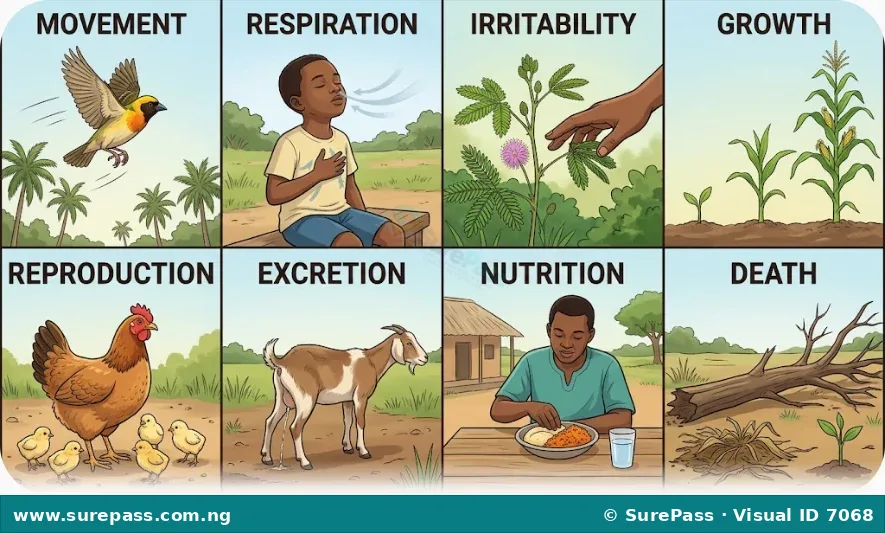
All living things exhibit a set of fundamental characteristics. These include movement, respiration, nutrition, irritability, growth, excretion, reproduction, and eventually, death.
Movement
Movement is the ability of an organism or part of an organism to change its position. This can involve changing location or simply changing shape or orientation.
- Animals: Most animals show locomotion, which is the ability to move from one place to another. Examples include walking, running, flying, swimming, and crawling.
- Plants: Plants generally do not show locomotion. However, they exhibit movements such as the growth of shoots towards light, roots growing towards water, the closing of leaves (e.g., Mimosa pudica), and the opening and closing of flowers.
Respiration
Respiration is the process by which living organisms break down food substances to release energy. This energy is essential for all life activities, such as movement, growth, and reproduction.
Respiration occurs in all living cells, continuously, day and night. It is important to note that respiration is different from breathing, which is simply the physical act of taking in and letting out air. Breathing is a part of the respiratory process in many animals.
Nutrition
Nutrition is the process by which living organisms obtain and use food. Food provides the energy and raw materials needed for growth, repair, and maintenance of the body.
- Autotrophic Nutrition: Some organisms, like plants, can produce their own food using simple inorganic substances (e.g., carbon dioxide and water) through a process called photosynthesis. These organisms are called autotrophs.
- Heterotrophic Nutrition: Other organisms, like animals, cannot produce their own food. They obtain food by consuming other organisms or organic matter. These organisms are called heterotrophs.
Irritability (Sensitivity)
Irritability, also known as sensitivity, is the ability of an organism to detect and respond to changes in its environment. These changes are called stimuli.
Stimuli can include light, temperature, touch, sound, chemicals, and water. Responding to stimuli helps organisms to survive and adapt to their surroundings.
Examples of irritability include:
- A snail withdrawing into its shell when touched.
- A plant growing towards a light source.
- A human blinking when a bright light shines in their eyes.
- The leaves of a Mimosa plant folding inwards when touched.
Growth
Growth is an irreversible increase in the size and mass of an organism. It involves an increase in the number and size of cells.
Growth is a continuous process in many organisms, though the rate may vary at different stages of life. For example, a seedling grows into a mature plant, and a baby grows into an adult human.
Excretion
Excretion is the process by which living organisms remove waste products of metabolism from their bodies. These waste products can be harmful if allowed to accumulate.
Examples of waste products include carbon dioxide, urea, and excess water. Animals excrete waste through urine, faeces, and sweat. Plants excrete waste products like oxygen (during photosynthesis) and excess water (through transpiration), and some store waste in leaves that are later shed.
Reproduction
Reproduction is the process by which living organisms produce new individuals of their own kind. This ensures the continuation of the species from one generation to the next.
Reproduction can be:
- Sexual Reproduction: Involves the fusion of male and female gametes (sex cells).
- Asexual Reproduction: Involves a single parent producing offspring that are genetically identical to itself.
Examples include animals giving birth to young or laying eggs, and plants producing seeds or spores.
Death
Death is the permanent cessation of all vital functions in an organism. It is a natural and inevitable part of the life cycle of all living things.
After a period of growth, development, and reproduction, all organisms eventually die. This characteristic completes the cycle of life.
Differences Between Plants and Animals
While both plants and animals are living things and share the general characteristics of life, they also have distinct differences that allow them to be classified into separate kingdoms.
Nutrition
One of the most significant differences between plants and animals lies in how they obtain their food.
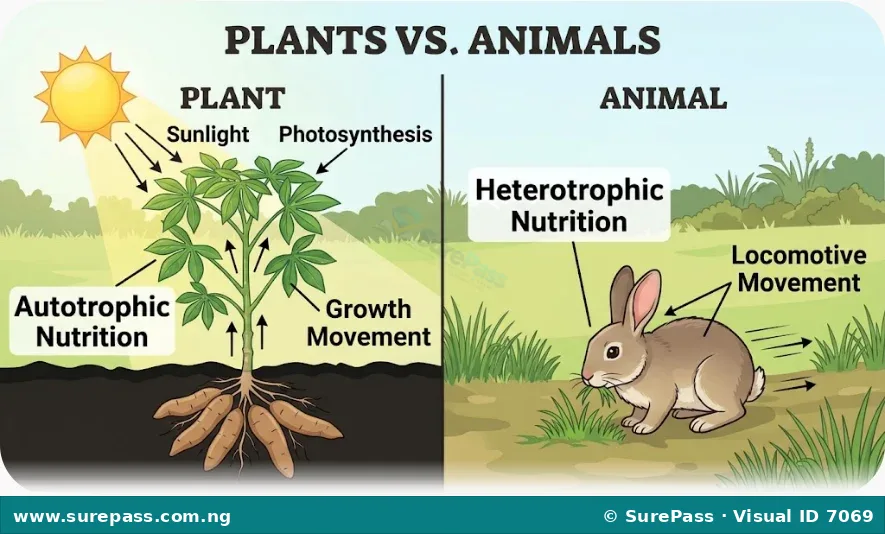
- Animals (Heterotrophic): Animals are heterotrophs. This means they cannot produce their own food. They must consume other organisms (plants or other animals) to obtain the organic compounds they need for energy and growth. Animals have specialised digestive systems to break down the food they ingest.
- Plants (Autotrophic): Plants are autotrophs. They produce their own food through photosynthesis, a process that uses sunlight, water, and carbon dioxide to create glucose (sugar). This ability to make their own food is a fundamental difference from animals.
Movement
The type and extent of movement also differ significantly between plants and animals.
- Animals (Locomotive Movements): Most animals exhibit locomotive movements, meaning they can move their entire body from one place to another. This allows them to search for food, escape predators, find mates, and adapt to changing environmental conditions. Examples include walking, running, swimming, and flying.
- Plants (Growth Movements): Plants generally do not show locomotion. They are typically fixed in one place by their roots. However, plants do exhibit various forms of movement, primarily related to growth and response to stimuli. These include:
- Growth of shoots towards light (phototropism).
- Growth of roots towards water (hydrotropism) and downwards into the soil (geotropism).
- Opening and closing of flowers.
- Folding of leaves in response to touch (e.g., Mimosa pudica).
The table below summarises the key differences between plants and animals:
| Characteristic | Plants | Animals |
|---|---|---|
| Nutrition | Autotrophic (make their own food via photosynthesis) | Heterotrophic (obtain food by consuming other organisms) |
| Movement | Exhibit growth movements (e.g., towards light, root growth), but generally no locomotion (movement from place to place) | Exhibit locomotive movements (e.g., walking, running, flying, swimming) |

0 comments
Open the discussion when you need it. Comments stay collapsed until requested so the initial article remains light.