


ARTICLE CONTENTSOn this page 6 sections
Introductory Concepts
Performance Objectives
By the end of the lesson, students should be able to:
- define chemistry;
- describe the scientific method;
- deduce the stages of the scientific method (e.g. problem identification, hypothesizing, experimenting etc.) through simple laboratory activities;
- identify various applications of chemistry in the society;
- apply scientific method to carry out simple activities.
Meaning of Chemistry
Chemistry is the branch of science that studies matter, its properties, how it changes, and the energy associated with these changes.
Matter is anything that has mass and occupies space. Everything around us, from the air we breathe to the food we eat, the clothes we wear, and the devices we use, is made of matter. Chemistry helps to understand what these things are made of, why they behave the way they do, and how they can be transformed into new substances.
For example, when wood burns, it changes into ash and smoke, releasing heat and light. Chemistry explains this process, including the substances involved and the energy released. It also explains why some foods spoil, how medicines work, and how new materials like plastics are made.
The Scientific Method
The scientific method is a systematic approach used by scientists to investigate natural phenomena, acquire new knowledge, or correct and integrate previous knowledge. It is a logical and organised way of solving problems and understanding the world around us.
Using the scientific method helps to ensure that conclusions are based on evidence and can be tested and verified by others. It is not a rigid, step-by-step process that must always be followed in the same order, but rather a flexible framework that guides scientific inquiry.
Stages of the Scientific Method
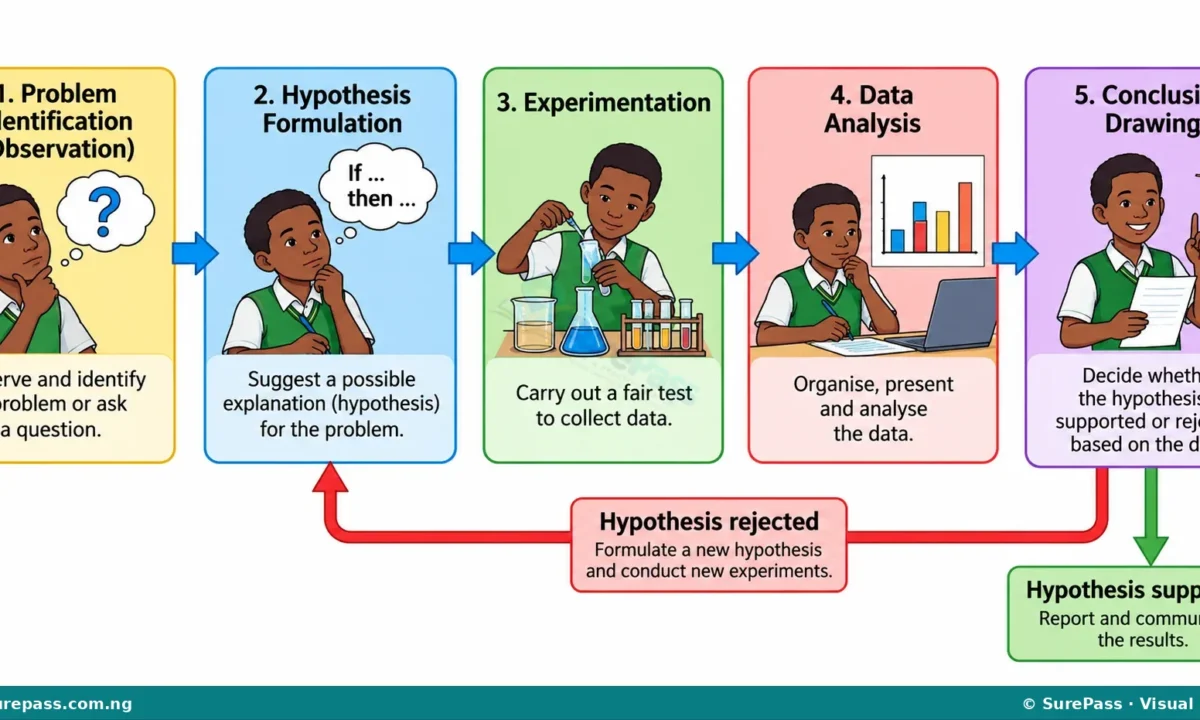
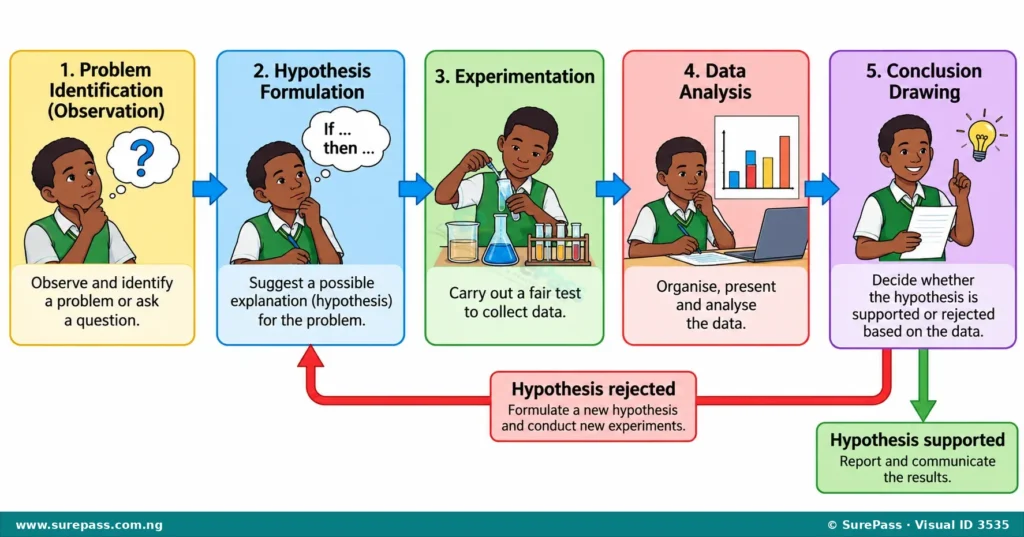
The scientific method typically involves several key stages:
- Problem Identification (Observation): This is the first step, where a scientist notices something unusual or interesting and asks a question about it. Observations can be made using the five senses or with instruments like microscopes and telescopes. The problem must be clearly defined and specific.
- Hypothesis Formulation: After identifying a problem or asking a question, a scientist proposes a possible explanation or answer. This proposed explanation is called a hypothesis. A hypothesis is an educated guess that can be tested through experimentation. It is often stated as an “if…then…” statement.
- Experimentation: This stage involves designing and carrying out experiments to test the hypothesis. Experiments are carefully controlled procedures designed to collect data. During an experiment, scientists manipulate one variable (the independent variable) and observe its effect on another variable (the dependent variable), while keeping all other factors constant (control variables).
- Data Analysis and Conclusion Drawing: After conducting experiments, the collected data is analysed. This involves organising, interpreting, and looking for patterns or relationships in the data. Based on the analysis, a conclusion is drawn about whether the hypothesis is supported or rejected. If the hypothesis is rejected, a new hypothesis may be formulated, and the process can begin again. If the hypothesis is supported by repeated experiments, it can contribute to a scientific theory.
Applying the Scientific Method: A Simple Activity
The scientific method can be applied to solve everyday problems and understand simple phenomena. This activity demonstrates how to use the scientific method to investigate why some objects float and others sink in water.
The required materials are:
- A plastic bowl filled with water
- Various common objects: a bottle cap, a feather, an iron nail, a small plastic bottle (empty and capped), a small stone.
The procedure involves the following steps:
- Problem Identification (Observation): Observe the objects provided. Ask the question: “Why do some objects float on water while others sink?”
- Hypothesis Formulation: Formulate a hypothesis. For example: “If an object is lighter than water, then it will float, and if it is heavier than water, it will sink.” (This is a common initial hypothesis, which can be refined later to include density).
-
Experimentation:
- Gently place the bottle cap on the surface of the water in the bowl. Observe whether it floats or sinks.
- Repeat the process for the feather, iron nail, empty plastic bottle, and small stone, one by one.
- Record your observations for each object in a simple table.
-
Data Analysis and Conclusion Drawing:
- Review your recorded observations. Which objects floated? Which objects sank?
- Consider your initial hypothesis. Does the data support the idea that lighter objects float and heavier objects sink? For example, the iron nail is small but sinks, while the empty plastic bottle is larger but floats. This suggests that “lightness” or “heaviness” alone might not be the complete explanation.
- Refine your conclusion: The ability of an object to float or sink depends not just on its total weight, but on how heavy it is for its size (its density) compared to the density of water. Objects less dense than water float, while objects more dense than water sink.
This simple activity demonstrates how observations lead to questions, which lead to testable hypotheses, experiments, and conclusions that help refine understanding.
Applications of Chemistry in Society
Chemistry plays a crucial role in almost every aspect of modern society. Its applications are vast and impact daily life, health, agriculture, industry, and the environment.
Chemistry in Daily Life
Many everyday items and processes rely on chemical principles:
- Cleaning Agents: Soaps, detergents, bleaches, and disinfectants are all chemical products designed to clean, sanitise, and remove stains. They work by chemical reactions that break down dirt and kill germs.
- Food and Cooking: The cooking process itself involves chemical changes. For example, baking bread involves yeast causing fermentation, and frying an egg involves protein denaturation. Food preservation methods like salting, smoking, and refrigeration also rely on chemistry to slow down spoilage.
- Clothing and Textiles: The dyes used to colour fabrics, the synthetic fibres like nylon and polyester, and the processes for treating natural fibres like cotton are all products of chemical research.
- Personal Care Products: Cosmetics, perfumes, toothpastes, shampoos, and lotions are complex mixtures of chemicals formulated to enhance personal hygiene and appearance.
- Building Materials: Cement, concrete, paints, and plastics used in construction are all products of chemical engineering and synthesis.
Chemistry in Medicine and Health
Chemistry is fundamental to modern medicine and maintaining health:
- Drug Development: Pharmaceutical chemists design and synthesise new drugs to treat diseases, relieve pain, and improve health. Understanding chemical structures and reactions is essential for creating effective medicines.
- Medical Diagnostics: Chemical tests are used to diagnose illnesses by analysing blood, urine, and other body fluids. For example, blood glucose tests for diabetes or pregnancy tests rely on specific chemical reactions.
- Medical Imaging: Contrast agents used in MRI scans or radioactive tracers in PET scans are chemical substances that help doctors visualise internal body structures and functions.
- Sterilisation: Chemical disinfectants are used in hospitals and homes to kill harmful microorganisms on surfaces and medical instruments, preventing the spread of infections.
Chemistry in Agriculture
Chemistry helps to improve food production and protect crops:
- Fertilisers: Chemical fertilisers provide essential nutrients like nitrogen, phosphorus, and potassium to the soil, helping crops grow faster and yield more food.
- Pesticides and Herbicides: These chemical compounds are used to protect crops from pests (insects, rodents) and weeds, ensuring higher crop yields and reducing food loss.
- Soil Analysis: Chemists analyse soil composition to determine nutrient deficiencies and recommend appropriate fertilisers, optimising agricultural practices.
- Food Processing and Preservation: Chemical additives are used to preserve food, enhance flavour, and extend shelf life, making food safer and more accessible.
Chemistry in Industry
Industrial processes heavily rely on chemical knowledge:
- Petroleum Industry: Chemistry is central to refining crude oil into useful products like petrol, diesel, kerosene, and lubricants. It also involves the production of petrochemicals used in plastics and other materials.
- Manufacturing: The production of plastics, rubber, metals, glass, ceramics, and paper all involve chemical processes and transformations.
- Energy Production: The combustion of fuels (coal, natural gas, biomass) to generate electricity, and the development of new energy sources like batteries and fuel cells, are all chemical processes.
- Mining and Metallurgy: Chemical methods are used to extract metals from their ores and purify them for various applications.
Chemistry and Environmental Protection
Chemistry also contributes to protecting the environment:
- Pollution Control: Chemists develop methods to monitor pollutants in air and water, and design technologies to remove harmful substances from industrial emissions and wastewater.
- Waste Management: Chemical processes are used in recycling to break down materials and convert waste into useful products.
- Alternative Energy: Research in chemistry helps develop cleaner and more sustainable energy sources, such as solar cells and biofuels, to reduce reliance on fossil fuels.
- Water Treatment: Chemical processes are used to purify drinking water, removing impurities and harmful microorganisms to make it safe for consumption.


0 comments
Open the discussion when you need it. Comments stay collapsed until requested so the initial article remains light.