


ARTICLE CONTENTSOn this page 9 sections
Food Service and Cover
Performance Objectives
By the end of the lesson, students should be able to:
- explain the meaning of food service and Cover;
- mention different types of food services and cover;
- apply techniques in food services;
- list the characteristics of a cover;
- demonstrate food service and cover.
Meaning of Food Service
Food service refers to the process of presenting and serving prepared food and beverages to customers in a catering establishment or at an event.
It involves all the steps from the kitchen to the customer’s table, ensuring that food is delivered efficiently, attractively, and at the correct temperature.
Meaning of Cover
In catering, a cover refers to the complete place setting for one person at a dining table.
It includes all the necessary cutlery, crockery, glassware, and linen required for a specific meal or course.
The arrangement of these items on the table is crucial for a pleasant dining experience.
Types of Food Services
Different methods are used to serve food, depending on the type of establishment, the occasion, and the number of guests. Understanding these types helps in choosing the most suitable service style.
Silver Service
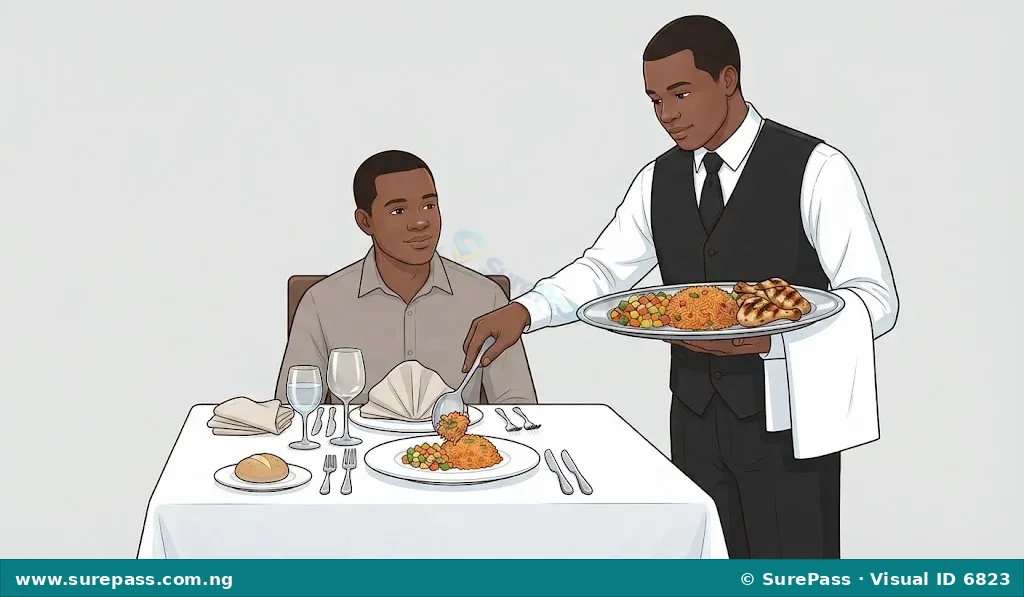
Silver service is a formal and elegant style of food service where food is presented to guests on platters or dishes by trained waiters, who then serve the food onto the guests’ plates using a spoon and fork (often called service gear or silver service tongs).
This service style is typically used in fine dining restaurants, banquets, and formal events. Waiters approach guests from the left side to serve the food.
Self-Service
Self-service is a casual style where guests collect their own food and beverages from a buffet counter or serving station.
This method is common in cafeterias, canteens, and some informal restaurants. Guests choose their desired items and carry them to their tables.
Assisted Service
Assisted service combines elements of both self-service and waiter service. Guests may collect some items themselves, such as salads or desserts, while main courses or hot dishes are served by staff.
This style is often found in hotels for breakfast buffets or in casual dining establishments where some items require portion control or special handling by staff.
Single Point Service
Single point service involves guests ordering and collecting their food and drinks from a single counter or point.
Examples include fast-food restaurants, takeaways, food stalls, and coffee shops where customers place an order, pay, and receive their items at the same counter. There is no table service involved.
Types of Cover
The type of cover refers to the specific arrangement of cutlery, crockery, and glassware required for a particular meal or dining occasion. The items laid out depend on the menu that will be served.
Common types of cover include:
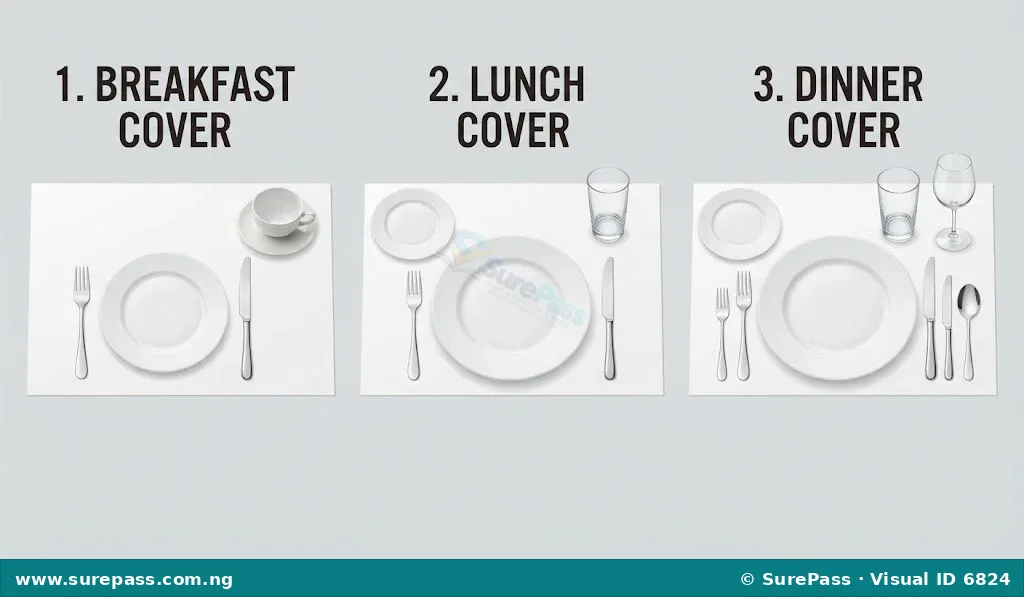
- Breakfast Cover: Usually includes a breakfast plate, a side plate for bread/toast, a cup and saucer, a breakfast knife, and a breakfast fork.
- Lunch Cover: Often includes a main plate, a side plate, a water glass, a lunch knife, and a lunch fork.
- Dinner Cover (Table d’hôte): A more formal setting with a main plate, side plate, water glass, wine glass (if applicable), dinner knife, dinner fork, soup spoon, and dessert spoon/fork.
- À la Carte Cover: This is a basic setting that includes a main plate, side plate, water glass, dinner knife, and dinner fork. Additional cutlery and glassware are brought to the table as specific courses are ordered by the guest.
Techniques in Food Services
Effective food service relies on specific techniques to ensure professionalism, hygiene, and guest satisfaction. These techniques apply to various service styles.
- Serving from the Correct Side: In formal service (like silver service), food is typically served from the guest’s left side, and beverages are served from the right. Plates are cleared from the right.
- Plate Handling: Plates should be carried and placed carefully, avoiding touching the food contact surface with fingers. Hot plates should be handled with a service cloth or tray.
- Cutlery Handling: Cutlery should be handled by the handles, not the eating ends. When placing cutlery, ensure it is clean and correctly positioned.
- Glassware Handling: Glasses should be held by the stem or base to avoid leaving fingerprints on the rim or bowl.
- Order Taking: When taking orders, stand upright, maintain eye contact, and listen carefully. Repeat the order to the guest for confirmation.
- Communication: Use polite language, address guests respectfully, and be attentive to their needs.
- Hygiene: Always maintain personal hygiene and ensure all service equipment is clean and sanitised.
- Speed and Efficiency: Serve food promptly to maintain its temperature and quality, but without rushing the guests.
- Clearing Tables: Clear tables quietly and efficiently, removing used items without disturbing other guests.
Characteristics of a Cover
A well-prepared cover has several important characteristics that contribute to a positive dining experience.
- Cleanliness: All items on the cover (cutlery, crockery, glassware, linen) must be spotlessly clean, free from stains, smudges, or food particles.
- Completeness: The cover must include all the necessary items for the specific meal or course being served, as determined by the menu. Nothing should be missing.
- Correct Arrangement: Each item must be placed in its precise position according to standard table setting rules. For example, forks on the left, knives on the right with the blade facing the plate, spoons to the right of the knives, and glasses above the knife.
- Suitability: The cover should be appropriate for the occasion, the type of meal, and the establishment’s style. A formal dinner requires a different cover than a casual breakfast.
- Uniformity: In a dining room with multiple covers, all similar covers should be identical in their arrangement and items used, creating a consistent and professional look.
- Good Condition: All items should be in good repair, without chips, cracks, bends, or excessive wear.
Demonstrating Correct Table Laying and Food Services
Laying a table correctly and performing food service are practical skills that require attention to detail and practice. This demonstration focuses on a basic formal cover and general service techniques.
Materials Required:
- A clean dining table
- Tablecloth (optional, but recommended for formal settings)
- Table mat (if not using a tablecloth)
- Dinner plate
- Side plate
- Water glass
- Dinner knife
- Dinner fork
- Soup spoon (optional, if serving soup)
- Dessert spoon and fork (optional, if serving dessert)
- Table napkin
- Serving tray (for food service demonstration)
- Platter with prepared food (for food service demonstration)
- Service gear (spoon and fork)
Procedure for Table Laying (Basic Dinner Cover):
The procedure involves the following steps:
- Prepare the Table: Ensure the table is clean and stable. If using a tablecloth, lay it smoothly and evenly, ensuring it hangs uniformly around the table. If using table mats, place one at each guest’s position.
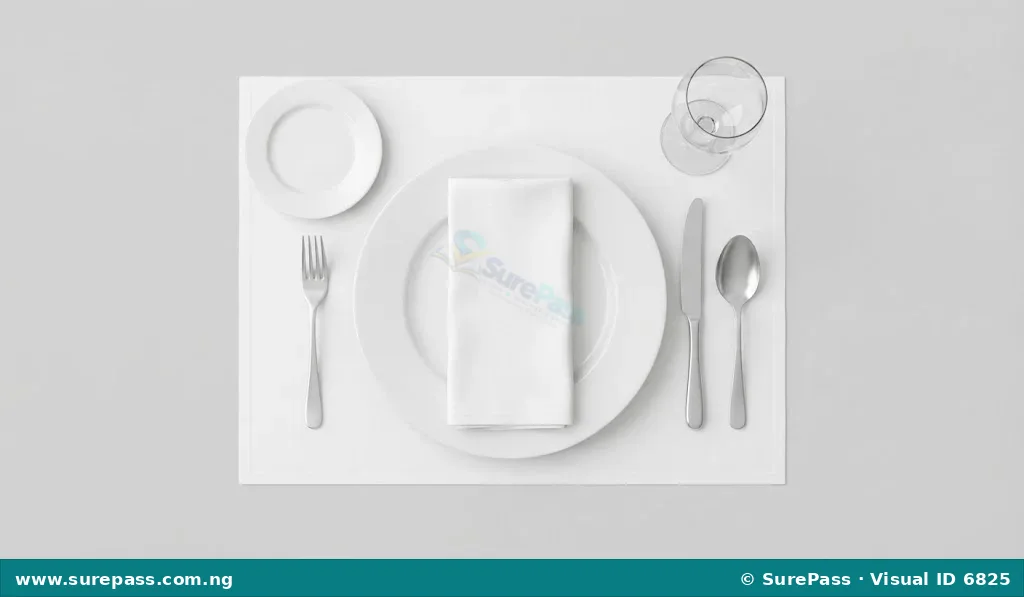
- Place the Dinner Plate: Position the dinner plate in the centre of the cover, about 1 inch (2.5 cm) from the edge of the table.
- Place the Side Plate: Place the side plate (for bread or side dishes) to the upper left of the dinner plate, above the forks.
- Arrange Cutlery (Forks): Place the dinner fork to the left of the dinner plate. If a salad fork is also used, it goes to the left of the dinner fork. Forks are placed with their tines facing up.
- Arrange Cutlery (Knives): Place the dinner knife to the right of the dinner plate, with the blade facing the plate. If a butter knife is used for the side plate, it can be placed horizontally across the top of the side plate.
- Arrange Cutlery (Spoons): If a soup spoon is needed, place it to the right of the dinner knife. Dessert spoons and forks are usually placed horizontally above the dinner plate, with the spoon handle pointing right and the fork handle pointing left.
- Place Glassware: Position the water glass above the dinner knife. If other glasses (e.g., wine glass) are used, they are placed to the right of the water glass, forming a diagonal line.
- Fold and Place Napkin: Fold the table napkin neatly and place it either on the dinner plate, to the left of the forks, or under the forks.
- Check and Adjust: Step back and check the entire setting. Ensure all items are aligned, evenly spaced, and clean. All covers should look uniform.
Procedure for Food Service (Demonstrating Silver Service Technique):
This procedure demonstrates how a waiter would serve food using the silver service technique.
- Prepare the Food: Ensure the food is neatly arranged on a serving platter in the kitchen and is at the correct temperature.
- Carry the Platter: Carry the platter carefully from the kitchen to the dining area, using a service cloth if the platter is hot.
- Approach the Guest: Approach the guest from their left side. Stand slightly behind and to the left of the guest.
- Present the Food: Hold the platter steady and low, close to the guest’s plate, allowing them to see the food clearly.
- Serve the Food: Using the service gear (spoon and fork), carefully transfer a portion of the food from the platter onto the guest’s plate. Use the spoon as the base and the fork to assist in lifting and placing the food.
- Maintain Portion Control: Serve an appropriate portion size, ensuring consistency for all guests.
- Avoid Spillage: Be careful not to spill food on the table or the guest. If a spill occurs, discreetly clean it up immediately.
- Move to the Next Guest: Once a guest has been served, move clockwise to the next guest and repeat the serving process.
- Clearing Plates: After the guests have finished their meal, approach from the right side to clear the used plates. Stack plates carefully on a service tray, avoiding noise.


0 comments
Open the discussion when you need it. Comments stay collapsed until requested so the initial article remains light.