



ARTICLE CONTENTSOn this page 9 sections
Chemical Bonds
Performance Objectives
By the end of the lesson, students should be able to:
- explain the meaning of chemical bond;
- name the major types of chemical bonds;
- identify substances with each type of chemical bonds;
- describe the properties of each type of bond;
- state the IUPAC nomenclature of compounds;
- construct models to illustrate different types of chemical bonds in simple compounds.
Meaning of Chemical Bonding
Chemical bonding is the attractive force that holds atoms, ions or molecules together in a chemical species to achieve stability.
In nature, noble gases such as helium, neon and argon exist as monoatomic gases because they possess stable electronic configurations. They have either a duplet (two electrons in the outermost shell, as in helium) or an octet (eight electrons in the outermost shell, as in neon and argon). Other elements do not have this stable configuration and are chemically reactive. To attain stability, these reactive atoms lose, gain or share valence electrons. This rearrangement of valence electrons results in the formation of chemical bonds.
Types of Chemical Bonds
Chemical bonds are broadly classified into two main categories based on their strength. These are strong bonds and weak bonds.
The primary types of chemical bonds are:
- Strong bonds (electrovalent, covalent, dative and metallic bonds)
- Weak bonds (hydrogen bonds and van der Waals forces)
Strong Chemical Bonds
Strong bonds require a significant amount of energy to break. They involve the transfer, sharing or pooling of valence electrons between atoms.
Electrovalent (Ionic) Bonding
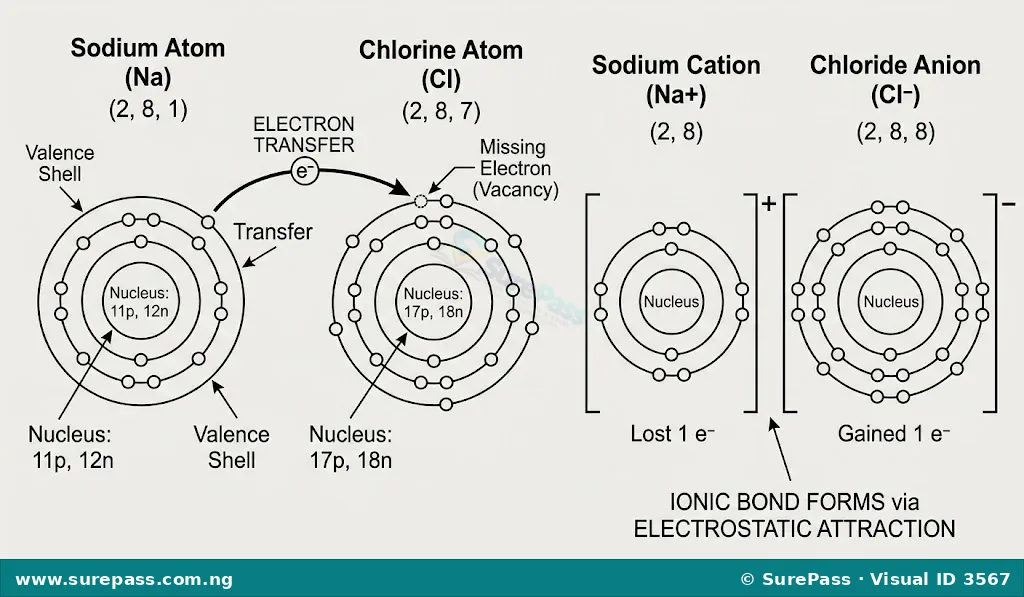
Electrovalent bonding is a type of chemical bonding that involves the complete transfer of one or more electrons from a metallic atom to a non-metallic atom.
The metallic atom loses electrons to become a positively charged ion (cation), while the non-metallic atom gains the electrons to become a negatively charged ion (anion). The electrostatic force of attraction that holds these oppositely charged ions together constitutes the ionic bond.
An example is the formation of sodium chloride (NaCl). A sodium atom has an electronic configuration of 2,8,1. It loses its single valence electron to achieve a stable octet configuration (2,8), forming a sodium ion (Na+). A chlorine atom has an electronic configuration of 2,8,7. It gains the electron lost by sodium to complete its octet (2,8,8), forming a chloride ion (Cl−). The electrostatic attraction between Na+ and Cl− forms the ionic compound, sodium chloride.
Observe the diagram below to understand the transfer of electrons during ionic bond formation.
Common examples of substances with electrovalent bonds include:
- Sodium chloride (NaCl)
- Calcium oxide (CaO)
- Magnesium chloride (MgCl2)
- Potassium fluoride (KF)
Covalent Bonding
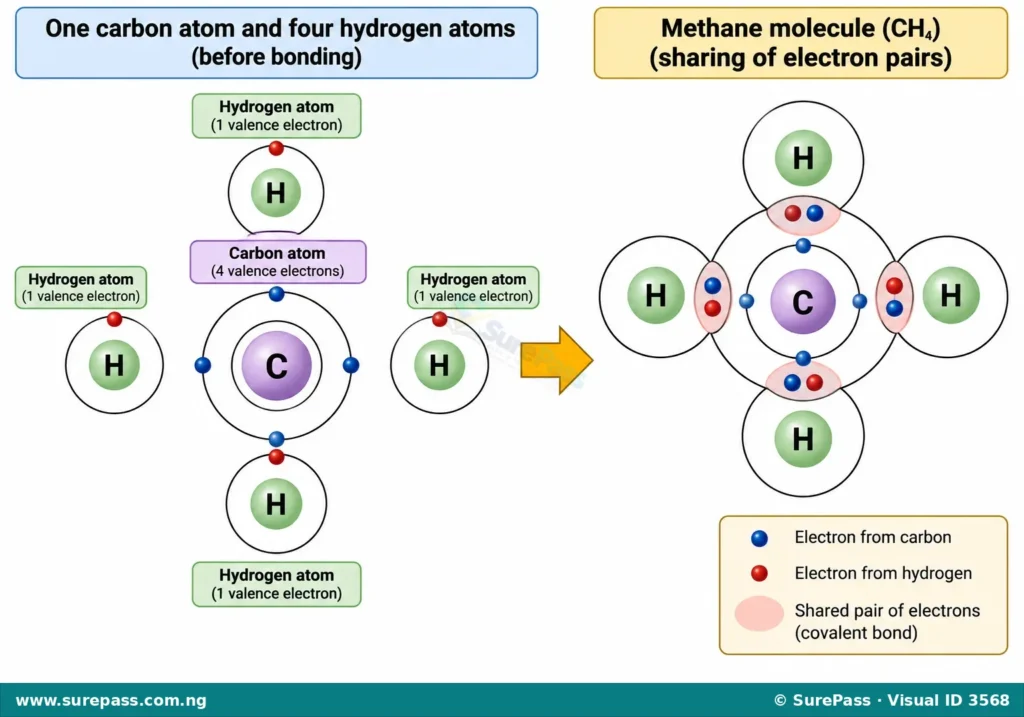
Covalent bonding is a type of chemical bonding that involves the sharing of one or more pairs of electrons between non-metallic atoms.
When non-metals react, they share valence electrons so that each atom attains a stable octet or duplet configuration. The shared pair of electrons is attracted to the nuclei of both atoms, holding them together. Covalent bonds can be single (one shared pair), double (two shared pairs) or triple (three shared pairs).
An example is the formation of a methane molecule (CH4). A carbon atom has four valence electrons (configuration 2,4) and requires four more to complete its octet. Four hydrogen atoms, each with one electron, share their electrons with the carbon atom. This results in four single covalent bonds, allowing carbon to achieve an octet and each hydrogen to achieve a stable duplet.
Look at the diagram below showing electron sharing in a covalent molecule.
Common examples of substances with covalent bonds include:
- Water (H2O)
- Carbon dioxide (CO2)
- Oxygen gas (O2)
- Methane (CH4)
- Ammonia (NH3)
Dative (Coordinate Covalent) Bonding
Dative bonding is a type of covalent bonding in which the shared pair of electrons is contributed by only one of the bonding atoms.
The atom that provides the electron pair is called the donor, and it must possess a lone pair of electrons (a pair of valence electrons not involved in bonding). The atom that accepts the electron pair is called the acceptor, and it must have an empty orbital in its valence shell to accommodate the shared pair. Once formed, a dative bond behaves exactly like an ordinary covalent bond, but it is often represented by an arrow pointing from the donor atom to the acceptor atom.
An example is the formation of the ammonium ion (NH4+). An ammonia molecule (NH3) has a nitrogen atom with a lone pair of electrons. When it reacts with a hydrogen ion (H+), which has an empty 1s orbital, the nitrogen atom donates its lone pair to form a dative covalent bond with the hydrogen ion.
Common examples of substances containing dative bonds include:
- Ammonium ion (NH4+)
- Hydronium ion (H3O+)
- Carbon monoxide (CO)
Metallic Bonding
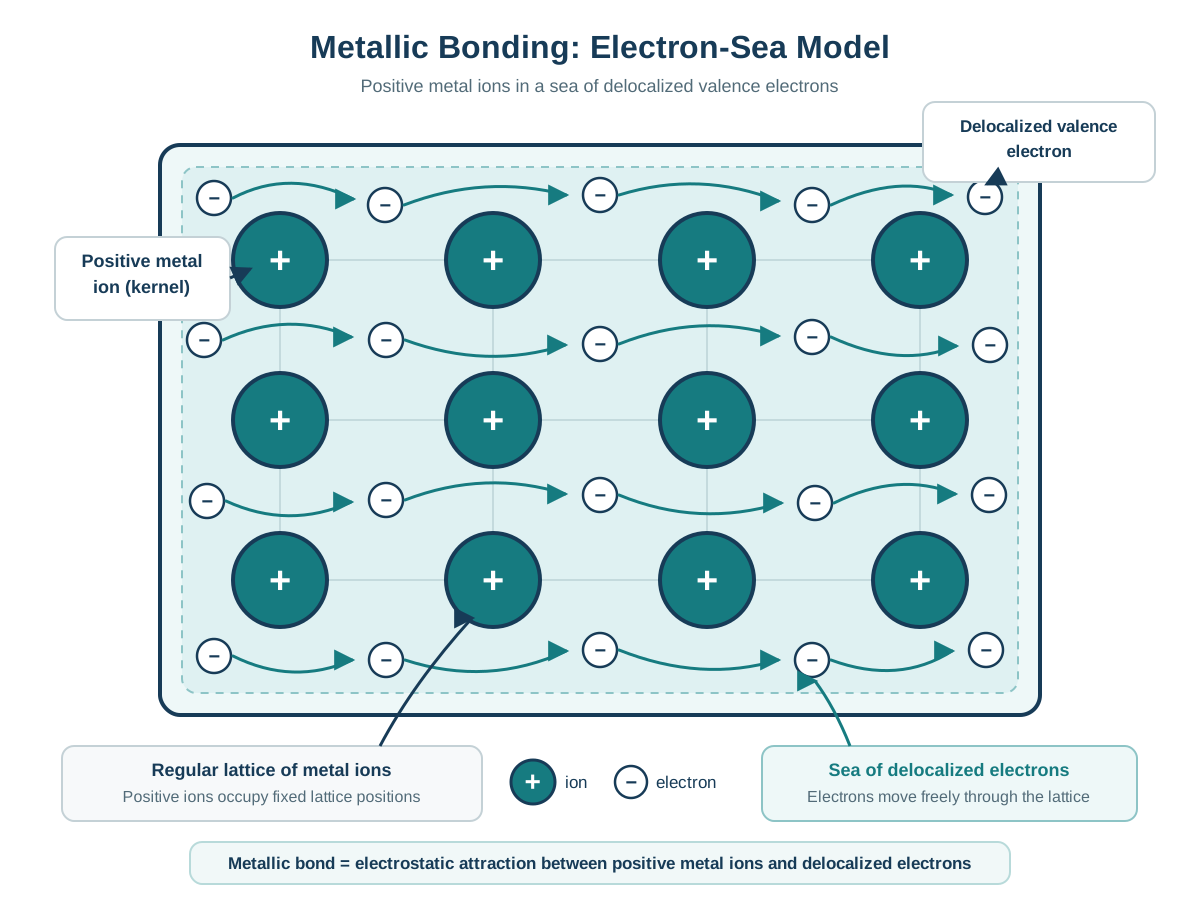
Metallic bonding is the electrostatic force of attraction between positive metal ions and the sea of mobile, delocalized valence electrons surrounding them.
In a metal lattice, metal atoms lose their valence electrons to become positive ions (kernels). These lost electrons do not belong to any single atom but are free to move throughout the entire crystal structure, forming a mobile “sea” of electrons. The strong attraction between the positive metal ions and this sea of mobile electrons holds the metal structure together.
Observe the diagram below representing the structure of a metal lattice.
Common examples of substances with metallic bonding include:
- Copper (Cu)
- Iron (Fe)
- Aluminium (Al)
- Sodium metal (Na)
Weak Chemical Bonds
Weak bonds are intermolecular forces that exist between molecules. They are much weaker than electrovalent, covalent or metallic bonds and require far less energy to break.
Hydrogen Bonding
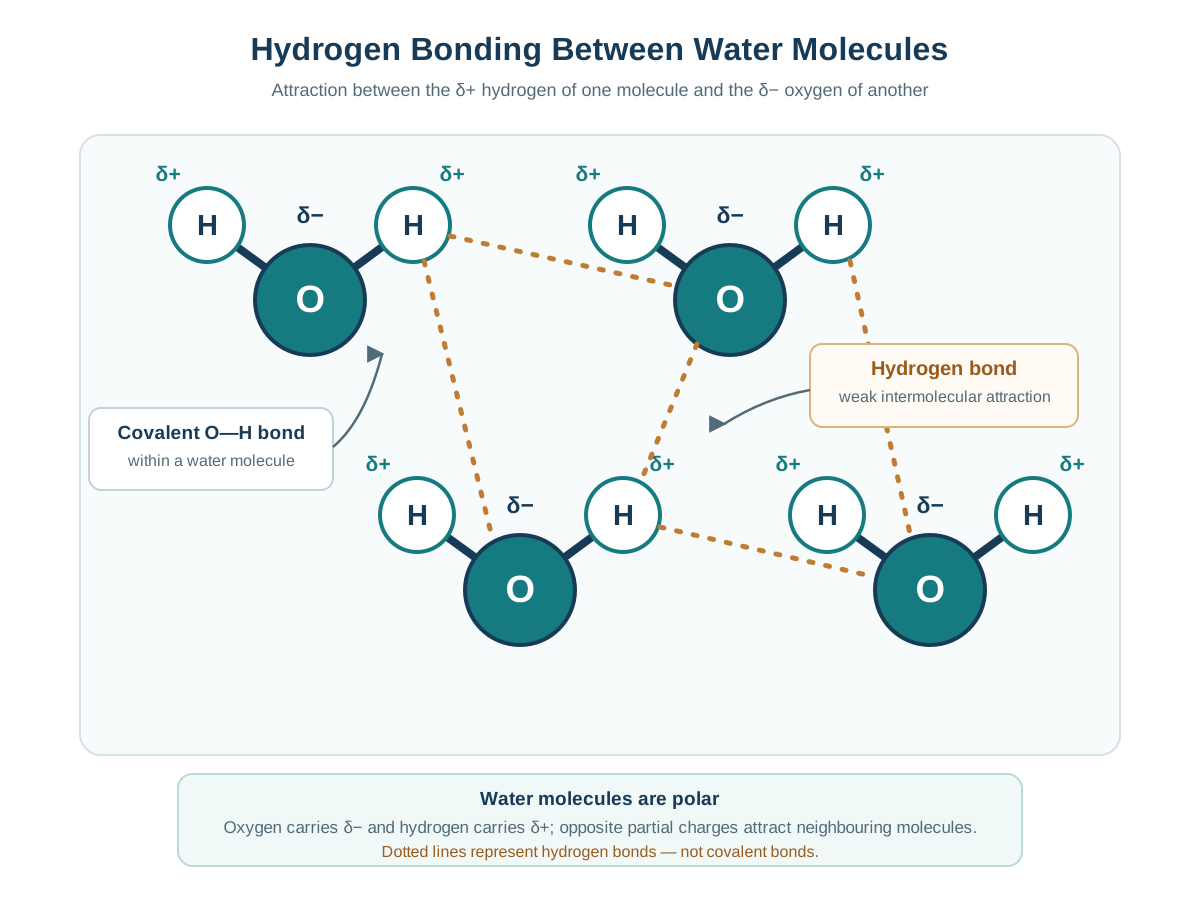
Hydrogen bonding is a weak electrostatic force of attraction between a hydrogen atom covalently bonded to a highly electronegative atom and another electronegative atom containing a lone pair of electrons.
The highly electronegative atoms that typically form hydrogen bonds are fluorine, oxygen and nitrogen. Because these atoms pull the shared electron pair strongly towards themselves, the hydrogen atom acquires a partial positive charge ($\delta+$) and the electronegative atom acquires a partial negative charge ($\delta-$). This creates a polar molecule. The partial positive hydrogen atom of one molecule is then attracted to the partial negative atom of a neighbouring molecule.
Hydrogen bonding explains why water (H2O) is a liquid at room temperature with a relatively high boiling point, while hydrogen sulphide (H2S), which has a similar molecular structure but lacks hydrogen bonding, is a gas.
Look at the diagram below showing hydrogen bonds between water molecules.
Common examples of substances with hydrogen bonding include:
- Water (H2O)
- Hydrogen fluoride (HF)
- Ammonia (NH3)
- Ethanol (C2H5OH)
Van der Waals Forces
Van der Waals forces are weak, short-range electrostatic forces of attraction that exist between non-polar molecules or noble gas atoms due to temporary dipoles.
These forces arise because the continuous movement of electrons within an atom or molecule can create a temporary, uneven distribution of charge. This temporary dipole induces a corresponding dipole in a neighbouring atom or molecule, leading to a weak attraction. Van der Waals forces increase in strength as the size and molecular mass of the substance increase.
Common examples of substances held together by van der Waals forces in the solid or liquid state include:
- Iodine crystals (I2)
- Dry ice (solid Carbon dioxide, CO2)
- Liquid nitrogen (N2)
- Noble gases in liquid or solid states (e.g., liquid Argon)
Properties of Substances with Different Bond Types
The physical properties of substances are directly determined by the nature of the chemical bonds holding their constituent particles together.
The table below compares the properties of substances based on their bond types:
| Property | Electrovalent Compounds | Covalent Compounds | Metallic Substances |
|---|---|---|---|
| Physical State | Hard, crystalline solids at room temperature. | Gases, liquids or soft solids at room temperature. | Hard, lustrous solids (except mercury which is liquid). |
| Melting and Boiling Points | Very high, due to strong electrostatic forces between ions. | Low, because weak intermolecular forces are easily broken. | High to very high, due to strong metallic bonds. |
| Solubility | Soluble in polar solvents (like water); insoluble in non-polar solvents. | Insoluble in polar solvents; soluble in organic solvents (like benzene). | Insoluble in both polar and non-polar solvents (may react with some). |
| Electrical Conductivity | Conduct electricity when molten or in aqueous solution; do not conduct as solids. | Do not conduct electricity in any state (non-electrolytes). | Excellent conductors of electricity and heat in both solid and molten states. |
| Malleability and Ductility | Brittle; shatter when struck with a hammer. | Non-malleable and non-ductile. | Highly malleable (can be beaten into sheets) and ductile (can be drawn into wires). |
IUPAC Nomenclature of Compounds
The International Union of Pure and Applied Chemistry (IUPAC) established a systematic method for naming chemical compounds. This system ensures that each compound has a unique and unambiguous name based on its chemical formula.
Rules for Naming Simple Inorganic Compounds
The naming of simple inorganic compounds follows specific guidelines depending on the elements present and their oxidation states.
Binary Compounds
Binary compounds consist of only two elements. The metal or less electronegative element is named first, followed by the non-metal with its ending changed to “-ide”.
Examples of binary compounds include:
- NaCl: Sodium chloride
- CaO: Calcium oxide
- Al2S3: Aluminium sulphide
Compounds with Metals of Variable Oxidation States
When a metal can exhibit more than one oxidation state (such as transition metals), the oxidation state of the metal in that specific compound must be indicated in Roman numerals inside parentheses immediately after the metal’s name.
To determine the oxidation state, the overall charge of a neutral compound is set to zero. Oxygen is generally assigned an oxidation state of -2, and hydrogen is assigned +1.
For example, in FeCl2, chlorine has an oxidation state of -1. Since there are two chlorine atoms, the total negative charge is -2. For the compound to be neutral, the iron atom must have an oxidation state of +2. The compound is named Iron(II) chloride.
In FeCl3, the iron atom has an oxidation state of +3. The compound is named Iron(III) chloride.
Compounds Containing Radicals (Oxyanions)
Radicals are groups of atoms that behave as a single charged unit. When naming compounds containing oxyanions (radicals containing oxygen), the name of the non-metal in the radical is modified to end in “-ate”, and its oxidation state is written in Roman numerals.
The prefixes “mono-“, “di-“, “tri-“, “tetra-“, etc., are used to indicate the number of oxygen atoms present in the radical.
Consider the compound Na2SO4:
- The radical is SO42−, which contains sulphur and four oxygen atoms.
- The name of the radical starts with “tetraoxo” (for four oxygen atoms) followed by “sulphate” (for sulphur).
- To find the oxidation state of sulphur (S) in Na2SO4:
Let the oxidation state of S be $x$.
The oxidation state of Sodium (Na) is +1.
The oxidation state of Oxygen (O) is -2.
Since the compound is neutral:
$2(+1) + x + 4(-2) = 0$
$2 + x – 8 = 0$
$x – 6 = 0$
$x = +6$ - The oxidation state of sulphur is VI. Therefore, the IUPAC name of Na2SO4 is Sodium tetraoxosulphate(VI).
Other examples of compounds named using IUPAC conventions include:
- CaCO3: Calcium trioxocarbonate(IV)
- KNO3: Potassium trioxonitrate(V)
- H2SO4: Tetraoxosulphate(VI) acid (or Hydrogen tetraoxosulphate(VI))
- CuSO4: Copper(II) tetraoxosulphate(VI)
Practical Activity: Making Models of Chemical Bonds
Physical models help to visualize the spatial arrangement of atoms and the nature of electron transfer or sharing in chemical bonds.
The required materials are:
- Coloured plastic balls (to represent different atoms, e.g., black for carbon, red for oxygen, white for hydrogen, green for chlorine)
- Broomsticks or plastic straws (to represent chemical bonds)
- Strings or adhesive clay (to secure connections)
- Markers (to label charges or atom names)
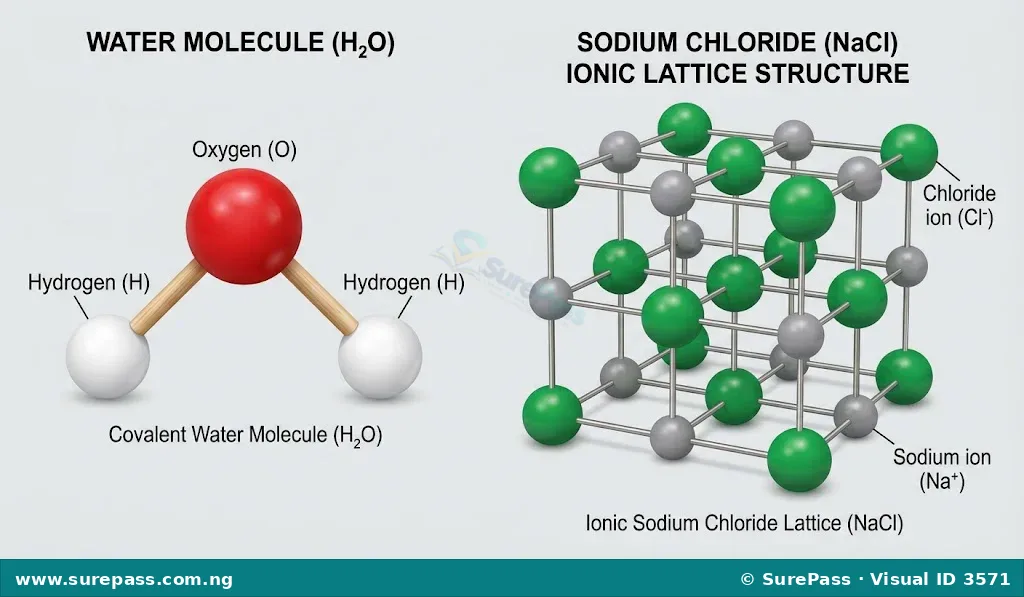
Observe the image below showing completed molecular models.
Procedure for Modeling a Covalent Molecule (Water – H2O)
The procedure involves the following steps:
- Select one large red plastic ball to represent the oxygen atom and two smaller white plastic balls to represent the hydrogen atoms.
- Cut two equal lengths of broomsticks (about 5 cm each) to represent the single covalent bonds.
- Insert one end of each broomstick into the red ball (oxygen) at an angle of approximately 104.5 degrees to represent the bent shape of a water molecule.
- Attach the white balls (hydrogen) to the free ends of the broomsticks.
- Observe the completed model, which illustrates the sharing of electron pairs between the oxygen atom and the two hydrogen atoms.
Procedure for Modeling an Ionic Lattice (Sodium Chloride – NaCl)
The procedure involves the following steps:
- Select six green plastic balls to represent chloride ions (Cl−) and six slightly smaller grey or blue plastic balls to represent sodium ions (Na+).
- Use a marker to write a positive sign (+) on the sodium balls and a negative sign (−) on the chloride balls to represent the charges resulting from electron transfer.
- Cut several short pieces of broomsticks to act as the electrostatic forces holding the ions together.
- Connect the balls in an alternating pattern (sodium-chlorine-sodium) to form a cubic lattice structure.
- Observe how each positive ion is surrounded by negative ions, illustrating the non-directional nature of ionic bonding in a solid crystal.
Summary of Key Concepts
The main points covered in this unit include:
- Chemical bonding is the attractive force that holds atoms, ions or molecules together to achieve a stable electronic configuration.
- Strong chemical bonds include electrovalent (transfer of electrons), covalent (sharing of electrons), dative (one-sided sharing) and metallic bonds (attraction between metal ions and mobile electrons).
- Weak chemical bonds include hydrogen bonds (polar attractions involving hydrogen) and van der Waals forces (temporary dipole attractions).
- Electrovalent compounds have high melting points and conduct electricity when molten or dissolved, while covalent compounds have low melting points and do not conduct electricity.
- IUPAC nomenclature provides a systematic way of naming compounds using rules based on oxidation states and the composition of the substance.
Questions for Evaluation
Answer the following questions to test understanding of the concepts:
- Define chemical bonding.
- Differentiate between ionic, covalent and metallic bonds in terms of electron behavior.
- State three physical properties of electrovalent compounds and explain why they differ from those of covalent compounds.
- Identify the type of chemical bond present in each of the following substances:
a. Magnesium oxide (MgO)
b. Water (H2O)
c. Copper wire (Cu)
d. Ammonium ion (NH4+) - Determine the IUPAC name for each of the following chemical formulas:
a. CaCO3
b. Fe2O3
c. H2SO4
d. AlCl3 - Explain why water has a much higher boiling point than hydrogen sulphide, even though oxygen and sulphur belong to the same group on the periodic table.


0 comments
Open the discussion when you need it. Comments stay collapsed until requested so the initial article remains light.