



ARTICLE CONTENTSOn this page 8 sections
Chemical Symbols, Formulae, Valencies and Equations
Performance Objectives
By the end of the lesson, students should be able to:
- define the following:
- symbols, formulae, valencies and equations,
- empirical and molecular formulae;
- identify the first 20 elements on the Periodic Table;
- write the symbols of the first 20 elements and other common elements;
- write the chemical formula of common substances;
- write and balance simple chemical equations;
- calculate mass of atomic numbers and valencies of elements from symbols and formulae.
Introduction to Chemical Language
Chemistry uses a special language to represent elements, compounds, and chemical reactions. This language involves symbols, formulae, and equations, which make it easier to communicate complex chemical information in a concise way.
Chemical Symbols
A chemical symbol is a one or two-letter abbreviation used to represent a chemical element.
These symbols are universally recognised, allowing chemists worldwide to understand which element is being discussed, regardless of the language they speak. The first letter of a chemical symbol is always capitalised, while the second letter (if present) is always lowercase.
Symbols of the First 20 Elements
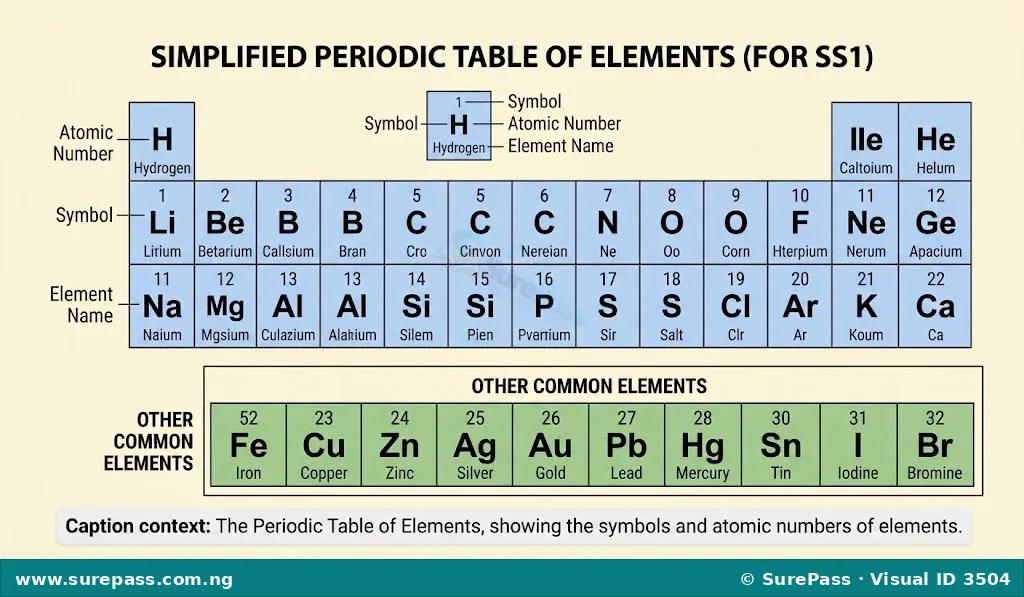
The first 20 elements in the Periodic Table are fundamental to understanding chemistry. Their names and symbols are:
- Hydrogen (H)
- Helium (He)
- Lithium (Li)
- Beryllium (Be)
- Boron (B)
- Carbon (C)
- Nitrogen (N)
- Oxygen (O)
- Fluorine (F)
- Neon (Ne)
- Sodium (Na)
- Magnesium (Mg)
- Aluminium (Al)
- Silicon (Si)
- Phosphorus (P)
- Sulphur (S)
- Chlorine (Cl)
- Argon (Ar)
- Potassium (K)
- Calcium (Ca)
Symbols of Other Common Elements
Beyond the first 20, several other elements are commonly encountered in everyday life and in chemical studies. Their names and symbols include:
- Iron (Fe)
- Copper (Cu)
- Zinc (Zn)
- Silver (Ag)
- Gold (Au)
- Lead (Pb)
- Mercury (Hg)
- Tin (Sn)
- Iodine (I)
- Bromine (Br)
The Periodic Table is an organised chart of all known elements, arranged by their atomic number. It is a crucial tool for identifying elements and understanding their properties.
Atomic Structure, Atomic Number, Mass Number and Valency
To understand how elements combine, it is important to know about their atomic structure and related properties.
Atomic Structure
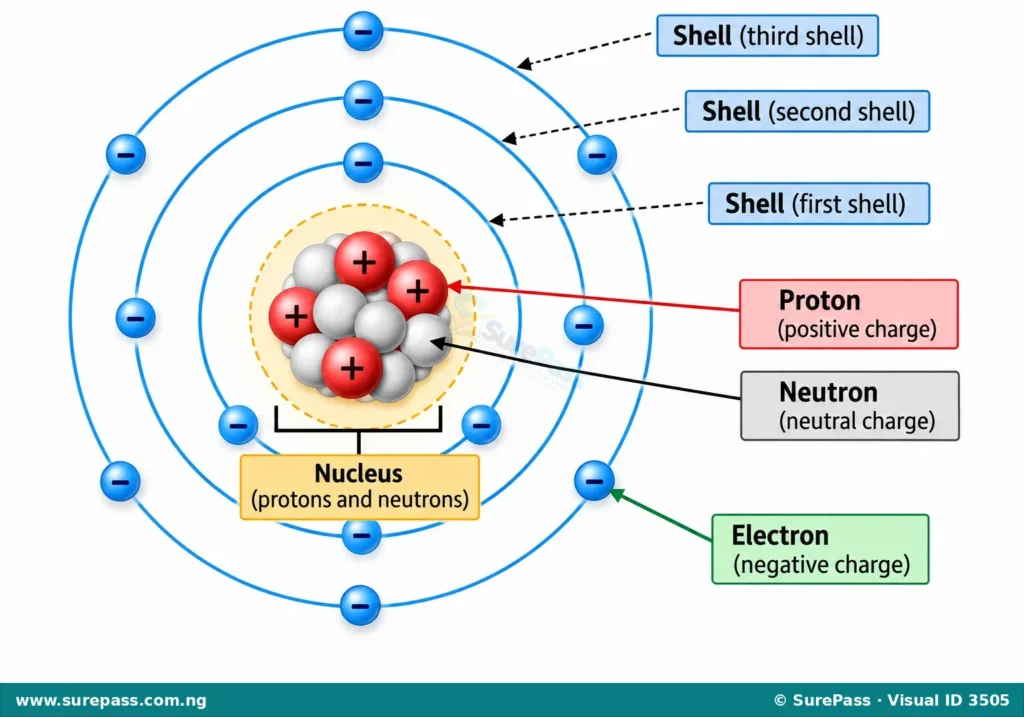
An atom is the smallest unit of an element that retains the chemical identity of that element. Atoms are made up of three main subatomic particles:
- Protons: Positively charged particles found in the nucleus of an atom.
- Neutrons: Neutral particles (no charge) also found in the nucleus.
- Electrons: Negatively charged particles that orbit the nucleus in specific energy levels or shells.
The number of protons determines the identity of an element.
Atomic Number (Z)
The atomic number (Z) is the number of protons in the nucleus of an atom of an element.
It is unique for each element and determines its position on the Periodic Table. In a neutral atom, the number of electrons is equal to the number of protons.
Mass Number (A)
The mass number (A) is the total number of protons and neutrons in the nucleus of an atom.
It represents the approximate relative atomic mass of an element. The number of neutrons can be calculated by subtracting the atomic number from the mass number (Number of neutrons = Mass number – Atomic number).
Valency
Valency is the combining power of an element or radical.
It indicates the number of hydrogen atoms that an atom of an element can combine with or displace. For main group elements, valency is often related to the number of electrons an atom needs to gain, lose, or share to achieve a stable electron configuration (usually 8 electrons in its outermost shell, or 2 for hydrogen and helium).
Elements in Group 1 (e.g., Sodium, Na) have a valency of 1 because they tend to lose one electron. Elements in Group 2 (e.g., Magnesium, Mg) have a valency of 2 because they tend to lose two electrons. Elements in Group 17 (e.g., Chlorine, Cl) have a valency of 1 because they tend to gain one electron.
Atomic Numbers, Mass Numbers, and Valencies of the First 20 Elements
The table below summarises the atomic number, approximate mass number, and common valency for the first 20 elements:
| Element Name | Symbol | Atomic Number (Z) | Approximate Mass Number (A) | Common Valency |
|---|---|---|---|---|
| Hydrogen | H | 1 | 1 | 1 |
| Helium | He | 2 | 4 | 0 |
| Lithium | Li | 3 | 7 | 1 |
| Beryllium | Be | 4 | 9 | 2 |
| Boron | B | 5 | 11 | 3 |
| Carbon | C | 6 | 12 | 4 |
| Nitrogen | N | 7 | 14 | 3 |
| Oxygen | O | 8 | 16 | 2 |
| Fluorine | F | 9 | 19 | 1 |
| Neon | Ne | 10 | 20 | 0 |
| Sodium | Na | 11 | 23 | 1 |
| Magnesium | Mg | 12 | 24 | 2 |
| Aluminium | Al | 13 | 27 | 3 |
| Silicon | Si | 14 | 28 | 4 |
| Phosphorus | P | 15 | 31 | 3, 5 |
| Sulphur | S | 16 | 32 | 2, 4, 6 |
| Chlorine | Cl | 17 | 35.5 | 1 |
| Argon | Ar | 18 | 40 | 0 |
| Potassium | K | 19 | 39 | 1 |
| Calcium | Ca | 20 | 40 | 2 |
Note that elements like Helium, Neon, and Argon have a valency of 0 because they are noble gases with stable electron configurations, meaning they do not readily combine with other elements.
Chemical Formulae
A chemical formula is a shorthand notation that represents the types of atoms and their relative numbers in a chemical compound.
It uses chemical symbols and subscripts to show the composition of a substance. For example, H2O is the chemical formula for water, indicating that each molecule of water contains two hydrogen atoms and one oxygen atom.
Empirical Formula
The empirical formula is the simplest whole-number ratio of atoms in a compound.
It shows the relative number of atoms of each element in a compound, but not necessarily the actual number of atoms in a molecule. For example, the empirical formula for glucose is CH2O.
Molecular Formula
The molecular formula is the actual number of atoms of each element in a molecule of a compound.
It provides the exact composition of a molecule. For example, the molecular formula for glucose is C6H12O6. The molecular formula is a multiple of the empirical formula.
Writing Chemical Formulae of Simple Compounds
Chemical formulae for simple ionic compounds can be written using the valencies of the combining elements or radicals. The “criss-cross” method is a common way to do this:
- Write the symbols of the elements or radicals side-by-side, with the more electropositive element (usually a metal or hydrogen) first.
- Write the valency of each element or radical above its symbol.
- Criss-cross the valencies, bringing them down as subscripts for the other element or radical.
- Simplify the subscripts to the lowest whole-number ratio if possible.
- If a radical has a subscript greater than 1, enclose the radical in parentheses.
Examples of writing chemical formulae:
- Sodium Chloride
- Symbols: Na Cl
- Valencies: Na1 Cl1
- Criss-cross: Na1Cl1
- Formula: NaCl
- Magnesium Oxide
- Symbols: Mg O
- Valencies: Mg2 O2
- Criss-cross: Mg2O2
- Simplify: Mg1O1
- Formula: MgO
- Aluminium Oxide
- Symbols: Al O
- Valencies: Al3 O2
- Criss-cross: Al2O3
- Formula: Al2O3
- Calcium Hydroxide
- Symbols: Ca OH (Hydroxide is a radical with valency 1)
- Valencies: Ca2 (OH)1
- Criss-cross: Ca1(OH)2
- Formula: Ca(OH)2
- Ammonium Sulphate
- Symbols: NH4 SO4 (Ammonium is a radical with valency 1, Sulphate is a radical with valency 2)
- Valencies: (NH4)1 (SO4)2
- Criss-cross: (NH4)2(SO4)1
- Formula: (NH4)2SO4
Chemical Equations
A chemical equation is a symbolic representation of a chemical reaction, showing the reactants on the left side and the products on the right side, separated by an arrow.
The arrow indicates the direction of the reaction. Reactants are the starting substances that undergo change, while products are the new substances formed. For example, the reaction of hydrogen gas with oxygen gas to form water can be written as:
H2 + O2 → H2O
This equation shows that hydrogen and oxygen are the reactants, and water is the product.
Balancing Chemical Equations
According to the Law of Conservation of Mass, matter cannot be created or destroyed in a chemical reaction. This means that the total number of atoms of each element must be the same on both sides of a chemical equation (reactant side and product side).
Balancing a chemical equation involves placing coefficients (numbers) in front of the chemical formulae to ensure that the number of atoms of each element is equal on both sides of the equation. Subscripts within a chemical formula must never be changed when balancing an equation, as this would change the identity of the substance.
Steps for Balancing Simple Chemical Equations
The procedure for balancing simple chemical equations involves the following steps:
- Write the unbalanced equation: Write the correct chemical formulae for all reactants and products.
- Count atoms: Count the number of atoms of each element on both the reactant and product sides.
- Balance elements one by one: Start with elements that appear in only one reactant and one product. Leave hydrogen and oxygen for last.
- Use coefficients: Place whole numbers (coefficients) in front of the chemical formulae to balance the number of atoms. Do not change subscripts.
- Recount and adjust: After adding a coefficient, recount the atoms of all elements and adjust other coefficients as needed until all elements are balanced.
- Check: Ensure that the total number of atoms for each element is the same on both sides of the equation.
Worked examples of balancing chemical equations:
- Hydrogen reacting with Oxygen to form Water
Unbalanced equation: H2 + O2 → H2O
Step 1: Count atoms
- Reactants: H = 2, O = 2
- Products: H = 2, O = 1
Step 2: Balance Oxygen
To balance oxygen, place a coefficient of 2 in front of H2O on the product side:
H2 + O2 → 2H2O
Step 3: Recount atoms
- Reactants: H = 2, O = 2
- Products: H = 2 × 2 = 4, O = 2 × 1 = 2
Step 4: Balance Hydrogen
Now, hydrogen is unbalanced. Place a coefficient of 2 in front of H2 on the reactant side:
2H2 + O2 → 2H2O
Step 5: Final check
- Reactants: H = 2 × 2 = 4, O = 2
- Products: H = 2 × 2 = 4, O = 2
The equation is balanced.
- Combustion of Methane
Unbalanced equation: CH4 + O2 → CO2 + H2O
Step 1: Count atoms
- Reactants: C = 1, H = 4, O = 2
- Products: C = 1, H = 2, O = 3 (2 from CO2 + 1 from H2O)
Step 2: Balance Carbon
Carbon is already balanced (1 on each side).
Step 3: Balance Hydrogen
To balance hydrogen, place a coefficient of 2 in front of H2O on the product side:
CH4 + O2 → CO2 + 2H2O
Step 4: Recount atoms
- Reactants: C = 1, H = 4, O = 2
- Products: C = 1, H = 2 × 2 = 4, O = 2 (from CO2) + 2 (from 2H2O) = 4
Step 5: Balance Oxygen
Oxygen is now unbalanced. To balance oxygen, place a coefficient of 2 in front of O2 on the reactant side:
CH4 + 2O2 → CO2 + 2H2O
Step 6: Final check
- Reactants: C = 1, H = 4, O = 2 × 2 = 4
- Products: C = 1, H = 4, O = 2 + 2 = 4
The equation is balanced.
Calculating Atomic Numbers, Mass Numbers, and Valencies from Symbols and Formulae
The Periodic Table is the primary tool for determining the atomic number and mass number of an element from its symbol. Valency can also often be inferred from the element’s position in the Periodic Table or from its chemical formula in a compound.
Determining Atomic Number and Mass Number
To determine the atomic number and mass number of an element:
- Locate the element: Find the element’s symbol on the Periodic Table.
- Read the numbers: The atomic number (Z) is usually the smaller whole number associated with the element, often found above the symbol. The mass number (A) or relative atomic mass is typically the larger number, often a decimal, found below the symbol. For calculations, the mass number is usually rounded to the nearest whole number.
Example:
- For Sodium (Na):
- Locate Na on the Periodic Table.
- Atomic Number (Z) = 11
- Approximate Mass Number (A) = 23
- For Chlorine (Cl):
- Locate Cl on the Periodic Table.
- Atomic Number (Z) = 17
- Approximate Mass Number (A) = 35.5 (often used as 35.5 or 35 for calculations)
Determining Valency
Valency can be determined in a few ways:
- From Periodic Table Group: For main group elements, the valency is often related to their group number.
- Group 1 elements (e.g., Na, K) have a valency of 1.
- Group 2 elements (e.g., Mg, Ca) have a valency of 2.
- Group 13 elements (e.g., Al) have a valency of 3.
- Group 14 elements (e.g., C, Si) have a valency of 4.
- Group 15 elements (e.g., N, P) often have a valency of 3 (8 – 5 = 3).
- Group 16 elements (e.g., O, S) often have a valency of 2 (8 – 6 = 2).
- Group 17 elements (e.g., F, Cl) have a valency of 1 (8 – 7 = 1).
- Group 18 elements (noble gases) have a valency of 0.
- From Chemical Formulae: If the formula of a compound is known, the valency of an unknown element can be determined if the valency of the other element is known.
Example: In the compound H2S, hydrogen has a valency of 1. Since there are two hydrogen atoms, the total combining power from hydrogen is 2. Therefore, sulphur (S) must have a valency of 2 to combine with two hydrogen atoms.
Example: In the compound AlCl3, chlorine has a valency of 1. Since there are three chlorine atoms, the total combining power from chlorine is 3. Therefore, aluminium (Al) must have a valency of 3.




0 comments
Open the discussion when you need it. Comments stay collapsed until requested so the initial article remains light.