


ARTICLE CONTENTSOn this page 11 sections
Acids, Bases and Salts
Performance Objectives
By the end of the lesson, students should be able to:
- define acids, bases and salts;
- identify acids and bases and salts;
- state the uses of acids, bases and salts;
- describe how acid-base indicator works;
- explain neutralization reaction;
- write balanced equations for neutralization reactions;
- describe the pH a scale;
- discuss the importance of the pH values;
- identify and prepare salts (normal, acidic, basic salts);
- state properties of salts;’
- define the terms: hydroscopic, efflorescent and deliquescent;
- explain the solubility of salts in water.
Introduction to Acids, Bases and Salts
Acids, bases, and salts are fundamental chemical compounds found everywhere in nature and used widely in industries, homes, and laboratories. They play crucial roles in biological processes, agriculture, and many everyday applications. Understanding their properties and reactions is essential in chemistry.
Acids
An acid is a substance that produces hydrogen ions (H+) when dissolved in water. These hydrogen ions are responsible for the characteristic properties of acids.
Characteristics of Acids
Acids exhibit several distinct characteristics:
- Sour Taste: Acids generally have a sour taste. Examples include citrus fruits like oranges and lemons, which contain citric acid, and vinegar, which contains acetic acid.
- Corrosive Nature: Concentrated acids are corrosive, meaning they can burn skin and damage materials like cloth and metals.
- Effect on Indicators: Acids change the colour of indicators. For example, they turn blue litmus paper red.
- Reaction with Metals: Acids react with active metals to produce hydrogen gas and a salt. For example, hydrochloric acid reacts with zinc to produce zinc chloride and hydrogen gas.
- Reaction with Carbonates and Bicarbonates: Acids react with carbonates and bicarbonates to produce carbon dioxide gas, water, and a salt. For example, hydrochloric acid reacts with calcium carbonate (limestone) to produce calcium chloride, water, and carbon dioxide.
- Reaction with Bases: Acids react with bases to form salt and water in a process called neutralisation.
Preparation Methods of Acids
Acids can be prepared through various methods:
- By direct combination of elements: Some acids can be formed by combining hydrogen with a non-metal. For example, hydrogen reacts with chlorine to form hydrogen chloride gas, which dissolves in water to form hydrochloric acid.
H2(g) + Cl2(g) → 2HCl(g) - By dissolving acidic oxides in water: Non-metal oxides (acidic oxides) react with water to form acids. For example, sulfur trioxide dissolves in water to form sulfuric acid.
SO3(g) + H2O(l) → H2SO4(aq) - By oxidation of non-metals: Some non-metals can be oxidised to form acids. For example, nitrogen dioxide reacts with water and oxygen to form nitric acid.
4NO2(g) + 2H2O(l) + O2(g) → 4HNO3(aq)
Reactions of Acids
The reactions of acids are summarised below:
- Reaction with active metals:
Acid + Active Metal → Salt + Hydrogen gas
2HCl(aq) + Zn(s) → ZnCl2(aq) + H2(g) - Reaction with bases (neutralisation):
Acid + Base → Salt + Water
HCl(aq) + NaOH(aq) → NaCl(aq) + H2O(l) - Reaction with carbonates and bicarbonates:
Acid + Carbonate → Salt + Water + Carbon dioxide
2HCl(aq) + CaCO3(s) → CaCl2(aq) + H2O(l) + CO2(g)
Uses of Acids
Acids have many important uses in daily life and industry:
- Hydrochloric acid (HCl): Used in cleaning metals (pickling), in the stomach for digestion, and in the production of PVC plastic.
- Sulfuric acid (H2SO4): Used in car batteries, in the manufacture of fertilisers, detergents, and paints. It is also a dehydrating agent.
- Nitric acid (HNO3): Used in the production of fertilisers, explosives, and dyes.
- Acetic acid (CH3COOH): Found in vinegar, used as a food preservative and flavouring agent.
- Citric acid: Found in citrus fruits, used as a food additive and preservative.
Testing for Acids in Fruits and Vegetables
Many fruits and vegetables contain natural acids. These can be identified using simple indicators.
The procedure involves the following steps:
- Obtain samples of ripe and unripe fruits (e.g., lemon, orange, tomato) and some vegetables (e.g., garden egg).
- Cut a small piece from each fruit or vegetable.
- Place a drop of the juice from each sample onto a piece of blue litmus paper.
- Observe any colour change. If the blue litmus paper turns red, it indicates the presence of an acid.
- Compare the intensity of the colour change for ripe versus unripe fruits to infer relative acidity.
Bases
A base is a substance that produces hydroxide ions (OH−) when dissolved in water. Bases that are soluble in water are called alkalis.
Characteristics of Bases
Bases also have distinct characteristics:
- Bitter Taste: Bases generally have a bitter taste.
- Soapy Feel: Bases feel slippery or soapy to the touch.
- Corrosive Nature: Strong bases are corrosive and can cause chemical burns.
- Effect on Indicators: Bases change the colour of indicators. For example, they turn red litmus paper blue.
- Reaction with Acids: Bases react with acids to form salt and water (neutralisation).
Preparation Methods of Bases
Bases can be prepared by:
- Reaction of active metals with water: Active metals like sodium and potassium react with water to form a base and hydrogen gas.
2Na(s) + 2H2O(l) → 2NaOH(aq) + H2(g) - Reaction of metal oxides with water: Basic oxides (metal oxides) react with water to form bases. For example, calcium oxide reacts with water to form calcium hydroxide.
CaO(s) + H2O(l) → Ca(OH)2(aq) - Decomposition of some salts: Some salts decompose upon heating to form a metal oxide (a base) and a non-metal oxide. For example, calcium carbonate decomposes to calcium oxide and carbon dioxide.
CaCO3(s) → CaO(s) + CO2(g)
Reactions of Bases
The reactions of bases are summarised below:
- Reaction with acids (neutralisation):
Base + Acid → Salt + Water
KOH(aq) + HCl(aq) → KCl(aq) + H2O(l) - Reaction with ammonium salts (heating):
Base + Ammonium salt → Salt + Water + Ammonia gas
NaOH(aq) + NH4Cl(aq) → NaCl(aq) + H2O(l) + NH3(g)
Uses of Bases
Bases are also widely used:
- Sodium hydroxide (NaOH): Also known as caustic soda, used in the manufacture of soap, paper, and textiles. It is also used in drain cleaners.
- Potassium hydroxide (KOH): Used in the manufacture of soft soaps and alkaline batteries.
- Calcium hydroxide (Ca(OH)2): Also known as slaked lime, used to neutralise acidic soil in agriculture and in making mortar.
- Magnesium hydroxide (Mg(OH)2): Used as an antacid to relieve indigestion and heartburn.
- Ammonia (NH3): Used in the production of fertilisers and cleaning agents.
Acid-Base Indicators
Acid-base indicators are substances that change colour depending on whether they are in an acidic or basic solution. They are often weak organic acids or bases themselves.
How Acid-Base Indicators Work
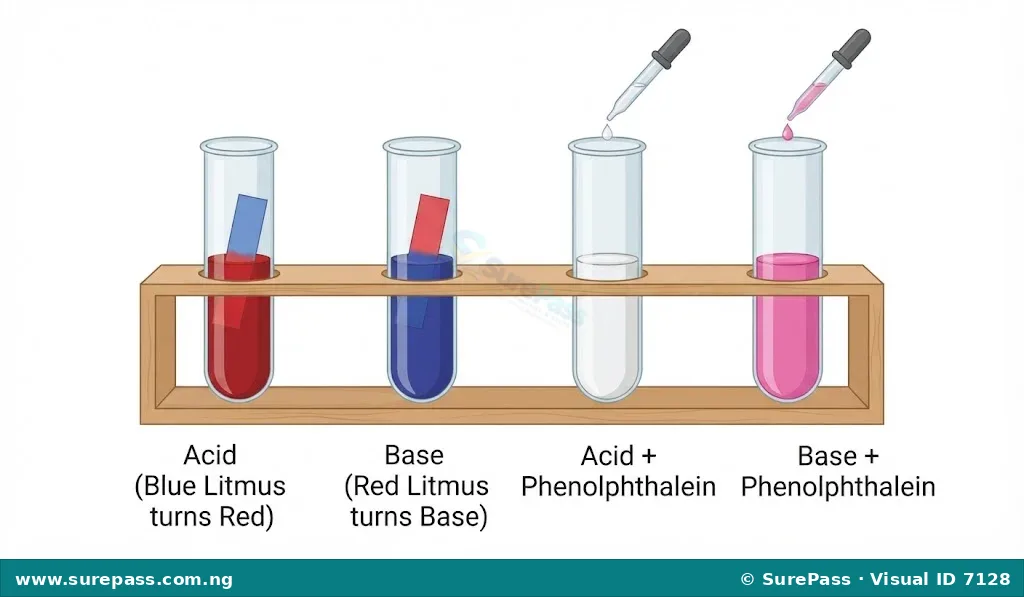
Indicators work by undergoing a reversible chemical change that results in a visible colour change. In an acidic solution, the indicator takes one colour, and in a basic solution, it takes a different colour. The colour change occurs over a specific pH range.
Common indicators and their colour changes are:
- Litmus paper: Turns red in acid, blue in base.
- Phenolphthalein: Colourless in acid, pink/red in base.
- Methyl orange: Red in acid, yellow in base.
- Universal indicator: A mixture of several indicators that shows a range of colours across the pH scale, allowing for a more precise estimation of pH.
Preparing Indicators from Flowers
Many flowers and plant leaves contain natural pigments that can act as acid-base indicators. Examples include hibiscus, rose petals, and red cabbage.
The procedure involves the following steps:
- Collect petals from brightly coloured flowers (e.g., hibiscus, rose) or red cabbage leaves.
- Tear the petals or leaves into small pieces.
- Place the pieces in a mortar and crush them using a pestle.
- Add a small amount of ethanol or distilled water to the crushed material and continue grinding to extract the colour.
- Filter the mixture using filter paper to separate the liquid extract (the indicator) from the solid plant material.
- Pour small amounts of the extracted indicator into separate test tubes.
- Add a few drops of an acidic solution (e.g., lemon juice, vinegar) to one test tube and observe the colour change.
- Add a few drops of a basic solution (e.g., soap solution, baking soda solution) to another test tube and observe the colour change.
- Record the observed colour changes for the prepared indicator.
Neutralisation Reaction
Neutralisation is a chemical reaction in which an acid and a base react quantitatively with each other to form a salt and water. The reaction essentially involves the combination of hydrogen ions (H+) from the acid and hydroxide ions (OH−) from the base to form water (H2O).
The general equation for a neutralisation reaction is:
Acid + Base → Salt + Water
Writing Balanced Equations for Neutralisation Reactions
It is important to write balanced chemical equations to represent neutralisation reactions accurately.
Examples of neutralisation reactions include:
- Hydrochloric acid and Sodium hydroxide:
HCl(aq) + NaOH(aq) → NaCl(aq) + H2O(l)
(This reaction forms sodium chloride, a common salt, and water.) - Sulfuric acid and Potassium hydroxide:
H2SO4(aq) + 2KOH(aq) → K2SO4(aq) + 2H2O(l)
(This reaction forms potassium sulfate and water. Note the balancing of the equation.) - Nitric acid and Calcium hydroxide:
2HNO3(aq) + Ca(OH)2(aq) → Ca(NO3)2(aq) + 2H2O(l)
(This reaction forms calcium nitrate and water.)
The pH Scale
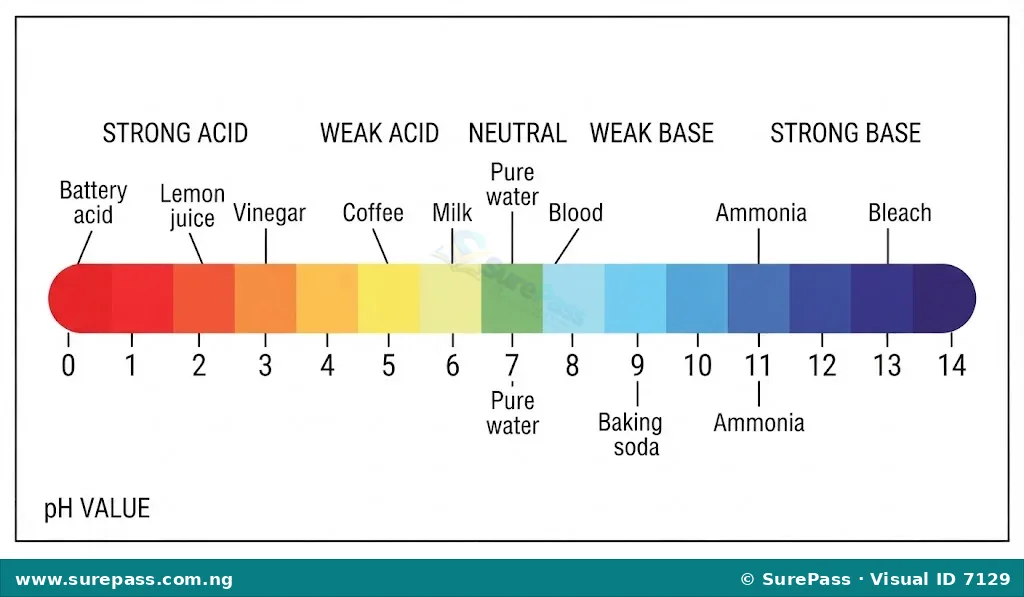
The pH scale is a numerical scale used to specify the acidity or alkalinity of an aqueous solution. It ranges from 0 to 14. The pH value indicates the concentration of hydrogen ions (H+) in a solution.
Relative Acidity and Alkalinity
The pH scale is interpreted as follows:
- pH less than 7: Indicates an acidic solution. The lower the pH value (closer to 0), the stronger the acid.
- pH equal to 7: Indicates a neutral solution. Pure water has a pH of 7.
- pH greater than 7: Indicates an alkaline (basic) solution. The higher the pH value (closer to 14), the stronger the base.
Importance of pH Values
The pH value is important in many aspects of life and industry:
- Agriculture: Soil pH affects nutrient availability for plants. Farmers adjust soil pH by adding lime (basic) for acidic soils or sulfur (acidic) for alkaline soils to ensure optimal crop growth.
- Biology and Medicine: The pH of body fluids (like blood, which is around pH 7.4) must be maintained within a narrow range for proper bodily functions. Deviations can lead to health problems.
- Food Processing: pH is critical in food preservation and flavour. For example, the acidity of fruits and vegetables affects their shelf life and taste.
- Water Treatment: The pH of drinking water and wastewater needs to be controlled to prevent corrosion of pipes and to ensure effective disinfection.
- Industrial Processes: Many chemical reactions in industries require specific pH conditions for optimal yield and safety.
Measuring pH
The pH of a solution can be measured using:
- Universal Indicator: This is a solution or paper impregnated with a mixture of indicators that shows different colours at different pH values. The colour of the universal indicator is compared to a standard colour chart to determine the pH.
- pH Meter: A pH meter is an electronic device with a probe that is dipped into the solution. It provides a precise numerical reading of the pH value.
Measuring pH using a pH Meter
A pH meter provides a more accurate measurement of pH compared to universal indicators.
The procedure involves the following steps:
- Calibrate the pH meter according to the manufacturer’s instructions, usually using buffer solutions of known pH (e.g., pH 4, 7, and 10).
- Rinse the pH electrode with distilled water and gently blot it dry with a tissue.
- Immerse the electrode into the solution whose pH is to be measured. Ensure the electrode tip is fully submerged.
- Allow the reading on the pH meter to stabilise.
- Record the pH value displayed on the meter.
- Rinse the electrode thoroughly with distilled water after each measurement before measuring another solution or storing it.
Salts
A salt is an ionic compound formed when the hydrogen ion of an acid is replaced by a metal ion or an ammonium ion. Salts are typically formed from the reaction of an acid with a base, metal, or carbonate.
Identification of Salts
Salts are generally crystalline solids at room temperature. They can be identified by their physical appearance and chemical tests for their constituent ions (cations and anions).
Preparation of Salts
Salts can be prepared by various methods, depending on whether the salt is soluble or insoluble in water.
Methods for preparing salts include:
- Neutralisation (Acid + Base): This method is used to prepare soluble salts. An acid reacts with a base to form a salt and water.
Example: Preparation of Sodium Chloride (NaCl)
HCl(aq) + NaOH(aq) → NaCl(aq) + H2O(l) - Reaction of Acid with Metal: This method is used for soluble salts of active metals.
Example: Preparation of Zinc Sulfate (ZnSO4)
H2SO4(aq) + Zn(s) → ZnSO4(aq) + H2(g) - Reaction of Acid with Carbonate: This method is also used for soluble salts.
Example: Preparation of Calcium Chloride (CaCl2)
2HCl(aq) + CaCO3(s) → CaCl2(aq) + H2O(l) + CO2(g) - Precipitation (Double Decomposition): This method is used to prepare insoluble salts. Two soluble salts are mixed, and their ions exchange to form an insoluble salt (precipitate) and another soluble salt.
Example: Preparation of Barium Sulfate (BaSO4)
BaCl2(aq) + Na2SO4(aq) → BaSO4(s) + 2NaCl(aq)
Types of Salts
Salts can be classified into different types based on their composition and the extent of neutralisation:
- Normal Salts: These are formed when all the replaceable hydrogen ions of an acid are completely replaced by metal ions or ammonium ions. They are neutral to litmus.
Example: Sodium chloride (NaCl), Potassium sulfate (K2SO4). - Acidic Salts: These are formed when only a part of the replaceable hydrogen ions of a polybasic acid (an acid with more than one replaceable hydrogen ion) is replaced by metal ions. They contain replaceable hydrogen ions and can react with bases.
Example: Sodium hydrogen sulfate (NaHSO4), Sodium hydrogen carbonate (NaHCO3). - Basic Salts: These are formed when a polyacidic base (a base with more than one replaceable hydroxide ion) is only partially neutralised by an acid. They contain replaceable hydroxide ions and can react with acids.
Example: Basic lead nitrate (Pb(OH)NO3), Basic magnesium chloride (Mg(OH)Cl).
Uses of Salts
Salts are indispensable in various sectors:
- Sodium chloride (NaCl): Common table salt, used as a food seasoning and preservative. Also used in the chemical industry to produce chlorine, sodium hydroxide, and sodium carbonate.
- Sodium carbonate (Na2CO3): Used in glass manufacturing, soap and detergent production, and as a water softener.
- Calcium carbonate (CaCO3): Found in limestone, marble, and chalk. Used in construction, as an antacid, and in the production of cement.
- Potassium nitrate (KNO3): Used in fertilisers and gunpowder.
- Ammonium sulfate ((NH4)2SO4): Used as a nitrogen and sulfur fertiliser.
- Copper(II) sulfate (CuSO4): Used as a fungicide, in electroplating, and as a mordant in dyeing.
Properties of Salts
Some salts exhibit special properties related to their interaction with moisture in the air.
Deliquescent Substances
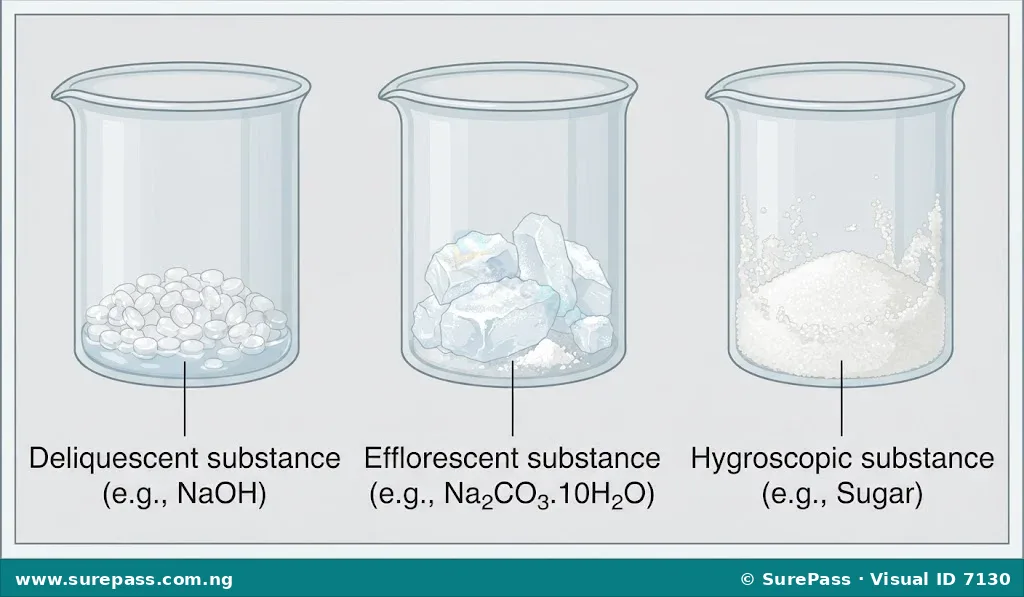
A deliquescent substance is a substance that absorbs moisture from the atmosphere and dissolves in it to form a solution. This process occurs when the vapour pressure of the saturated solution formed is less than the partial pressure of water vapour in the air.
Examples of deliquescent substances include:
- Sodium hydroxide (NaOH) pellets
- Calcium chloride (CaCl2)
- Iron(III) chloride (FeCl3)
Efflorescent Substances
An efflorescent substance is a crystalline hydrate that loses its water of crystallisation when exposed to the atmosphere. This occurs when the vapour pressure of the hydrate is greater than the partial pressure of water vapour in the air.
Examples of efflorescent substances include:
- Washing soda (sodium carbonate decahydrate, Na2CO3·10H2O)
- Glauber’s salt (sodium sulfate decahydrate, Na2SO4·10H2O)
- Epsom salt (magnesium sulfate heptahydrate, MgSO4·7H2O)
Hygroscopic Substances
A hygroscopic substance is a substance that absorbs moisture from the atmosphere without dissolving in it to form a solution. They simply become damp or sticky.
Examples of hygroscopic substances include:
- Concentrated sulfuric acid (H2SO4)
- Anhydrous calcium chloride (CaCl2) (can be deliquescent if enough moisture is absorbed)
- Silica gel
- Sugar
Solubility of Salts in Water
Solubility refers to the maximum amount of a substance (solute) that can dissolve in a given amount of solvent (usually water) at a specific temperature to form a saturated solution. The solubility of salts in water varies greatly.
General Solubility Rules for Salts
While there are exceptions, some general rules help predict the solubility of common salts in water:
- All nitrates are soluble.
- All alkali metal (Group 1) salts (e.g., sodium, potassium, ammonium) are soluble.
- All chlorides are soluble, except silver chloride (AgCl), lead(II) chloride (PbCl2), and mercury(I) chloride (Hg2Cl2).
- All sulfates are soluble, except barium sulfate (BaSO4), lead(II) sulfate (PbSO4), and calcium sulfate (CaSO4).
- All carbonates and phosphates are insoluble, except those of alkali metals and ammonium.
- All hydroxides are insoluble, except those of alkali metals and barium hydroxide (Ba(OH)2).
Demonstrating Solubility of Substances
The solubility of different salts can be demonstrated experimentally.
The procedure involves the following steps:
- Obtain several test tubes and label them.
- Add a small, equal amount of different salts (e.g., sodium chloride, copper(II) sulfate, calcium carbonate, silver nitrate) to each labelled test tube.
- Add about 5 mL of distilled water to each test tube.
- Shake each test tube vigorously for about 30 seconds.
- Observe whether the salt completely dissolves, partially dissolves, or remains undissolved.
- Record the observations for each salt, noting which are soluble and which are insoluble.
- Draw the apparatus set-up, showing the test tubes with the salts and water before and after shaking, indicating the dissolved or undissolved state.
Relating Solubility to Bond Type
The solubility of a substance in water is related to the type of chemical bonds present in the substance and its interaction with water molecules.
Water is a polar solvent, meaning its molecules have a slight positive charge on one side and a slight negative charge on the other. This polarity allows water to effectively dissolve substances that are also polar or ionic.
- Ionic Compounds (Salts): Many salts are ionic compounds, formed by electrostatic attraction between positively charged metal ions and negatively charged non-metal ions. When an ionic salt is placed in water, the polar water molecules surround and separate the ions, pulling them into solution. This process is called hydration. Generally, ionic compounds are soluble in water if the energy released during hydration is sufficient to overcome the lattice energy holding the ions together in the solid crystal.
- Covalent Compounds: Covalent compounds share electrons between atoms. Non-polar covalent compounds (like oils) do not dissolve well in water because there is little attraction between their molecules and polar water molecules. Polar covalent compounds (like sugar or ethanol) can dissolve in water because they can form hydrogen bonds with water molecules.
Therefore, most soluble salts are ionic compounds, and their solubility depends on the strength of the ionic bonds compared to the strength of the attraction between the ions and water molecules.




0 comments
Open the discussion when you need it. Comments stay collapsed until requested so the initial article remains light.