


ARTICLE CONTENTSOn this page 12 sections
Water
Performance Objectives
By the end of the lesson, students should be able to:
- identify the sources;
- draw the structure of water;
- deduce the chemical formular for water from its electronic configuration;
- state the properties of water;
- distinguish between pure and impure water;
- identify substances that contaminate water;
- use different methods to purify water.
Introduction to Water
Water is one of the most essential substances on Earth, crucial for the survival of all living things. It covers about 71% of the Earth’s surface and exists in three states: solid (ice), liquid (water), and gas (water vapour). Water plays a vital role in various natural processes and human activities.
Sources of Water
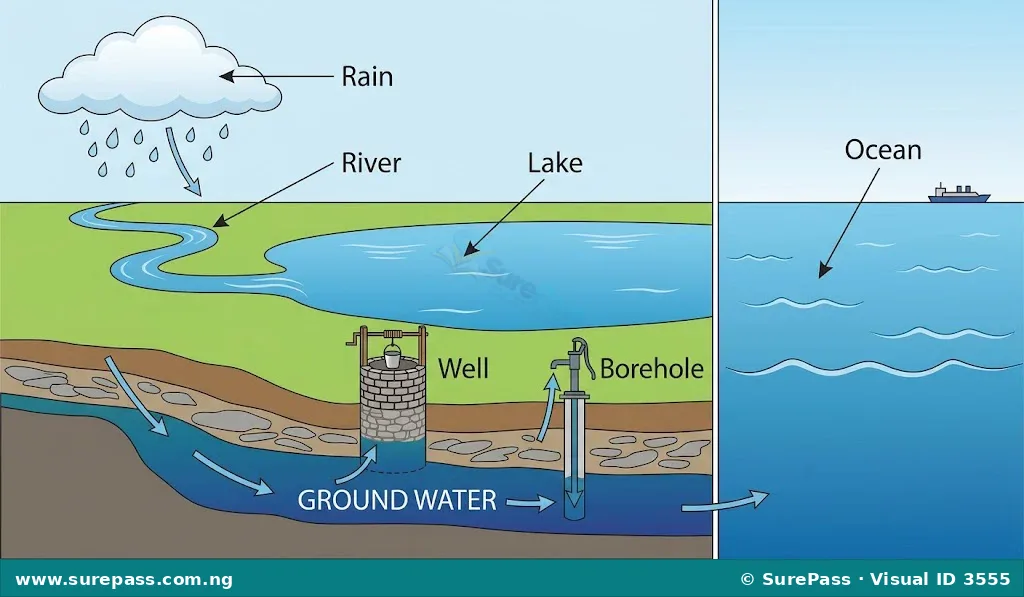
Water is found in many places, both naturally occurring and through human intervention. These sources can be broadly categorised into natural and artificial sources.
Natural Sources of Water
Natural sources are those where water occurs naturally without significant human construction.
- Rainwater: This is the purest natural form of water, formed by the condensation of water vapour in the atmosphere. However, it can pick up impurities like dust, smoke, and dissolved gases as it falls through the air.
- Rivers: Rivers are natural flowing watercourses, usually freshwater, flowing towards an ocean, sea, lake, or another river. River water often contains suspended particles and dissolved minerals.
- Lakes and Ponds: These are bodies of standing water, usually freshwater, found in depressions on the Earth’s surface. Lake water can contain various impurities depending on its surroundings.
- Oceans and Seas: These are vast bodies of saltwater covering most of the Earth’s surface. Ocean water is highly saline due to dissolved salts, primarily sodium chloride.
- Underground Water: This includes water found beneath the Earth’s surface in aquifers. It is accessed through springs, wells, and boreholes. Underground water is generally clearer than surface water but can contain dissolved minerals.
Artificial Sources of Water
Artificial sources are created or managed by humans to store and supply water.
- Dams and Reservoirs: Dams are barriers constructed across rivers to hold back water, forming reservoirs. These reservoirs store large quantities of water for various uses, including drinking, irrigation, and power generation.
- Boreholes and Wells: These are holes drilled or dug into the ground to access underground water. They are common sources of water in many communities, especially where surface water is scarce.
- Water Treatment Plants: These facilities collect raw water from natural sources and treat it to make it safe for drinking and other uses.
Structure of Water
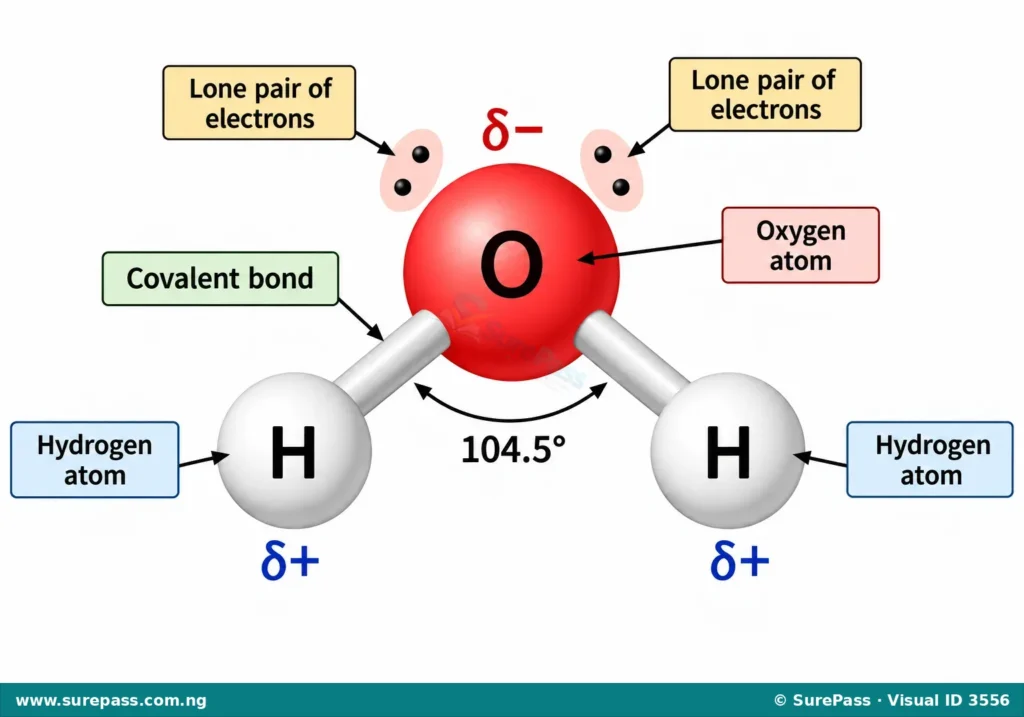
Water is a compound with the chemical formula H₂O. This means each molecule of water is made up of two hydrogen atoms covalently bonded to one oxygen atom.
The oxygen atom is at the centre, and the two hydrogen atoms are attached to it. The oxygen atom has six valence electrons. It shares one electron with each hydrogen atom, forming two single covalent bonds. This leaves two lone pairs of electrons on the oxygen atom.
These lone pairs of electrons repel the bonding pairs, pushing the hydrogen atoms closer together. This repulsion gives the water molecule a bent or V-shaped structure, rather than a linear one. The bond angle between the two O-H bonds is approximately 104.5 degrees.
Due to the bent shape and the difference in electronegativity between oxygen and hydrogen, the water molecule is polar. The oxygen atom attracts electrons more strongly, giving it a slight negative charge (δ-), while the hydrogen atoms have slight positive charges (δ+).
Chemical Formula of Water from Electronic Configuration
The chemical formula of water (H₂O) can be deduced by considering the electronic configurations of hydrogen and oxygen atoms and their tendency to achieve stable electron configurations.
The electronic configuration of hydrogen (H) is 1. It has one valence electron and needs one more electron to achieve a stable duplet configuration (like helium).
The electronic configuration of oxygen (O) is 2, 6. It has six valence electrons and needs two more electrons to achieve a stable octet configuration (like neon).
To achieve stability, one oxygen atom shares electrons with two hydrogen atoms. Each hydrogen atom shares its single electron with the oxygen atom, forming a single covalent bond. In return, the oxygen atom shares one of its electrons with each hydrogen atom.
This results in two single covalent bonds between the oxygen atom and the two hydrogen atoms. The oxygen atom now has eight electrons in its outermost shell (two from each bond and two lone pairs), and each hydrogen atom has two electrons in its outermost shell. This stable arrangement leads to the chemical formula H₂O.
Properties and Uses of Water
Water possesses unique physical and chemical properties that make it essential for life and various applications.
Physical Properties of Water
- Colourless, Odourless, and Tasteless: Pure water has no colour, smell, or taste.
- Boiling Point: Water boils at 100 °C at standard atmospheric pressure (760 mmHg or 1 atmosphere).
- Freezing Point: Water freezes at 0 °C at standard atmospheric pressure.
- Density: The density of water is maximum at 4 °C, where it is 1 g/cm³. Above and below this temperature, its density decreases. This property allows ice to float on water.
- Universal Solvent: Water is an excellent solvent for many substances due to its polarity. It can dissolve a wide range of ionic and polar covalent compounds, earning it the name “universal solvent.”
- High Surface Tension: Water molecules at the surface are more attracted to each other than to the air, creating a “skin” on the surface. This allows small insects to walk on water and helps in capillary action.
- High Specific Heat Capacity: Water can absorb a large amount of heat energy without a significant rise in its temperature. This property helps to regulate Earth’s climate and maintain stable body temperatures in living organisms.
Chemical Properties of Water
- Neutrality: Pure water is neutral to litmus paper, meaning it is neither acidic nor basic. Its pH is 7.
- Reaction with Active Metals: Water reacts with very active metals like sodium (Na) and potassium (K) to produce hydrogen gas and a metal hydroxide.
Example:
2Na(s) + 2H₂O(l) → 2NaOH(aq) + H₂(g)
- Reaction with Metallic Oxides (Basic Oxides): Some metallic oxides, especially those of Group 1 and 2 metals, react with water to form bases.
Example:
CaO(s) + H₂O(l) → Ca(OH)₂(aq)
- Reaction with Non-Metallic Oxides (Acidic Oxides): Many non-metallic oxides react with water to form acids.
Example:
SO₃(g) + H₂O(l) → H₂SO₄(aq)
- Formation of Hydrates (Water of Crystallisation): Water molecules can combine with certain salts to form crystalline substances known as hydrates. The water molecules are chemically bound within the crystal structure.
Example:
CuSO₄(s) + 5H₂O(l) → CuSO₄·5H₂O(s) (Copper(II) sulphate pentahydrate)
Uses of Water
Water is indispensable for numerous activities and processes.
- Domestic Uses: This includes drinking, cooking, bathing, washing clothes, and cleaning homes.
- Agricultural Uses: Water is essential for irrigating crops, watering livestock, and supporting aquaculture (fish farming).
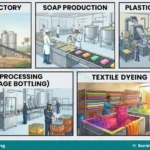
- Industrial Uses: Industries use water as a solvent, a coolant in machinery, a raw material in manufacturing processes, and for cleaning.
- Transportation: Rivers, lakes, and oceans serve as waterways for transporting goods and people.
- Recreational Uses: Water bodies are used for swimming, fishing, boating, and other leisure activities.
- Power Generation: Hydroelectric power plants use the force of flowing water to generate electricity.
Pure and Impure Water
Water can exist in various forms, ranging from highly pure to significantly impure, depending on the substances dissolved or suspended in it.
Pure Water
Pure water is water that contains only H₂O molecules and no other dissolved minerals, gases, suspended particles, or microorganisms. It is often obtained through processes like distillation. Pure water has a neutral pH of 7, boils at exactly 100 °C, and freezes at exactly 0 °C at standard atmospheric pressure.
Impure Water
Impure water is water that contains dissolved substances, suspended particles, gases, or microorganisms in addition to H₂O molecules. Most natural water sources, such as rivers, lakes, and groundwater, are impure to varying degrees. Impure water may have a taste, odour, or colour, and its boiling and freezing points may differ from those of pure water.
Distinguishing Between Pure and Impure Water
The main differences between pure and impure water are:
- Composition: Pure water consists only of H₂O molecules. Impure water contains H₂O plus other substances.
- Boiling Point: Pure water boils at a constant temperature of 100 °C at standard pressure. Impure water usually boils at a temperature slightly above 100 °C, and its boiling point may not be constant due to the presence of dissolved impurities.
- Freezing Point: Pure water freezes at 0 °C. Impure water usually freezes at a temperature slightly below 0 °C.
- Taste and Odour: Pure water is tasteless and odourless. Impure water may have a taste or odour depending on the impurities present.
- Conductivity: Pure water is a poor conductor of electricity. Impure water, especially with dissolved salts, conducts electricity better.
Substances that Contaminate Water
Water contamination occurs when harmful substances or excessive amounts of natural substances are present in water, making it unsafe or unsuitable for its intended use. These substances can be natural or human-made.
Natural Contaminants
- Dissolved Minerals: Salts of calcium, magnesium, iron, and other minerals can dissolve in water as it passes through rocks and soil. While some are harmless, high concentrations can make water hard or give it an unpleasant taste.
- Suspended Soil Particles: Clay, silt, and sand particles can be carried by water, making it turbid or muddy.
- Decaying Organic Matter: Decomposing plant and animal remains can release organic compounds and nutrients into water, affecting its quality and promoting microbial growth.
- Microorganisms: Bacteria, viruses, protozoa, and other pathogens can naturally occur in water, especially from animal waste, and cause diseases.
Human-Made Contaminants
- Industrial Waste: Factories and industries discharge various pollutants, including heavy metals (e.g., lead, mercury), toxic chemicals, acids, and alkalis, into water bodies.
- Agricultural Run-off: Rainwater can wash pesticides, herbicides, and fertilisers from farmlands into rivers and lakes, leading to chemical pollution and excessive algal growth (eutrophication).
- Sewage and Domestic Waste: Untreated or poorly treated human and animal waste from homes and communities contains pathogens, organic matter, and nutrients that contaminate water.
- Oil Spills: Accidents involving oil tankers or offshore drilling platforms can release large quantities of crude oil into oceans and coastal waters, causing severe environmental damage.
- Plastics and Microplastics: Plastic waste that enters water bodies breaks down into tiny particles (microplastics) that can harm aquatic life and enter the food chain.
- Detergents and Soaps: Household cleaning agents can contribute phosphates and other chemicals to water, leading to pollution.
Purification of Water
Water purification is the process of removing undesirable chemicals, biological contaminants, suspended solids, and gases from water to make it suitable for a specific purpose, such as drinking or industrial use. Several methods are employed for water purification.
Common Water Purification Methods
- Boiling: Heating water to its boiling point (100 °C) for several minutes effectively kills most disease-causing microorganisms (bacteria, viruses, protozoa). It does not remove dissolved solids or suspended particles.
- Sedimentation: This method involves allowing water to stand undisturbed for some time. Heavier suspended particles settle at the bottom due to gravity. This process is often enhanced by adding coagulants like alum (aluminium sulphate), which cause smaller particles to clump together and settle faster.
- Decantation: After sedimentation, the clear water at the top is carefully poured off, leaving the settled impurities behind. This process is called decantation.
- Filtration: Filtration is a physical process that separates suspended solid particles from a liquid by passing the mixture through a porous material (filter medium) that retains the solids but allows the liquid to pass through.
- Chlorination: This involves adding chlorine or chlorine compounds (like bleaching powder) to water. Chlorine is a powerful disinfectant that kills most bacteria and viruses, making the water safe for drinking.
- Distillation: Distillation is a process that involves heating water to produce steam, which is then cooled and condensed back into liquid water. This method effectively removes dissolved solids, salts, and most microorganisms, producing very pure water (distilled water).
Practical: Purifying Water by Filtration
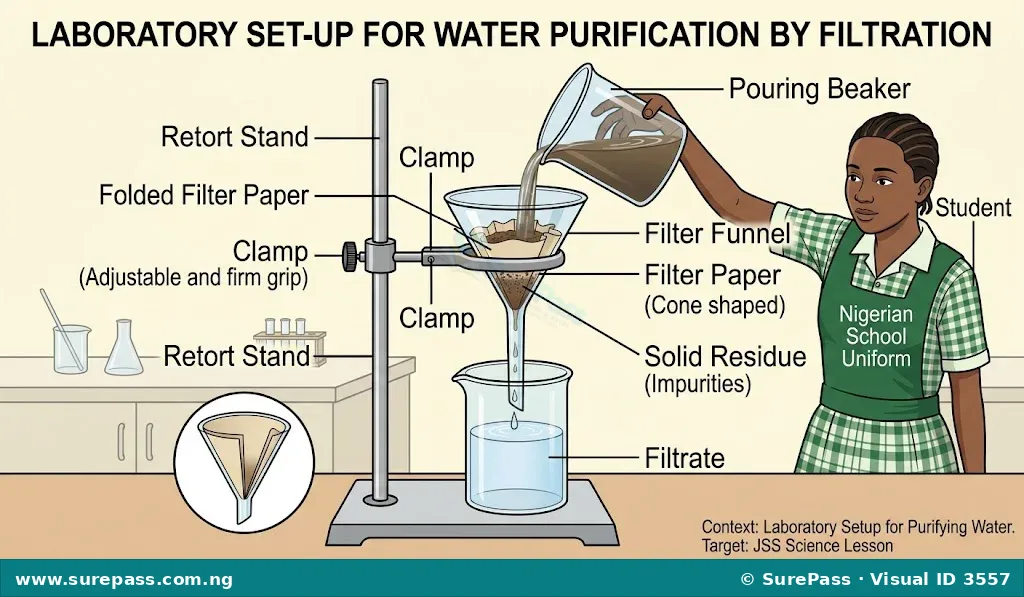
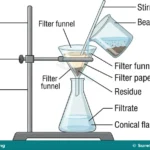
Filtration is a common method used to remove suspended solid impurities from water. This procedure demonstrates how to separate insoluble solids from water using simple laboratory equipment.
Materials Required:
- Impure water sample (e.g., muddy water, water with sand)
- Filter funnel
- Filter paper
- Beaker or conical flask (to collect filtrate)
- Retort stand with clamp (to hold the funnel)
- Stirring rod
Procedure:
- Set up the retort stand and clamp. Attach the filter funnel to the clamp, ensuring it is positioned over a clean beaker or conical flask.
- Fold a piece of filter paper into a cone shape. First, fold it in half, then fold it in half again to form a quadrant.
- Separate one layer of the folded filter paper from the other three layers to form a cone.
- Place the filter paper cone inside the filter funnel. Wet the filter paper with a small amount of clean water to make it stick to the funnel walls.
- Stir the impure water sample to ensure all suspended particles are evenly distributed.
- Carefully pour the impure water into the filter funnel, ensuring the water level does not go above the edge of the filter paper. Use a stirring rod to guide the water flow if necessary.
- Observe the water passing through the filter paper and collecting in the beaker below. This collected clear water is called the filtrate.
- Observe the solid particles retained on the filter paper. These are called the residue.
- Continue pouring until all the impure water has passed through or the filter paper becomes clogged.
Practical: Purifying Water by Distillation
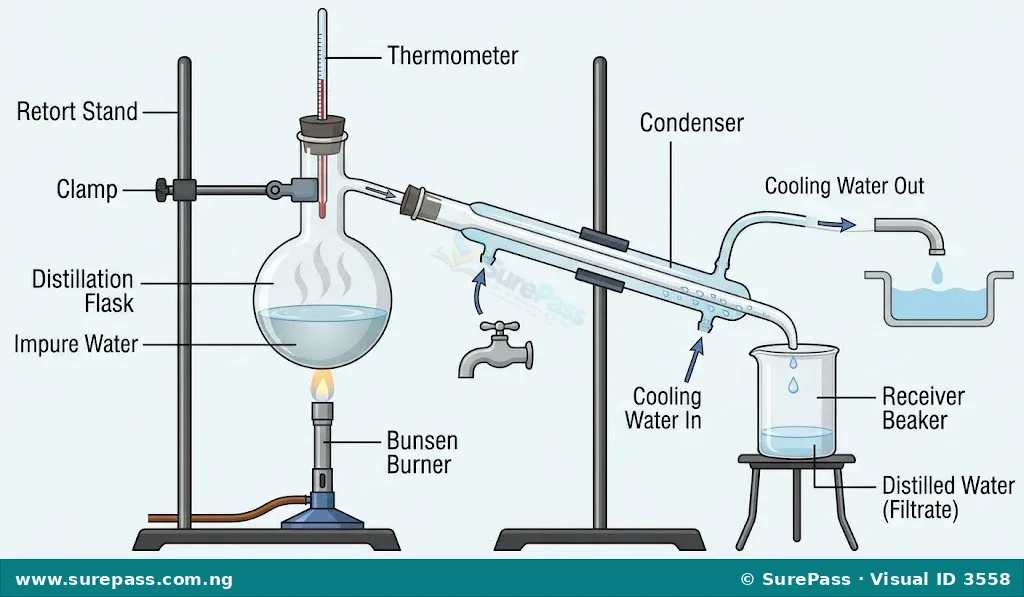
Distillation is a more effective method for purifying water, especially when dissolved solids and salts need to be removed. This process involves boiling and condensation.
Materials Required:
- Impure water sample (e.g., salty water)
- Distillation flask (round-bottom flask)
- Condenser (Liebig condenser)
- Receiver beaker or conical flask (to collect distillate)
- Thermometer
- Bunsen burner or heating mantle
- Retort stands with clamps (to hold flask and condenser)
- Rubber tubing (for condenser water inlet/outlet)
- Source of cooling water (tap water)
- Boiling chips (optional, to ensure smooth boiling)
Procedure:
- Set up the distillation apparatus as shown in the diagram. Secure the distillation flask with a clamp to a retort stand.
- Pour the impure water sample into the distillation flask. Add a few boiling chips to prevent bumping during boiling.
- Insert the thermometer into the neck of the distillation flask, ensuring its bulb is positioned at the level of the side arm leading to the condenser. This measures the temperature of the vapour.
- Connect the condenser to the side arm of the distillation flask. Secure the condenser with another clamp to a retort stand.
- Connect rubber tubing to the condenser’s water inlet (lower opening) and outlet (upper opening). Connect the inlet to a tap water source and the outlet to a sink for drainage. Turn on the cooling water gently to allow cold water to flow through the condenser jacket.
- Place a clean receiver beaker or conical flask at the end of the condenser to collect the purified water (distillate).
- Begin heating the distillation flask gently with a Bunsen burner or heating mantle.
- Observe the water in the flask boiling and turning into steam. The steam rises, passes the thermometer, and enters the condenser.
- In the condenser, the cold water flowing through the jacket cools the steam, causing it to condense back into liquid water.
- The condensed pure water (distillate) drips into the receiver beaker.
- Continue heating until a sufficient amount of distillate is collected or until only a small amount of residue remains in the distillation flask. Do not heat to dryness.
- Turn off the heat source and then turn off the cooling water. Allow the apparatus to cool before dismantling.
Safety Precautions:
- Always wear safety goggles to protect your eyes.
- Handle hot apparatus with care, using heat-resistant gloves or tongs.
- Ensure all connections in the apparatus are secure to prevent leaks of steam or cooling water.
- Do not heat the flask to dryness, as this can cause it to crack or shatter.
- Ensure good ventilation in the laboratory.


0 comments
Open the discussion when you need it. Comments stay collapsed until requested so the initial article remains light.