



ARTICLE CONTENTSOn this page 7 sections
Concept of Money
Performance Objectives
By the end of the lesson, students should be able to:
- explain the meaning and origin of money;
- discuss the uses of money;
- state the importance and methods of saving money;
- describe the sources of funding for GSM repairs start-up.
Meaning of Money
Money is anything generally accepted as a medium of exchange for goods and services, and for the settlement of debts.
It is a tool that makes buying and selling easier. Without money, people would have to trade items directly, which can be difficult.
Evolution of Money
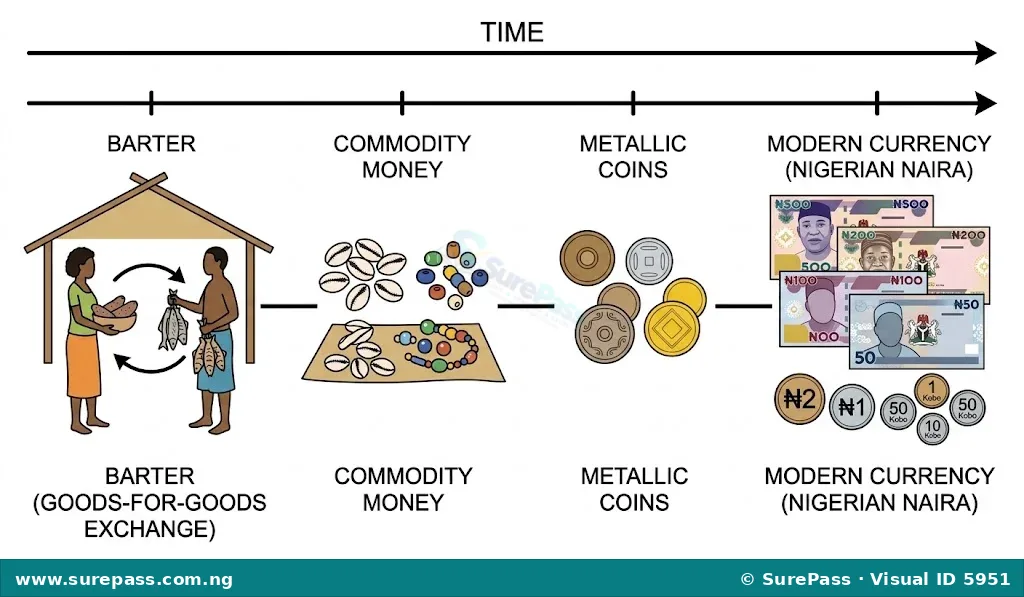
Before money as we know it existed, people used different ways to get what they needed. The journey of money has changed over a long time.
Barter System
In ancient times, people used a system called barter. Barter is the direct exchange of goods and services for other goods and services without the use of money.
For example, a farmer with yam might exchange some of his yam for a fisherman’s fish. This system worked when people had exactly what others needed, but it was often difficult to find someone who wanted what you had and had what you wanted.
Commodity Money
As communities grew, people started using certain valuable items as a form of money. These items were called commodity money because they had value in themselves.
Examples of commodity money included cowries, salt, beads, livestock like cows or goats, and even tools. These items were easier to exchange than direct barter, but they could be heavy, difficult to divide, or spoil over time.
Metallic Money (Coins)
Later, people began to use metals like gold, silver, and copper as money. These metals were durable, easy to carry, and could be divided into smaller units.
Over time, governments started minting coins with specific weights and values, making them easier to trust and use. This was a major step towards modern money.
Paper Money (Banknotes)
The next major development was paper money. Initially, paper money was like a promise note, representing a certain amount of gold or silver held in a bank.
Today, paper money, also known as banknotes, is issued by central banks (like the Central Bank of Nigeria). Its value is based on the trust people have in the government and the economy, rather than being directly backed by a physical commodity like gold.
Uses of Money
Money serves several important purposes in daily life and business. These uses make economic activities smooth and efficient.
-
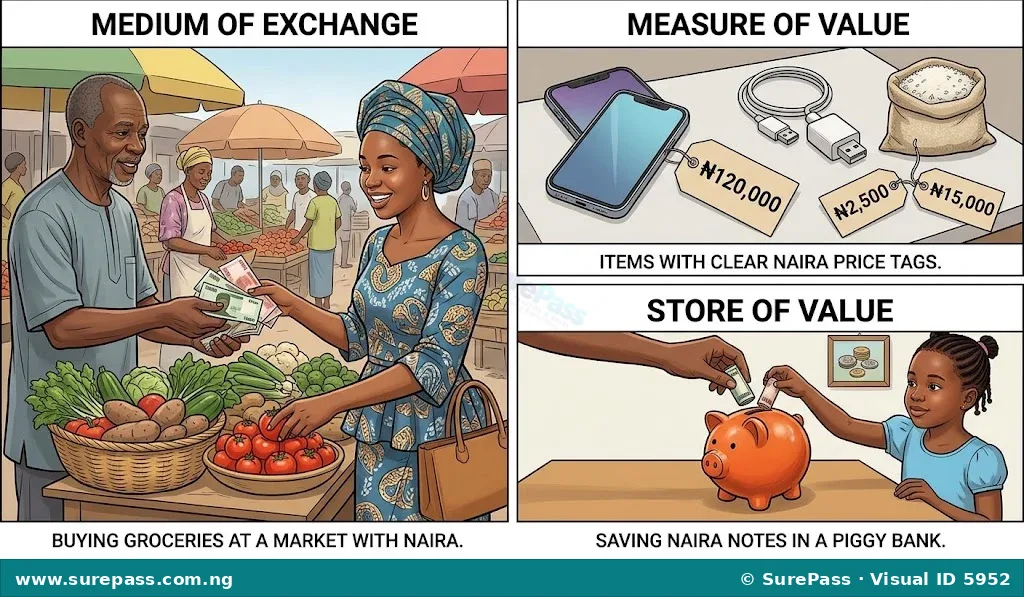
Medium of Exchange: This is the most common use of money. It means money is accepted by everyone for buying and selling goods and services.
Instead of trading a phone for a bag of rice, a person can sell the phone for money and then use that money to buy the rice. This avoids the problem of finding someone who wants exactly what you have.
-
Measure of Value: Money helps to determine the value of different goods and services. Everything can be priced in terms of money.
For example, a phone might cost N50,000, while a charger costs N5,000. This allows people to compare the value of different items easily.
-
Store of Value: Money can be saved and used later. It holds its value over time, allowing people to save their earnings for future needs.
Instead of keeping perishable goods, people can keep money and use it when they need to buy something in the future, like a new tool for a GSM repair business.
-
Standard of Deferred Payment: Money is used to settle debts or make payments in the future.
When a person takes a loan, they promise to pay back a certain amount of money over time. This makes it possible for people to borrow and lend.
Saving Money
Saving money is an important habit for individuals and businesses.
Meaning of Saving Money
Saving money is the act of setting aside a portion of one’s income or earnings for future use instead of spending it immediately.
It involves putting money away in a safe place, such as a bank or a secure container, so it can be accessed later.
Importance of Saving Money
Saving money offers many benefits, especially for future plans and unexpected events.
-
For Future Needs: Saving helps people achieve future goals, such as buying a new phone, a tool for a GSM repair business, or paying for education.
-
For Emergencies: Unexpected events like illness, accidents, or sudden repairs can require money. Savings provide a safety net during such times.
-
To Start a Business: For aspiring entrepreneurs, like those wanting to start a GSM repair business, savings can provide the initial capital needed to buy equipment and rent a space.
-
Financial Security: Having savings gives a sense of security and reduces worry about money problems.
-
To Avoid Debt: When people have savings, they are less likely to borrow money at high interest rates for everyday needs or emergencies.
Methods of Saving Money
There are several ways people can save money, depending on their income and goals.
-
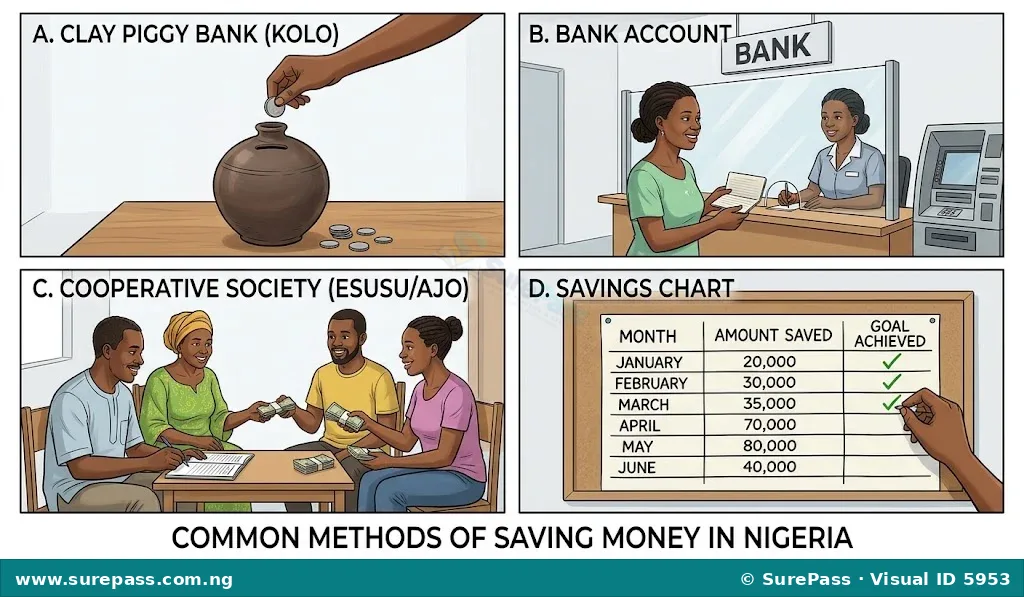
Using a Piggy Bank (Kolo): This is a simple and common method, especially for children and small amounts of money. A piggy bank is a container where coins and small notes can be dropped and kept securely.
It helps to develop the habit of saving regularly.
-
Bank Account: Opening a savings account at a commercial bank is a secure way to save larger amounts of money. Banks keep money safe and often pay a small interest, which means the money grows over time.
It also allows for easy deposits and withdrawals when needed.
-
Cooperative Societies (Esusu/Ajo): In many Nigerian communities, people form cooperative societies where members contribute a fixed amount of money regularly.
The total collected money is then given to each member in rotation. This method encourages disciplined saving and provides a lump sum when it is a member’s turn to collect.
-
Recording Savings: Keeping a record of savings, either in a notebook or on a savings chart, helps to track progress and stay motivated.
This method allows a person to see how much money they have saved and how close they are to their savings goal.
Sources of Funding for GSM Repair Start-up
Starting a GSM repair business requires money to buy tools, spare parts, and possibly rent a small space. This initial money is called funding or capital.
For a JSS1 student thinking about a future business, the most accessible sources of funding are usually personal and family-based.
Personal Sources
Personal sources of funding come directly from the individual who wants to start the business.
-
Personal Savings: The money saved over time from allowances, gifts, or small jobs can be used as initial capital.
This is often the first and most important source for young entrepreneurs.
-
Selling Personal Items: If there are items that are no longer needed but have value, selling them can generate some funds.
Examples include old textbooks, unused toys, or other personal belongings that can be sold to raise money for the business.
Family Sources
Family members can be a great support when starting a new venture, especially for young people.
-
Loans from Parents or Guardians: Parents or guardians can provide a loan, which might be interest-free or with very low interest, to help start the business.
This usually comes with an agreement on how and when the money will be paid back.
-
Gifts from Family Members: Relatives such as uncles, aunts, or grandparents might offer money as a gift to support the business idea.
This is often given without the expectation of repayment, but it is still important to use it wisely for the business.
-
Support from Siblings: Older siblings who are working might also be able to contribute a small amount to help their younger sibling start a business.



0 comments
Open the discussion when you need it. Comments stay collapsed until requested so the initial article remains light.