



ARTICLE CONTENTSOn this page 7 sections
Book Keeping in GSM repairs
Performance Objectives
By the end of the lesson, students should be able to:
- explain the meaning of Book-Keeping in Business;
- identify sources of primary book of entries;
- identify types and methods of Book-Keeping;
- explain the benefits of book-keeping to enterprises, business owners and customers;
- record transactions in receipts, vouchers and other documents.
Meaning of Book-Keeping in Business
Book-keeping is the process of recording all the financial transactions of a business in an organised way. It involves keeping track of every time money is spent or received by the business.
In a GSM repair business, book-keeping means writing down details of every repair job, every phone part bought, every payment received from a customer, and every expense like rent or electricity. This helps the business owner know exactly how much money is coming in and going out.
Sources of Primary Book of Entries
Primary book of entries refers to the first place where business transactions are recorded. These are the original documents that provide evidence of a transaction. They are important because they show when, where, how, and why money was exchanged.
Common sources of primary book of entries include:
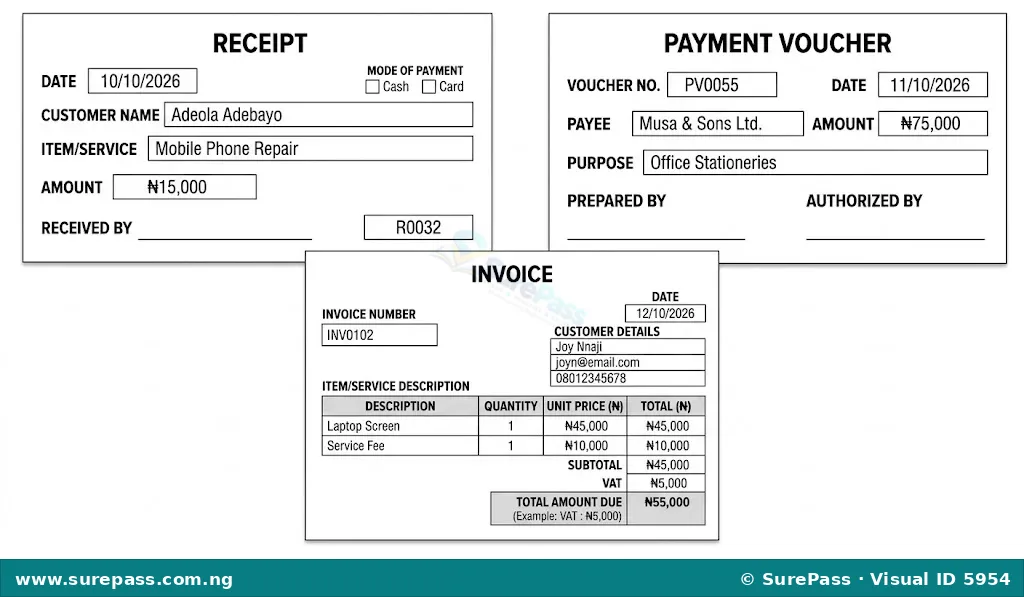
- Receipts: A receipt is a written acknowledgement that a specific amount of money has been received for goods or services. When a customer pays for a phone repair, the business issues a receipt. When the business buys spare parts, it receives a receipt from the supplier.
- Payment Vouchers: A payment voucher is a document used to record payments made by the business. It shows who was paid, how much, for what purpose, and when. For example, when the GSM repair shop pays for electricity, a payment voucher is filled out.
- Invoices: An invoice is a bill sent by a seller to a buyer, listing the goods or services provided and the amount owed. In a GSM repair business, if a corporate client gets several phones repaired and agrees to pay later, the repair shop will issue an invoice.
- Cash Memos: A cash memo is similar to a receipt but is usually issued for cash sales of goods. If the GSM repair shop sells a phone accessory for cash, a cash memo might be issued.
These documents are the starting point for all financial records. They provide the necessary information to properly record transactions in the business’s books.
Types and Methods of Book-Keeping
Book-keeping can be done in different ways, depending on the size and nature of the business. For a JSS1 level, we will focus on two main methods:
- Manual Book-Keeping: This method involves recording all transactions by hand in physical record books, ledgers, and using paper documents like receipts and vouchers. It is a traditional method often used by small businesses or those just starting out.
- Computerised Book-Keeping: This method uses computers and special software or applications to record and manage financial transactions. For a small GSM repair business, this could be as simple as using a spreadsheet program like Microsoft Excel or Google Sheets to keep track of income and expenses.
Both methods aim to achieve the same goal: to keep accurate and organised records of all financial activities. Manual book-keeping requires careful writing and calculation, while computerised book-keeping can help with faster calculations and easier organisation, but still requires accurate data entry.
Benefits of Book-Keeping
Keeping good records is very important for any business, including a GSM repair shop. Book-keeping provides many benefits to different groups:
Benefits to the Enterprise (The Business Itself)
- Knowing Financial Performance: Book-keeping helps the business know if it is making a profit or a loss. It shows how much money the business earned and how much it spent over a period.
- Tracking Stock: For a GSM repair business, book-keeping helps track how many spare parts (screens, batteries, charging ports) are bought and used. This prevents running out of important parts or having too many unused parts.
- Making Informed Decisions: With clear records, the business owner can make better decisions, such as whether to expand, buy new tools, or adjust repair prices.
- Meeting Legal Requirements: Businesses often need to keep records for tax purposes or to show to government agencies if required.
Benefits to Business Owners
- Understanding Cash Flow: Owners can see exactly how much money is available at any time. This helps them manage daily expenses and plan for future investments.
- Planning and Budgeting: By looking at past records, owners can create budgets and plans for the future, setting financial goals for the business.
- Detecting Errors or Fraud: Regular book-keeping can help owners spot mistakes in calculations or identify any suspicious activities that might lead to losses.
- Applying for Loans: If a business owner needs a loan from a bank, well-kept financial records are usually required to show the business’s financial health.
Benefits to Customers
- Proof of Payment: When customers receive a receipt for their repair, it serves as proof that they have paid. This is important if there are any disputes later.
- Warranty Claims: Receipts often include warranty information. If a repaired phone develops the same fault within the warranty period, the customer can use the receipt to claim a free re-repair.
- Trust and Reliability: A business that keeps good records and issues proper documents appears more professional and trustworthy to customers. This builds confidence and encourages repeat business.
Recording Transactions in Documents
One of the key skills in book-keeping is accurately recording transactions in primary documents like receipts and vouchers. This ensures that every financial activity has a written record.
How to Record a Transaction Using a Receipt
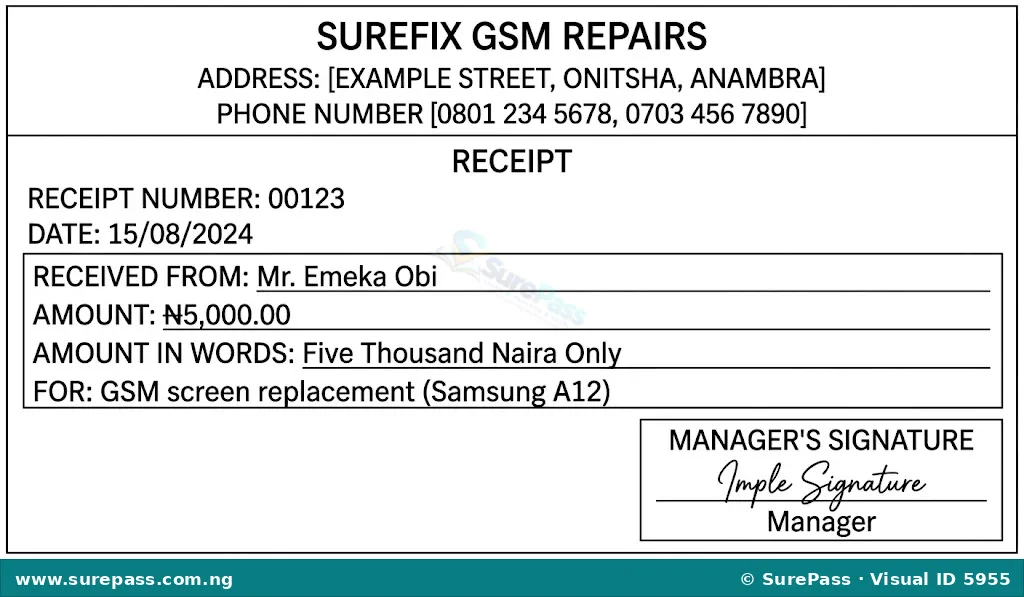
Imagine a customer, Mr. Emeka, brings his phone for a screen replacement, and the repair costs N5,000. He pays in cash. The GSM repair business needs to issue him a receipt.
The procedure involves the following steps:
- Obtain a Receipt Booklet: Ensure you have a receipt booklet with pre-numbered receipts.
- Fill in the Date: Write the current date of the transaction at the top of the receipt. For example, “15/08/2024”.
- Write the Receipt Number: Each receipt has a unique number. Ensure it is visible.
- Enter Customer’s Name: Write the full name of the customer who made the payment. For example, “Mr. Emeka Obi”.
- State the Amount Received: Write the amount of money received both in figures and in words. For example, “N5,000.00” and “Five Thousand Naira Only”.
- Describe the Service/Goods: Clearly state what the payment is for. For example, “For GSM screen replacement (Samsung A12)”.
- Sign and Stamp: The person receiving the money (or the business owner) should sign the receipt. If the business has an official stamp, it should be stamped on the receipt.
- Issue the Receipt: Give the original copy of the receipt to the customer and keep the duplicate copy for the business’s records.
Recording transactions accurately helps maintain clear financial records for the business.





0 comments
Open the discussion when you need it. Comments stay collapsed until requested so the initial article remains light.