



ARTICLE CONTENTSOn this page 10 sections
Two dimensional shapes
Performance Objectives
By the end of the lesson, students should be able to:
- identify a Square, a Rectangle and a Circle.
- match and name a square, a rectangle and a Circle.
- distinguish between squares and rectangles.
- mention square, rectangular and circular shapes in homes.
Shapes All Around Us
The world is full of different shapes. Look around your classroom, your home, or outside. You will see many things that have different shapes. Some shapes are flat, while others are solid.
What Are Two-Dimensional Shapes?
A two-dimensional shape is a flat shape that can be drawn on a piece of paper or seen on a flat surface. These shapes have length and width, but they do not have thickness.
Imagine drawing a shape on the ground with chalk. That flat drawing is a two-dimensional shape. We will learn about three important two-dimensional shapes: squares, rectangles, and circles.
Understanding Squares
A square is a flat shape that looks very even. All its four straight sides look the same length. It also has four corners.
Observe the shape below.
Many objects around us have a square shape. When you look at the face of a dice, it is a square. Some small wall tiles are also square. A small picture frame can also be square.
Square Shapes in the Home
Examples of square shapes found in the home include:
- A small window pane
- A biscuit
- Some floor tiles
- A small cushion
Understanding Rectangles
A rectangle is also a flat shape with four straight sides and four corners. However, a rectangle is different from a square because its sides are not all the same length. It has two long sides and two short sides.
Look at the diagram below.
Many objects have a rectangular shape. A door is a rectangle. Most books are rectangular. A blackboard in the classroom is also a rectangle.
Rectangular Shapes in the Home
Examples of rectangular shapes found in the home include:
- A door
- A book
- A mat
- A mobile phone
- An empty packet of sugar
Distinguishing Between Squares and Rectangles
Both squares and rectangles have four straight sides and four corners. The main difference is how long their sides are.
- A square has all its four sides looking the same length.
- A rectangle has two long sides and two short sides.
Observe the shapes below to see the difference.
Understanding Circles
A circle is a flat, round shape. It has no straight sides and no corners. It is smooth all the way around.
The diagram below shows this item clearly.
Many things around us are circular. The face of a clock is a circle. A coin is also a circle. The bottom of an empty Bournvita tin or milk tin is a circle.
Circular Shapes in the Home
Examples of circular shapes found in the home include:
- A plate
- A cooking pot lid
- A coin
- The bottom of a cup
- The face of a clock
Identifying and Naming Shapes
It is important to be able to look at an object and know its shape. When you see a flat object, you can decide if it is a square, a rectangle, or a circle by looking at its sides and how round it is.
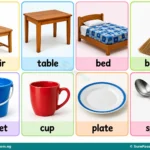
Look at the objects shown below and try to name their shapes.
Shapes in the Home
Our homes are filled with objects that have square, rectangular, and circular shapes. Being able to identify these shapes helps us understand the world around us better.
Here are some common objects and their shapes:
- Square: A small wall clock, a photo frame, a cushion.
- Rectangle: A television screen, a door, a bed, a window.
- Circle: A plate, a cooking pot lid, a bicycle wheel, a wall clock.



0 comments
Open the discussion when you need it. Comments stay collapsed until requested so the initial article remains light.