



ARTICLE CONTENTSOn this page 10 sections
Des annonces, des signes de route, des panneaux de signalisation
Performance Objectives
By the end of the lesson, students should be able to:
- Lire et comprendre les différents types de documents disponibles.
Meaning of Road Signs
Un panneau de signalisation est un outil visuel placé sur la route pour donner des instructions ou des informations aux usagers de la route.
Road signs and traffic symbols are universal languages used worldwide to ensure order and safety on public roads. In French-speaking countries, these signs are called “les panneaux de signalisation” or “les signes de la route.” Understanding these signs helps pedestrians and drivers navigate roads safely and avoid accidents.
Common Road Signs and Traffic Symbols
Road signs are categorized by their shapes and colours. Each shape and colour carries a specific meaning that road users can recognize instantly, even from a distance.
The four main categories of road signs in French-speaking regions are:
- Les panneaux de danger (Danger signs): These are triangular signs with a red border. They warn road users of upcoming hazards on the road.
- Les panneaux d’interdiction (Prohibition signs): These are round signs with a red border. They indicate actions that are strictly forbidden.
- Les panneaux d’obligation (Obligation signs): These are round blue signs. They show actions that road users must perform.
- Les panneaux d’indication (Information signs): These are square or rectangular blue signs. They provide helpful information about directions, services, or road conditions.
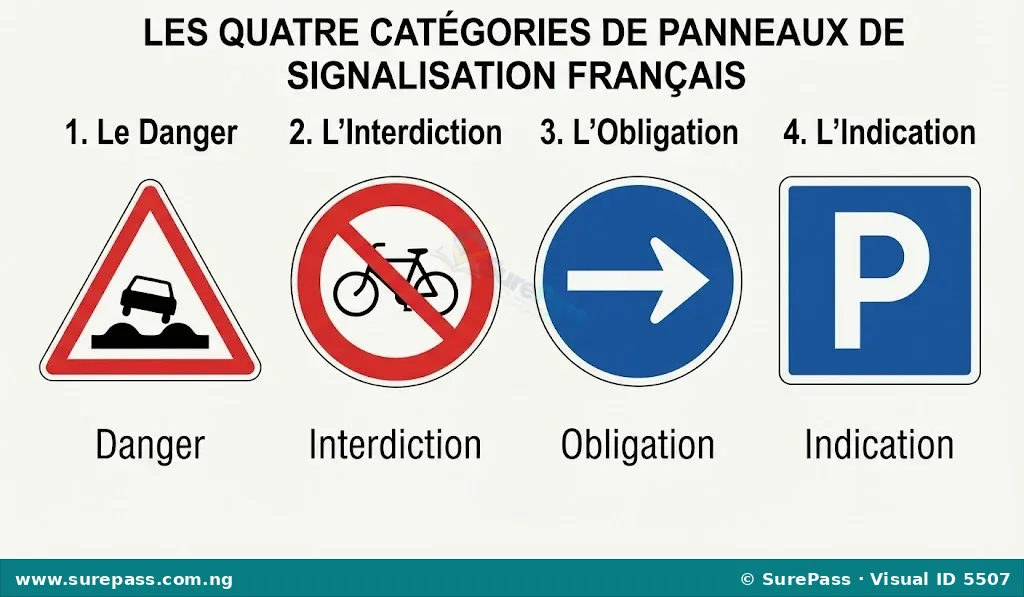
The following table contains common road signs, their French names, English meanings, and their functions:
| Le Panneau (The Sign) | Nom en Français (French Name) | Signification en Anglais (English Meaning) | Fonction (Function) |
|---|---|---|---|
| STOP | Le panneau stop | Stop sign | Forces the driver to bring the vehicle to a complete stop. |
| 🚫 | Le sens interdit | No entry / Forbidden direction | Indicates that vehicles must not enter that road. |
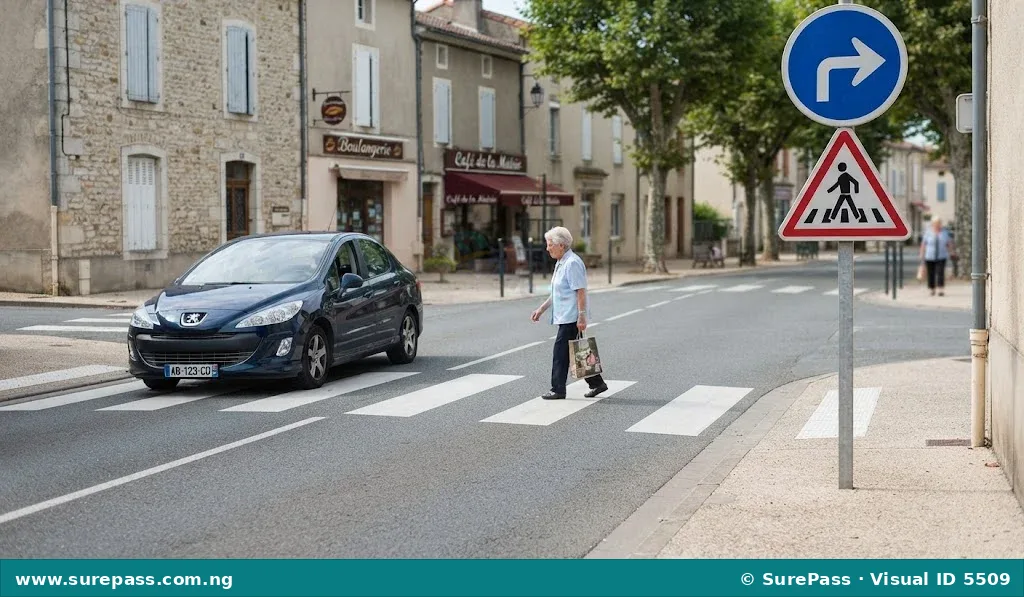
| 🚸 | Le passage piéton / Passage clouté | Pedestrian crossing | Warns drivers to slow down for pedestrians crossing the road. |
| 🚴🚫 | Interdit aux vélos | No entry for bicycles | Prohibits bicycles from using the specific path or road. |
| ⚠️ | Attention / Danger général | General danger warning | Alerts road users to be cautious of unspecified hazards ahead. |
| ↗️ | Obligation de tourner à droite | Turn right ahead | Instructs drivers that they must turn to the right. |
Traffic Lights (Le Feu Tricolore)
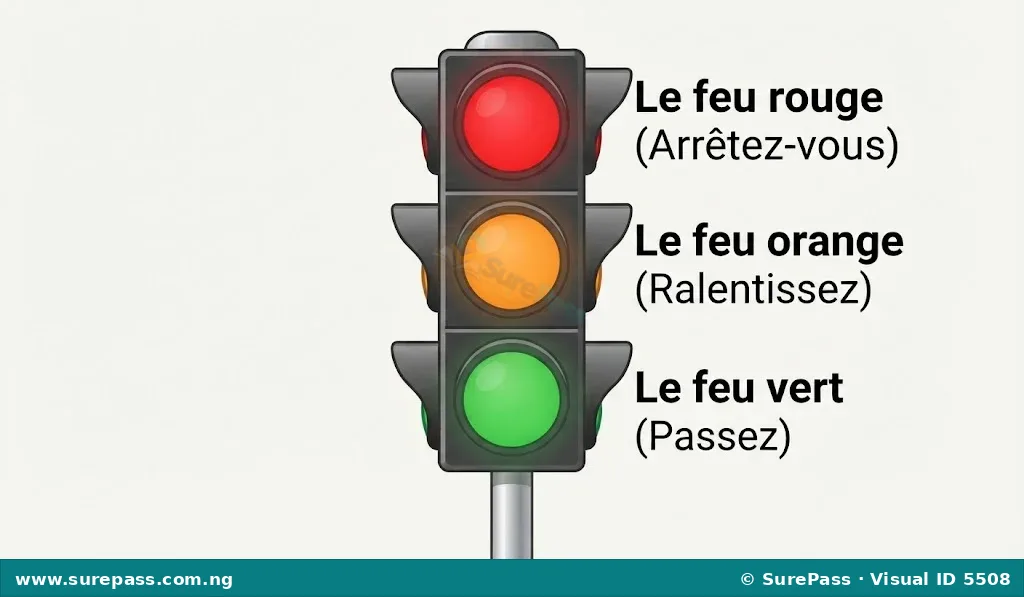
Le feu tricolore is a specific type of traffic signal that controls the flow of vehicles and pedestrians at intersections using three distinct colours.
The meanings of the colours on a French traffic light are:
- Le feu rouge (Red light): This means “Arrêtez-vous” (Stop). Vehicles must stop completely.
- Le feu orange (Orange/Yellow light): This means “Ralentissez et préparez-vous à vous arrêter” (Slow down and prepare to stop).
- Le feu vert (Green light): This means “Passez” (Go / Proceed). Vehicles can move forward safely.
The Importance of Road Signs
Road signs play a vital role in maintaining order and safety in communities. Discussing their importance helps road users appreciate why traffic rules must be obeyed.
The main reasons why road signs are important include:
- La sécurité routière (Road safety): They protect pedestrians, drivers, and passengers from accidents by providing clear warnings and instructions.
- La régulation de la circulation (Traffic regulation): They prevent traffic jams and confusion at intersections, ensuring a smooth flow of vehicles.
- L’orientation (Direction and guidance): They help travellers find their way to different destinations, towns, or services like hospitals and parking spaces.
- La prévention des infractions (Prevention of traffic offences): They clearly state speed limits and forbidden actions, helping drivers obey the law.
Grammar: The Imperative Mood (L’Impératif)
L’impératif est un mode verbal utilisé pour donner un ordre, un conseil, une instruction ou une interdiction.
Because road signs and traffic announcements are designed to direct human behaviour, they frequently use the imperative mood. In French, the imperative is unique because it does not use subject pronouns (such as tu, nous, or vous) before the verb. Instead, the verb stands alone.
For road signs and public announcements, the vous form (polite or plural) is the most common form used because it addresses the general public. Sometimes, the infinitive form of the verb is also used on signs to express a general instruction.
The following examples show how regular verbs are conjugated in the imperative mood for instructions:
1. Verbs ending in -er (e.g., Arrêter – To stop, Tourner – To turn)
To form the imperative, the present tense conjugation is used without the subject pronoun. For “-er” verbs, the “s” is dropped in the “tu” form.
Examples of the verb Arrêter (To stop) in the imperative:
- Arrête ! (Stop! – addressing a single friend or child)
- Arrêtons ! (Let’s stop! – addressing a group including oneself)
- Arrêtez ! (Stop! – addressing the public, a stranger, or a group)
Examples of the verb Tourner (To turn) in the imperative:
- Tourne à droite ! (Turn right! – singular/informal)
- Tournez à gauche ! (Turn left! – formal/plural)
2. Verbs ending in -ir (e.g., Ralentir – To slow down)
Examples of the verb Ralentir (To slow down) in the imperative:
- Ralentis ! (Slow down! – singular/informal)
- Ralentissez ! (Slow down! – formal/plural)
3. General Instructions using the Infinitive
On many French signs, the verb is kept in its unconjugated (infinitive) form to represent a general rule for everyone.
Examples of infinitive instructions on signs include:
- Ralentir (Slow down / To slow down)
- Ne pas fumer (No smoking / Do not smoke)
- Serrez à droite (Keep right)
Reading and Understanding Road Announcements (Lecture et Compréhension)
Read the short dialogue below between a French teacher (Monsieur Koffi) and a student (Chidi) as they discuss road signs on their way to school.
M. Koffi: Regarde ce panneau, Chidi. Qu’est-ce que c’est ?
Chidi: C’est un panneau rouge avec le mot “STOP”.
M. Koffi: Très bien ! Qu’est-ce que le conducteur doit faire ici ?
Chidi: Le conducteur doit arrêter la voiture complètement.
M. Koffi: Exactement. Et là-bas, regarde le feu tricolore. Le feu est rouge. Que faisons-nous ?
Chidi: Nous nous arrêtons. Quand le feu devient vert, nous pouvons passer.
M. Koffi: Bravo, Chidi ! Tu comprends bien les signes de la route.
English Translation of the Dialogue
Mr. Koffi: Look at this sign, Chidi. What is it?
Chidi: It is a red sign with the word “STOP”.
Mr. Koffi: Very well! What must the driver do here?
Chidi: The driver must stop the car completely.
Mr. Koffi: Exactly. And over there, look at the traffic light. The light is red. What do we do?
Chidi: We stop. When the light becomes green, we can go.
Mr. Koffi: Well done, Chidi! You understand road signs well.
Summary of Key Vocabulary
The following list contains key French terms related to road signs and their English equivalents:
- Le panneau: The sign / board
- La route: The road
- Le piéton: The pedestrian
- Le conducteur: The driver
- La voiture: The car
- S’arrêter: To stop
- Ralentir: To slow down
- Tourner: To turn
- Le danger: The danger / hazard
- La sécurité: The safety
Class Exercises
Exercise 1: Written Matching (Associez les signes)
Match the French road sign terms in Column A with their correct English meanings in Column B.
| Column A (French) | Column B (English) |
|---|---|
| 1. Le feu rouge | A. No entry / Forbidden direction |
| 2. Le passage piéton | B. Red light (Stop) |
| 3. Le sens interdit | C. Slow down |
| 4. Ralentissez | D. Pedestrian crossing |
| 5. Tournez à droite | E. Turn right |
Exercise 2: Identification (Donnez les noms des signes)
Provide the correct French name for each of the following descriptions:
- The traffic light colour that tells drivers to stop.
- The triangular sign with a red border that warns of a hazard.
- The round sign with a red border and a white horizontal bar in the middle.
- The traffic light colour that allows vehicles to proceed.
- The white stripes painted on the road where people walk across.
Exercise 3: Grammar Practice (L’Impératif)
Conjugate the verbs in brackets into the correct imperative form (vous form) to complete the road instructions:
- (Arrêter) _ devant le passage piéton !
- (Ralentir) _ près de l’école !
- (Tourner) _ à gauche après le feu tricolore !
- (Regarder) _ à gauche et à droite avant de traverser !



0 comments
Open the discussion when you need it. Comments stay collapsed until requested so the initial article remains light.