


ARTICLE CONTENTSOn this page 9 sections
Portrait physique et moral
Performance Objectives
By the end of the lesson, students should be able to:
- Décrire leurs caractéristiques personnelles.
Introduction to Personal Descriptions
Describing a person in French involves two main aspects: the physical appearance and the moral character. Together, these descriptions help to create a clear picture of an individual.
Le portrait physique is the description of a person’s physical appearance, including height, build, age, hair, and eye colour.
Le portrait moral is the description of a person’s character, personality, habits, and moral qualities.
To describe these characteristics, French speakers use two primary verbs: être (to be) and avoir (to have). The present tense conjugations of these verbs are essential for making descriptions.
The present tense of the verb être (to be) is conjugated as follows:
- Je suis (I am)
- Tu es (You are – informal)
- Il est (He is) / Elle est (She is)
- Nous sommes (We are)
- Vous êtes (You are – formal/plural)
- Ils sont (They are – masculine) / Elles sont (They are – feminine)
The present tense of the verb avoir (to have) is conjugated as follows:
- J’ai (I have)
- Tu as (You have)
- Il a (He has) / Elle a (She has)
- Nous avons (We have)
- Vous avez (You have – formal/plural)
- Ils ont (They have – masculine) / Elles ont (They have – feminine)
Le Portrait Physique (Physical Description)
Physical descriptions use the verb être followed by an adjective of physical size or build, or the verb avoir followed by a noun and a colour adjective to describe hair and eyes.
Common adjectives used with the verb être for physical build include:
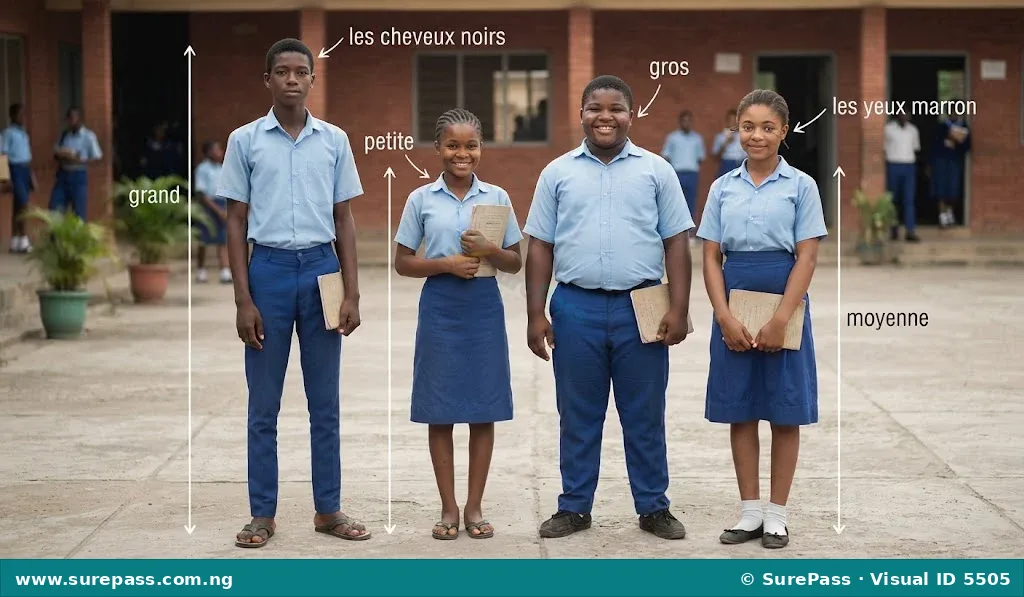
- Grand / Grande: Tall
- Petit / Petite: Short
- Mince / Mince: Slim / Thin
- Gros / Grosse: Fat / Stout
- Jeune / Jeune: Young
- Fort / Forte: Strong
Common expressions used with the verb avoir for describing hair (les cheveux) and eyes (les yeux) include:
- Avoir les cheveux noirs: To have black hair
- Avoir les cheveux courts: To have short hair
- Avoir les cheveux longs: To have long hair
- Avoir les yeux marron: To have brown eyes
- Avoir les yeux noirs: To have black eyes
- Avoir les yeux bleus: To have blue eyes
Observe the image below to see how these physical characteristics are represented visually.
Le Portrait Moral (Moral and Character Description)
Moral descriptions refer to a person’s personality, intelligence, behavior, and temperament. These descriptions almost always use the verb être followed by a qualifying adjective.
Common adjectives used to describe character and personality include:
- Gentil / Gentille: Kind / Nice
- Sympathique (Sympa) / Sympathique: Friendly / Likable
- Intelligent / Intelligente: Intelligent / Smart
- Sérieux / Sérieuse: Serious
- Paresseux / Paresseuse: Lazy
- Travailleur / Travailleuse: Hardworking
- Calme / Calme: Calm / Quiet
- Amusant / Amusante: Funny / Amusing
Examples of moral descriptions in sentences include:
- Chidi est très intelligent: Chidi is very intelligent.
- Amina est gentille et calme: Amina is kind and calm.
- Le garçon est paresseux: The boy is lazy.
- La fille est travailleuse: The girl is hardworking.
Grammar: Adjective Agreement (L’accord des adjectifs)
In French, adjectives must agree in gender (masculine or feminine) and number (singular or plural) with the noun or pronoun they describe.
The general rule for forming feminine adjectives is to add an -e to the masculine singular form. If the masculine adjective already ends in an unaccented -e, it does not change in the feminine form.
Some adjectives have irregular feminine forms. The table below shows how common descriptive adjectives change from masculine to feminine:
| Masculine Adjective | Feminine Adjective | English Meaning | Rule Applied |
|---|---|---|---|
| grand | grande | Tall | Add -e |
| petit | petite | Short | Add -e |
| intelligent | intelligente | Intelligent | Add -e |
| mince | mince | Slim | No change (already ends in -e) |
| calme | calme | Calme | No change (already ends in -e) |
| sympathique | sympathique | Friendly | No change (already ends in -e) |
| gros | grosse | Fat / Stout | Double the consonant and add -e |
| gentil | gentille | Kind | Double the consonant and add -e |
| sérieux | sérieuse | Serious | Change -eux to -euse |
| paresseux | paresseuse | Lazy | Change -eux to -euse |
| travailleur | travailleuse | Hardworking | Change -eur to -euse |
Look at the diagram below to understand the visual patterns of adjective agreement in French.
Describing People in Different Contexts
Descriptions can be applied to oneself, classmates, teachers, or family members. Below are practical examples of how to combine physical and moral descriptions.
Describing Oneself (Se décrire)
To describe oneself, a person uses the first-person singular forms je suis and j’ai.
Examples of self-description include:
- Je suis grand et mince. J’ai les cheveux noirs. Je suis très intelligent et calme. (I am tall and slim. I have black hair. I am very intelligent and calm. – spoken by a male)
- Je suis petite. J’ai les yeux marron. Je suis gentille et travailleuse. (I am short. I have brown eyes. I am kind and hardworking. – spoken by a female)
Describing the Teacher (Décrire le professeur)
To describe a teacher, students use the third-person singular forms il est / elle est (he is / she is) and il a / elle a (he has / she has).
Examples of describing a teacher include:
- Monsieur Okafor est notre professeur de français. Il est grand et fort. Il a les cheveux courts. Il est très sérieux mais gentil. (Mr. Okafor is our French teacher. He is tall and strong. He has short hair. He is very serious but kind.)
- Madame Balogun est intelligente et sympathique. Elle est petite et mince. Elle est toujours travailleuse. (Mrs. Balogun is intelligent and friendly. She is short and slim. She is always hardworking.)
Describing a Family Member (Décrire un membre de la famille)
Describing family members helps practice the third-person singular and plural forms of verbs and adjectives.
Examples of describing family members include:
- Mon père (My father): Mon père est grand. Il est très sérieux et travailleur. (My father is tall. He is very serious and hardworking.)
- Ma mère (My mother): Ma mère est petite et mince. Elle est gentille et très intelligente. (My mother is short and slim. She is kind and very intelligent.)
- Mon frère (My brother): Mon frère a les cheveux courts. Il est amusant et paresseux. (My brother has short hair. He is funny and lazy.)
- Ma sœur (My sister): Ma sœur est jeune. Elle a les yeux noirs. Elle est calme. (My sister is young. She has black eyes. She is calm.)
Oral and Written Practice (Pratique orale et écrite)
Read the dialogue below between two JSS 1 classmates, Olu and Ngozi, as they describe their new class teacher.
Olu: Comment est notre nouveau professeur de mathématiques?
(What is our new mathematics teacher like?)
Ngozi: Il s’appelle Monsieur Audu. Il est grand et mince. Il a les cheveux noirs et courts.
(His name is Mr. Audu. He is tall and slim. He has short black hair.)
Olu: Est-ce qu’il est sympathique?
(Is he friendly?)
Ngozi: Oui, il est très sympathique, intelligent et calme.
(Yes, he is very friendly, intelligent, and calm.)
Evaluation Exercises
Multiple-Choice Questions
Choose the correct form of the adjective to complete each sentence:
- Amina est très __.
- intelligent
- intelligente
- intelligents
- Mon père est __ et fort.
- grand
- grande
- grandes
- La fille de l’oncle est __.
- paresseux
- paresseuse
- paresseuses
- Le professeur de français est __.
- sérieuse
- sérieux
- sérieuxes
- Ma mère est très __.
- gentil
- gentille
- gentils
- Chidi et Olu sont __.
- mince
- minces
- mincees
Written and Oral Description Exercise
Perform the following descriptive tasks in writing and practice speaking them aloud:
- Write a short paragraph of four sentences in French describing your own physical and moral characteristics. Use the verbs être and avoir correctly.
- Describe the personal characteristics (both physical and moral) of one member of your family (e.g., your father, mother, brother, or sister). Write at least five sentences in French, ensuring correct adjective agreement.

0 comments
Open the discussion when you need it. Comments stay collapsed until requested so the initial article remains light.