


ARTICLE CONTENTSOn this page 11 sections
L’écriture des phrases courtes
Performance Objectives
By the end of the lesson, students should be able to:
- Écrire des phrases courtes sur eux-mêmes et leur famille (Write short sentences about themselves and their family).
- Répondre aux exercices de dictée (Respond to dictation exercises).
Meaning of a Short Sentence in French
A short sentence in French is a group of words that expresses a complete thought using a subject, a verb, and an object or adjective.
Writing short sentences helps learners build confidence in communication. In French, simple sentences follow a basic structure similar to English, which is Subject + Verb + Object or Adjective.
Vocabulary for Family and Professions
To write sentences about family and friends, specific vocabulary is required. This includes terms for family members and common professions.
Common family terms include:
| French Term | English Meaning |
|---|---|
| la famille | the family |
| le père | the father |
| la mère | the mother |
| le frère | the brother |
| la sœur | the sister |
| le grand-père | the grandfather |
| la grand-mère | the grandmother |
| l’enfant | the child |
| l’ami / l’amie | the friend (male / female) |
Observe the diagram below.
Common professions include:
| French Term | English Meaning |
|---|---|
| l’étudiant / l’étudiante | the student (male / female) |
| l’ingénieur | the engineer |
| l’avocat / l’avocate | the lawyer (male / female) |
| le médecin | the doctor |
| l’enseignant / l’enseignante | the teacher (male / female) |
Basic Grammar for Sentence Construction
To construct simple sentences, learners must understand subject pronouns, basic verbs, and possessive adjectives.
Subject Pronouns (Les pronoms sujets)
Subject pronouns replace nouns and perform the action in a sentence.
The singular subject pronouns are:
- Je (I)
- Tu (You – informal)
- Il (He / It)
- Elle (She / It)
Essential Verbs (Les verbes essentiels)
The verbs être (to be), avoir (to have), and s’appeler (to be called) are used to describe people, ages, and professions.
The present tense conjugations for these verbs are:
- Être (To be): Je suis (I am), Il est (He is), Elle est (She is).
- Avoir (To have): J’ai (I have), Il a (He has), Elle a (She has).
- S’appeler (To be called): Je m’appelle (My name is), Il s’appelle (His name is), Elle s’appelle (Her name is).
Possessive Adjectives (Les adjectifs possessifs)
Possessive adjectives show ownership. In French, they must agree with the gender (masculine or feminine) of the noun that follows them.
The singular possessive adjectives are:
- Mon: Used before masculine singular nouns (e.g., mon père – my father).
- Ma: Used before feminine singular nouns (e.g., ma mère – my mother).
- Mes: Used before plural nouns (e.g., mes parents – my parents).
Writing Short Sentences About Oneself and Family
By combining possessive adjectives, family nouns, verbs, and professions, short sentences can be written easily.
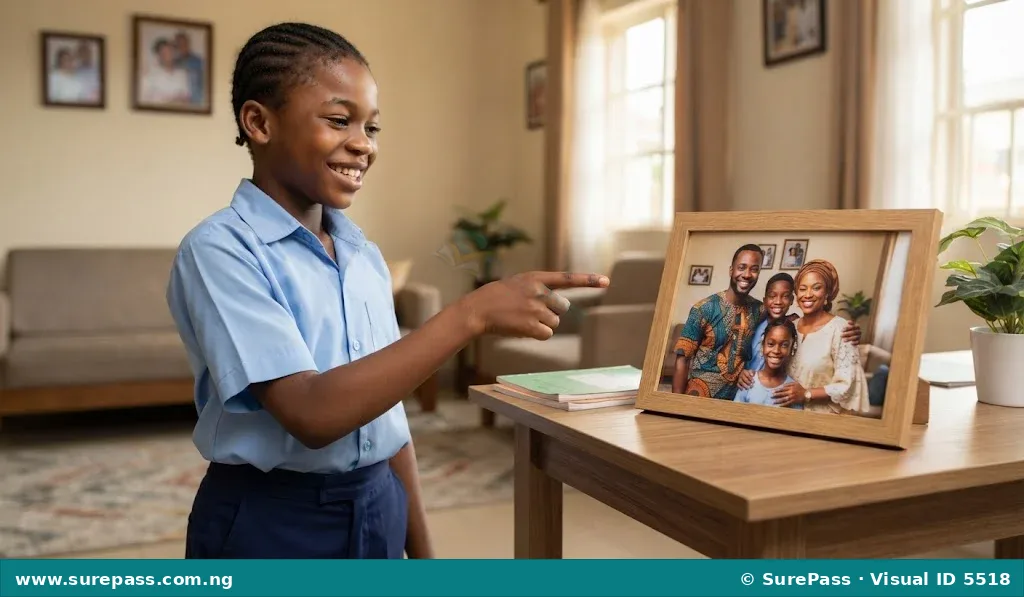
Look at the object shown below.
Examples of short sentences about oneself include:
- Je m’appelle Emeka. (My name is Emeka.)
- Je suis étudiant. (I am a student.)
- J’ai douze ans. (I am twelve years old.)
- Je suis nigérian. (I am Nigerian.)
Examples of short sentences about family members include:
- Voici ma famille. (Here is my family.)
- Mon père s’appelle M. Okeke. (My father’s name is Mr. Okeke.)
- Il est ingénieur. (He is an engineer.)
- Ma mère s’appelle Mme Okeke. (My mother’s name is Mrs. Okeke.)
- Elle est avocate. (She is a lawyer.)
- Mon frère est un enfant. (My brother is a child.)
- Ma grand-mère est gentille. (My grandmother is kind.)
Pronunciation of Sentences
Correct pronunciation is essential for effective oral communication in French. Some letters at the end of French words are silent, and nasal sounds require careful practice.
Key pronunciation rules for JSS 1 learners include:
- Silent Consonants: The final consonants in words like père, mère, and avocat (the ‘t’ is silent) are often not pronounced unless followed by a vowel.
- Nasal Sounds: Words containing “an”, “en”, or “in” (such as enfant, ingénieur, and étudiant) are pronounced through the nose.
- The Elision (L’): When a word begins with a vowel or a silent ‘h’, the article le or la becomes l’ (e.g., l’enfant, l’ami). This creates a smooth, continuous sound.
Dictation Exercises (La dictée)
Dictation is an exercise where a person writes down words or sentences spoken aloud by a teacher.
Dictation helps learners connect spoken sounds to written letters and words. It improves spelling, listening skills, and grammatical accuracy.
Common vocabulary words for dictation practice include:
- famille
- père
- grand-mère
- sœur
- enfant
- étudiant
- ingénieur
- avocat
Simple sentences for dictation practice include:
- Mon père est avocat.
- Ma sœur est étudiante.
- Voici mon frère.
- Elle a un enfant.
How to Write and Speak About the Family
This practical activity guides learners on how to prepare a short written profile of their family and present it orally.
The required materials are:
- A writing notebook
- A pen or pencil
The procedure involves the following steps:
- Write down the name, age, and profession of the father using the verbs s’appeler, avoir, and être.
- Write down the name, age, and profession of the mother.
- List the names of any brothers or sisters.
- Combine these sentences into a single paragraph.
- Read the paragraph aloud, paying close attention to silent final letters and nasal sounds.
Summary
Writing short sentences in French requires a basic understanding of vocabulary, subject pronouns, and verbs. By practicing vocabulary related to family and professions, learners can easily describe themselves and their relatives. Regular dictation and pronunciation exercises help build strong listening and writing skills.
Questions for Evaluation
Answer the following questions in written and oral French:
- Écrivez dix phrases sur votre famille, soi-même, votre frère, ou votre grand-mère. (Write ten sentences about your family, yourself, your brother, or your grandmother).
- Écrivez les mots suivants sous la dictée de votre enseignant: famille, père, grand-mère, sœur, enfant, étudiant, ingénieur, avocat. (Write the following words under your teacher’s dictation: family, father, grandmother, sister, child, student, engineer, lawyer).


0 comments
Open the discussion when you need it. Comments stay collapsed until requested so the initial article remains light.