



ARTICLE CONTENTSOn this page 9 sections
Des clips audio/vidéos
Performance Objectives
By the end of the lesson, students should be able to:
- Savoir utiliser des clips audio/vidéo pour apprendre.
Meaning of Audio and Video Clips in Learning
An audio clip is a short recording of sound, such as speech, music or pronunciation guides, without any moving pictures.
A video clip is a short recording of moving images combined with sound that shows actions, scenes or stories.
In the study of the French language, audio and video clips are valuable tools. They help learners hear how native French speakers pronounce words, express emotions and use intonation. While audio clips focus entirely on sound, video clips provide visual context, which makes it easier to understand the meaning of words without needing direct translation.
Differences Between Audio and Video Clips
Understanding the difference between audio and video resources helps learners choose the right tool for specific language skills. Oral comprehension involves identifying whether a resource is an audio clip or a video clip based on sensory inputs.
The main differences between these two media types are:
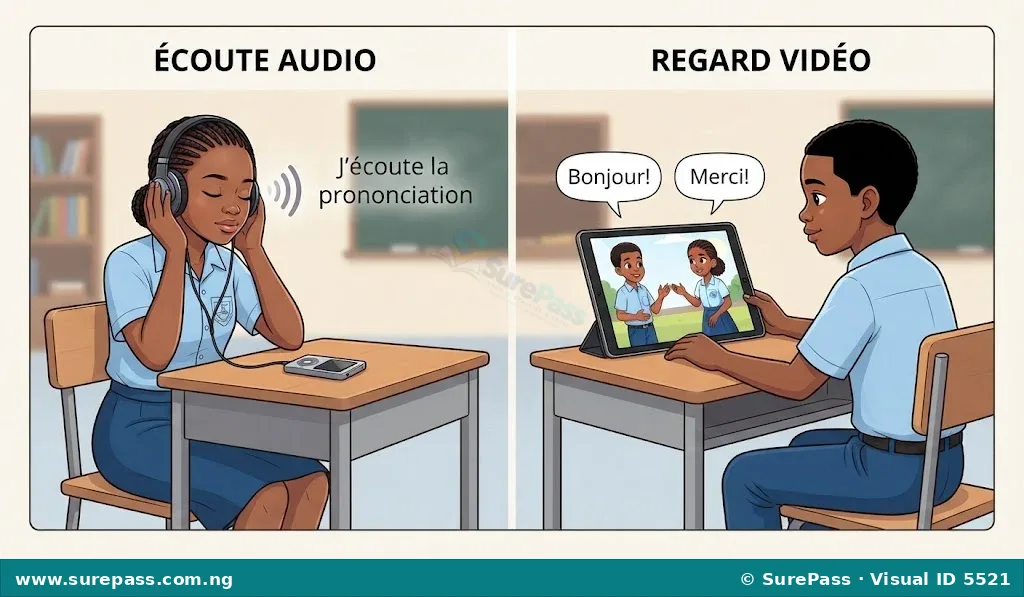
- Sensory Input: Audio clips require only the sense of hearing (l’ouïe), while video clips require both hearing and sight (la vue).
- Equipment Used: Audio clips are often enjoyed using headphones, speakers or radio sets. Video clips require a screen, such as a television, smartphone, tablet or computer monitor.
- Visual Context: Audio clips do not show body language, facial expressions or physical settings. Video clips show the environment, gestures and facial expressions of the speakers, which provide clues to the meaning of the dialogue.
Observe the illustration below to see how learners interact with different media types.
Useful French vocabulary for identifying and discussing these media types includes:
- Un clip audio: An audio clip.
- Un clip vidéo: A video clip.
- Écouter: To listen.
- Regarder: To watch.
- Le son: The sound.
- L’image: The image or picture.
- L’écran: The screen.
- Les écouteurs: The headphones or earphones.
The Importance of Video Clips in Understanding French
Video clips are highly effective for learning French because they combine spoken words with visual actions. When a learner watches a video, the physical actions of the characters explain the vocabulary naturally.
The main reasons why video clips improve comprehension include:
- Facial Expressions: A smile, a frown or a surprised look helps the learner understand the mood of the speaker even if some French words are unfamiliar.
- Gestures and Body Language: Hand movements, shrugging shoulders or waving goodbye give immediate meaning to French verbs like “saluer” (to greet) or “partir” (to leave).
- Setting and Objects: Seeing a kitchen, a classroom or a market in the video immediately tells the learner the context of the conversation.
- Subtitles and Text: Many educational videos include French subtitles, which help learners connect the spoken sounds to the written words.
Actors and Their Roles in a Scene
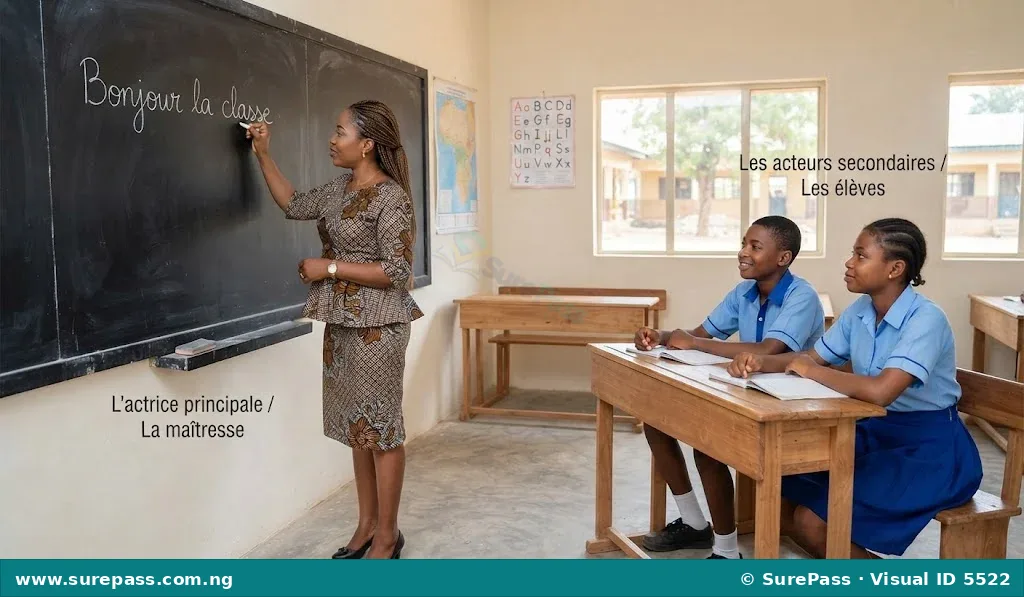
When watching a French video clip, learners must pay attention to the people in the scene. These people are called actors. In any given scene, there are main actors and secondary actors, each playing specific roles.
An actor is a person who plays a part in a clip, movie or play.
A role is the specific character or part that an actor portrays in a scene.
To describe a scene in writing, learners must identify who the actors are and what they are doing. The following vocabulary is used to describe actors and their roles:
- L’acteur principal / L’actrice principale: The main actor / The main actress. This is the central person around whom the story or conversation revolves.
- Les acteurs secondaires: The secondary or supporting actors. These are the people who interact with the main character but have smaller parts.
- Le personnage: The character played by the actor.
- L’action: The action or what the character is doing (such as speaking, eating, running or writing).
The table below shows common French verbs used to describe the actions of actors in a clip:
| French Verb | English Meaning | Example Sentence in French | English Translation |
|---|---|---|---|
| Parler | To speak / To talk | L’acteur principal parle au professeur. | The main actor is speaking to the teacher. |
| Écrire | To write | L’actrice écrit dans son cahier. | The actress is writing in her notebook. |
| Sourire | To smile | Le garçon sourit à sa mère. | The boy is smiling at his mother. |
| Saluer | To greet | Ils saluent les élèves. | They are greeting the students. |
| Mimer | To mime / To gesture | L’acteur mime l’action de manger. | The actor mimes the action of eating. |
Observe the diagram below to understand how to identify different actors in a French learning video.
How to Use Audio and Video Clips to Learn French
To get the best results from audio and video resources, learners should follow a structured approach. Simply watching or listening once is rarely enough to master the language content.
The procedure for using clips effectively involves the following steps:
- First Listening/Viewing: Watch or listen to the entire clip without stopping. Focus on getting the general idea of the scene (the topic, the setting and the main characters).
- Identify the Media Type: Determine if the resource is purely audio or video, and note how this affects understanding.
- Second Viewing with Pauses: Play the clip again, pausing after key sentences. Repeat the words aloud to practice pronunciation.
- Identify the Actors and Roles: Write down who the main actor is and what role they are playing. Note the actions of the secondary characters.
- Write Key Words: Write down new French vocabulary words heard in the clip and look up their meanings.
- Summarise the Scene: Write a short description in French or English explaining what happened in the clip.
Summary of Roles in a Sample Scene
Imagine a short French video clip set in a school yard. There are three characters: Kofi, Amina and a teacher, Monsieur Obi.
The roles and actions in this sample scene are described below:
- Kofi (L’acteur principal): He is the main character. He walks into the school yard, looks lost and asks for directions. His action is “demander le chemin” (asking the way).
- Amina (L’actrice secondaire): She is a student. She points to the classroom building and smiles. Her action is “aider Kofi” (helping Kofi).
- Monsieur Obi (L’acteur secondaire): He is the teacher. He stands near the door and welcomes Kofi. His action is “accueillir l’élève” (welcoming the student).
Classroom Exercises
Part A: Multiple-Choice Questions
Choose the correct answer for each of the following questions:
- What is the main difference between an audio clip and a video clip?
- Audio clips have moving pictures, while video clips do not.
- Video clips have both sound and moving pictures, while audio clips have only sound.
- Audio clips are longer than video clips.
- Video clips do not use sound.
- Which of the following senses is used when listening to an audio clip?
- La vue (Sight)
- Le toucher (Touch)
- L’ouïe (Hearing)
- Le goût (Taste)
- In a French video clip, the central character around whom the story revolves is called:
- L’acteur principal
- L’acteur secondaire
- Le spectateur
- Le réalisateur
- Which French verb means “to watch”?
- Écouter
- Regarder
- Parler
- Écrire
- How does visual context in a video clip help a French learner?
- It makes the sound louder.
- It provides clues to the meaning through gestures, settings and facial expressions.
- It translates all the words into English automatically.
- It reduces the need to pay attention.
Part B: True or False (Vrai ou Faux)
State whether the following statements are Vrai (True) or Faux (False):
- An audio clip requires a television screen to be understood.
- Facial expressions of actors can help a learner understand the mood of a conversation in French.
- “L’actrice principale” refers to a male supporting actor.
- Repeating sentences aloud after pausing a clip helps improve French pronunciation.
- Secondary actors do not play any part in a video scene.
Part C: Written Description Exercise
Read the description of the short French scene below, then answer the questions that follow in written English or simple French.
Scene Description:
In a French video clip, a girl named Chidi is sitting at a desk. She is crying because she cannot find her French textbook. A boy named Tunde walks up to her, hands her a textbook and smiles. Chidi wipes her tears and says, “Merci beaucoup, Tunde!”
- Identify the main actress (l’actrice principale) in this scene.
- Describe the role and action of Tunde in this scene.
- Explain how watching this scene as a video clip helps you understand the meaning of “Merci beaucoup” compared to just hearing it as an audio clip.


0 comments
Open the discussion when you need it. Comments stay collapsed until requested so the initial article remains light.