



ARTICLE CONTENTSOn this page 12 sections
Se présenter et présenter ses amis
Performance Objectives
By the end of the lesson, students should be able to:
- se présenter et présenter leurs amis;
- prononcer correctement les phrases courtes et simples utilisées pour la présentation.
Meaning of Self-Introduction
Self-introduction is the act of sharing basic personal details such as name, age, nationality, and status with others.
In French, introducing oneself is called se présenter, while introducing someone else, such as a friend, is called présenter quelqu’un. These are essential communication skills used when meeting people for the first time in school, at home, or in the community.
Introducing Oneself (Se présenter)
To introduce oneself in French, specific simple phrases are used to express the name, age, nationality, and role as a student.
The basic expressions used for self-introduction include:
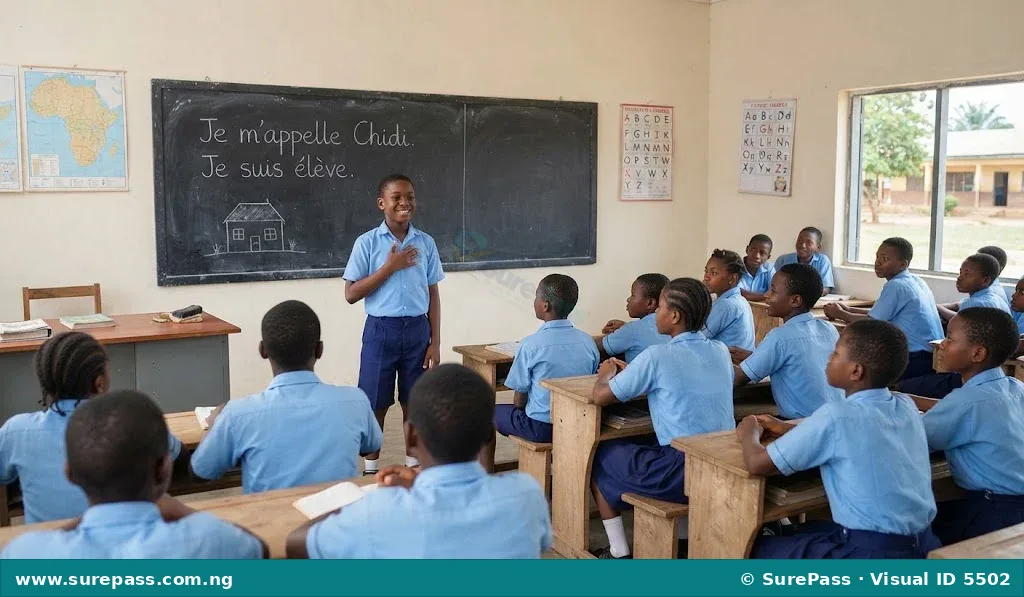
- Je m’appelle… (My name is…) – Used to state a name. Example: Je m’appelle Chidi. (My name is Chidi.)
- J’ai… ans (I am… years old) – Used to state age. Example: J’ai 12 ans. (I am 12 years old.)
- Je suis… (I am…) – Used to state nationality or profession. Example: Je suis nigérian for a boy, or Je suis nigériane for a girl. (I am Nigerian.)
- Je suis élève (I am a student) – Used to state school status.
- J’habite à… (I live in…) – Used to state the place of residence. Example: J’habite à Lagos. (I live in Lagos.)
Observe the image below to see how a student introduces himself to his classmates.
Key Verbs for Introduction (Les verbes de la présentation)
Three primary verbs are used when introducing oneself or others in French. These are s’appeler (to be called), être (to be), and avoir (to have).
The Verb “S’appeler” (To be called)
This pronominal verb is used to state names. The conjugation in the present tense (présent de l’indicatif) is shown below:
| French Pronoun and Verb | English Meaning |
|---|---|
| Je m’appelle | I am called (My name is) |
| Tu t’appelles | You are called (Your name is) |
| Il s’appelle | He is called (His name is) |
| Elle s’appelle | She is called (Her name is) |
| Nous nous appelons | We are called (Our names are) |
| Vous vous appelez | You are called (Your name is – formal/plural) |
| Ils s’appellent | They are called (Their names are – masculine) |
| Elles s’appellent | They are called (Their names are – feminine) |
The Verb “Être” (To be)
This verb is used to state nationality, profession, or status. The conjugation in the present tense is shown below:
| French Pronoun and Verb | English Meaning |
|---|---|
| Je suis | I am |
| Tu es | You are |
| Il / Elle est | He / She is |
| Nous sommes | We are |
| Vous êtes | You are (formal/plural) |
| Ils / Elles sont | They are |
The Verb “Avoir” (To have)
In French, the verb avoir is used to express age, unlike in English where the verb “to be” is used. For example, to say “I am twelve years old,” the French translation is literally “I have twelve years” (J’ai douze ans). The conjugation in the present tense is shown below:
| French Pronoun and Verb | English Meaning |
|---|---|
| J’ai | I have |
| Tu as | You have |
| Il / Elle a | He / She has |
| Nous avons | We have |
| Vous avez | You have (formal/plural) |
| Ils / Elles ont | They have |
Introducing a Friend (Présenter ses amis)
To introduce a friend, different pronouns and adjectives are used depending on whether the friend is male (masculine) or female (feminine).
In French, a male friend is un ami, and a female friend is une amie. The possessive adjective mon (my) is used before both words because amie begins with a vowel. Therefore, “my friend” is written as mon ami for a boy and mon amie for a girl.
The key expressions used to introduce a friend include:
- Voici… (This is… / Here is…) – Used for both males and females. Example: Voici Tunde. (This is Tunde.)
- C’est mon ami (This is my friend – masculine) – Used to introduce a male friend.
- C’est mon amie (This is my friend – feminine) – Used to introduce a female friend.
- Il s’appelle… (His name is…) – Used for a male friend. Example: Il s’appelle Obi. (His name is Obi.)
- Elle s’appelle… (Her name is…) – Used for a female friend. Example: Elle s’appelle Amina. (Her name is Amina.)
- Il a… ans / Elle a… ans (He / She is… years old) – Used to state the friend’s age.
- Il est… / Elle est… (He is… / She is…) – Used to state the friend’s nationality or status. Example: Il est nigérian (He is Nigerian) or Elle est nigériane (She is Nigerian).
Pronunciation Guide (La prononciation)
Correct pronunciation is important for clear communication. Some letters in French are silent, and some letter combinations produce unique sounds.
Important pronunciation rules for introduction words include:
- The silent “e”: In words like appelle, the final “e” is silent. The word is pronounced as “a-pel”.
- The nasal “an” sound: In the word ans (years), the “an” is pronounced through the nose, similar to the sound in the English word “yawn”, but without pronouncing the “n” fully. The “s” at the end of ans is silent.
- Liaison: When a word ending in a silent consonant is followed by a word starting with a vowel, the consonant is pronounced. For example, in mon ami, the silent “n” of mon links with the “a” of ami to sound like “mo-na-mi”. In j’ai douze ans, the silent “s” of douze links with the “a” of ans to make a “z” sound, pronounced as “dou-zan”.
- The “ch” sound: In words like enchanté (nice to meet you), the “ch” is pronounced like the “sh” in the English word “shop”.
Dialogue: Meeting and Introducing Friends
The dialogue below shows a conversation between JSS1 students in a school courtyard. Amina meets Chidi and introduces her friend, Tunde.
Amina: Bonjour ! Comment tu t’appelles ?
(Hello! What is your name?)
Chidi: Bonjour ! Je m’appelle Chidi. Et toi ?
(Hello! My name is Chidi. And you?)
Amina: Je m’appelle Amina. J’ai 11 ans. Quel âge as-tu ?
(My name is Amina. I am 11 years old. How old are you?)
Chidi: J’ai 12 ans. Je suis nigérian. Je te présente mon ami, Tunde.
(I am 12 years old. I am Nigerian. I present to you my friend, Tunde.)
Amina: Salut Tunde ! C’est mon amie, Fatimah.
(Hi Tunde! This is my friend, Fatimah.)
Tunde: Salut Amina ! Salut Fatimah ! Enchanté !
(Hi Amina! Hi Fatimah! Nice to meet you!)

Reading Comprehension (Lecture)
Read the French text below carefully, then read the English translation to understand the passage fully.
Texte de présentation
Je m’appelle Fatoumata. J’ai 12 ans. Je suis nigériane. Je suis élève à l’école secondaire à Abuja. J’habite avec ma famille. Voici mon ami. Il s’appelle Obi. Il a 13 ans. Il est nigérian aussi. Obi est un bon ami. Nous sommes dans la même classe.
English Translation
My name is Fatoumata. I am 12 years old. I am Nigerian. I am a student at the secondary school in Abuja. I live with my family. Here is my friend. His name is Obi. He is 13 years old. He is Nigerian too. Obi is a good friend. We are in the same class.
Questions on the Text
Answer the following questions based on the text above:
- Question: Comment s’appelle la fille dans le texte ?
Answer: Elle s’appelle Fatoumata. (Her name is Fatoumata.) - Question: Quel âge a Fatoumata ?
Answer: Elle a 12 ans. (She is 12 years old.) - Question: Quelle est la nationalité de Fatoumata ?
Answer: Elle est nigériane. (She is Nigerian.) - Question: Comment s’appelle son ami ?
Answer: Il s’appelle Obi. (His name is Obi.) - Question: Quel âge a Obi ?
Answer: Il a 13 ans. (He is 13 years old.)
Writing Guide: Presenting a Friend in Five Sentences
To write a short presentation of a friend, a structured format should be followed. This ensures that all necessary details are included in simple, correct French sentences.
The steps to write a five-sentence presentation of a friend are:
- Sentence 1: State the relationship. Use C’est mon ami (for a boy) or C’est mon amie (for a girl).
- Sentence 2: State the friend’s name. Use Il s’appelle [Name] or Elle s’appelle [Name].
- Sentence 3: State the friend’s age. Use Il a [Age] ans or Elle a [Age] ans.
- Sentence 4: State the friend’s nationality. Use Il est nigérian or Elle est nigériane.
- Sentence 5: State the friend’s status. Use Il est élève or Elle est élève.
Model 1: Presenting a Male Friend (Obi)
The five sentences for a male friend are:
- C’est mon ami. (This is my friend.)
- Il s’appelle Obi. (His name is Obi.)
- Il a 12 ans. (He is 12 years old.)
- Il est nigérian. (He is Nigerian.)
- Il est élève. (He is a student.)
Model 2: Presenting a Female Friend (Amina)
The five sentences for a female friend are:
- C’est mon amie. (This is my friend.)
- Elle s’appelle Amina. (Her name is Amina.)
- Elle a 11 ans. (She is 11 years old.)
- Elle est nigériane. (She is Nigerian.)
- Elle est élève. (She is a student.)
Summary
The main points covered in this unit are:
- Self-introduction (se présenter) involves stating one’s name, age, nationality, and status using simple French phrases.
- Introducing a friend (présenter ses amis) requires using masculine forms (mon ami, il s’appelle, il est) for boys and feminine forms (mon amie, elle s’appelle, elle est) for girls.
- The three essential verbs for introduction are s’appeler (for names), être (for nationality and status), and avoir (for age).
- Correct pronunciation involves paying attention to silent letters, nasal sounds, and linking words together (liaison).
Questions
Answer the following questions to test your understanding:
- Translate the following sentence into French: “My name is Tunde and I am 12 years old.”
- Which French verb is used to express age? Conjugate this verb for the pronoun “Je”.
- What is the difference between “mon ami” and “mon amie”?
- Translate the following sentences into English:
- Elle s’appelle Ngozi.
- Il est nigérian.
- C’est mon amie.
- Write five simple sentences in French to introduce your best friend.



0 comments
Open the discussion when you need it. Comments stay collapsed until requested so the initial article remains light.