



ARTICLE CONTENTSOn this page 10 sections
Compréhension des documents simples
Performance Objectives
By the end of the lesson, students should be able to:
- Lire et comprendre les documents simples et répondez aux questions sur les documents.
Meaning of Simple Documents
A simple document in French is a short, everyday text that contains specific personal, social or official information, such as invitation cards, birth certificates, identity cards and forms.
Understanding these documents helps people to identify key information, respond to social invitations, prove their identity and complete official registrations in French-speaking environments.
Les Cartes d’Invitation (Invitation Cards)
An invitation card is a social document used to invite people to an event such as a birthday party, a wedding or a school celebration.
In French, invitation cards contain essential details about the event. The most common terms found on these cards include:
- L’invitation: The invitation.
- La fête d’anniversaire: The birthday party.
- Le mariage: The wedding.
- La date: The date of the event.
- L’heure: The time of the event.
- Le lieu / L’adresse: The venue or address.
- R.S.V.P. (Répondez s’il vous plaît): Please reply to confirm attendance.
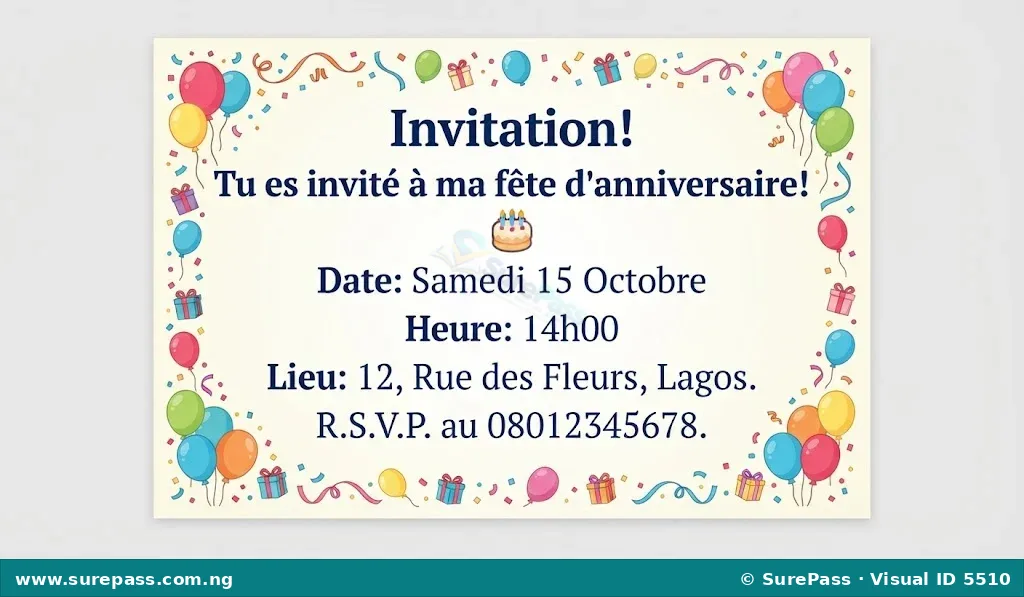
Observe the image below to see a sample French birthday invitation card.
Comprehension Exercise: Reading an Invitation Card
The following questions are based on the sample invitation card shown above:
- Question: Quel est l’événement? (What is the event?)
Réponse: C’est une fête d’anniversaire. (It is a birthday party.) - Question: Quelle est la date de la fête? (What is the date of the party?)
Réponse: La fête est le samedi 15 octobre. (The party is on Saturday, 15th October.) - Question: À quelle heure commence la fête? (What time does the party start?)
Réponse: La fête commence à 14h00 (quatorze heures / deux heures de l’après-midi). (The party starts at 2:00 PM.) - Question: Où se passe la fête? (Where is the party taking place?)
Réponse: La fête se passe au 12, Rue des Fleurs, Lagos. (The party is taking place at 12, Rue des Fleurs, Lagos.)
Les Actes de Naissance (Birth Certificates)
An acte de naissance is an official document that records the birth of a person, showing details such as their name, date of birth, place of birth and parents’ names.
This document is issued by government authorities and is required for school registration, obtaining passports and other official purposes. The key vocabulary terms found on a French birth certificate include:
- Nom de famille: Surname or last name.
- Prénom(s): First name or given names.
- Date de naissance: Date of birth.
- Lieu de naissance: Place of birth.
- Sexe: Gender (Masculin for male, Féminin for female).
- Nom du père: Father’s name.
- Nom de la mère: Mother’s name.
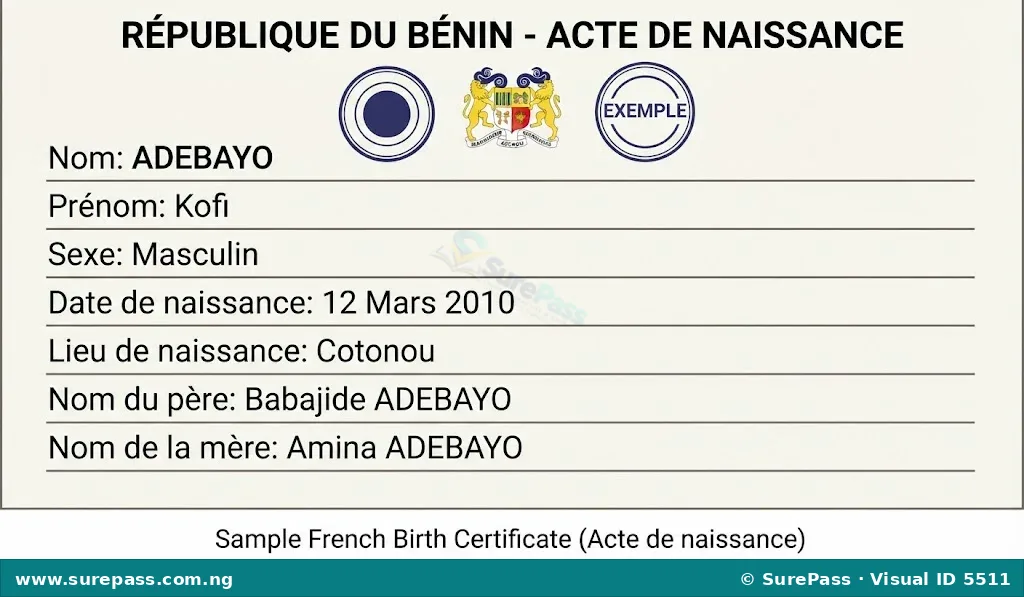
Observe the document below to see a simplified French birth certificate.
Comprehension Exercise: Reading a Birth Certificate
The following questions are based on the sample birth certificate shown above:
- Question: Quel est le nom de famille de l’enfant? (What is the child’s surname?)
Réponse: Le nom de famille est ADEBAYO. (The surname is ADEBAYO.) - Question: Quel est le prénom de l’enfant? (What is the child’s first name?)
Réponse: Le prénom est Kofi. (The first name is Kofi.) - Question: Quand est-il né? (When was he born?)
Réponse: Il est né le 12 mars 2010. (He was born on 12th March 2010.) - Question: Où est-il né? (Where was he born?)
Réponse: Il est né à Cotonou. (He was born in Cotonou.) - Question: Comment s’appelle sa mère? (What is his mother’s name?)
Réponse: Elle s’appelle Amina ADEBAYO. (Her name is Amina ADEBAYO.)
Les Cartes d’Identité (Identity Cards)
A carte d’identité is an official document that proves a person’s identity by displaying their photo, name, nationality and other personal details.
In schools, students are often issued a student identity card, known as a carte d’identité scolaire. The common terms found on a French identity card include:
- Nom: Last name.
- Prénom: First name.
- Nationalité: Nationality.
- Établissement / École: School name.
- Classe: Class or grade level.
- Signature: Signature.
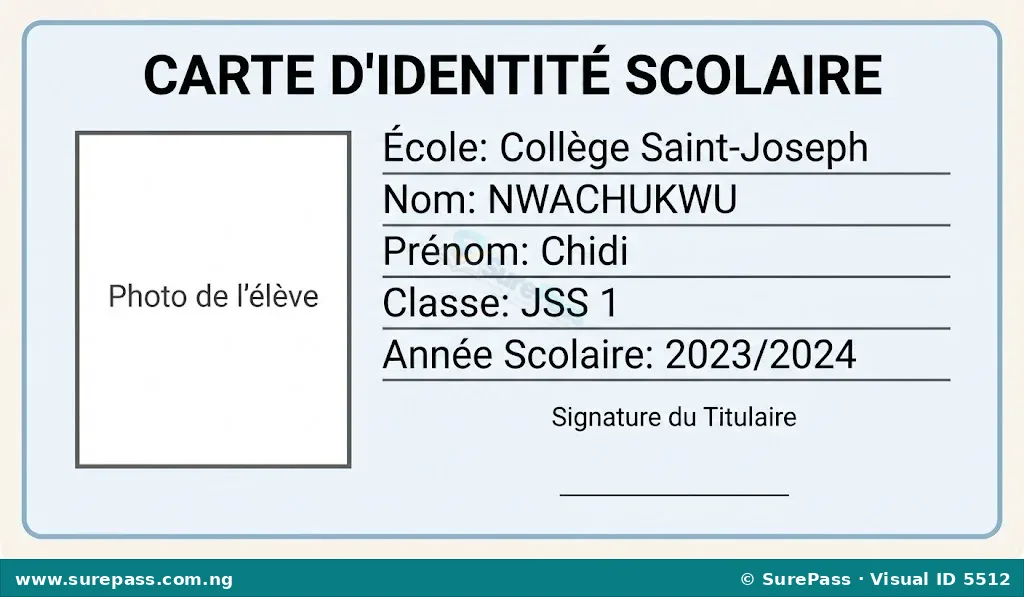
Observe the image below to see a sample student identity card.
Comprehension Exercise: Reading an Identity Card
The following questions are based on the sample student identity card shown above:
- Question: Comment s’appelle l’élève? (What is the student’s name?)
Réponse: Il s’appelle Chidi NWACHUKWU. (His name is Chidi NWACHUKWU.) - Question: Quelle école fréquente-t-il? (Which school does he attend?)
Réponse: Il fréquente le Collège Saint-Joseph. (He attends Collège Saint-Joseph.) - Question: En quelle classe est-il? (What class is he in?)
Réponse: Il est en classe de JSS 1. (He is in JSS 1 class.)
Remplir des Formulaires (Filling out Forms)
A form is a document with blank spaces where a person writes their personal information to register for a service, join a club or enroll in a school.
Filling out forms accurately is an important practical skill. In French, forms require specific personal details. The common headings found on French forms include:
- Civilité: Title (M. for Monsieur/Mr., Mme for Madame/Mrs., Mlle for Mademoiselle/Miss).
- Âge: Age.
- Nationalité: Nationality.
- Adresse: Home address.
- Téléphone: Phone number.
- Courriel / Email: Email address.
Observe the diagram below to see a blank registration form in French.
How to Fill out a Form in French
Filling out a form requires careful reading of each label to ensure the correct information is written in the corresponding blank space.
The procedure for filling out a personal registration form involves the following steps:
- Read the title of the form to understand its purpose (e.g., Formulaire d’Inscription means Registration Form).
- Write the family name in capital letters next to the label Nom.
- Write the first name next to the label Prénom.
- State the age in numbers next to the label Âge.
- Indicate the gender next to the label Sexe by writing M for Masculin (Male) or F for Féminin (Female).
- Write the current class level next to the label Classe (e.g., JSS 1).
- Write the country of origin next to the label Nationalité (e.g., Nigériane for Nigerian).
- Provide the residential address next to the label Adresse.
- Write the contact number next to the label Téléphone.
Summary of Key Vocabulary
The table below provides a quick reference for the French terms used in simple documents and their English meanings:
| French Term | English Meaning |
|---|---|
| Nom de famille | Surname / Last name |
| Prénom | First name |
| Date de naissance | Date of birth |
| Lieu de naissance | Place of birth |
| Sexe (M/F) | Gender (Male/Female) |
| Adresse | Address |
| Téléphone | Phone number |
| Carte d’invitation | Invitation card |
| Acte de naissance | Birth certificate |
| Carte d’identité | Identity card |
Classroom Exercises and Evaluation
Exercise 1: Reading Comprehension
Read the short text below and answer the questions that follow in complete sentences:
Voici l’acte de naissance de Fatoumata. Elle est née le 5 mai 2011 à Dakar, au Sénégal. Son père s’appelle Amadou DIOP et sa mère s’appelle Mariama DIOP. Fatoumata est de nationalité sénégalaise.
The questions for this exercise are:
- Comment s’appelle la fille?
- Quand est-elle née?
- Où est-elle née?
- Comment s’appelle son père?
- Quelle est sa nationalité?
Exercise 2: Form Filling Practice
The prompt for this exercise is:
- Remplissez ce formulaire avec vos informations personnelles (Fill this form with your personal information):
FORMULAIRE D’INSCRIPTION SCOLAIRE
Nom: _________________________
Prénom: _______________________
Âge: __________________________
Sexe (M/F): __________________
Classe: _______________________
Nationalité: __________________
Adresse: ______________________
Exercise 3: Creative Task
The instructions for this task are:
- Préparez un modèle d’acte de naissance ou produisez une carte d’identité scolaire sur une feuille de papier. Dessinez un cadre pour la photo et écrivez vos informations en français.

0 comments
Open the discussion when you need it. Comments stay collapsed until requested so the initial article remains light.