



ARTICLE CONTENTSOn this page 7 sections
L’alphabet français et les numéros de 0 à 100
Performance Objectives
By the end of the lesson, students should be able to:
- Prononcer correctement l’alphabet français
- Lire et écrire correctement les numéros 0 à 100
L’alphabet français (The French Alphabet)
The alphabet is a set of letters used to write a language.
The French alphabet consists of the same 26 letters as the English alphabet, from A to Z. However, the pronunciation of these letters is different. Understanding these differences is essential for correct spelling and pronunciation in French.
The table below shows the 26 letters of the French alphabet, their approximate pronunciation using English sounds, and an example word for each letter:
| Letter | French Pronunciation Guide | Example Word | English Meaning |
|---|---|---|---|
| A | ah | avion | airplane |
| B | bay | ballon | ball |
| C | say | crayon | pencil |
| D | day | table | table |
| E | euh (like the “u” in “burn”) | école | school |
| F | eff | fenêtre | window |
| G | jhay (soft “j” sound, like “s” in “measure”) | garçon | boy |
| H | ash | homme | man |
| I | ee | image | picture |
| J | jee (soft “j” sound) | jour | day |
| K | kah | kilo | kilo |
| L | ell | livre | book |
| M | emm | maison | house |
| N | enn | nom | name |
| O | oh | orange | orange |
| P | pay | porte | door |
| Q | koo (lips rounded as if saying “koo”, but making an “kee” sound) | quatre | four |
| R | air (pronounced from the back of the throat) | règle | ruler |
| S | ess | sac | bag |
| T | tay | stylo | pen |
| U | ew (lips rounded as if saying “oo”, but making an “ee” sound) | un | one |
| V | vay | vélo | bicycle |
| W | dooble-vay | wagon | carriage |
| X | eeks | xylophone | xylophone |
| Y | ee-grec | yeux | eyes |
| Z | zed | zèbre | zebra |
Observe the chart below to see the letters and their pronunciation guides visually.
Vowels and Consonants (Les voyelles et les consonnes)
Just like in English, the French alphabet is divided into vowels and consonants.
The French language has six vowels:
- A
- E
- I
- O
- U
- Y
The remaining 20 letters are consonants. In French, the letter “H” is usually silent, meaning it is not pronounced when it appears at the beginning of a word (for example, homme is pronounced “omm”).
French Accents (Les accents)
An accent is a mark placed on a letter to change its pronunciation or to distinguish words with the same spelling but different meanings.
Accents are an essential part of the French writing system. The five main accents used in French are:
- L’accent aigu (é): This accent is only placed on the letter “e” to make a sharp “ay” sound, as in école (school).
- L’accent grave (à, è, ù): This accent is used on “e” to make an open “eh” sound, as in très (very). It is also used on “a” and “u” to distinguish words, such as à (to/at) versus a (has).
- L’accent circonflexe (â, ê, î, ô, û): This accent can be placed on any vowel. It often indicates that an “s” used to follow that vowel in older forms of the language, as in forêt (forest).
- La cédille (ç): This mark is only placed under the letter “c” before the vowels “a”, “o”, or “u” to make it sound like an “s”, as in garçon (boy).
- Le tréma (ë, ï, ü): This mark consists of two dots placed over a vowel to show that it must be pronounced separately from the vowel before it, as in noël (Christmas).
Spelling Names in French (Épeler les noms)
Spelling names is a practical way to apply the pronunciation of the French alphabet. When asking someone to spell their name, specific expressions are used.
The key expressions for asking and spelling names include:
- Comment t’appelles-tu ? (What is your name? – informal)
- Comment vous appelez-vous ? (What is your name? – formal)
- Comment ça s’écrit ? (How is that written/spelled?)
- Épelez votre nom, s’il vous plaît. (Spell your name, please.)
To spell a name, each letter is pronounced individually using its French sound. Hyphens and accents must also be mentioned if they are part of the name.
Examples of spelling common Nigerian names in French include:
- Olu: O (oh) – L (ell) – U (ew)
- Musa: M (emm) – U (ew) – S (ess) – A (ah)
- Amina: A (ah) – M (emm) – I (ee) – N (enn) – A (ah)
- Ngozi: N (enn) – G (jhay) – O (oh) – Z (zed) – I (ee)
- Chidi: C (say) – H (ash) – I (ee) – D (day) – I (ee)
Les numéros de 0 à 100 (Numbers from 0 to 100)
Numbers are mathematical symbols used to count, measure and label objects.
French numbers follow a logical pattern, but they also contain unique mathematical structures, especially from 70 to 99. Understanding these structures makes it easier to read and write them correctly.
Numbers from 0 to 19
These are the foundational numbers in French. They must be memorized thoroughly because they form the basis for all larger numbers.
The numbers from 0 to 19 are written and pronounced as follows:
| Number | French Word | Number | French Word |
|---|---|---|---|
| 0 | zéro | 10 | dix |
| 1 | un | 11 | onze |
| 2 | deux | 12 | douze |
| 3 | trois | 13 | treize |
| 4 | quatre | 14 | quatorze |
| 5 | cinq | 15 | quinze |
| 6 | six | 16 | seize |
| 7 | sept | 17 | dix-sept |
| 8 | huit | 18 | dix-huit |
| 9 | neuf | 19 | dix-neuf |
Numbers from 20 to 69
These numbers follow a regular decimal pattern. A person must learn the word for each “tens” value and then add the units from 1 to 9.
The words for the tens from 20 to 60 are:
- 20: vingt
- 30: trente
- 40: quarante
- 50: cinquante
- 60: soixante
When combining tens and units, two important rules apply:
- For the number 1 (21, 31, 41, 51, 61), the conjunction et (and) is used without a hyphen. For example: vingt et un (twenty and one).
- For the numbers 2 to 9, a hyphen is used to connect the tens and the units. For example: vingt-deux (twenty-two), trente-cinq (thirty-five).
The table below shows examples of numbers from 20 to 69:
| Number | French Word | Number | French Word |
|---|---|---|---|
| 20 | vingt | 45 | quarante-cinq |
| 21 | vingt et un | 50 | cinquante |
| 22 | vingt-deux | 51 | cinquante et un |
| 30 | trente | 58 | cinquante-huit |
| 31 | trente et un | 60 | soixante |
| 37 | trente-sept | 61 | soixante et un |
| 40 | quarante | 69 | soixante-neuf |
Numbers from 70 to 79
In French, there is no single word for 70. Instead, the number 70 is built mathematically as “60 + 10” (soixante-dix). The units that follow continue from 11 to 19 instead of 1 to 9.
The numbers from 70 to 79 are written as follows:
- 70: soixante-dix (sixty-ten)
- 71: soixante et onze (sixty and eleven)
- 72: soixante-douze (sixty-twelve)
- 73: soixante-treize (sixty-thirteen)
- 74: soixante-quatorze (sixty-fourteen)
- 75: soixante-quinze (sixty-fifteen)
- 76: soixante-seize (sixty-sixteen)
- 77: soixante-dix-sept (sixty-seventeen)
- 78: soixante-dix-huit (sixty-eighteen)
- 79: soixante-dix-neuf (sixty-nineteen)
Numbers from 80 to 89
The number 80 is built mathematically as “4 x 20” (quatre-vingts). Note that vingts ends with an “s” because it is plural.
For numbers from 81 to 89, the “s” at the end of vingt is dropped, and the conjunction “et” is not used for 81. Hyphens are used for all these numbers.
The numbers from 80 to 89 are written as follows:
- 80: quatre-vingts
- 81: quatre-vingt-un
- 82: quatre-vingt-deux
- 83: quatre-vingt-trois
- 84: quatre-vingt-quatre
- 85: quatre-vingt-cinq
- 86: quatre-vingt-six
- 87: quatre-vingt-sept
- 88: quatre-vingt-huit
- 89: quatre-vingt-neuf
Numbers from 90 to 99
The number 90 is built mathematically as “4 x 20 + 10” (quatre-vingt-dix). Just like the 70s, the units that follow continue from 11 to 19.
The numbers from 90 to 99 are written as follows:
- 90: quatre-vingt-dix
- 91: quatre-vingt-onze
- 92: quatre-vingt-douze
- 93: quatre-vingt-treize
- 94: quatre-vingt-quatorze
- 95: quatre-vingt-quinze
- 96: quatre-vingt-seize
- 97: quatre-vingt-dix-sept
- 98: quatre-vingt-dix-huit
- 99: quatre-vingt-dix-neuf
The Number 100
The number 100 is written as cent.
Observe the diagram below to understand the mathematical structure of French numbers from 70 to 99.
Counting Classroom Objects (Compter les objets de la classe)
Counting physical items in the classroom helps learners practice French numbers in a real-world context. To count objects correctly, one must know the French names of the objects and their grammatical gender (masculine or feminine).
In French, nouns are either masculine or feminine. The number “1” changes form depending on the gender of the noun it describes:
- Un is used for masculine nouns (e.g., un sac – one bag).
- Une is used for feminine nouns (e.g., une table – one table).
Other numbers (2 to 100) do not change their form based on gender, but the noun itself must take a plural “s” at the end (though the “s” is usually silent in pronunciation).
Common classroom objects and their genders include:
- un sac (a bag / schoolbag)
- un livre (a book)
- un cahier (a notebook)
- un stylo (a pen)
- un crayon (a pencil)
- un tableau (a board / blackboard)
- une table (a table)
- une chaise (a chair)
- une règle (a ruler)
- une fenêtre (a window)
- une porte (a door)
Observe the classroom scene below to see these objects and their quantities labeled in French.
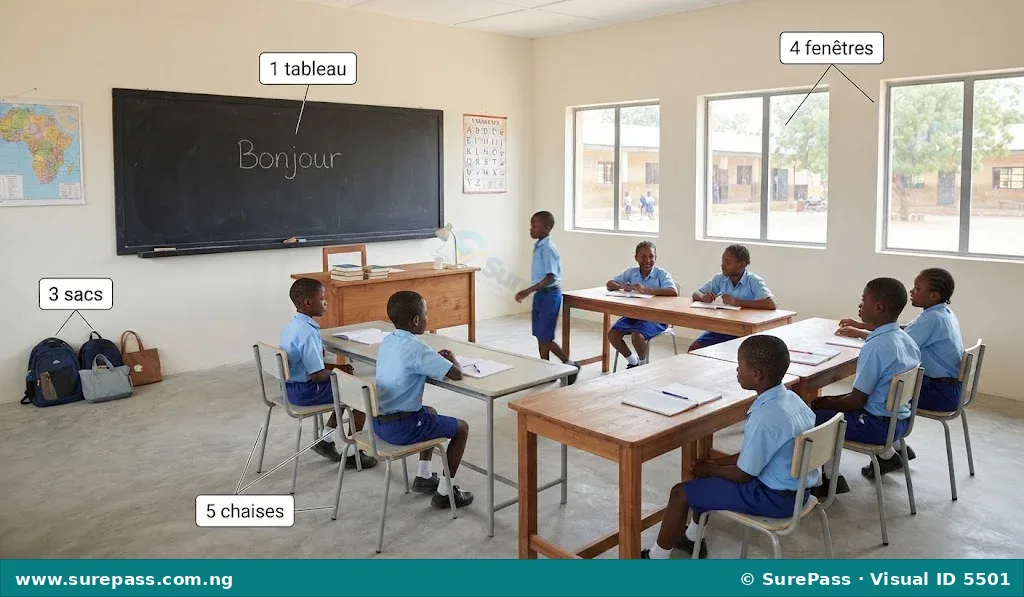
How to Count Objects in the Classroom
To count objects in the classroom, the following procedure should be followed:
- Identify the object to be counted (e.g., chairs).
- Determine the French name and gender of the object (e.g., chaise is feminine, so one chair is une chaise).
- Count each item aloud in French, starting from one up to the total number.
- Write down the final count by placing the number before the plural form of the noun.
Examples of counted classroom objects include:
- 3 bags: trois sacs
- 5 chairs: cinq chaises
- 12 books: douze livres
- 21 tables: vingt et une tables (Note: un becomes une because table is feminine)
- 35 pens: trente-cinq stylos
Evaluation Exercises
Exercise 1: Spelling Names (L’orthographe)
Spell the following names aloud using the French pronunciation of each letter:
- BOLA
- CHIDI
- AMINA
- EZE
- YUSUF
Exercise 2: Writing Numbers in Words (Écrire les nombres)
Write the following numbers in French words:
- 15
- 24
- 41
- 68
- 75
- 80
- 83
- 91
- 99
- 100
Exercise 3: Counting Classroom Objects (Compter les objets)
Count the items described below and write the correct French phrase (number + noun):
- 8 pens (stylos)
- 12 chairs (chaises)
- 21 notebooks (cahiers)
- 30 rulers (règles)
- 75 books (livres)



0 comments
Open the discussion when you need it. Comments stay collapsed until requested so the initial article remains light.