


ARTICLE CONTENTSOn this page 8 sections
La lecture des documents simples en français
Performance Objectives
By the end of the lesson, students should be able to:
- Lire et comprendre les mots des cartes flash, des murs de classe et des textes en français.
Introduction to Simple Documents in French
Reading is a foundational skill in learning the French language. In the early stages of language acquisition, learners interact with simple written materials to build vocabulary and understand basic sentence structures.
A simple document is any short, clear written material that conveys a direct message using basic vocabulary and simple sentences.
In a Junior Secondary School French classroom, these simple documents are found in various forms. Examples of simple documents include:
- Flashcards (les cartes flash) containing single words or short phrases.
- Classroom posters (les affiches) displayed on the walls.
- Labels on classroom objects.
- Short reading passages (les textes simples) describing people, places, or daily activities.
Observe the classroom environment shown below, which features various French educational posters and labels on the walls.
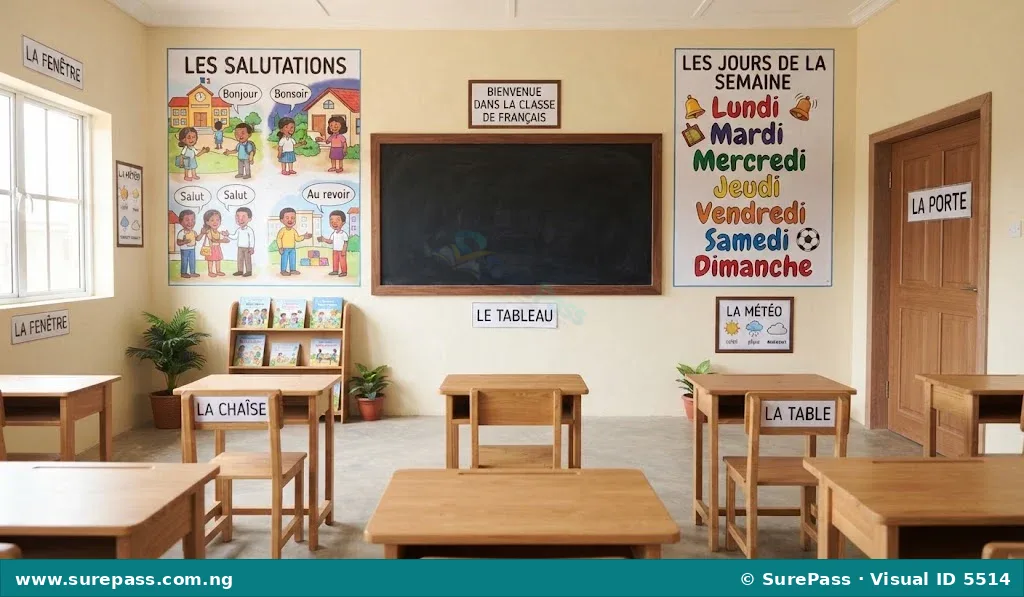
Reading Flashcards and Classroom Posters
Flashcards and posters are excellent tools for learning new words, correct spelling, and pronunciation. They often combine written French words with pictures to help learners understand the meaning immediately without needing direct translation.
A flashcard is a small card containing a word, picture, or symbol used as an aid for learning and memory.
A classroom poster is a large printed paper displayed on a wall to show educational information.
To read these documents effectively, learners must observe the spelling of the words, listen to the correct pronunciation, and associate the words with their meanings.
The table below presents common words found on classroom flashcards and posters, along with their English meanings and pronunciation guides:
| French Word | English Meaning | Pronunciation Guide (Approximate) |
|---|---|---|
| Le livre | The book | luh leevr |
| Le stylo | The pen | luh stee-loh |
| Le crayon | The pencil | luh krey-ohn |
| La table | The table | lah tahbl |
| La chaise | The chair | lah shez |
| Le professeur | The teacher | luh pro-feh-suhr |
| L’élève | The student | lay-lehv |
| Le tableau | The board / chalkboard | luh tah-bloh |
Look at the set of illustrated flashcards below, which are used to learn the names of common classroom objects.
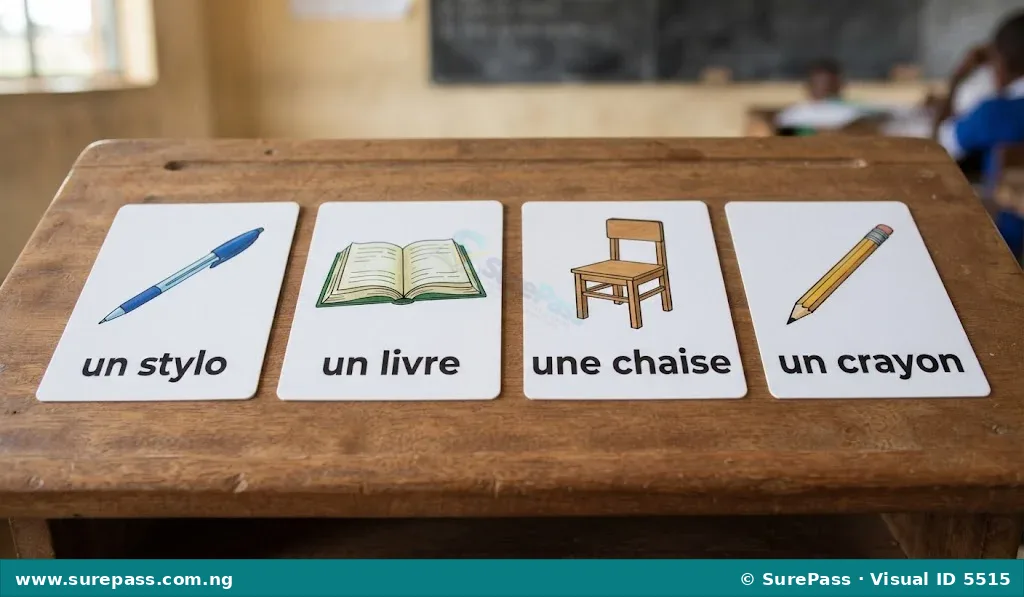
Reading and Understanding Simple French Texts
Reading short texts helps learners see how words are put together to form complete sentences. At the JSS 1 level, these texts are kept short and focus on familiar topics such as self-introduction, family, or the school environment.
Below are two simple texts. Each text is followed by an explanation of the vocabulary and the overall meaning of the passage.
Texte 1: Je me présente (Introducing Myself)
Bonjour ! Je m’appelle Kofi. J’ai douze ans. Je suis nigérian. Je suis élève en classe de JSS 1. J’aime le français.
The line-by-line English translation of Texte 1 is:
- Bonjour ! — Hello! / Good morning!
- Je m’appelle Kofi. — My name is Kofi.
- J’ai douze ans. — I am twelve years old.
- Je suis nigérian. — I am Nigerian.
- Je suis élève en classe de JSS 1. — I am a student in JSS 1 class.
- J’aime le français. — I like French.
Key vocabulary words from Texte 1 include:
| French Word / Phrase | English Meaning | Grammatical Explanation |
|---|---|---|
| Je m’appelle | My name is / I call myself | Used to introduce one’s name. |
| J’ai | I have | From the verb “avoir” (to have), used in French to state age. |
| Douze | Twelve | The number 12. |
| Je suis | I am | From the verb “être” (to be), used to state nationality or profession. |
| J’aime | I like / I love | From the verb “aimer” (to like/love). |
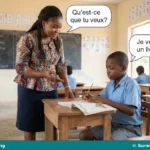
Observe the visual representation of Kofi introducing himself to his classmates.
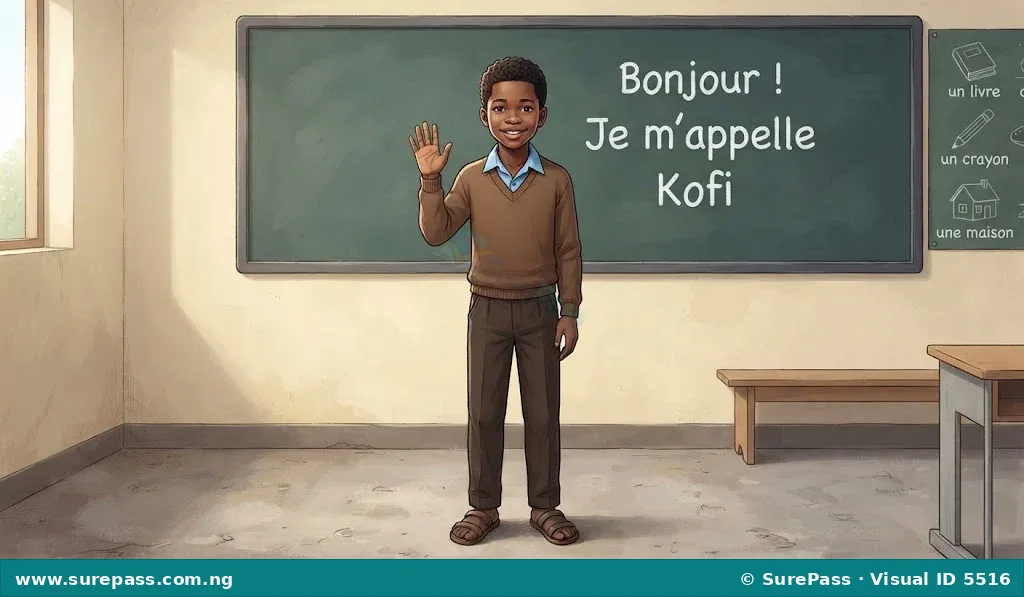
Texte 2: Dans la classe (In the Classroom)
Voici ma classe. La classe est grande et propre. Dans la classe, il y a un tableau noir, dix tables et dix chaises. Le professeur est devant le tableau. Les élèves écoutent le professeur.
The line-by-line English translation of Texte 2 is:
- Voici ma classe. — Here is my classroom.
- La classe est grande et propre. — The classroom is big and clean.
- Dans la classe, il y a un tableau noir, dix tables et dix chaises. — In the classroom, there is a chalkboard, ten tables, and ten chairs.
- Le professeur est devant le tableau. — The teacher is in front of the board.
- Les élèves écoutent le professeur. — The students are listening to the teacher.
Key vocabulary words from Texte 2 include:
| French Word / Phrase | English Meaning | Grammatical Explanation |
|---|---|---|
| Voici | Here is / Here are | Used to point out something nearby. |
| Grande | Big / Large | Feminine singular adjective describing “la classe”. |
| Propre | Clean | Adjective describing the state of the classroom. |
| Il y a | There is / There are | An expression used to show existence. |
| Devant | In front of | A preposition of place. |
| Écoutent | Listen / Are listening | Plural form of the verb “écouter” (to listen). |
Pronunciation and Spelling Practice
To develop strong reading skills, learners must practice spelling (épeler) and pronouncing (prononcer) French words correctly. French pronunciation has specific rules regarding silent letters and accents that differ from English.
Spelling in French involves naming the individual letters of a word using the French alphabet. Pronunciation involves producing the correct sounds of the letters and letter combinations.
Important pronunciation and spelling guidelines for JSS 1 learners include:
- Silent Consonants: In many French words, the final consonant is silent. For example, in the word “grand” (big), the final “d” is not pronounced. In “cours” (class/lesson), the final “s” is silent.
- The Letter “H”: The letter “h” is always silent in French. For example, “homme” (man) is pronounced starting with the “o” sound.
- Accents: Accents change the pronunciation of vowels. For example, the acute accent (l’accent aigu) on the letter “é” in “élève” makes an “ay” sound, while the grave accent (l’accent grave) on “è” makes an “eh” sound.
- Nasal Sounds: Combinations like “an”, “en”, “in”, and “on” produce nasal sounds where air escapes through both the nose and mouth. An example is the word “garçon” (boy).
How to Practice Spelling and Pronunciation
The procedure for mastering the spelling and pronunciation of new French words involves the following steps:
- Look closely at the written word on the flashcard or poster.
- Listen carefully to the teacher pronouncing the word.
- Repeat the pronunciation aloud, paying attention to silent letters and nasal sounds.
- Spell the word aloud letter by letter using the French alphabet names (e.g., “table” is spelled: té, a, bé, el, e).
- Write the word down in a notebook to reinforce memory.
- Read the word aloud in the context of a complete sentence.
Classroom Dictation (La Dictée)
Dictation is an exercise where the teacher reads words or sentences aloud, and students write them down exactly as heard. This practice helps evaluate listening comprehension, spelling accuracy, and understanding of grammatical agreements.
The procedure for taking a French dictation involves the following steps:
- Listen quietly to the teacher reading the entire passage once without writing, to understand the general meaning.
- Listen to the second reading, which is done slowly with pauses, and write down the words carefully.
- Pay close attention to accents (é, è, à) and plural markers (such as silent “s” or “nt” at the end of words).
- Listen to the final reading to check for missing words or punctuation marks.
- Review the written text and correct any spelling errors before submission.
Comprehension Exercises
Exercise 1: Vocabulary Matching
Match the French words in List A with their correct English meanings in List B.
List A:
- Le stylo
- Grande
- Devant
- L’élève
- Il y a
List B:
- In front of
- The student
- The pen
- There is / There are
- Big
Exercise 2: Questions on Texte 1 (Je me présente)
Answer the following questions in English based on Texte 1:
- What is the name of the boy introducing himself?
- How old is he?
- What is his nationality?
- What class is he in?
- What subject does he like?
Exercise 3: Questions on Texte 2 (Dans la classe)
Answer the following questions in French or English based on Texte 2:
- Comment est la classe ? (How is the classroom?)
- Combien de tables y a-t-il dans la classe ? (How many tables are in the classroom?)
- Où est le professeur ? (Where is the teacher?)
- Que font les élèves ? (What are the students doing?)
Exercise 4: Dictation Practice (La Dictée)
Listen to the teacher read the following sentences aloud and write them down accurately in French:
- Voici un livre et un stylo.
- La classe est propre.
- J’aime le français.


0 comments
Open the discussion when you need it. Comments stay collapsed until requested so the initial article remains light.