


ARTICLE CONTENTSOn this page 7 sections
Parts of speech: Nouns, Verbs and Adjectives
Performance Objectives
By the end of the lesson, students should be able to:
- explain the meaning and features of nouns, verbs and adjectives;
- list the functions of nouns, verbs and adjectives;
- identify the nouns, verbs and adjectives in texts;
- use nouns, verbs and adjectives appropriately in sentences.
The Noun
Meaning of a Noun
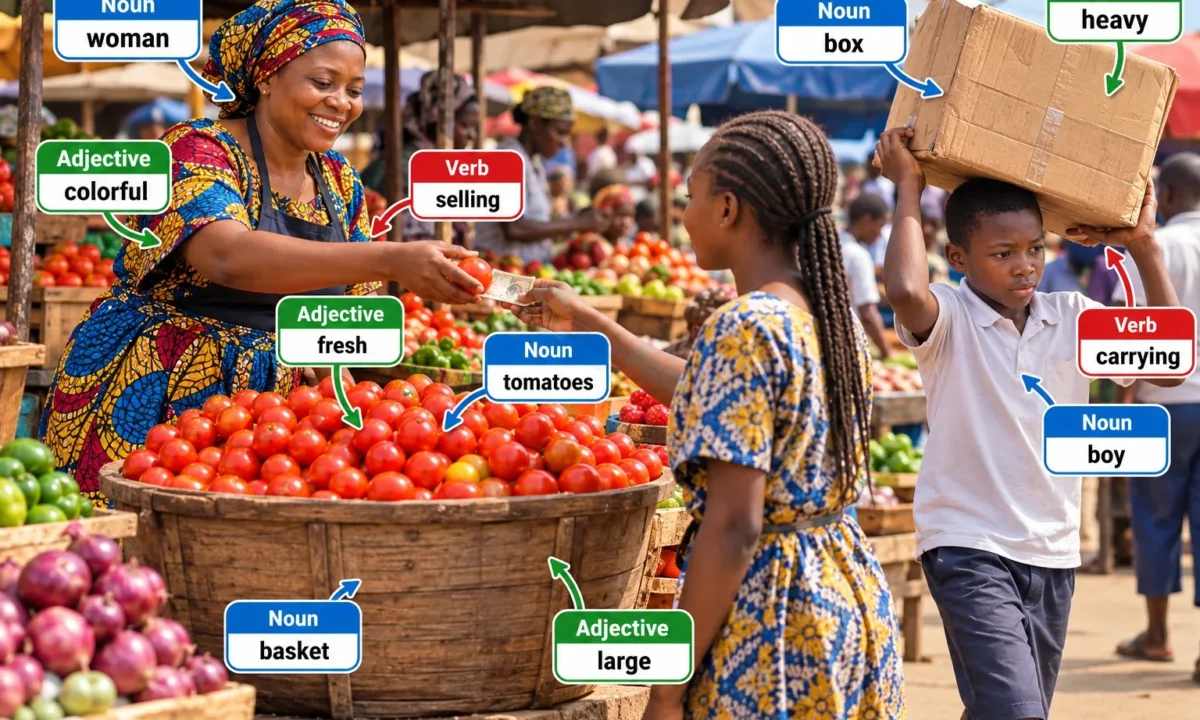
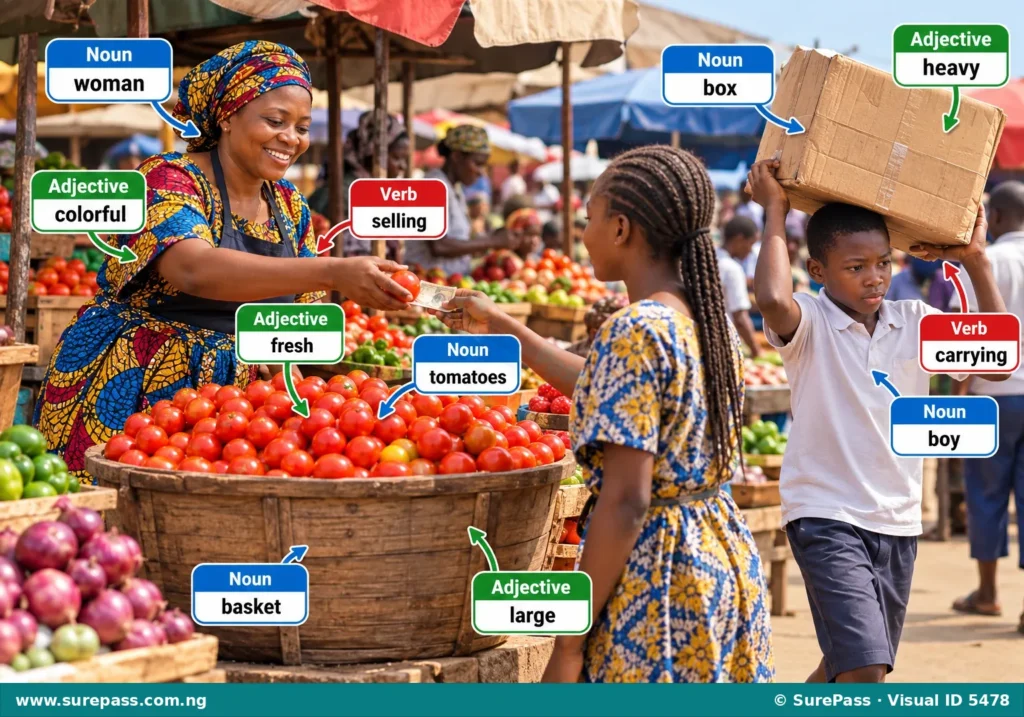
A noun is a word that names a person, place, animal, thing, idea or quality.
Nouns are the basic building blocks of sentences because they identify the entities that perform actions, receive actions or exist in various states.
Features of Nouns
Nouns possess distinct grammatical features that help in their identification:
- Pluralisation: Most nouns can change from a singular form to a plural form, usually by adding suffixes such as “-s”, “-es” or “-ies”. For example, “book” becomes “books”, and “city” becomes “cities”.
- Determinative Association: Nouns frequently follow determiners or articles such as “a”, “an” or “the”. For example, “a teacher”, “an orange”, “the school”.
- Adjectival Modification: Nouns can be preceded and described by adjectives. For example, “a diligent student”, “the large field”.
- Position in Sentences: Nouns typically occupy the subject position before a verb or the object position after a transitive verb or preposition.
Types of Nouns
Nouns are classified into several types based on what they name:
- Proper Nouns: These are specific names of particular people, places, days of the week, months or institutions. They always begin with capital letters. Examples include: “Ngozi”, “Nigeria”, “Abuja”, “Monday”, “Lagoon Hospital”.
- Common Nouns: These are general names given to people, places, animals or things of the same class or kind. They do not begin with capital letters unless they start a sentence. Examples include: “girl”, “country”, “city”, “day”, “hospital”.
- Concrete Nouns: These are names of physical objects that can be seen, touched, heard, smelt or tasted. Examples include: “table”, “stone”, “water”, “drum”, “bread”.
- Abstract Nouns: These are names of ideas, qualities, feelings or states of being that cannot be perceived by the physical senses. Examples include: “honesty”, “happiness”, “poverty”, “freedom”, “anger”.
- Collective Nouns: These are names given to a group of people, animals or things taken together as a single unit. Examples include: “family”, “team”, “flock” (of birds), “herd” (of cattle), “class” (of students).
Functions of Nouns
Nouns perform several grammatical functions in sentences:
- Subject of a Verb: The noun performs the action in the sentence. In the sentence, “Amina sang beautifully,” the noun “Amina” is the subject of the verb “sang”.
- Direct Object of a Verb: The noun receives the action performed by the subject. In the sentence, “The boy kicked the ball,” the noun “ball” is the direct object of the verb “kicked”.
- Indirect Object of a Verb: The noun identifies to whom or for whom the action is done. In the sentence, “The teacher gave Obi a book,” the noun “Obi” is the indirect object.
- Object of a Preposition: The noun follows a preposition to complete a prepositional phrase. In the sentence, “The cat slept under the table,” the noun “table” is the object of the preposition “under”.
The Verb
Meaning of a Verb
A verb is a word that expresses an action, an occurrence or a state of being.
Verbs are essential to sentences because a complete sentence cannot exist without a finite verb. They indicate what the subject is doing, what is happening to the subject or the state in which the subject exists.
Features of Verbs
Verbs can be identified by the following grammatical features:
- Tense Variation: Verbs change their form to show the time of an action, such as present tense, past tense or future tense. For example, “walk” (present) becomes “walked” (past).
- Inflectional Endings: Verbs take different endings depending on the subject and tense, such as “-s”, “-es”, “-ed” or “-ing”. For example, “writes”, “writing”, “played”.
- Subject-Verb Agreement: Verbs change form to agree with the singular or plural nature of the subject. For example, “The boy runs” (singular) versus “The boys run” (plural).
Types of Verbs
Verbs are grouped into different categories based on their function and structure:
- Action (Lexical) Verbs: These verbs express physical or mental activities. Examples include: “run”, “write”, “think”, “jump”, “speak”.
- Auxiliary (Helping) Verbs: These verbs work with main verbs to express tense, aspect, mood or voice. Examples include: “is”, “was”, “has”, “have”, “will”, “can”, “should”. In the sentence, “They are playing football,” “are” is the auxiliary verb and “playing” is the main verb.
- Transitive Verbs: These are action verbs that require a direct object to complete their meaning. Examples include: “buy”, “kick”, “bring”. In the sentence, “She bought a pen,” the verb “bought” is transitive because it acts on the object “pen”.
- Intransitive Verbs: These are action verbs that do not require a direct object to complete their meaning. Examples include: “sleep”, “laugh”, “cry”, “arrive”. In the sentence, “The baby slept,” the verb “slept” is intransitive.
- Linking Verbs: These verbs do not show action but connect the subject to a word that describes or identifies the subject. Examples include: “is”, “seem”, “become”, “look”. In the sentence, “The food smells delicious,” “smells” acts as a linking verb.
Functions of Verbs
The primary functions of verbs in sentences include:
- Expressing Physical Action: Showing what the subject physically does. For example, “The farmer cleared the land.”
- Expressing Mental Action: Showing thoughts, feelings or decisions. For example, “The students understand the lesson.”
- Indicating State of Being: Showing existence or condition. For example, “Abuja is the capital of Nigeria.”
- Establishing Time (Tense): Indicating when an event occurred, is occurring or will occur. For example, “We will travel tomorrow.”
The Adjective
Meaning of an Adjective
An adjective is a word that describes, modifies or gives more information about a noun or a pronoun.
Adjectives add detail to sentences by specifying qualities, quantities, sizes, shapes, colours or ownership of nouns.
Features of Adjectives
Adjectives have specific features that distinguish them from other parts of speech:
- Degrees of Comparison: Many adjectives can change form to show positive, comparative and superlative degrees. For example, “tall” (positive), “taller” (comparative), “tallest” (superlative).
- Attributive Position: Adjectives can appear directly before the noun they modify. For example, “the ripe mango”.
- Predicative Position: Adjectives can appear after a linking verb to describe the subject. For example, “The mango is ripe“.
Types of Adjectives
Adjectives are classified into several types based on the kind of information they provide:
- Adjectives of Quality: These describe the nature, character or physical state of a noun. Examples include: “beautiful”, “strong”, “cold”, “honest”, “round”.
- Adjectives of Quantity: These indicate how much of something is intended, usually with uncountable nouns. Examples include: “some”, “much”, “little”, “any”, “enough”.
- Adjectives of Number: These show how many nouns exist or their order in a sequence. Examples include: “three”, “many”, “few”, “first”, “second”.
- Demonstrative Adjectives: These point out specific nouns. Examples include: “this”, “that”, “these”, “those”. For example, “This book belongs to me.”
- Possessive Adjectives: These show ownership or possession. Examples include: “my”, “your”, “his”, “her”, “its”, “our”, “their”. For example, “This is my classroom.”
Functions of Adjectives
The primary functions of adjectives include:
- Describing Attributes: Providing details about the appearance, size, colour or quality of a noun. For example, “The red car stopped.”
- Limiting or Restricting: Narrowing down the scope of a noun to make it specific. For example, “Give me that ruler.”
- Quantifying: Specifying the exact or approximate amount of a noun. For example, “There are ten books on the shelf.”
Identifying Nouns, Verbs and Adjectives in Texts
To develop grammatical accuracy, learners must practice identifying these parts of speech within continuous passages. Observe the short passage below:
“Mr. Okeke is a hardworking farmer. He lives in a quiet village near Enugu. Every morning, he carries a sharp cutlass to his large farm. He cultivates fertile soil to grow healthy crops. Yesterday, he harvested sweet yams and sold them at the local market.”
The table below shows the classification of selected words from the passage above:
| Nouns | Verbs | Adjectives |
|---|---|---|
| Mr. Okeke, farmer, village, Enugu, morning, cutlass, farm, soil, crops, yams, market | is, lives, carries, cultivates, grow, harvested, sold | hardworking, quiet, sharp, large, fertile, healthy, sweet, local |
A substitution table can also be used to construct sentences by selecting appropriate nouns, verbs and adjectives. Look at the table below:
The following sentences can be formed from the substitution table structure:
- The diligent student worked.
- A young girl ran.
- The tall farmer smiled.
Exercises
Exercise 1: Identification
Read the sentences below and identify the underlined words as either a noun, a verb or an adjective:
- The clever pupil solved the difficult puzzle.
- Amina swept the classroom before the assembly.
- The crowd cheered when the team scored a goal.
- They live in a beautiful house near the river.
- The sun shines brightly in the afternoon.
Exercise 2: Sentence Completion
Complete the sentences below by choosing the most appropriate word from the options provided in brackets:
- The __ teacher explained the lesson clearly. (angry, loudly, write)
- Chidi __ a letter to his pen pal yesterday. (wrote, paper, neat)
- We saw a __ of cattle crossing the road. (flock, herd, pack)
- The water in the stream is very __. (cold, run, quickly)
- The children __ happily in the playground. (played, happy, game)
Exercise 3: Sentence Generation
Write five original sentences using the instructions below:
- Write a sentence containing a proper noun, an action verb and a common noun.
- Write a sentence containing a possessive adjective, a concrete noun and a linking verb.
- Write a sentence containing an abstract noun as the subject.
- Write a sentence containing an adjective of quality modifying the object.
- Write a sentence containing a collective noun and a transitive verb.




0 comments
Open the discussion when you need it. Comments stay collapsed until requested so the initial article remains light.