


ARTICLE CONTENTSOn this page 10 sections
Conversation on Various Issues
Performance Objectives
By the end of the lesson, students should be able to:
- discuss current national and global issues relating to climate change, economy, security, education, etc;
- use appropriate registers on various issues.
Understanding Conversation and Register
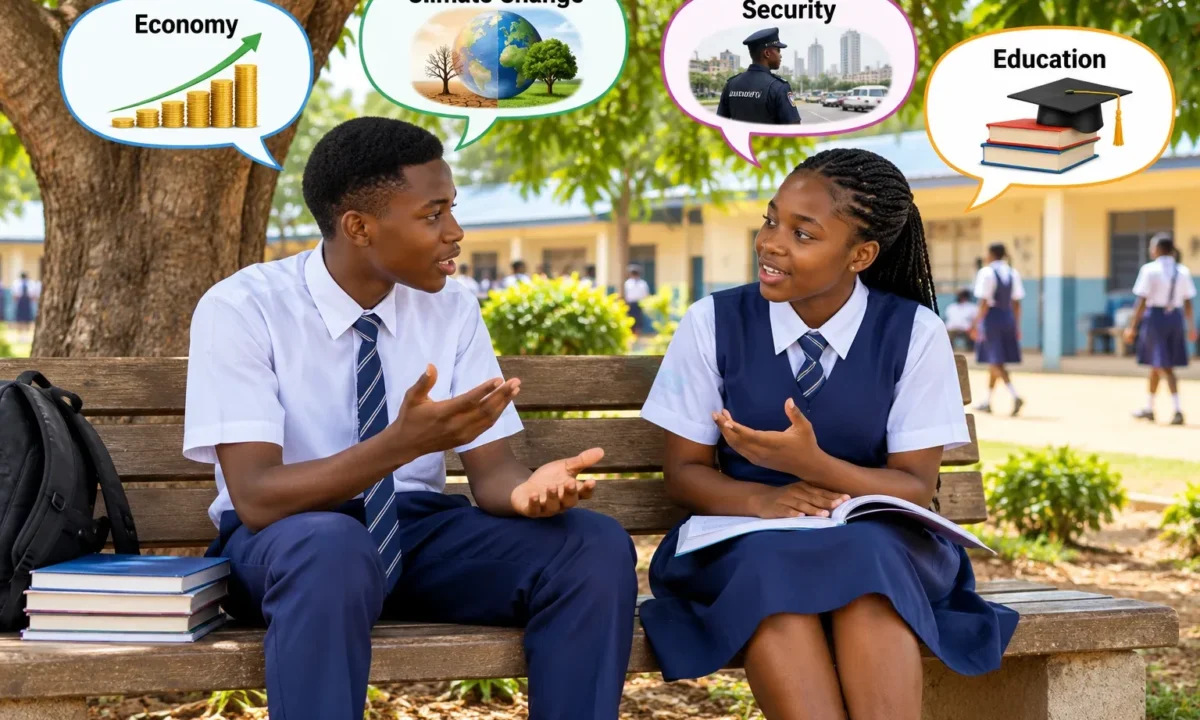
A conversation is an informal talk between two or more people in which thoughts, feelings and ideas are expressed, questions are asked and answered, or news and information is shared.
Conversations are the primary way people build relationships, share information and solve problems in the home, school and community. To have an effective conversation, speakers must listen attentively and respond appropriately to what others say.
A register is the specific vocabulary, tone and style of language used by speakers when discussing a particular subject or in a specific social situation.
Every subject or topic has its own set of words that people use when they talk about it. For example, the words used when talking about football are different from the words used when talking about a hospital. Using the correct register helps speakers express their ideas clearly and shows that they understand the topic being discussed.
Conversing on the Economy
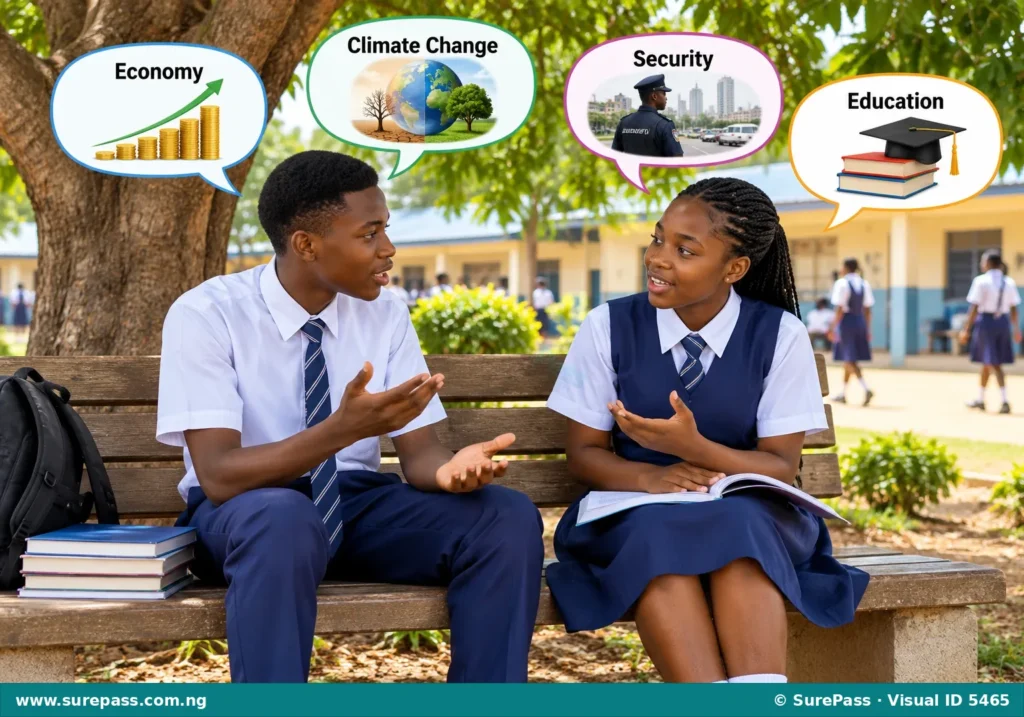
The economy is the system of how a country or region makes, distributes and uses money, goods and services.
When people discuss the economy, they talk about how much things cost, how people earn money, and how businesses operate. Understanding economic terms helps citizens understand news reports and daily financial decisions.
Key register words for discussing the economy include:
- Inflation: A general increase in prices and fall in the purchasing value of money.
- Budget: A plan of how money will be earned and spent over a period of time.
- Goods: Physical items that are produced, bought and sold, such as food, clothes and books.
- Services: Actions or work performed by others, such as teaching, medical care and transport.
- Currency: The system of money in common use in a country, such as the Naira in Nigeria.
- Income: Money received, especially on a regular basis, for work or through investments.
Model Dialogue on the Economy
The following dialogue shows a conversation between two students, Tunde and Ngozi, discussing the rising cost of school items:
Tunde: Have you noticed that the prices of exercise books and pens have gone up at the school buttery?
Ngozi: Yes, Tunde. My parents mentioned that inflation is affecting almost every sector of the economy. It means our money buys fewer goods than before.
Tunde: That is true. My father had to adjust our family budget this month just to make sure we could afford our school materials and transport fare.
Ngozi: It is quite difficult. I hope the government takes steps to stabilize our currency so that the cost of basic goods and services will stop rising.
Conversing on Security
Security is the state of being safe and free from danger, harm, fear or threat.
Security is a major concern for individuals, communities and nations. Conversations about security often focus on safety measures, the role of law enforcement, and how citizens can cooperate to maintain peace.
Key register words for discussing security include:
- Surveillance: The close observation of a person, place or behavior to prevent crime.
- Patrol: An expedition, usually by security officers, to keep watch over an area.
- Threat: A statement or event indicating damage, violence or danger.
- Vigilance: The action or state of keeping careful watch for possible danger or difficulties.
- Law enforcement: Agencies and officers responsible for enforcing laws, maintaining public order and managing public safety.
- Peace: A state of friendliness and calm, free from civil disturbance or violence.
Model Dialogue on Security
The following dialogue shows a conversation between two students, Amina and Chidi, discussing safety in their neighborhood:
Amina: There was a community meeting yesterday about improving security in our neighborhood.
Chidi: That is a good initiative. Did they discuss any new safety measures?
Amina: Yes, they decided to increase night patrols by local vigilantes and install streetlights for better visibility. They also urged everyone to maintain high vigilance.
Chidi: That will help reduce any potential threat. It is important for law enforcement and community members to work together to ensure peace and safety for everyone.
Conversing on Out-of-School Children and Education
Out-of-school children are children of official school age who are not enrolled in or attending any formal school or educational institution.
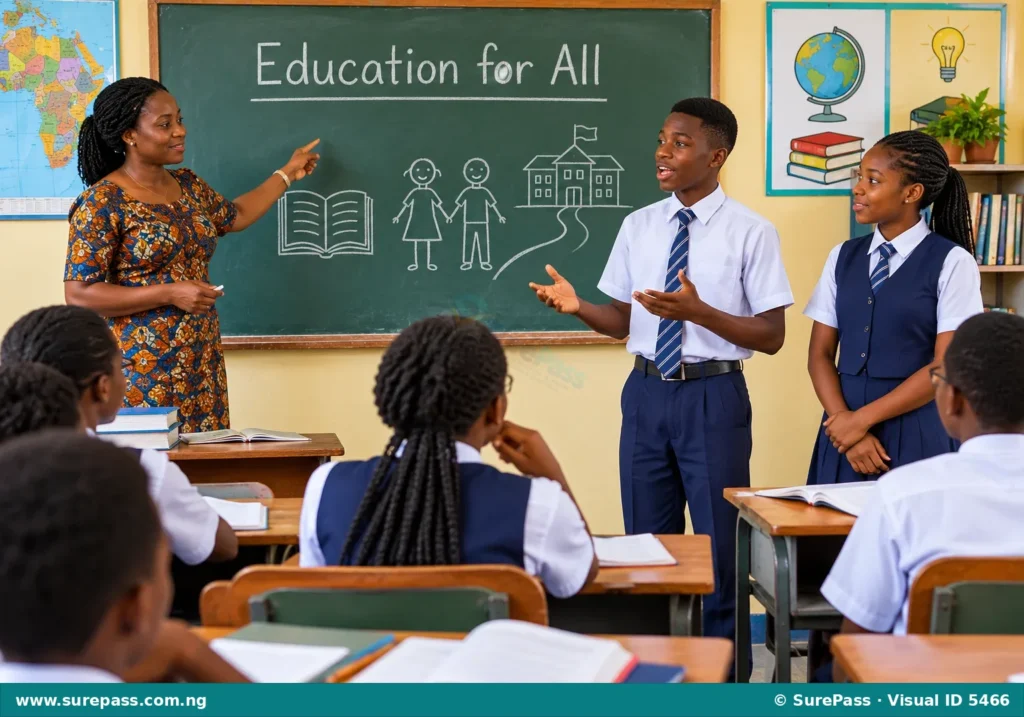
Education is a fundamental right, yet many children do not attend school due to poverty, conflict or lack of infrastructure. Discussing this issue involves looking at solutions to ensure every child receives quality basic education.
Key register words for discussing out-of-school children and education include:
- Literacy: The ability to read and write.
- Enrollment: The act of officially registering or joining a school.
- Dropout: A person who leaves school before completing their education.
- Tuition: The fee charged for instruction or teaching, especially in schools.
- Basic education: The foundational level of education, which usually covers primary and junior secondary school.
- Infrastructure: The physical structures needed for a school, such as classrooms, desks and libraries.
Model Dialogue on Out-of-School Children
The following dialogue shows a conversation between two students, Fatima and Emeka, discussing children who do not attend school:
Fatima: I saw some children hawking goods on the street during school hours today. It made me sad.
Emeka: It is a serious problem. The number of out-of-school children in our country is quite high. Many of them miss out on basic education because their families cannot afford tuition or uniforms.
Fatima: Education is the key to literacy and a better future. If these children dropout of school early, it limits their opportunities in life.
Emeka: I agree. The government and non-governmental organizations need to build more school infrastructure and provide free education so that school enrollment will increase.
Conversing on Climate Change
Climate change is the long-term shift in global or regional climate patterns, often characterized by rising temperatures and extreme weather conditions caused by human activities.
Climate change affects agriculture, water supply and weather patterns across the globe. Conversations on this topic often focus on environmental protection and sustainable habits.
Key register words for discussing climate change include:
- Global warming: The gradual increase in the overall temperature of the earth’s atmosphere.
- Pollution: The introduction of harmful materials or substances into the environment.
- Deforestation: The action of clearing a wide area of trees, which harms the ecosystem.
- Renewable energy: Energy from sources that do not run out, such as wind, water and solar power.
- Erosion: The gradual wearing away of soil by water, wind or ice.
- Conservation: The careful preservation and protection of natural resources and the environment.
Model Dialogue on Climate Change
The following dialogue shows a conversation between two students, Musa and Yetunde, discussing environmental changes:
Musa: The rainy season has been very unpredictable this year. We experienced severe flooding last week, and now the heat is intense.
Yetunde: That is a direct effect of climate change. Human activities like deforestation and air pollution are accelerating global warming.
Musa: It is affecting our farmers because soil erosion is washing away crops, making it hard to harvest food.
Yetunde: We must practice environmental conservation. Planting more trees and using renewable energy like solar power can help protect our planet.
Conversing on Drug Abuse
Drug abuse is the habitual or excessive use of chemical substances, drugs or medicines in a way that is harmful to physical, mental or emotional health.
Drug abuse is a major social issue that affects the health of individuals and the safety of communities. Conversations on this topic focus on prevention, health education and support systems.
Key register words for discussing drug abuse include:
- Addiction: A physical or mental dependency on a substance, making it difficult to stop using it.
- Substance: A chemical or drug, especially one that can be harmful if misused.
- Rehabilitation: The process of helping a person recover from drug dependency through therapy and medical care.
- Peer pressure: Influence from members of one’s peer group to behave in a certain way.
- Prevention: The act of stopping something bad from happening.
- Therapy: Treatment intended to relieve or heal a physical or mental disorder.
Model Dialogue on Drug Abuse
The following dialogue shows a conversation between two students, Kelechi and Zainab, discussing the dangers of drug abuse:
Kelechi: Our guidance counselor gave a talk today about the dangers of substance abuse among teenagers.
Zainab: That was an important talk. Many young people fall into drug abuse because of peer pressure and a lack of awareness about the dangers.
Kelechi: Yes, she explained that drug abuse can lead to severe addiction, which damages both physical and mental health.
Zainab: It is good that there are rehabilitation centers to help those who want to recover. However, prevention through continuous education is the best way to keep students safe.
Active Listening and Speaking Skills in Conversations
To have a successful conversation on any issue, speakers must practice good communication habits. This ensures that ideas are shared clearly and respectfully.
Important conversation skills include:
- Active Listening: Paying close attention to the speaker, nodding to show understanding, and not interrupting.
- Turn-taking: Waiting for the other person to finish speaking before responding, rather than talking over them.
- Polite Expressions: Using phrases like “In my opinion,” “I agree with you,” or “I understand your point, but…” to express different views politely.
- Clarification: Asking polite questions when a point is not clear, such as “Could you please explain what you mean by that?”
- Eye Contact: Looking at the person speaking to show interest and engagement in the conversation.
Classroom Speaking Practice
The following steps should be followed to practice conversation skills in the classroom:
- Form pairs or small groups of three.
- Select one of the issues discussed in this unit (Economy, Security, Out-of-school children, Climate change, or Drug abuse).
- Spend five minutes discussing the chosen issue with your partner or group members.
- Ensure that each person speaks at least twice during the conversation.
- Use at least three key register words from the selected topic during the discussion.
- Practice active listening, turn-taking and polite expressions throughout the conversation.



0 comments
Open the discussion when you need it. Comments stay collapsed until requested so the initial article remains light.