



ARTICLE CONTENTSOn this page 7 sections
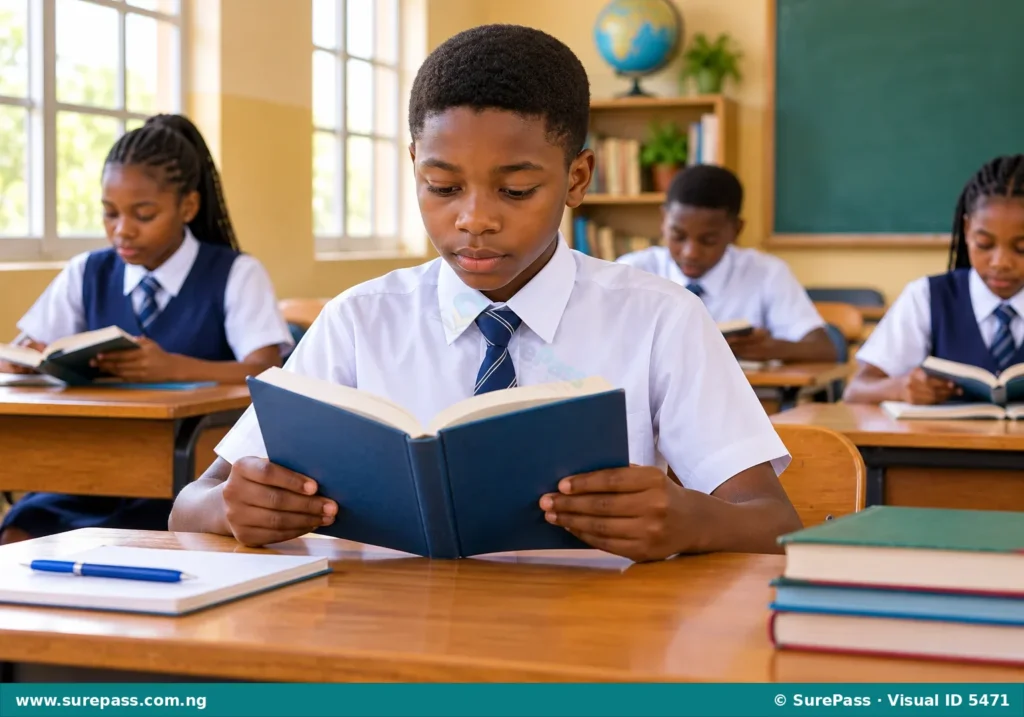
Reading Short Passages with Fluency
Performance Objectives
By the end of the lesson, students should be able to:
- read fluently with speed, accuracy, comprehension and prosody (good pronunciation);
- give correct answers to questions on passages read.
Meaning of Reading Fluency
Reading fluency is the ability to read a text quickly, accurately, and with proper expression.
When a person reads fluently, the reading sounds natural, much like spoken language. It is not slow, jerky, or word-by-word. Fluency is important because it bridges the gap between recognizing individual words and understanding the overall meaning of a text. A fluent reader does not struggle to decode words and can therefore focus on what the passage is actually saying.
Key Skills of Reading Fluency
To achieve reading fluency, a reader must develop specific skills. The four main skills required for reading fluency are:
- Speed: This refers to the rate at which a person reads. It is usually measured in words per minute. A fluent reader maintains a steady, appropriate pace without unnecessary pauses.
- Accuracy: This is the ability to read words correctly without making mistakes, skipping words, or mispronouncing them.
- Comprehension: This is the ability to understand the meaning of the text being read. Reading fast without understanding is not true fluency.
- Prosody (Good Pronunciation and Expression): This involves reading with the correct rhythm, stress, intonation, and pronunciation. It means pausing at punctuation marks, such as commas and full stops, and changing the tone of voice to match the feelings or actions in the text.
Conditions for Speed Reading
Speed reading is an important part of fluency. To read quickly while still understanding the text, certain physical and mental conditions must be met. The key conditions for speed reading include:
- Good Eyesight: Clear vision is necessary to see letters and words distinctly. If a reader struggles to see the text, reading speed and accuracy will decrease. Regular eye checks help ensure that vision does not hinder reading.
- Avoiding Word Vocalisation: Vocalisation is the habit of whispering, moving the lips, or pronouncing words silently in the mind (sub-vocalisation) while reading. This slows down reading because the eyes can move much faster than the mouth can speak. Silent reading should be done entirely with the eyes and the brain.
- Avoiding Regressive Reading: Regressive reading is the habit of constantly looking back at words or sentences that have already been read. This breaks the flow of reading and reduces speed. Trusting the eyes to move forward improves speed.
- Increasing Eye Span: Eye span is the number of words the eyes can see and register in a single glance. A wider eye span allows a reader to take in more words at once, which increases reading speed.
- Reading Phrases Instead of Words: Instead of reading word-by-word, a fluent reader groups words into meaningful phrases. For example, instead of reading “The / boy / went / to / the / market”, a fluent reader reads “The boy / went to the market”.
How to Practise Fluent Reading
Developing reading fluency requires regular practice. The following steps should be followed when practicing fluent reading:
- Sit in a comfortable position with good lighting to avoid eye strain.
- Hold the reading material at a comfortable distance from the eyes.
- Scan the passage quickly to get a general idea of the topic before reading in detail.
- Read the passage silently, focusing on grouping words into phrases and avoiding lip movements.
- Read the passage aloud, paying close attention to punctuation marks. A reader should pause briefly at commas and take a longer pause at full stops.
- Pronounce each word clearly and use appropriate expression to show emotion, questions, or emphasis.
- Answer questions based on the passage to test comprehension.
Fluency and Comprehension Passages
The following passages are designed to help practice reading speed, accuracy, pronunciation, and comprehension. Read each passage fluently and answer the questions that follow.
Passage 1: Agriculture in Nigeria
Agriculture is the backbone of many communities in Nigeria. It provides food for the population and raw materials for industries. In many villages, farmers wake up early in the morning to work on their farms. They cultivate crops such as yam, cassava, maize, and vegetables. Some farmers also rear animals like goats, sheep, and poultry. Apart from providing food, agriculture is a major source of employment for millions of people. When farmers harvest their crops, they sell them in local markets to earn an income. Modern farming methods, such as using tractors and improved seeds, are helping to increase food production. Agriculture ensures that the nation remains healthy and self-sufficient.
Answer the following questions based on Passage 1:
- What is described as the backbone of many communities in Nigeria?
- List three crops cultivated by farmers as mentioned in the passage.
- Why do farmers sell their harvested crops in local markets?
- Mention one modern farming method that helps increase food production.
- What is the main benefit of agriculture to the nation according to the text?
Passage 2: The School Inter-House Sports Competition
The annual inter-house sports competition is one of the most exciting events at Unity Secondary School. Students from different houses, such as Red, Blue, Green, and Yellow, prepare for weeks to compete in various athletic events. On the day of the competition, the school field is decorated with colourful banners and balloons. Parents, teachers, and invited guests fill the stands to cheer the athletes. The events begin with the march past, followed by track events like the 100-metre dash, relay races, and high jump. The spectators shout with joy as the runners race towards the finish line. At the end of the day, medals and trophies are presented to the winning athletes and the overall best house. The event promotes teamwork, physical fitness, and healthy competition among students.
Answer the following questions based on Passage 2:
- Which event is described as one of the most exciting at Unity Secondary School?
- Name two track events mentioned in the passage.
- How is the school field decorated on the day of the competition?
- What is presented to the winning athletes and the best house at the end of the day?
- State two values that the inter-house sports competition promotes among students.



0 comments
Open the discussion when you need it. Comments stay collapsed until requested so the initial article remains light.