




ARTICLE CONTENTSOn this page 9 sections
Introduction to Creative Writing
Performance Objectives
By the end of the lesson, students should be able to:
- discuss the meaning of creative writing;
- describe the elements of a story;
- explain creative forms;
- explain writing techniques;
- do creative writing.
Meaning of Creative Writing
Creative writing is any writing that goes beyond normal professional, journalistic, academic, or technical forms of literature to express ideas and thoughts in an imaginative and unique way.
Unlike factual reports, science textbooks, or news articles, creative writing focuses on narrative craft, character development, and the artistic use of language. It allows writers to share their feelings, build imaginary worlds, and entertain readers. The primary goal of creative writing is to evoke emotion, provoke thought, or simply share a beautiful story.
Elements of a Story
Every good story is built using specific structural components. These components work together to make the narrative interesting and easy to follow.
The six main elements of a story are:
- Plot: This is the sequence of events that make up the story. It includes the beginning where the characters are introduced, the middle where a conflict or problem arises, and the end where the problem is resolved.
- Characterisation: This is the method a writer uses to create, develop, and describe characters. Through characterisation, readers learn about a character’s appearance, personality, thoughts, and actions.
- Setting: This is the time and place where the story events occur. A setting can be a real place, such as a school in Enugu, or an imaginary place, such as a village in the clouds. It also includes the time period, such as the past, present, or future.
- Theme: This is the central message, moral, or main idea of the story. Common themes in literature include honesty, friendship, bravery, and the consequences of greed.
- Style: This refers to the unique way a writer uses words, constructs sentences, and shapes the narrative voice. Style is what makes one writer’s work sound different from another’s.
- Language: This involves the specific choice of words, tone, and grammatical structures used to convey meaning and mood. Language can be formal, informal, poetic, or simple.
Creative Forms
Creative writing can take many different shapes depending on how the writer chooses to organize their thoughts and present them to the audience.
The primary forms of creative writing include:
- Stories (Prose): This form of writing is written in ordinary sentences and paragraphs. It includes short stories, which can be read in one sitting, and novels, which are long, book-length narratives. An example is a story about a young boy who finds a lost puppy on his way home from school.
- Poems (Poetry): This is a highly artistic form of writing arranged in lines and stanzas. Poetry often uses rhythm, rhyme, and vivid imagery to express deep feelings and ideas in a compact space.
- Plays (Drama): This is writing meant to be performed by actors on a stage or in a broadcast. It consists almost entirely of dialogue spoken by characters, along with stage directions that tell the actors how to move and express emotions.
- Biographies: This is the true story of a person’s life written by someone else. Although it is based on real facts, it is considered a creative form because the writer uses narrative techniques, descriptive language, and scene-building to make the historical events engaging and lively.
Writing Techniques
Writers use specific tools and methods to make their writing more interesting, realistic, and emotionally powerful. These tools are known as writing techniques.
Important writing techniques include:
- Dialogue: This is the written conversation between two or more characters. Dialogue is placed inside quotation marks. It helps to reveal character personalities, advance the plot, and make the story feel realistic. For example: “Where are you going, Amina?” asked Emeka.
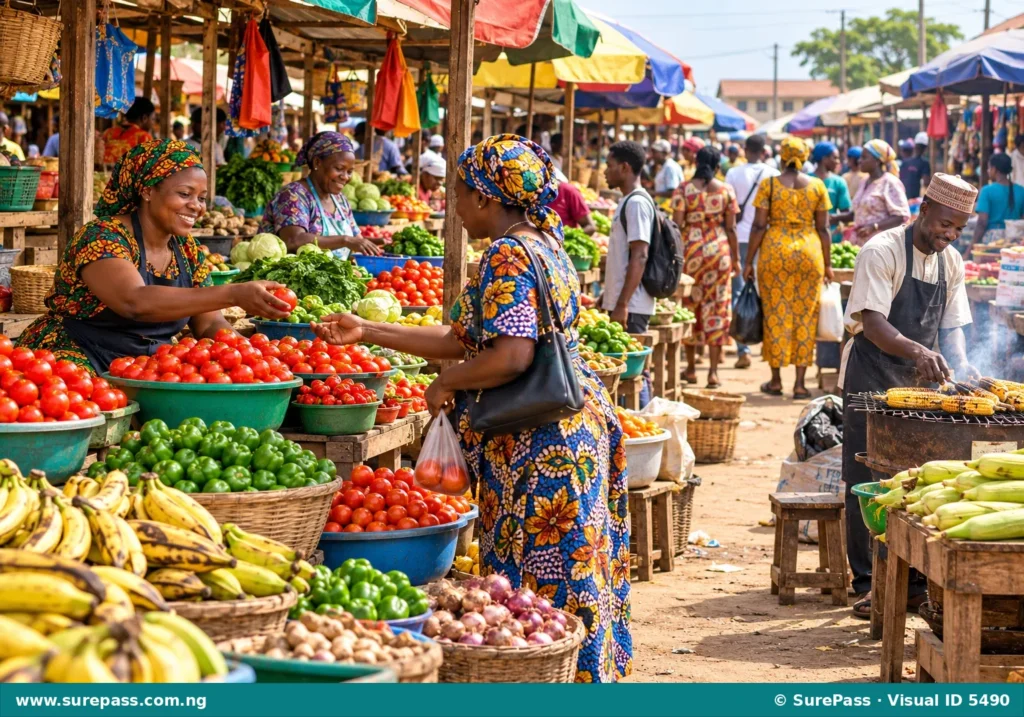
- Descriptive Writing: This technique uses sensory details to paint a clear picture in the reader’s mind. It appeals to the five senses: sight, hearing, smell, touch, and taste. Instead of simply writing “The market was busy,” a writer using descriptive writing might write, “The loud cries of tomato sellers filled the warm air, while the rich smell of roasted maize drifted through the crowded stalls.”
- Figurative Use of Language: This involves using words in non-literal ways to create strong images or comparisons. Common examples include similes, which compare two things using “as” or “like” (for example, “He is as brave as a lion”), and metaphors, which compare by stating one thing is another (for example, “The classroom was a beehive of activity”).
Observe the scene below to see how descriptive writing captures sensory details in a real-world setting.
How to Do Creative Writing
Writing a creative piece requires planning, imagination, and careful drafting. Following a structured process helps to organize ideas and produce a clear, engaging story.
The creative writing process involves the following steps:
- Brainstorming: Think of an interesting idea, a character, or a conflict. Write down all the thoughts that come to mind without worrying about spelling or grammar.
- Planning the Setting and Characters: Decide where and when the story will take place. Create the main characters and decide what they look like, what they want, and what challenges they will face.
- Outlining the Plot: Sketch a simple outline of what happens at the beginning, the middle, and the end of the story.
- Drafting: Write the first version of the story. Focus on getting the ideas down on paper. Use dialogue, descriptive writing, and figurative language to make the scenes come alive.
- Reviewing and Editing: Read through the draft to check for spelling, punctuation, and grammatical errors. Improve word choices and ensure the story flows smoothly from one event to the next.
A Model Short Story
Below is a short creative story demonstrating the elements and techniques discussed in this unit.
The Missing Goat
The afternoon sun beat down mercilessly on the dusty paths of Umuahia village. Chidi stood near the empty wooden pen, his heart pounding like a traditional drum. His father’s prize goat, a stubborn animal with a coat as white as cotton, was gone. If Chidi did not find the goat before twilight, his father would be deeply disappointed.
“Have you checked near the stream?” whispered his little sister, Adanna, her eyes wide with worry.
“I have searched everywhere,” Chidi replied, his voice trembling. “But I will not give up.”
Chidi ran toward the forest path, where the air was cool and smelled of damp earth and wild ferns. He listened closely. Amidst the rustling of leaves and the distant chirping of birds, he heard a faint, familiar sound: “Mbaa! Mbaa!” Chidi smiled with relief. Behind a thick bush of green hibiscus flowers, the white goat was tangled in a wild vine, chewing happily on a leaf. Chidi gently untangled the animal and led it safely back home just as the first stars began to blink in the evening sky.
Summary of the Unit
Creative writing is an imaginative form of expression that includes stories, poems, plays, and biographies. A successful story relies on key elements such as plot, characterisation, setting, theme, style, and language. By using writing techniques like dialogue, descriptive writing, and figurative language, writers can create engaging and memorable experiences for their readers.
Evaluation Exercises
Answer the following questions to test your understanding of the lesson:
- Define creative writing in your own words.
- List and explain four elements of a story.
- What is the difference between a play and a poem?
- Identify the writing technique used in the following sentence: “The wind whispered secrets through the tall palm trees.”
- Write a short descriptive paragraph about a heavy rainfall in your school compound, using at least two sensory details (sight, sound, smell, touch, or taste).




0 comments
Open the discussion when you need it. Comments stay collapsed until requested so the initial article remains light.