


ARTICLE CONTENTSOn this page 11 sections
Folktales
Performance Objectives
By the end of the lesson, students should be able to:
- identify features of folktales;
- retell folktales;
- explain the themes of folktales;
- identify the moral lessons in folktales; and
- narrate folktales.
Meaning of Folktales
A folktale is a traditional story passed down from generation to generation by word of mouth.
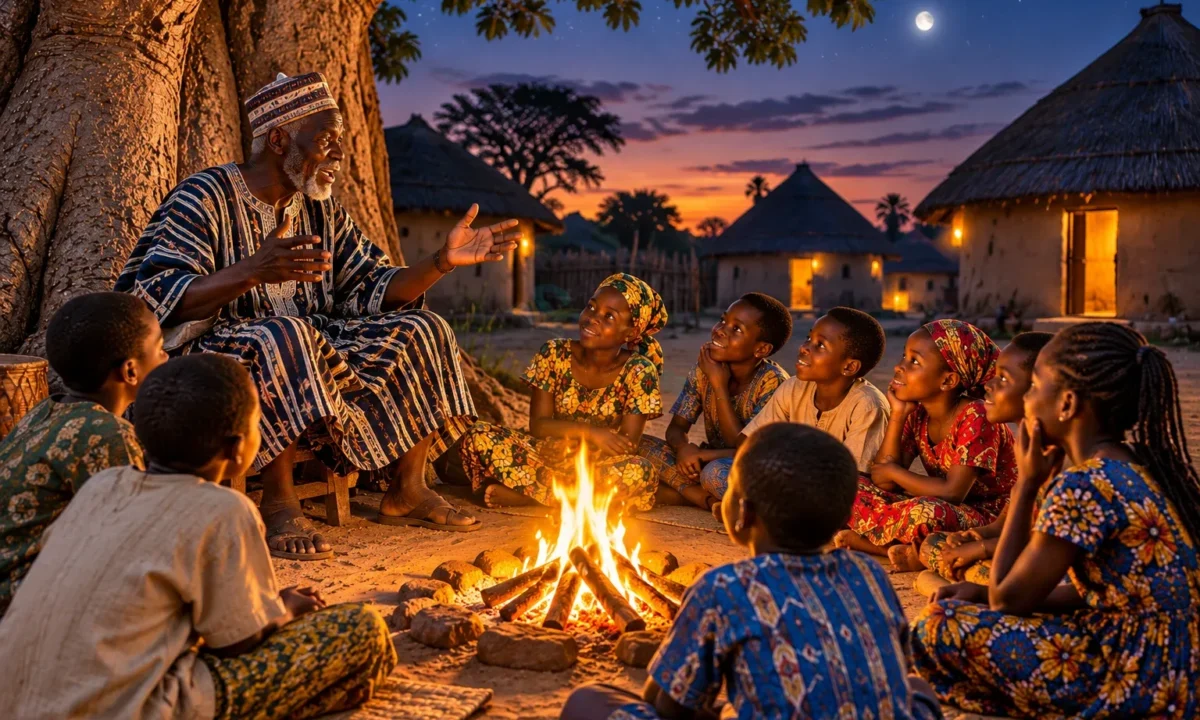
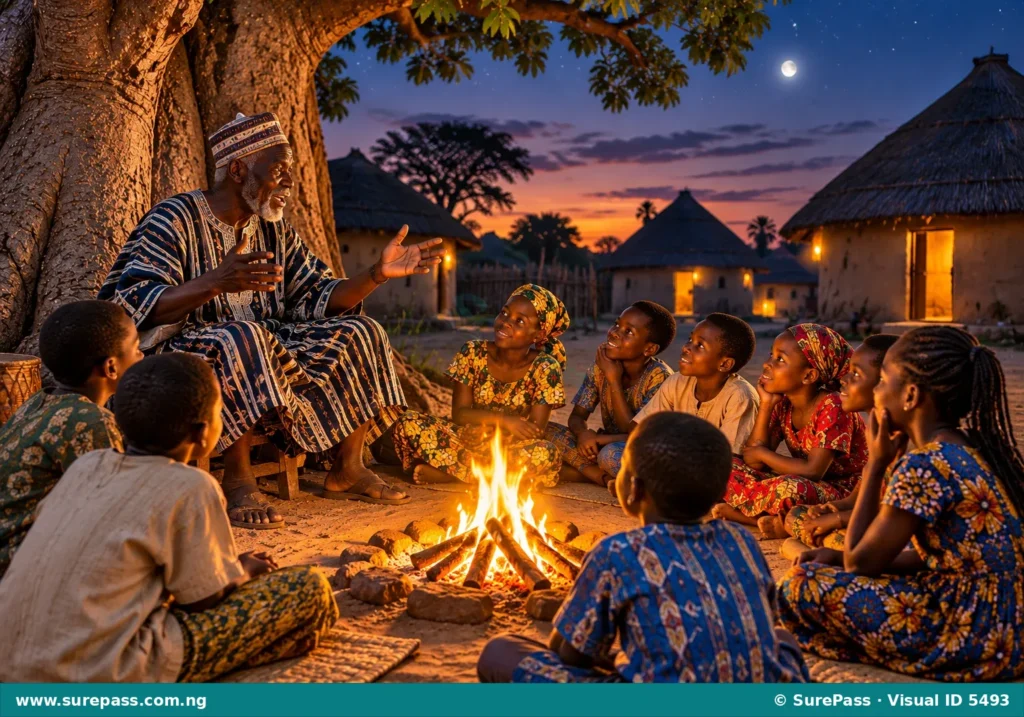
Before writing systems were developed, communities preserved their history, values, and beliefs through oral literature. Folktales form a major part of this oral tradition. These stories were told by elders to children, usually in the evening under the moonlight or around a fire. Over time, many of these stories have been written down in books, but they still retain their oral character and simple structure.
Features of Folktales
Folktales have distinct characteristics that make them easy to recognize and remember. These features helped oral storytellers deliver the tales effectively to their audience.
The main features of folktales include:
- Oral Origin: They were originally spoken, chanted, or sung rather than written down.
- Unspecified Setting: The stories are set in an indefinite time and place. They often begin with opening formulas such as “Once upon a time,” “Long, long ago,” or “In a land far away.”
- Stock Characters: Characters are often flat and represent specific human traits such as greed, wisdom, foolishness, or kindness. Animals are frequently personified, meaning they talk, wear clothes, and behave like humans.
- Simple Plot: The storyline is straightforward and easy to follow, usually focusing on a single conflict and its resolution.
- Repetition: Certain phrases, songs, or actions are repeated throughout the story to build rhythm and help the audience remember the plot.
- Magic and the Supernatural: Magical objects, talking animals, spirits, and supernatural events are common elements used to resolve conflicts or teach lessons.
- Didactic Ending: The story almost always ends with a clear moral lesson or an explanation of why things are the way they are in nature.
Themes and Moral Lessons in Folktales
Every folktale is built around central ideas and messages that the storyteller wishes to convey to the audience.
A theme is the central idea, message, or subject matter that a story explores.
A moral lesson is a practical lesson about right and wrong behavior that the audience learns from the actions of the characters.
Common themes in folktales include:
- The Triumph of Wisdom over Strength: Small or weak characters often defeat larger, stronger opponents through cleverness and quick thinking.
- The Consequences of Greed: Greedy characters who refuse to share or who try to take everything for themselves usually end up losing what they already have.
- Obedience and Respect: Characters who obey their parents, elders, or community rules are rewarded, while disobedient characters face severe consequences.
- The Power of Honesty: Truthful and humble characters are vindicated, while liars and cheats are exposed and punished.
African and Non-African Folktales
Folktales exist in every culture around the world. While they share similar structures and purposes, they differ in their settings, characters, and cultural symbols.
African Folktales
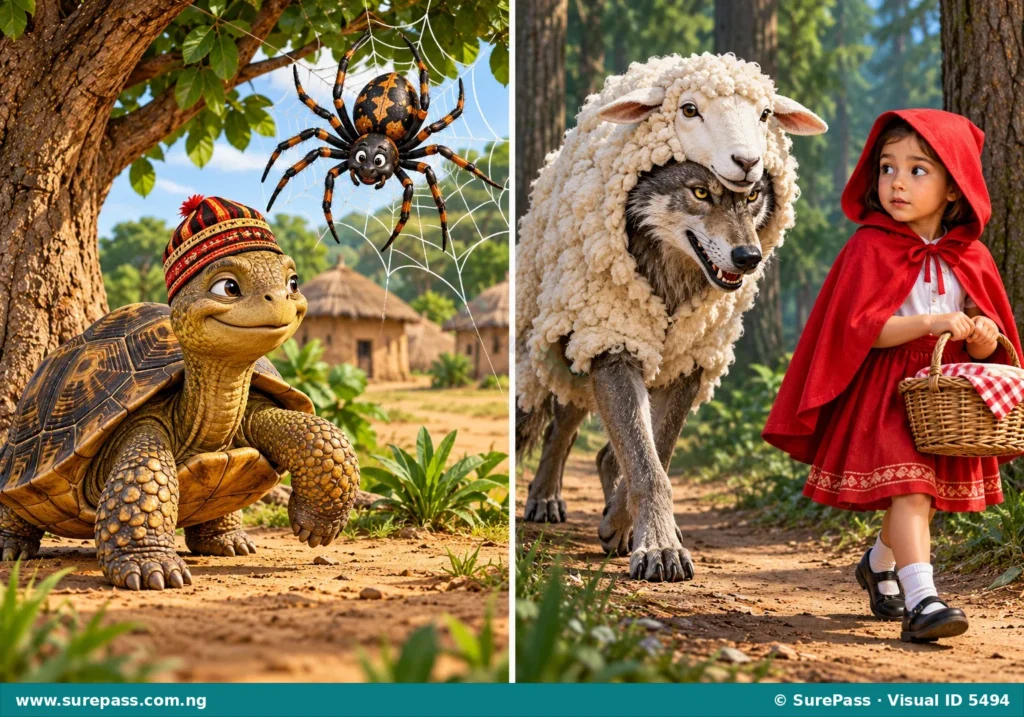
African folktales are deeply rooted in the communal life of African societies. They often feature animal tricksters that reflect human behavior. In West Africa, the tortoise (known as Mbe in Igbo, Alabahun in Yoruba, and Gizo in Hausa) and Anansi the Spider are the most common trickster characters. These stories often explain natural phenomena, such as why the tortoise has a cracked shell or why the mosquito buzzes in the ear.
Examples of African folktales include:
- The Tortoise and the Wiseman (Nigeria)
- Anansi and the Pot of Wisdom (Ghana)
- Why the Sun and the Moon Live in the Sky (West Africa)
- The Lion’s Whisker (Ethiopia)
Non-African Folktales
Non-African folktales come from Europe, Asia, the Americas, and other parts of the world. They often feature characters like wolves, foxes, giants, fairies, and peasants. Many European folktales were collected and written down by writers such as the Brothers Grimm and Aesop.
Examples of Non-African folktales include:
- The Tortoise and the Hare (Aesop’s Fables – Ancient Greece)
- Cinderella (Europe)
- Jack and the Beanstalk (England)
- The Boy Who Cried Wolf (Ancient Greece)
Purpose of Folktales
Folktales serve several important functions within a society. They are not told merely to pass the time; they are vital tools for social education.
The main purposes of folktales are:
- Didactic Purpose: To teach moral values, ethics, and proper social behavior to children.
- Entertainment: To amuse and delight the audience through humor, suspense, songs, and dramatic storytelling.
- Cultural Preservation: To pass down the history, customs, beliefs, and language of a community to the next generation.
- Explanation of Nature: To provide imaginative explanations for the origins of animals, plants, and natural elements.
How to Narrate and Retell a Folktale
Storytelling is an active performance skill. To narrate or retell a folktale effectively, a storyteller must engage the audience and bring the characters to life.
The procedure for narrating a folktale involves the following steps:
- Select a Story: Choose a folktale with a clear plot, distinct characters, and a strong moral lesson.
- Use an Opening Formula: Begin with a traditional opening to signal to the audience that the story is starting. In English, use “Once upon a time.” In Nigerian traditions, use local call-and-response formulas, such as the Yoruba “Alo o!” to which the audience responds “Alo!”
- Vary the Voice: Change the pitch, tone, and speed of the voice to represent different characters. For example, use a low, slow voice for a tortoise and a loud, booming voice for a giant.
- Use Gestures and Expressions: Use hand movements, facial expressions, and body posture to show emotions like fear, joy, anger, or surprise.
- Incorporate Songs: If the folktale contains a song, sing the lead part and encourage the audience to sing the chorus. This keeps the audience active and engaged.
- Deliver the Moral Lesson: Conclude the story by clearly stating the lesson or the explanation of nature, such as, “And that is why the tortoise has a cracked shell to this very day.”
Sample Folktales for Analysis
The following stories demonstrate the features, themes, and moral lessons of both African and Non-African traditions.
Sample 1: The Tortoise and the Dog (African Folktale)
Once upon a time, there was a great famine in the animal kingdom. Food was very scarce, and all the animals grew thin and weak. However, the Dog remained fat and healthy. The Tortoise noticed this and decided to spy on the Dog.
One morning, the Tortoise hid behind a bush and watched the Dog walk to a secret farm in the forest. The farm was filled with sweet potatoes and yams. The Tortoise confronted the Dog and begged to be shown how to get food. The Dog agreed on one condition: the Tortoise must never tell anyone else about the farm, and he must only take enough food to satisfy his hunger for the day.
The Tortoise agreed. For a few days, they went to the farm together and ate well. But the Tortoise grew greedy. He wanted to take all the food at once to sell to the other animals. One afternoon, while the Dog was asleep, the Tortoise took a large sack to the farm and began digging up all the yams. The noise woke up the farmer, who rushed out and caught the Tortoise. The Dog, hearing the commotion, escaped quietly. The Tortoise was beaten by the farmer, and his shell was cracked during the struggle. He crawled back to the village in shame.
The literary analysis of “The Tortoise and the Dog” reveals the following elements:
- Theme: The destructive nature of greed and the betrayal of trust.
- Moral Lesson: Greed leads to ruin and shame, while contentment and keeping promises bring safety.
- Characters: The Tortoise (greedy, cunning, and untrustworthy) and the Dog (generous, disciplined, and cautious).
- Explanation of Nature: The story explains why the tortoise has a rough, cracked shell.
Sample 2: The Boy Who Cried Wolf (Non-African Folktale)
Long ago, there was a young shepherd boy who watched over a flock of sheep near a dark forest. The job was very lonely, and the boy grew bored. To amuse himself, he ran toward the village shouting, “Wolf! Wolf! The wolf is chasing the sheep!”
The villagers dropped their work and ran up the hill to help the boy drive the wolf away. When they arrived, they found no wolf. The boy laughed at their angry faces. The villagers warned him not to play such tricks.
A few days later, the boy played the same trick again. Once more, the villagers ran to help him, only to find that they had been deceived. They were very angry and warned him a second time.
Later that week, a real wolf came out of the forest and began attacking the sheep. Terrified, the boy ran toward the village screaming, “Wolf! Wolf! Please help me, a real wolf is here!” But the villagers thought he was lying again, so they ignored his cries. The wolf destroyed the flock, and the boy was left weeping for his foolishness.
The literary analysis of “The Boy Who Cried Wolf” reveals the following elements:
- Theme: The consequences of dishonesty and the loss of credibility.
- Moral Lesson: A liar will not be believed, even when speaking the truth.
- Characters: The Shepherd Boy (foolish, dishonest, and playful) and the Villagers (helpful, hardworking, but cautious).
- Setting: An unspecified village near a forest in an ancient time.
Summary of Differences
The differences between African and Non-African folktales can be observed in their typical elements:
| Feature | African Folktales | Non-African Folktales | |
|---|---|---|---|
| Common Characters | Tortoise, Spider (Anansi), Hare, Lion, Elephant | Wolf, Fox, Giants, Fairies, Woodcutters | |
| Cultural Symbols | Baobab trees, calabashes, yams, village squares | Castles, pine forests, gold coins, beanstalks | |
| Performance Style | Highly interactive, often featuring call-and-response songs | Mainly narrative prose, sometimes written as fables |
Review Questions
The following questions help to assess understanding of the topic:
- Define a folktale in your own words.
- State four major features of folktales.
- What is the difference between a theme and a moral lesson?
- Give two examples of African folktales and two examples of Non-African folktales.
- Explain the moral lesson of the story “The Boy Who Cried Wolf.”
- Why did the Tortoise end up with a cracked shell in the story “The Tortoise and the Dog”?


0 comments
Open the discussion when you need it. Comments stay collapsed until requested so the initial article remains light.