


ARTICLE CONTENTSOn this page 10 sections
Reading Passages to Answer Literal, Inferential and Critical Questions
Performance Objectives
By the end of the lesson, students should be able to:
- Read passages and provide correct answers to literal, inferential and critical questions.
Understanding Comprehension Questions
Reading comprehension is the ability to understand, process and find meaning in a written text.
When reading a passage, different types of questions are asked to test how well the text has been understood. These questions generally fall into three distinct levels: literal, inferential and critical. Mastering these three levels helps readers become highly skilled and thoughtful.
Literal Questions
Literal comprehension is the understanding of information that is directly and clearly stated in a text.
Literal questions are often called “right there” questions because the answers are written directly on the page. To answer a literal question, a reader does not need to guess or search for hidden meanings. The reader only needs to locate the exact words, facts or details provided by the author.
Common words used to start literal questions include:
- Who
- What
- Where
- When
- How many
An example of a literal relationship can be seen in this simple sentence: “Chidi wore a bright green cap to the market on Tuesday.”
A literal question based on this sentence would be: “What day did Chidi go to the market?” The direct answer is: “Tuesday.”
Inferential Questions
Inferential comprehension is the understanding of information that is not directly stated but is suggested or implied by the writer.
Inferential questions require readers to “read between the lines.” To answer these questions, readers must combine clues from the text with their own background knowledge to make a logical guess, which is called an inference. The author provides hints, and the reader must connect those hints to find the answer.
Common words and phrases used to start inferential questions include:
- Why do you think
- What does this suggest about
- How did the character feel when
- What is likely to happen next
- What is the writer’s attitude toward
Using the same sentence: “Chidi wore a bright green cap to the market on Tuesday.”
An inferential question would be: “How do you know Chidi wanted to be easily noticed?” The answer is: “He wore a bright green cap, which is a highly visible colour.” The text does not say Chidi wanted to be noticed, but the choice of a “bright green” cap implies it.
Critical Questions
Critical comprehension is the evaluation of ideas, actions or events in a text based on personal judgment, values and logic.
Critical questions require readers to analyze, judge or express an opinion about what they have read. Instead of just finding facts or making inferences, the reader must decide whether they agree with the author, evaluate the characters’ decisions, or relate the passage to real-world situations.
Common words and phrases used to start critical questions include:
- Do you agree with the action taken by
- Was the character’s decision right or wrong, and why
- What is your opinion about
- How would you solve the problem described in the passage
- What lessons can be learned from this story
Using the same sentence: “Chidi wore a bright green cap to the market on Tuesday.”
A critical question would be: “Was it wise for Chidi to wear a bright, noticeable cap to a crowded market?” An answer could be: “Yes, it was wise because if he was travelling with friends, they could easily spot him in the crowd.” Another answer could be: “No, it was not wise because a bright cap could attract unwanted attention from pickpockets.” Both answers are correct as long as they are supported by sound reasoning.
Guided Reading Passage 1: The Great Green Wall
Read the following passage carefully. The passage is adapted from an environmental studies report on desertification in Northern Nigeria.
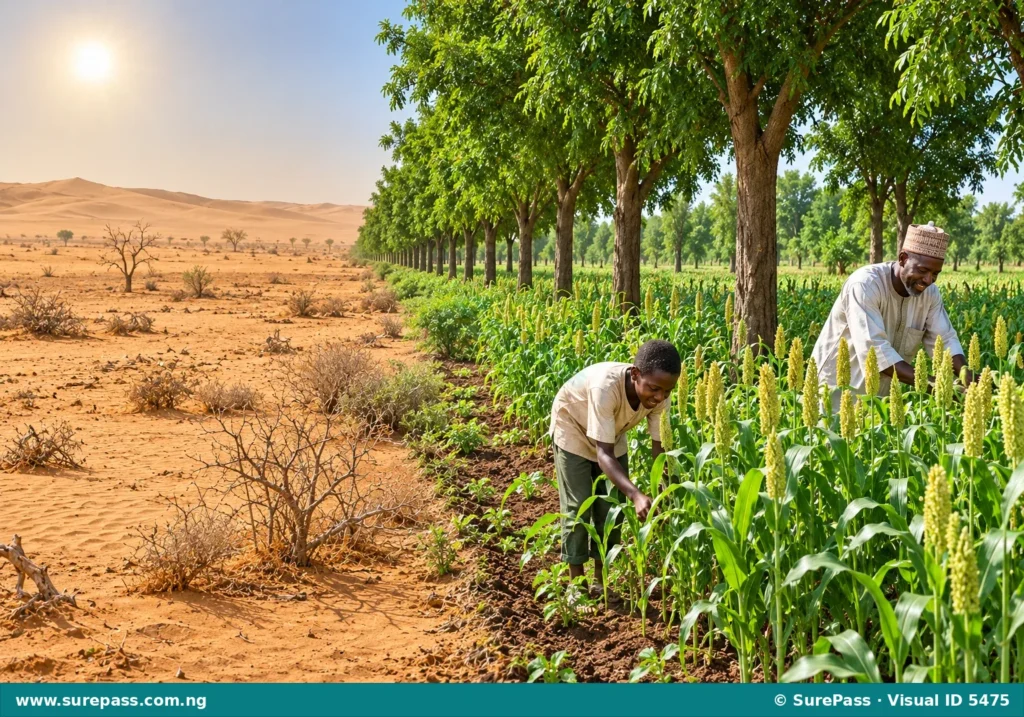
In many parts of Northern Nigeria, the desert is slowly moving southward. This process is called desertification. Strong winds blow dry sand over fertile farmland, making it impossible for crops to grow. To stop this, the government and local communities joined the Great Green Wall project. This project involves planting a wide belt of trees across the entire width of the region, stretching from Kebbi State to Borno State.
Musa, a fifteen-year-old boy from a small village in Jigawa State, remembers when his father’s farm was covered in dust. “We could barely harvest three bags of millet in a whole year,” Musa said, looking at the tall neem trees that now stand behind his house. Today, the trees act as a shield. They block the hot desert winds and hold the soil firmly in place with their roots. The soil has become rich and moist again. Musa’s family now harvests over twenty bags of millet annually, and local birds have returned to build nests in the branches.
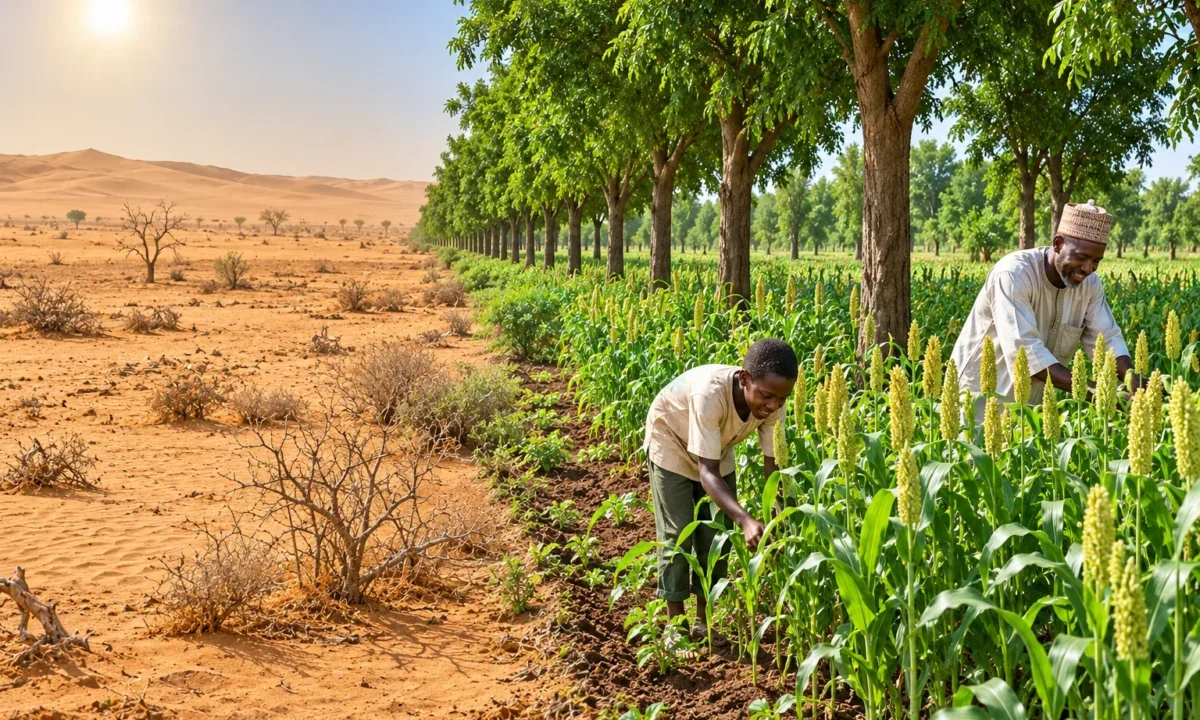
Observe the image below to see the visual representation of the Great Green Wall project.
Worked Examples of Comprehension Questions
Below are examples of literal, inferential and critical questions based on the passage about the Great Green Wall, along with explanations of how to answer them.
Literal Question and Answer
Question: Which states in Nigeria are mentioned as part of the Great Green Wall project area?
Answer: Kebbi State, Borno State and Jigawa State.
Explanation: This is a literal question. The reader can find the exact names of the states directly in the text. Kebbi and Borno are mentioned in the first paragraph, and Jigawa is mentioned in the second paragraph.
Inferential Question and Answer
Question: Why did Musa’s family harvest only three bags of millet in the past?
Answer: The dry desert winds blew dust over the farm and ruined the soil, making it infertile for crops.
Explanation: This is an inferential question. The passage does not state the exact words “the soil was infertile because of the dust.” However, it states that dry sand makes it impossible for crops to grow, and that Musa’s father’s farm was covered in dust. By connecting these two facts, the reader infers the reason for the poor harvest.
Critical Question and Answer
Question: Do you think planting trees is the best way to solve the problem of desertification in Northern Nigeria? Support your opinion.
Answer: Yes, planting trees is an excellent solution because tree roots hold the soil together to prevent erosion, and the leaves block dry winds. This naturally restores the environment without using expensive chemicals.
Explanation: This is a critical question. It asks for the reader’s opinion and judgment. The answer requires the reader to evaluate the information in the passage and use logical reasoning to support their view.
Practice Reading Passage 2: The Community Borehole
Read the passage below and answer the questions that follow to practice literal, inferential and critical reading skills.
For many years, the people of Ogba village walked three kilometres every morning to fetch water from a shallow stream. The stream was often dirty, especially during the rainy season when mud washed into it. Many children in the village suffered from stomach pain and skin rashes because of the unclean water. The village head, Chief Alao, held several meetings with the elders to discuss how to get clean water, but the community lacked the funds to dig a modern well.
Last year, a non-governmental organisation called Clean Water Africa visited Ogba village. After assessing the situation, they brought a large drilling machine and constructed a solar-powered borehole in the center of the village square. The borehole pump uses sunlight to generate electricity, which pumps clean water from deep underground into two massive plastic tanks. Now, the villagers only walk a few minutes to get safe drinking water. The cases of waterborne illnesses have disappeared, and children now arrive at school early and clean.
Comprehension Exercises
The following questions are based on the passage “The Community Borehole” and are divided into literal, inferential and critical categories:
Literal Questions
- How far did the villagers walk to fetch water before the borehole was built?
- What is the name of the organisation that built the solar-powered borehole?
- Where is the new borehole located in Ogba village?
Inferential Questions
- Why did the children of Ogba village start arriving at school early after the borehole was built?
- What made the stream water dirty during the rainy season?
- Why was Chief Alao unable to solve the water problem before Clean Water Africa arrived?
Critical Questions
- In your opinion, what are the advantages of using solar power instead of petrol generators to run the borehole pump?
- If you were a leader in Ogba village, how would you ensure that the new borehole is protected and maintained for a long time?




0 comments
Open the discussion when you need it. Comments stay collapsed until requested so the initial article remains light.